
Is Writing a Good Hobby After Retirement?


Tablet for Seniors

Portable Radio with Large Buttons

Book Holder Stand
Quick Answer
Yes, writing is an excellent hobby after retirement because it is inexpensive, flexible, mentally engaging, and easy to enjoy at home. You can journal, write family memories, create stories, send letters, or even start a blog. If you’re comparing several possibilities, these fun hobbies to start after retirement can help you see where writing fits.
Why writing works well in retirement
- Low cost: A notebook and pen may be everything you need.
- Flexible pace: Write for ten minutes or spend an entire afternoon on a project.
- Mental challenge: Writing uses memory, language, organization, imagination, and attention.
- Personal meaning: Memories and family stories can become something worth preserving.
- Easy to adapt: Typing, handwriting, dictation, and voice-to-text all work.
Retirement finally gives many people something they wanted during working life: more control over their time. Writing can turn some of those quieter hours into a creative routine that feels useful without feeling like another job.
You don’t need to call yourself a writer. You only need something you want to put into words.
In This Guide
- Why is writing a good hobby after retirement?
- What are the benefits of writing in retirement?
- What kinds of writing can retirees try?
- How do you start writing as a retirement hobby?
- How often should you write?
- Can writing become a social hobby?
- What if writing becomes difficult or frustrating?
- Frequently asked questions
- Final takeaway
Why Is Writing a Good Hobby After Retirement?
Writing works especially well after retirement because you can make it as simple or ambitious as you want. There are almost no rules about where, when, or how much you must write.
That’s a useful quality in a retirement hobby.
A writing hobby is any regular writing you choose to do for enjoyment, reflection, creativity, learning, communication, or preserving memories. Publication isn’t required.
It fits around your life
Many hobbies depend on equipment, transportation, weather, or scheduled classes. Writing can happen at the kitchen table, in a park, at a library, or from a comfortable chair.
- Five minutes: Record one memory from the day.
- Fifteen minutes: Complete a journal entry.
- Thirty minutes: Work on a family story or short story.
- One hour: Develop a longer memoir, article, or creative project.
If you’re still figuring out what type of activity suits your new routine, my guide on how to choose a hobby after retirement offers a simple way to compare your options.
You can begin almost for free
A basic notebook is enough. If you prefer digital writing, software already included with a computer or phone can handle most beginner projects.
You also don’t need a special writing room. A comfortable place with decent light is usually more useful than expensive equipment.
Life experience gives you plenty to write about
Retirement doesn’t mean you’ve run out of subjects. In many cases, you have more material than you did at 25.
- Childhood memories
- Family traditions
- Work experiences
- Travel stories
- Recipes and their histories
- Lessons learned from mistakes
- Changes you’ve witnessed
- Stories about relatives and friends
You don’t need to turn those experiences into a formal autobiography. One well-told page about your first job can be meaningful on its own.
Section Takeaway: Writing is unusually flexible, inexpensive, and personal. Retirement gives you both the time and life experience to make it meaningful.
What Are the Benefits of Writing in Retirement?
Writing can provide mental challenge, creativity, structure, and a way to preserve personal experiences. The value comes from staying engaged, not from producing perfect work.
The National Institute on Aging notes that meaningful activities and creative pursuits can support well-being as people grow older.
Writing gives your mind something to work on
Creating even a short story involves choosing words, organizing ideas, recalling details, and making decisions. Those processes make writing more mentally active than simply consuming information.
The National Institute on Aging’s cognitive health guidance says research on creative writing and other arts activities shows promise for older adults, although lasting cognitive benefits aren’t yet certain.
That’s an important distinction. I wouldn’t treat writing as a medical treatment or a guaranteed way to prevent memory problems.
It’s a satisfying activity that keeps you learning.
It can give quieter days some structure
Work once divided your day into meetings, tasks, lunch breaks, and deadlines. Retirement may remove that structure almost overnight.
A small writing routine creates an appointment you control.
- Write with morning coffee.
- Record one memory every afternoon.
- Work on a story every Tuesday and Thursday.
- Send one thoughtful letter each weekend.
The National Institute on Aging also encourages older adults to participate in activities they find enjoyable and meaningful.
Writing preserves stories that could otherwise disappear
Family history is often stored in people’s memories rather than documents. Small details can disappear when nobody records them.
You might remember how your grandparents spoke, what your childhood kitchen smelled like, or how your neighborhood looked decades ago. A future family member won’t know those details unless someone saves them.
Start with one scene instead of trying to write your entire life story. Specific memories are easier to write and usually more enjoyable to read.
Writing can create a sense of progress
A filled notebook gives you something tangible to look back on. So does a finished story, family history, recipe collection, poem, or stack of letters.
That progress doesn’t need an audience to matter.
As of 2026, the broader guidance from the National Institute on Aging still emphasizes meaningful, mentally engaging activities rather than promising that one particular hobby can protect the brain.
Section Takeaway: Writing can challenge your mind, add rhythm to your week, and preserve experiences. Enjoyment and consistency matter more than performance.
What Kinds of Writing Can Retirees Try?
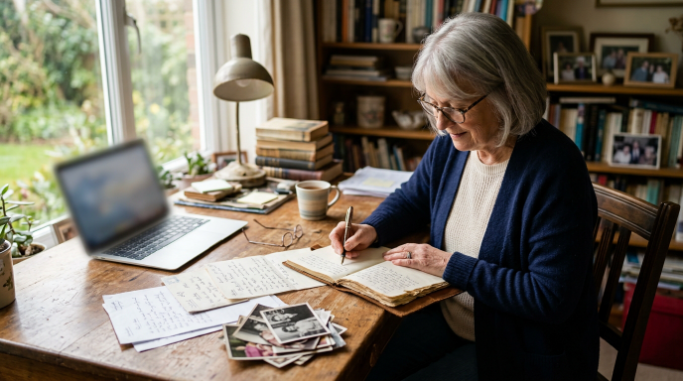
You don’t have to write a novel. Retirement writing can range from three-line journal entries to a full family memoir.
Try the format that makes you want to return tomorrow.
| Writing Type | Easy Starting Goal | Typical Cost | Best For |
|---|---|---|---|
| Journaling | 5–10 minutes daily | Very low | Reflection and daily observations |
| Memoir writing | One memory weekly | Very low | Family history and legacy |
| Short stories | 500–1,000 words | Very low | Imagination and creativity |
| Letters | One letter weekly | Low | Staying connected |
| Poetry | One short poem | Very low | Creative expression |
| Blogging | One post monthly | Low to moderate | Sharing knowledge publicly |
Journaling is the easiest starting point
Journaling removes the pressure to entertain anyone. You can write about what happened, what you’re planning, or one thing you noticed.
This makes it one of the easier hobbies for seniors to learn.
Memoir writing doesn’t require a full autobiography
Instead of starting with “I was born,” choose one event. Write about your first car, first apartment, favorite teacher, wedding day, military service, or an unforgettable trip.
Small stories eventually form a bigger picture.
Fiction lets you leave real life behind
You can invent characters, mysteries, romances, adventures, or humorous situations. Nobody needs to see the first draft.
The freedom to experiment is part of the fun.
How Do You Start Writing as a Retirement Hobby?
Start small enough that writing feels easy to repeat. Ten minutes and one simple topic are better than planning a 300-page memoir you never begin.
- Choose one format. Start with journaling, memories, letters, poetry, or short stories.
- Pick your writing tool. Use a notebook, laptop, tablet, or voice-to-text app.
- Set a small target. Try ten minutes or 200 words.
- Use one clear prompt. Don’t begin with a blank-page challenge.
- Stop before it feels like work. Leave yourself interested in returning.
Use prompts when you don’t know what to write
- What did my childhood home look like?
- What was my first paid job?
- Which family tradition do I hope continues?
- What advice would I give myself at age 25?
- Which trip do I still remember clearly?
- What ordinary object reminds me of someone important?
- Which historical change surprised me most during my lifetime?
If writing isn’t the only activity you’re considering, compare it with the best hobbies for seniors before buying supplies or joining classes.
Don’t edit every sentence as you write it
Constant editing can turn a relaxing session into frustrating work. Put the idea down first and polish it later only if you want to.
For private journaling, you may never need to edit at all.
How Often Should You Write?
There is no required schedule for hobby writing. Two or three short sessions each week can be enough to create a satisfying routine.
Consistency matters only if consistency helps you enjoy it.
Try a simple four-week experiment
- Week 1: Write for 10 minutes on three days.
- Week 2: Continue three sessions and try one new topic.
- Week 3: Extend one session to 20–30 minutes if you want.
- Week 4: Decide which format and schedule felt easiest.
You might discover that daily writing suits you. You might prefer one long Sunday session instead.
Neither approach is better.
Retirement also doesn’t need to become a calendar filled with hobbies. My guide to how many hobbies a retired person should have explains why a small, balanced mix often works well.
Can Writing Become a Social Hobby?
Yes. Writing may look solitary, but classes, writing groups, family projects, and letter exchanges can make it surprisingly social.
This can be useful when retirement reduces everyday contact with coworkers.
Join a local or online writing group
Libraries, senior centers, community colleges, and community organizations may offer memoir or creative-writing groups. Online groups can work when transportation is difficult.
The CDC explains that social connection is important for health and well-being, especially as circumstances change with age.
Create a family writing project
You don’t need strangers to form a writing group. Ask relatives to answer the same family-history question and collect everyone’s responses.
- What family meal do you remember most?
- Who made you laugh when you were young?
- What was your first home like?
- Which family story should never be forgotten?
The finished collection can become a simple family keepsake.
Use writing to stay in touch
Emails, handwritten letters, birthday notes, and longer messages can turn writing into connection. A grandchild may value a thoughtful letter years after a casual phone conversation is forgotten.
For more ways to combine hobbies with companionship, see these activities to do with seniors.
What If Writing Becomes Difficult or Frustrating?

Change the method before abandoning the hobby. Handwriting isn’t the only way to be a writer.
Adapt the tools to your comfort
- Hand discomfort: Try a thicker pen, keyboard, or voice dictation.
- Vision changes: Increase screen text size or use larger-lined paper.
- Fatigue: Write for 5–10 minutes instead of forcing long sessions.
- Spelling worries: Ignore them during the first draft.
- Blank-page anxiety: Start from a specific question or photograph.
- Typing difficulty: Use speech-to-text and edit only what matters.
Don’t turn the hobby into another career
Publication can be exciting, but it isn’t the definition of success. A private journal or a ten-page family booklet is still worthwhile writing.
Be careful when goals begin stealing the enjoyment.
What if writing brings up painful memories?
Memoir and personal writing can sometimes surface difficult experiences. You don’t have to write about anything that leaves you distressed.
Research on expressive writing has produced mixed results, so it shouldn’t be treated as a substitute for mental health care.
Health note: If writing repeatedly brings up severe distress, trauma, depression, or anxiety, consider discussing those feelings with a qualified healthcare or mental health professional.
Frequently Asked Questions
Is writing a good hobby for seniors?
Yes. Writing is inexpensive, flexible, mentally engaging, and adaptable to many abilities. Seniors can journal, write memoirs, create fiction, send letters, or record family history without needing professional-level skills or expensive supplies.
Is journaling a good hobby after retirement?
Journaling is one of the simplest writing hobbies to begin after retirement. A session can take five or ten minutes, and you don’t have to share it. Daily events, memories, gratitude notes, observations, and plans can all become journal topics.
Am I too old to start creative writing?
No. There is no age limit for learning creative writing. Older adults also bring decades of observations, vocabulary, relationships, experiences, and memories to their work. Start with short pieces instead of worrying about completing a book.
Does writing help keep your brain active?
Writing uses attention, language, organization, memory, and decision-making. The National Institute on Aging says creative writing and other meaningful activities show promising links with well-being, but research does not prove that writing alone prevents cognitive decline.
What should a retired person write about?
Start with subjects you already know. Childhood memories, work experiences, family traditions, travel, recipes, local history, friendships, lessons learned, fiction, poetry, and letters are all practical starting points.
How much should a beginner write each day?
There is no required word count. Ten minutes or about 100–300 words is a manageable starting session for many beginners. Increase the amount only when longer sessions remain enjoyable rather than becoming another obligation.
Do I need a computer to make writing a hobby?
No. A notebook and comfortable pen are enough. You can also use a computer, tablet, smartphone, typewriter, or voice-to-text software. Choose the tool that creates the least friction and feels most comfortable.
Final Takeaway: Should You Try Writing After Retirement?
Yes, especially if you enjoy stories, memories, learning, language, or quiet creative time. Writing costs little to start and adapts easily to changing schedules and abilities.
Don’t begin by deciding to “become a writer.” Begin by giving yourself ten minutes and one story worth remembering.
Write about the first place you called home, a person you still think about, or one lesson you learned the hard way. Tomorrow, write another page.
