
What Is a Walking Cane? A Complete Guide to Types, Uses, Fit, and Safety


Hands-Free Neck Magnifier

Smart Health Watch for Seniors
Bed Rail for Seniors
Quick Answer
A walking cane is a handheld mobility aid that provides extra balance, stability, or partial support while walking. It can help people with mild weakness, joint pain, an injury, or balance problems move more confidently, although the correct type and fit matter for safe use. The MedlinePlus guide to mobility aids explains that canes are one of several devices designed to help people move more independently.
What a walking cane does
- Improves balance: A cane gives you another contact point with the ground while walking.
- Adds support: It can take some pressure away from a painful or weaker leg.
- Supports mobility: A properly fitted cane may make everyday walking easier and more comfortable.
- Offers several styles: Single-point, quad, folding, and offset-handle canes meet different needs.
- Requires proper fit: The handle should generally sit near wrist height when you stand upright.
One important point
- If you need substantial weight support or have significant balance problems, ask a healthcare professional whether a walker or another mobility aid would be safer.
I think the easiest way to understand a walking cane is to forget the stereotype of it being only for old age. A cane is simply a practical tool that adds support while helping you stay mobile.
The details matter, though. In this guide, I’ll explain what canes do, the main types, proper sizing, safe walking technique, and how a cane compares with walking sticks and walkers.
In This Guide
What Is a Walking Cane?
A walking cane is a handheld assistive device used to improve stability or provide limited physical support while walking. Most designs consist of a handle, shaft, and non-slip tip that contacts the ground.
The cane effectively gives you an extra point of contact with the floor. That extra contact can make walking feel steadier when balance, strength, or comfort isn’t quite what it used to be.
Definition: A walking cane is a mobility aid designed to provide supplemental balance, stability, and limited weight-bearing assistance during walking.
Is a walking cane only for seniors?

No. Older adults commonly use canes, but age isn’t the deciding factor.
People may temporarily or permanently use one because of:
- Knee or hip discomfort
- A leg or foot injury
- Mild muscle weakness
- Balance difficulties
- Recovery after certain procedures
- Reduced endurance during longer outings
Someone in their forties recovering from an injury may need a cane, while an active person in their seventies may not. Mobility needs are individual.
Does a cane hold your full body weight?
Usually, no. A standard cane is intended for relatively limited support rather than supporting most of your body weight.
The Health in Aging Foundation notes that a cane may support up to about 25% of body weight in appropriate use. People needing substantially more support may need a walker or another device instead.
Section Takeaway: A walking cane adds balance and limited support, but it isn’t designed to replace a leg or carry most of your body weight.
Why Do People Use Walking Canes?
People use canes because they want to walk with greater stability, less discomfort, or more confidence. The underlying reason can range from temporary injury to long-term mobility changes.
Balance and stability
A cane creates another contact point with the ground. That can be useful when mild balance problems make uneven surfaces, turns, or longer walks more challenging.
The National Institute on Aging’s fall-prevention guidance recommends using an appropriate assistive device when extra stability is needed. It also stresses correct sizing and proper use.
Reducing pressure on a painful side
A cane can help reduce some of the load placed on an affected leg. This is one reason people with certain knee, hip, foot, or leg problems may use one.
The amount of support needed matters. Significant weakness or severe pain deserves professional assessment rather than simply buying a stronger-looking cane.
Keeping everyday activities accessible
A cane may also help someone continue activities that require more walking. Think about museums, shopping trips, neighborhood walks, gardening areas, vacations, or attending family events.
That’s one reason I prefer to think of a cane as an independence tool rather than a symbol of limitation. The right aid can make an activity more manageable instead of forcing someone to avoid it entirely.
Health note: New balance problems, unexplained weakness, dizziness, or a sudden change in walking ability should be discussed with a healthcare professional.
What Are the Different Types of Walking Canes?
Walking canes come in several designs, and they don’t all provide the same experience. The best choice depends on balance, hand comfort, storage needs, and how much support you require.
Single-point cane
This is the classic cane with one rubber-tipped contact point. It is usually lightweight and easy to move naturally with each step.
Single-point canes often suit people who need mild balance assistance or modest support. Mayo Clinic notes that many cane users do well with a single-tip design.
Quad cane
A quad cane has a base with four contact points. The wider base provides more ground contact than a standard single-point cane.
However, bigger isn’t automatically better. Quad canes are heavier and can feel less natural to move, so suitability depends on the individual.
Offset-handle cane
An offset cane has a curved shaft that positions the handle more directly over the shaft. Many users find this configuration comfortable when putting some pressure through the cane.
Handle shape is also important. A poor grip can make the hand or wrist uncomfortable even when the cane’s height is correct.
Folding cane
Folding canes break into several connected sections for storage. They can be useful for travel, restaurants, cars, or occasional outings.
Check every joint before walking. All sections should lock or seat firmly before weight is applied.
Wooden cane
Traditional wooden canes can be sturdy, attractive, and simple. Many also appeal to people who view a cane as part mobility aid and part personal accessory.
The tradeoff is adjustability. A fixed wooden cane may need professional cutting or careful sizing to match the user.
Cane with a seat
Some specialty canes unfold into small seats. They may look convenient for events or queues, but they shouldn’t automatically be treated as more stable walking aids.
If stability is your main concern, choose the mobility function first. Extra accessories come second.
Section Takeaway: A single-point cane is simple and mobile, while wider-base or specialty designs change stability, weight, storage, and handling.
How Should a Walking Cane Fit?
A properly fitted cane lets you stand upright while keeping a slight bend in your elbow. A cane that’s noticeably too tall or short can make walking awkward.
The Mayo Clinic’s cane-fitting guidance recommends placing the top of the cane around the wrist crease when your arm hangs naturally. It describes an elbow bend of roughly 15 to 30 degrees as a typical target.
A simple cane-fitting check
- Put on the shoes you normally wear while walking.
- Stand upright on a level floor.
- Let both arms hang naturally beside you.
- Adjust the cane handle to approximately wrist-crease height.
- Grip the cane and check for a comfortable, slight elbow bend.
- Walk several steps and make sure you aren’t leaning sideways or shrugging a shoulder.
What happens if the cane is too high?
A cane that’s too tall can make you lift your shoulder or work harder to move the cane forward. That can make the walking motion feel unnatural.
What happens if it is too short?
A short cane can encourage leaning toward one side or bending down to reach the handle. That may interfere with balance and posture.
I like to check fit before worrying about premium handles, colors, or accessories. A beautifully made cane at the wrong height still isn’t the right cane.
Health note: A physical therapist or other qualified healthcare professional can help assess cane height and determine whether a cane provides enough support for your needs.
How Do You Use a Walking Cane Correctly?
When one leg is weaker or painful, the cane is generally held in the hand opposite that leg. The cane then moves forward with the affected leg.
This technique is described in MedlinePlus guidance on using a cane. Your own clinician or therapist may give different instructions based on your condition.
How to walk with a cane
- Stand upright with the cane securely planted beside you.
- Hold it on the side opposite the weaker or painful leg, unless instructed otherwise.
- Move the cane forward as the weaker leg steps forward.
- Place the cane tip firmly on the floor.
- Step through with the stronger leg.
- Keep your eyes forward instead of constantly staring at your feet.
Don’t reach excessively far ahead with the cane. Keeping it at a comfortable step distance helps maintain a more natural walking pattern.
How do you use a cane on stairs?
Use a handrail when one is available. Go slowly, especially while you’re still learning the sequence.
For stairs, the basic sequence is:
- Going up: Lead with the stronger leg, then bring the weaker leg and cane up.
- Going down: Move the cane down first, then the weaker leg, followed by the stronger leg.
- Use the rail: Hold the handrail with your free hand whenever possible.
- Take one step: Avoid rushing or skipping steps.
What about wet or uneven ground?
Uneven pavement, loose gravel, wet tile, and icy surfaces require extra care. The cane tip needs secure contact before you depend on it for support.
Footwear matters too. Shoes with stable, non-slip soles generally make sense when balance is already a concern.
Health note: If a cane still leaves you feeling unstable, don’t compensate by putting excessive weight through it. Ask a healthcare professional whether another mobility aid would offer safer support.
Section Takeaway: Proper cane technique combines correct hand placement, coordinated steps, good posture, and secure placement of the cane tip.
Walking Cane vs Walking Stick vs Walker: What’s the Difference?
A walking cane, recreational walking stick, and walker can all assist movement, but they serve different purposes. Choosing between them depends mainly on how much support and stability you need.
| Feature | Walking Cane | Walking Stick / Hiking Pole | Walker |
|---|---|---|---|
| Main purpose | Balance and limited physical support | Walking rhythm, outdoor balance, terrain assistance | Greater stability and weight support |
| Ground contacts | Usually 1; some canes have 4 | 1 per pole | Usually 4 legs, tips, or wheels |
| Typical support | Up to about 25% of body weight in appropriate use | Usually light balance or recreational support | Some walkers can support about half or more of body weight |
| Portability | High | High | Lower |
| Common use | Everyday mobility | Hiking and recreational walking | More significant balance or strength needs |
The Health in Aging Foundation’s cane and walker guide recommends matching the mobility aid to the person’s balance, pain, weakness, and support requirements. That’s more important than choosing whichever device appears smallest or most convenient.
How Do You Choose and Maintain a Walking Cane?
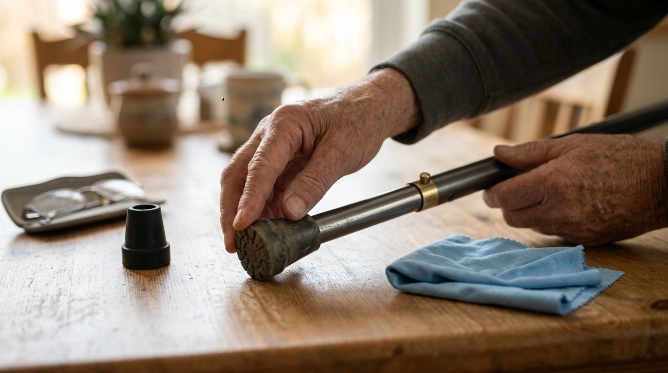
Start with function, fit, and grip. Style matters, but it comes after the features that make a cane safe and comfortable to use.
What should you look for when buying a cane?
- Correct height: Choose an adjustable range that reaches your wrist level comfortably.
- Comfortable grip: Consider a larger or contoured handle if gripping narrow handles is difficult.
- Secure tip: Look for a non-slip rubber tip with visible tread.
- Appropriate base: Choose single-point or multi-point support according to your actual mobility needs.
- Manageable weight: You should be able to move the cane without excessive effort.
- Reliable construction: Adjustable sections and folding joints should lock securely.
How often should you inspect a cane?
I would make a quick visual check part of normal use. It takes only a few seconds and can catch obvious wear before it becomes a problem.
Check these areas regularly:
- Rubber tip wear or cracking
- Loose height-adjustment buttons
- Bent shafts
- Loose handles
- Worn folding-cane joints or cords
- Slippery or damaged grips
The rubber tip deserves special attention because it provides traction with the floor. Replace it when the tread becomes badly worn, hardened, split, or loose.
Can a walking cane also be stylish?
Absolutely. Once the functional requirements are met, there’s no reason a cane can’t reflect your taste.
Wood finishes, colors, patterned shafts, decorative handles, and discreet folding designs are widely available. A cane you’re comfortable carrying may be one you’re more willing to use when you need it.
Section Takeaway: Choose a cane for proper support and fit first, then consider convenience, appearance, and accessories.
Walking Cane FAQs
Which side should you use a walking cane on?
If one leg is weaker or painful, healthcare guidance commonly recommends holding the cane in the hand opposite that leg. Move the cane forward with the affected leg, unless your healthcare professional has instructed you differently.
How tall should my walking cane be?
When standing upright with your arms hanging naturally, the handle should generally be near the crease of your wrist. Your elbow should remain slightly bent when you grip the cane.
Is a quad cane safer than a regular cane?
A quad cane has a wider contact base, but that doesn’t automatically make it the best option for every person. It is heavier and may be more awkward to move, so the right choice depends on individual balance and support needs.
Can I use a hiking stick instead of a cane?
A hiking stick or trekking pole can provide light balance support during recreational walking. If you need a device because of pain, weakness, injury, or significant balance problems, ask a healthcare professional which mobility aid is appropriate.
Do walking canes help prevent falls?
A correctly chosen and properly used cane can improve stability for some people. However, a cane can’t eliminate fall risk, and poor fit or incorrect use may reduce its benefit.
When should I use a walker instead of a cane?
A walker may be more appropriate when you need greater stability, have weakness on both sides, or require more weight support than a cane can safely provide. A physical therapist or healthcare provider can help make that decision.
Can I take a folding cane when traveling?
Yes, folding canes are designed for easier storage and transport. Make sure every section is fully assembled and secure before putting weight through the cane after unfolding it.
Final Takeaway: What Should You Know About Walking Canes?
A walking cane is a simple mobility aid that can improve balance, provide limited support, and help keep everyday activities accessible. Its usefulness depends heavily on choosing the right type, getting the height correct, and learning proper technique.
As of 2026, the basic advice hasn’t changed: don’t choose a cane only by appearance. Start with your mobility needs, check the fit carefully, inspect the rubber tip regularly, and seek professional guidance when balance or weakness is significant.
If a properly fitted cane helps you keep enjoying neighborhood walks, shopping, travel, social outings, or favorite hobbies, that’s exactly what a good mobility aid should do. It should support your movement rather than define it.