
Walking Cane Handle Types Explained: A Grip Guide


Automatic Pill Dispenser

Rollator Walker with Seat

Tablet for Seniors
Quick Answer
Walking cane handles come in several shapes, including crook, Derby, Fritz, offset, and ergonomic contoured grips. Crook handles are easy to hang over an arm, Derby handles offer a traditional all-purpose grip, and wider or contoured ergonomic handles may feel more comfortable for people with hand pain. The right choice depends on your hand size, grip strength, comfort, and the support you need.
What Are the Main Types of Walking Cane Handles?
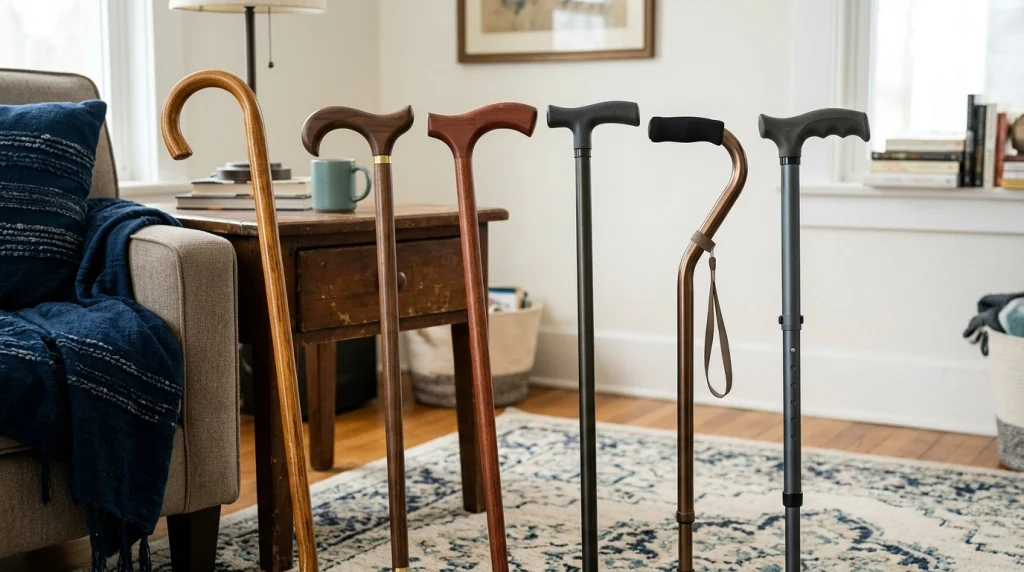
Different walking cane handle types arranged to show crook, Derby, T-shaped, offset, and ergonomic grips.
The main walking cane handle types are crook, Derby, Fritz, T-shaped, offset, and ergonomic or anatomical grips. Each has a different shape, contact area, and way of positioning your hand over the cane shaft.
These differences matter because the handle is the part you hold every time you take a step. A narrow grip may feel uncomfortable during longer walks, while a wider or contoured grip may distribute pressure more comfortably across the palm.
There is no single handle shape that suits everyone. A traditional handle may work well for someone who needs occasional balance assistance, while a person with painful finger joints may prefer a larger, easier-to-grasp surface.
How Do the Different Cane Handles Compare?
The following comparison explains the typical advantages and limitations of each style. Manufacturers sometimes use different names for similar designs, so examine the actual handle shape rather than relying on its label alone.
| Handle type | Typical advantage | Potential limitation |
|---|---|---|
| Crook | Curved shape can hang over an arm | May feel less comfortable for prolonged gripping |
| Derby | Traditional, curved grip that is easy to hang up | Shape may not suit every hand |
| Fritz | Broader, flatter gripping area | Fit still depends on hand shape and size |
| T-shaped | Simple, straightforward grip | A narrow version may concentrate pressure |
| Offset | Positions the hand more directly over the shaft | Grip comfort varies by design |
| Ergonomic or anatomical | Contoured surface may spread pressure | Some designs fit only the right or left hand |
The most useful distinction is between handle shape and handle comfort. A design that looks supportive may still feel awkward if it is too wide, too narrow, too firm, or shaped for the opposite hand.
1. Crook Handles: What Makes Them Different?
A crook handle has a curved, hook-like shape, similar to a shepherd’s crook. It is a familiar design on traditional wooden walking sticks and some everyday canes.
Its main convenience is that the curved section can hang over an arm or suitable support when the cane is not in use. This can make it convenient for occasional walking or carrying between uses.
The limitation is the gripping surface. Depending on its thickness and curvature, a crook handle may provide less comfortable contact for someone who needs to hold the cane for extended periods or has difficulty closing their fingers around it.
Consider it if: you prefer a traditional curved handle and can grip it comfortably. If finger stiffness or hand pain is a concern, compare it with a broader grip before choosing.
2. Derby Handles: Are They Good for Everyday Use?
A Derby handle has a curved, somewhat flattened shape with a downward-turning end. It typically provides a more defined place for the hand than a simple rounded crook.
Derby handles are common on traditional and folding canes. Their shape can make the cane easier to hold and can allow it to hang over an arm when not being used.
However, a Derby handle is not automatically the most comfortable choice for every person. A narrow or rigid version may press against sensitive areas of the palm, particularly during longer periods of use.
Consider it if: you want a familiar, versatile design for routine walking and the handle fits your hand without pinching or forcing your wrist into an uncomfortable position.
3. Fritz Handles: How Do They Differ From Derby Grips?
A Fritz handle, sometimes called a crutch-style handle, generally has a broader, flatter gripping surface and a more tapered profile than a traditional Derby handle. The precise shape varies between manufacturers.
This design may appeal to people who find a narrow curved grip uncomfortable. A broader contact area can change how pressure feels across the hand, although the benefit depends on the handle’s dimensions and the user’s grip.
Fritz handles are often considered by people with arthritis or finger stiffness. However, the label alone does not guarantee that a particular model will reduce pain. Handle thickness, surface texture, hand position, and the amount of force needed all matter.
Consider it if: a conventional handle feels too narrow or awkward. Try the grip if possible, and check that your fingers can rest naturally without excessive squeezing.
4. T-Shaped Handles: When Is a Simple Grip Enough?
A T-shaped handle has a relatively straight gripping section that meets the cane shaft at roughly a right angle. It offers a simple design without the pronounced hook of a crook handle.
Some T-shaped grips are compact and firm, while others are wider or padded. That means two canes with a similar outline may feel very different in the hand.
The key consideration is whether the grip allows you to hold and control the cane without excessive finger pressure. A small, hard handle may become uncomfortable if you rely on it for frequent support.
Consider it if: you prefer a straightforward grip and can comfortably wrap your fingers around it. If you have weak grip strength, compare the handle’s width and shape with larger alternatives.
5. Offset Handles: What Does the Bent Shaft Do?
An offset cane has a bend in the upper shaft that places the handle more directly above the shaft rather than positioning the hand well to one side. This arrangement can help align the hand with the cane’s support point.
Offset designs are available with different grip shapes and materials, including padded and contoured handles. Therefore, offset describes the cane’s geometry rather than one specific handle style.
The bend does not automatically make a cane suitable for every level of weight-bearing. The device’s rated capacity, construction, fit, and intended use still matter, and a handle alone cannot make an unsuitable mobility aid safe.
Consider it if: you want a grip positioned over the shaft and find that arrangement comfortable. Check the cane’s instructions and weight rating rather than assuming every offset model provides the same support.
6. Ergonomic and Anatomical Handles: Are They Better for Hand Pain?
Ergonomic handles are designed to make gripping more comfortable through features such as wider contact areas, molded contours, softer materials, or shapes that support the palm. Anatomical grips may be molded specifically for the right or left hand.
These features can be useful for people who experience hand fatigue, joint discomfort, or difficulty maintaining a firm grip. A larger handle may be easier to grasp when finger movement is limited, but an oversized grip can be difficult for someone with small hands.
Some contoured handles are handed. A right-hand model may not fit correctly when held in the left hand, so check the manufacturer’s instructions before purchasing.
Soft foam or rubber-like coverings can change the feel of the handle, but softness alone does not prove that the cane will reduce pain. A grip that compresses too much or feels slippery may be less suitable for a particular user.
Consider it if: you use a cane frequently or ordinary grips cause discomfort. Persistent pain, numbness, or tingling suggests the fit or use of the cane should be reviewed rather than simply choosing a softer handle.
How Should You Choose the Right Handle for Your Hand?
Start with the problem you want to solve, not the handle’s appearance. The following checks can help you narrow your options.
- If your fingers feel cramped: compare wider grips and handles with enough room for a relaxed hand position.
- If your palm becomes sore: try a different contour or a broader contact area rather than automatically choosing the softest material.
- If your hand feels weak: look for a grip that is secure without requiring a tight squeeze.
- If you have arthritis: compare Fritz and ergonomic designs, but judge the actual fit instead of relying on the product label.
- If you carry the cane between uses: a crook or Derby handle may be convenient because its shape can hang over an arm or suitable support.
- If you use the cane for longer walks: prioritize sustained comfort, secure control, appropriate cane height, and the correct level of support.
When possible, hold the cane in the hand you intend to use. Your fingers should rest naturally, your wrist should not be forced into an awkward angle, and you should not need to grip tightly just to keep the handle secure.
For more general mobility guidance, see our guide to what a walking cane is and how its main designs differ.
How Do You Check Cane Fit and Use It Safely?

A comfortable handle cannot compensate for a cane that is too tall, too short, or unsuitable for your balance needs. Fit and safe technique are essential parts of the choice.
- Check the height. Stand upright in your usual walking shoes with your arms relaxed. The handle should generally align with the crease of your wrist.
- Check your elbow. When holding the handle, your elbow should remain slightly bent. Cleveland Clinic and Mayo Clinic describe a comfortable bend as part of proper cane fitting.
- Check your grip. Make sure you can hold the handle without pinching, excessive squeezing, or painful wrist positioning.
- Check the cane tip. Inspect the rubber tip for wear and replace it when its tread is worn or it no longer provides reliable traction.
- Check your support needs. A cane is generally intended for limited balance assistance or support with one affected leg. Significant weakness or repeated falls may require a different aid.
The Cleveland Clinic’s guide to using a cane explains handle options and fitting, including wrist height and elbow position. If you are uncertain about fit or technique, a physical therapist or other qualified healthcare professional can assess how you walk and help select a suitable device.
Warning
Do not assume a more comfortable handle makes a cane safe for heavy weight-bearing or severe balance problems. If walking has become suddenly difficult, you experience repeated falls, or your weakness is worsening, seek appropriate medical assessment before relying on a different handle.
Related Product
Related Product
Ergonomic Walking Cane With a Contoured Grip
Compare contoured and wider-grip walking canes if traditional handles feel uncomfortable. Check the grip dimensions, hand orientation, height range, and stated weight capacity before choosing.
As an Amazon Associate, we earn from qualifying purchases.
Frequently Asked Questions
Which walking cane handle is best for seniors?
The best handle is the one that fits comfortably and allows secure control. Derby handles suit many users, while wider Fritz or ergonomic grips may be worth trying when finger stiffness or hand discomfort makes a narrow handle difficult to hold.
Which cane handle is best for arthritis?
A wider Fritz or contoured ergonomic grip may be more comfortable for some people with arthritis because it can reduce the need for a tight finger grip. The correct choice depends on hand size, joint movement, and the exact handle design.
What is the difference between a Derby and a Fritz handle?
A Derby handle typically has a curved, flattened shape with a downward-turning end. A Fritz handle generally has a broader, flatter gripping surface and a more tapered profile. The exact shapes vary by manufacturer.
Are ergonomic cane handles always more comfortable?
No. Ergonomic handles are designed to improve grip comfort, but a contour that suits one hand may feel awkward in another. Check handle width, firmness, texture, and whether the design is intended for the right or left hand.
Can you change the handle on a walking cane?
Some canes have replaceable handles, while others have integrated or model-specific designs. Check the manufacturer’s instructions and compatibility information before attempting a replacement, especially if the cane is used for weight-bearing support.
When should you consider a walker instead of a cane?
A walker may be more appropriate when you need more support than a cane can provide, have substantial weakness, or experience repeated falls. A healthcare professional or physical therapist can assess your walking ability and recommend an appropriate mobility aid.
Conclusion
Choosing a walking cane handle is about more than appearance. Crook and Derby handles offer familiar traditional shapes, Fritz grips provide a different contact area, offset designs position the hand over the shaft, and ergonomic handles offer contours intended to improve comfort.
Start by identifying what feels uncomfortable with your current grip, then compare handle shape, width, material, and hand orientation. Check the cane’s height and intended support level as well. If pain, numbness, weakness, or balance problems persist, seek an assessment rather than assuming a different handle alone will solve the problem.