
Can Hobbies Help Seniors Stay Mentally Active?


Hands-Free Neck Magnifier

Easy Grip Kitchen Utensils

Button Hook Dressing Aid
Quick Answer
Yes. Hobbies can help seniors stay mentally active by giving the brain regular chances to learn, remember, solve problems, create, and interact with other people. The National Institute on Aging also encourages older adults to take part in meaningful activities they enjoy as part of healthy aging, although no hobby can guarantee prevention of dementia or cognitive decline.
How hobbies can keep the mind engaged
- Learning: New skills make you pay attention, remember instructions, and practice unfamiliar tasks.
- Problem-solving: Games, crafts, gardening, and puzzles involve decisions and small challenges.
- Creativity: Music, painting, writing, and photography encourage imagination and expression.
- Social contact: Clubs, classes, games, and volunteering add conversation and shared experiences.
- Movement: Walking, dancing, and gardening can combine mental engagement with physical activity.
A simple way to start
- Choose one hobby you enjoy and try it for 15 to 30 minutes several times each week.
I think the word “hobby” sometimes makes an activity sound less important than it is. A good hobby can give an older adult curiosity, routine, conversation, and something enjoyable to anticipate.
The goal isn’t to keep the brain busy every minute. It is to create regular chances to think, learn, remember, move, and connect without turning retirement into another job.
In This Guide
- How do hobbies help seniors stay mentally active?
- Which hobbies are best for mental stimulation?
- Are new hobbies better than familiar hobbies?
- Do social hobbies help keep the mind active?
- Can active hobbies support brain health?
- How often should seniors do mentally engaging hobbies?
- How can hobbies be adapted as abilities change?
- Can hobbies prevent memory loss or dementia?
- Frequently asked questions
How Do Hobbies Help Seniors Stay Mentally Active?
Hobbies keep the mind involved because they give it something purposeful to do. Depending on the activity, that may involve attention, memory, planning, language, coordination, creativity, or decision-making.
Mental activity in a hobby means using thinking skills in a purposeful, enjoyable task. It doesn’t have to involve worksheets, tests, or a commercial “brain training” program.
Hobbies give the brain problems worth solving
Think about gardening for a moment. You choose plants, remember watering schedules, watch weather conditions, notice changes, and decide what needs attention.
A card game creates different challenges. You follow rules, remember previous moves, watch other players, and adjust your strategy.
- Reading uses attention, language, memory, and imagination.
- Cooking uses sequencing, measuring, timing, and planning.
- Photography encourages observation and technical learning.
- Music can involve memory, rhythm, listening, and coordination.
- Crafts often combine planning, fine movements, and problem-solving.
- Games can involve memory, strategy, language, or calculation.
The important part is engagement. An activity works better when the person enjoys it enough to return to it.
Meaning can matter as much as difficulty
I wouldn’t choose a hobby simply because somebody calls it “good for the brain.” If the activity feels like homework, it may end up sitting untouched after a week.
As of 2026, the National Institute on Aging’s brain health guidance still emphasizes a broader approach to cognitive health. Mental stimulation is one piece alongside physical health, social involvement, sleep, medical care, and other lifestyle factors.
A senior who loves family history may get far more mental engagement from genealogy than from a puzzle app. Interest creates a reason to keep learning.
Which Hobbies Are Best for Mental Stimulation?
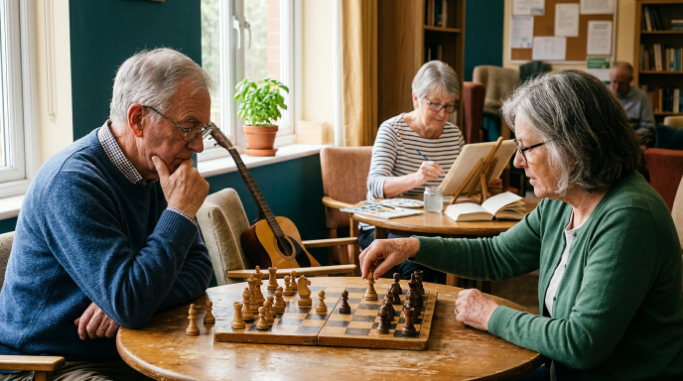
The best mentally engaging hobbies combine enjoyment with some level of attention, learning, memory, creativity, or problem-solving. They don’t need to be complicated.
I like hobbies that can grow with the person. You can start easily, then add challenge when the activity becomes familiar.
| Hobby | Mental skills used | Social level | Simple starting session |
|---|---|---|---|
| Reading | Attention, language, memory | Low | 15–30 minutes |
| Cards or chess | Strategy, memory, decisions | Medium to high | 20–40 minutes |
| Learning music | Memory, listening, coordination | Low to high | 10–20 minutes |
| Painting | Creativity, planning, observation | Low to medium | 20–30 minutes |
| Gardening | Planning, observation, memory | Low to medium | 15–30 minutes |
| Language learning | Recall, listening, language | Low to high | 10–15 minutes |
| Volunteering | Planning, communication, learning | High | 1–2 hours weekly |
Choose variety instead of chasing one perfect activity
One hobby doesn’t need to exercise every type of thinking. A mix can make the week more interesting.
- For learning: Languages, technology classes, photography, or music.
- For strategy: Chess, cards, puzzles, or board games.
- For creativity: Painting, writing, quilting, woodworking, or cooking.
- For memory: Reading, genealogy, music, or learning new recipes.
- For conversation: Book clubs, volunteering, classes, or group games.
There is no need to do everything. Two or three enjoyable activities can provide plenty of variety.
Are New Hobbies Better Than Familiar Hobbies?
New hobbies can add useful challenge, but familiar hobbies still have value. The strongest routine often includes both.
Learning something new forces you to slow down and pay attention. You have to remember instructions, notice mistakes, and make adjustments.
A little difficulty can be useful
The challenge should feel interesting rather than overwhelming. I think of it as being slightly outside your comfort zone, not miles beyond it.
A retired photographer might learn phone photo editing. Someone who already cooks could try one unfamiliar cuisine each month.
- Learn five phrases in a new language.
- Practice a new song on an instrument.
- Try a different painting technique.
- Learn one unfamiliar card game.
- Take a beginner computer class.
- Research one branch of the family tree.
Familiar hobbies still make the brain work
An old hobby isn’t mentally useless simply because you’re good at it. Reading, sewing, woodworking, gardening, and music still involve decisions and attention.
You can also add a new layer to a familiar pastime. A gardener might grow from seeds, while a reader might join a discussion group.
That balance feels more sustainable to me. Familiar activities provide confidence, while new challenges keep curiosity alive.
Do Social Hobbies Help Keep the Mind Active?
Yes. Social hobbies combine the activity itself with conversation, listening, memory, emotional awareness, and quick responses to other people.
The CDC’s social connection guidance describes supportive relationships as important to mental and physical health. Social connection becomes especially relevant when retirement, mobility changes, or losing loved ones reduces everyday contact.
Good hobbies for both thinking and connection
- Book clubs: Reading becomes discussion, recall, and interpretation.
- Card groups: Games combine rules, strategy, conversation, and friendly competition.
- Choirs: Singing adds memory, listening, rhythm, and teamwork.
- Volunteering: A regular role can provide purpose, communication, and problem-solving.
- Classes: Learning alongside others creates both challenge and conversation.
- Walking groups: Movement and social interaction happen at the same time.
I especially like activities with a regular schedule. Knowing that a card group meets every Tuesday gives the week a useful anchor.
Social hobbies don’t have to involve large crowds. One walking partner or a monthly book discussion may suit someone who prefers quieter company.
Can Active Hobbies Support Brain Health?
Physical hobbies can support both body and brain health. Walking, dancing, swimming, gardening, and other enjoyable movement are good examples.
The CDC’s guidance for adults age 65 and older recommends a weekly mix of aerobic activity, muscle strengthening, and balance activity. People who cannot meet the full recommendation should be as active as their abilities and health conditions allow.
Choose movement that feels like a hobby
Not everyone enjoys formal exercise. That doesn’t mean movement has to disappear from the day.
- Walk while birdwatching.
- Garden in raised containers.
- Dance to favorite music.
- Take nature photographs during a walk.
- Join a gentle swimming group.
- Try tai chi or another balance-focused class.
An activity can serve several purposes at once. Gardening, for example, may involve movement, planning, observation, learning, and time outdoors.
Vet note: For this human-health topic, a medical professional rather than a veterinarian is appropriate. Seniors with health conditions, recent surgery, dizziness, chest pain, or major mobility limits should ask their healthcare provider what activity level is suitable.
How Often Should Seniors Do Mentally Engaging Hobbies?
There isn’t a proven universal number of hobby minutes that every senior needs. Consistency and enjoyment matter more than forcing a rigid schedule.
I would rather see someone enjoy 20 minutes of painting four times a week than struggle through a two-hour session they dread. Short sessions are easier to repeat.
A practical weekly rhythm
- Quiet mental hobby: 15–30 minutes on several days.
- Creative hobby: 30–60 minutes once or twice weekly.
- Social hobby: One regular weekly or monthly gathering.
- Active hobby: Short sessions spread throughout the week.
- Learning hobby: 10–20 minutes of practice several times weekly.
Those times are practical starting points, not medical prescriptions. Someone may happily read for two hours while another person prefers ten-minute sessions.
Watch for the difference between challenge and frustration
A healthy challenge makes you concentrate but still leaves you wanting to continue. Too much frustration can make the hobby feel like a test.
Make the task easier when needed. Use a simpler puzzle, shorter lesson, larger project pieces, or fewer steps.
The goal is sustainable engagement. Enjoyment is what brings you back tomorrow.
How Can Hobbies Be Adapted as Abilities Change?
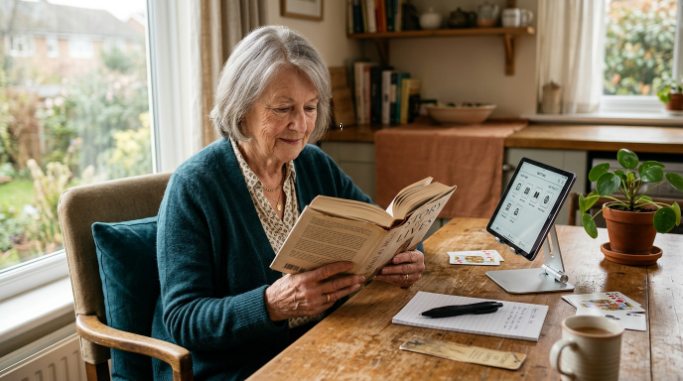
A good hobby doesn’t always need to be abandoned when eyesight, hearing, mobility, stamina, or hand strength changes. Often, the setup can change instead.
I think this is one of the most overlooked parts of choosing senior hobbies. Small adaptations can preserve years of enjoyment.
For reduced vision
- Use large-print books and puzzle books.
- Try audiobooks or voice-controlled devices.
- Increase task lighting.
- Use high-contrast craft materials.
- Choose tablets or e-readers with adjustable text sizes.
For limited hand strength
- Try thicker pens and easy-grip tools.
- Use larger playing cards or puzzle pieces.
- Choose lightweight garden equipment.
- Use voice-to-text for journaling or memoir writing.
For limited mobility
- Use raised garden beds or tabletop planters.
- Try seated art, music, reading, or games.
- Join online classes or discussion groups.
- Photograph birds or scenery from a comfortable location.
- Choose activities that don’t require carrying heavy supplies.
Comfort matters because pain and fatigue quickly turn a hobby into a chore. Adjust the activity before assuming the person has lost interest.
Can Hobbies Prevent Memory Loss or Dementia?
No hobby can guarantee that a person will avoid dementia or age-related cognitive decline. Claims that a puzzle, game, supplement, or app can “prevent Alzheimer’s” should be treated cautiously.
The National Institute on Aging notes that mentally stimulating activities, social engagement, physical activity, and other healthy behaviors may support cognitive health. Research is still examining how these factors affect cognitive decline and dementia risk.
Think support, not cure
A hobby is best viewed as one part of an active and meaningful life. It isn’t a substitute for medical care.
Reading, music, exercise, social interaction, hobbies, sleep, nutrition, and management of health conditions can all fit into a broader healthy-aging routine. No single activity carries the whole load.
Don’t use hobbies to explain away concerning changes
Occasional forgetfulness can happen with aging, but noticeable or worsening changes deserve attention. Problems that interfere with everyday tasks should not simply be blamed on getting older.
The NIA’s guidance on memory problems and aging explains that memory changes can have many causes. A healthcare professional can help determine what needs further evaluation.
- Getting lost in familiar places.
- Repeatedly forgetting important appointments or conversations.
- Increasing difficulty managing familiar daily tasks.
- Major changes in judgment or problem-solving.
- Memory problems that are getting noticeably worse.
Vet note: Memory changes in an older adult should be discussed with a doctor or other qualified healthcare professional, especially when they affect safety or daily independence.
Frequently Asked Questions About Hobbies and Mental Activity in Seniors
What hobby is best for keeping an older person’s mind active?
There isn’t one best hobby. Reading, strategy games, music, crafts, language learning, gardening, photography, classes, and volunteering can all provide meaningful mental engagement when the person enjoys them.
Are puzzles good for seniors?
Puzzles can provide concentration, problem-solving, recall, and pattern recognition. They can be a useful hobby, but they shouldn’t be treated as a guaranteed way to prevent dementia.
Is learning a new skill good for older adults?
Learning something new gives the brain unfamiliar information to process and remember. Music, technology, languages, cooking, photography, art, and community classes can all provide manageable learning challenges.
What are good mentally stimulating hobbies for seniors with limited mobility?
Reading, audiobooks, writing, card games, puzzles, genealogy, music, painting, online classes, photography, and tabletop gardening can work well. Equipment and project difficulty can be adapted to comfort and ability.
Are social hobbies better than hobbies done alone?
Neither is automatically better. Social hobbies add conversation and connection, while solo hobbies may provide focus, calm, creativity, and independence; many seniors benefit from having some of both.
Can watching television count as a hobby?
It can be enjoyable, but passive viewing usually demands less active participation than learning, creating, discussing, playing, or practicing. Watching a documentary and then researching or discussing the topic can make the experience more engaging.
Is it too late to start a new hobby in your 70s or 80s?
No. A hobby can begin at almost any age when the activity matches the person’s interests, health, abilities, and available resources.
Final Takeaway
Yes, hobbies can help seniors stay mentally active. The strongest choices encourage some combination of learning, attention, creativity, memory, movement, and social connection.
You don’t need an expensive brain-training program or a complicated schedule. Start with something enjoyable enough to repeat.
- Choose one hobby that sparks curiosity.
- Keep the first sessions short and manageable.
- Add a little challenge as confidence grows.
- Include social contact when it feels enjoyable.
- Adapt tools or surroundings when abilities change.
- Pair mental hobbies with movement and healthy daily routines.
A hobby should make life richer, not create another obligation. When someone keeps asking, “What can I try next?” the hobby is probably doing its job.
