
How Do Hobbies Benefit Older Adults?


Smart Plug with Alexa

Compression Socks

Glucose Monitor Kit
Quick Answer
Hobbies can benefit older adults by adding mental stimulation, social contact, physical activity, relaxation, and a stronger sense of purpose to everyday life. Enjoyable activities may also support healthy aging when they match a person’s interests and abilities. The National Institute on Aging encourages older adults to stay involved in meaningful activities they enjoy.
The main benefits of hobbies for older adults
- Mental stimulation: Reading, music, games, crafts, and learning can keep the mind engaged.
- Social connection: Clubs, classes, volunteering, and group hobbies create regular contact with other people.
- More movement: Walking, gardening, dancing, and similar hobbies can make physical activity feel enjoyable.
- Less stress: Quiet hobbies can create a pleasant break from worries and daily routines.
- Sense of purpose: Projects, goals, and shared interests give people something meaningful to anticipate.
- Daily structure: Regular activities can add rhythm to retirement or other major life changes.
A simple way to start
- Choose one activity you already enjoy, then try it for a few weeks before adding more.
Hobbies can look like small things, but they often fill several needs at once. For older adults and seniors, an enjoyable pastime can bring movement, curiosity, people, and structure into the same week.
I prefer to think of hobbies as part of a good life, not as a way to stay “busy.” As of 2026, healthy-aging guidance increasingly emphasizes meaningful activity alongside physical and social well-being.
In This Guide
- Why do hobbies matter more as we get older?
- How do hobbies help mental and emotional well-being?
- Can hobbies help keep the brain active?
- How do hobbies help older adults stay socially connected?
- Which hobbies can support physical health?
- Why can hobbies provide purpose after retirement?
- Which type of hobby offers which benefits?
- How should an older adult choose a hobby?
- Frequently asked questions
- Final takeaway
Why Do Hobbies Matter More as We Get Older?

Hobbies matter because aging can change routines, responsibilities, social circles, and how people spend their days. A chosen activity can replace some of the structure or connection that disappears after retirement or other life changes.
A hobby doesn’t need to be productive. Enjoyment itself is a good reason to keep doing it.
Definition: A hobby is a leisure activity someone chooses to do regularly for enjoyment, curiosity, creativity, movement, learning, relaxation, or social connection.
Hobbies can fill several needs at once
Gardening, for example, isn’t only about plants. It can involve light movement, planning, time outdoors, learning, and sharing vegetables or flowers with other people.
A weekly card group works differently. It combines games, conversation, routine, and a reason to leave the house.
- Creative hobbies provide self-expression and visible progress.
- Learning hobbies give the mind new information and challenges.
- Active hobbies add movement to the day.
- Social hobbies create repeated contact with other people.
- Quiet hobbies offer calm, focus, and personal time.
No single hobby needs to do everything. A mix often works better.
Enjoyment helps an activity stick
A complicated hobby isn’t automatically more valuable than a simple one. Reading on the porch may fit someone’s life better than an expensive class across town.
This matters because consistency usually comes from enjoyment. An activity that feels like another obligation often gets dropped.
I think this is one of the easiest mistakes to make after retirement. People sometimes search for the “right” hobby instead of noticing what they naturally want to repeat.
How Do Hobbies Help Mental and Emotional Well-Being?
Hobbies can support emotional well-being by giving attention somewhere pleasant to go. They may provide relaxation, accomplishment, anticipation, and a break from repetitive worries.
They also create small wins. That matters more than it may sound.
They give you something enjoyable to anticipate
Looking forward to Tuesday’s book club or Saturday morning gardening can change how a week feels. A hobby gives the calendar positive events that aren’t appointments or chores.
- Finishing a jigsaw puzzle creates a clear result.
- Learning a song gives you a measurable challenge.
- Growing herbs provides something to care for.
- Completing a painting gives you something tangible to keep or share.
These experiences aren’t medical treatment. They are everyday sources of interest and satisfaction.
Quiet hobbies can create useful mental space
Reading, drawing, knitting, birdwatching, fishing, and similar activities can slow the pace of the day. They ask for enough attention to interrupt constant mental chatter.
That doesn’t mean every hobby needs to be relaxing. Some people feel better after a lively dance class or competitive card game.
The important part is fit. Choose the type of stimulation you enjoy.
Creative activities make room for expression
Painting, music, woodworking, writing, sewing, photography, and crafts let people create something that didn’t exist before. The finished result doesn’t need to impress anyone.
The process can be enough. Progress also gives people a reason to keep learning.
Can Hobbies Help Keep the Brain Active?
Mentally engaging hobbies can challenge memory, attention, planning, language, or problem-solving. They won’t guarantee that someone avoids cognitive decline, but keeping the mind active is a sensible part of healthy aging.
Variety can also keep things interesting.
Different hobbies challenge different skills
- Reading: attention, comprehension, vocabulary, and memory.
- Chess and strategy games: planning and decision-making.
- Music: listening, coordination, timing, and recall.
- Language learning: memory, listening, and word retrieval.
- Crafts: sequencing, fine motor control, and visual planning.
- Photography: observation, composition, and technical learning.
- Genealogy: research, organization, memory, and storytelling.
The goal isn’t to make every leisure hour into “brain training.” A hobby still needs to be enjoyable.
Learning something new adds another layer
A familiar pastime can feel comforting, while a new one creates challenge. Older adults don’t have to choose between the two.
Someone who already loves cooking might learn unfamiliar recipes. A lifelong reader might join a discussion group and explore a new genre.
The National Institute on Aging notes that meaningful, mentally stimulating activities may have positive effects on some aspects of thinking and memory. Research continues to explore how different activities affect cognitive aging.
So I wouldn’t choose a hobby because someone promises it will “prevent dementia.” That’s too strong a claim.
Choose it because it keeps you engaged. Mental challenge can be one useful benefit.
How Do Hobbies Help Older Adults Stay Socially Connected?
Social hobbies create repeated reasons to meet, talk, and cooperate with other people. That regular contact can be especially valuable when work, family roles, or long-standing friendships change.
Connection often grows through repetition. Seeing the same people each week makes conversation easier.
Shared interests remove some social pressure
Meeting new people can feel awkward when there is nothing obvious to discuss. A shared hobby solves part of that problem.
You already have a subject.
- Book clubs give members a story to discuss.
- Walking groups create conversation while moving.
- Choirs work toward shared performances.
- Community gardens give members practical jobs.
- Card groups create regular friendly competition.
- Volunteer groups connect people around a common goal.
The CDC’s information for older adults highlights meaningful relationships and positive social interactions as parts of social connectedness. It also suggests hobbies, group activities, and community spaces as ways to connect.
A social hobby doesn’t need a large group
Some people love busy clubs. Others prefer one walking partner, a weekly chess opponent, or a neighbor who gardens nearby.
Both count. The best social setting is one you will return to.
Online activities can help when transportation, distance, weather, or mobility creates a barrier. Video-based classes and discussion groups aren’t identical to in-person contact, but they can widen the options.
Which Hobbies Can Support Physical Health?
Hobbies that involve movement can make physical activity feel less like a workout. Walking, dancing, gardening, swimming, cycling, tai chi, and recreational sports are common examples.
Enjoyment can make regular movement easier to maintain.
Active hobbies come in many intensity levels
- Gentle movement: easy gardening, casual walking, stretching, or tai chi.
- Moderate activity: brisk walking, dancing, water exercise, or steady cycling.
- Strength-related activity: gardening tasks, some home projects, or structured resistance exercise.
- Balance-focused activity: tai chi and appropriate balance exercises.
The National Institute on Aging’s physical activity guidance explains that aerobic, muscle-strengthening, and balance activities can support health and function in older adults.
Research summarized by the National Center for Complementary and Integrative Health also reports evidence that tai chi may help balance and reduce fall risk in older adults.
Health note: If you have a medical condition, recent surgery, chest symptoms, dizziness, significant balance problems, or major mobility limits, ask your healthcare professional which activities are appropriate for you.
Physical hobbies can also be social hobbies
A walk by yourself can be peaceful. The same walk with a neighbor adds conversation and accountability.
That overlap is useful. You don’t need a separate activity for every goal.
NIH research has also found links between leisure-time physical activity and longevity among older adults. The broader lesson is simple: enjoyable forms of movement can be easier to sustain than activity you dislike.
You can read the NIH summary on leisure activities and older adults for more context.
Why Can Hobbies Provide Purpose After Retirement?
Retirement can remove deadlines, coworkers, routines, and the daily feeling that someone needs you somewhere. Hobbies can replace part of that structure without turning retirement into another job.
A meaningful activity gives the week shape.
Projects create a reason to continue
A vegetable garden changes from week to week. A quilt grows piece by piece.
A musician can practice another song. A volunteer can return because the organization still needs help.
- Monday might become library day.
- Wednesday may be choir practice.
- Friday could be a morning walk with friends.
- Sunday afternoon might be reserved for painting.
None of those activities needs to occupy the whole day. Even a small recurring plan can provide useful rhythm.
Hobbies also preserve a sense of identity
People are more than their age or employment status. Being a gardener, reader, photographer, baker, musician, woodworker, mentor, or birdwatcher gives someone another way to describe themselves.
This can be important after a major role changes. Retirement is the obvious example, but caregiving changes, bereavement, relocation, and reduced mobility can also reshape daily identity.
A hobby can evolve with those changes. The exact form doesn’t have to stay the same forever.
Which Type of Hobby Offers Which Benefits?
Different hobbies tend to serve different needs. The table below can help you choose based on what you’d like more of in your week.
| Hobby Type | Examples | Main Benefits | Social Level | Physical Demand |
|---|---|---|---|---|
| Creative | Painting, knitting, writing, photography | Expression, focus, accomplishment | Low to medium | Usually low |
| Active | Walking, swimming, gardening, dancing | Movement, fitness, routine | Low to high | Low to high |
| Social | Clubs, volunteering, choir, card groups | Connection, belonging, routine | High | Low to medium |
| Learning | Languages, music, history, technology | Curiosity, mental challenge, progress | Low to medium | Usually low |
| Relaxing | Reading, puzzles, birdwatching, journaling | Calm, focus, personal enjoyment | Usually low | Low |
The strongest choice may cover two or three categories. Dancing can be active, social, mentally engaging, and creative at the same time.
Gardening can combine movement, learning, relaxation, and a sense of responsibility. That’s why I prefer choosing by enjoyment instead of category labels alone.
How Should an Older Adult Choose a Hobby?
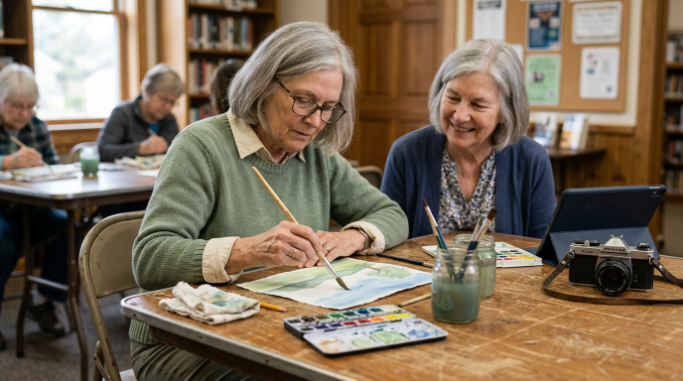
Choose a hobby by matching it to your interests, current abilities, budget, available space, and preferred level of social contact. Start cheaply and give yourself permission to change your mind.
A hobby is an experiment, not a lifetime contract.
Start with the benefit you want
- More movement: Try walking, gardening, swimming, dancing, or tai chi.
- More people: Try volunteering, clubs, classes, choirs, or group games.
- More creativity: Try painting, photography, woodworking, sewing, or writing.
- More learning: Try languages, music, genealogy, history, cooking, or technology.
- More quiet time: Try reading, puzzles, birdwatching, journaling, or crafts.
Remove practical barriers early
A hobby may sound perfect but still fail if it requires difficult transportation, expensive equipment, or too much setup. Make the first version easy.
- Borrow supplies before buying a full set.
- Try a library or community class first.
- Use a seated version if standing is difficult.
- Choose online options when transportation is limited.
- Begin with 15- to 30-minute sessions if energy varies.
- Invite a friend if starting alone feels uncomfortable.
Look at old interests too
You don’t always need a brand-new hobby. Think about what you enjoyed before work, parenting, caregiving, or other responsibilities took most of your time.
An old guitar, sketchbook, garden, camera, or favorite subject may point you in the right direction.
Start small. The hobby that keeps pulling you back is usually more valuable than the one that looks impressive on paper.
Frequently Asked Questions
What are the biggest benefits of hobbies for seniors?
The biggest benefits include mental stimulation, enjoyment, social connection, physical activity, daily structure, and a stronger sense of purpose. The exact benefits depend on the hobby, so choosing something enjoyable and appropriate for the person’s abilities matters more than following a fixed list.
Can hobbies help with loneliness in older adults?
Social hobbies can create regular contact with other people and may help someone build or maintain relationships. Clubs, volunteering, walking groups, choirs, classes, card games, and community gardening are useful because the same people often meet repeatedly.
Which hobbies are good for keeping the mind active?
Reading, chess, puzzles, music, language learning, genealogy, crafts, photography, writing, and classes can all challenge different thinking skills. No hobby can guarantee protection from dementia, but mentally engaging activities can form one part of a healthy and interesting lifestyle.
What are good hobbies for older adults with limited mobility?
Reading, audiobooks, painting, knitting, journaling, genealogy, puzzles, music, photography, container gardening, online classes, birdwatching, and virtual clubs can work well. Many hobbies can also be adapted with seated work areas, shorter sessions, or accessible equipment.
Are physical hobbies better than quiet hobbies?
No. They serve different needs. Active hobbies can add movement, while quieter hobbies may provide relaxation, creativity, or mental challenge. A person might benefit most from combining an active hobby with a quiet or social activity they also enjoy.
How many hobbies should an older adult have?
There is no required number. One satisfying hobby may be enough, while another person may enjoy several. A simple starting point is one or two regular activities, then adding more only when the extra variety feels enjoyable rather than tiring.
Is it too late to start a new hobby after retirement?
No. Retirement can provide more control over time and pace. Older adults can start music, art, gardening, photography, languages, technology, cooking, crafts, volunteering, and many other interests later in life, with adjustments when needed for comfort or mobility.
Final Takeaway
Hobbies benefit older adults because they can make everyday life more active, connected, interesting, and meaningful. The best hobby isn’t the one with the longest list of supposed health benefits.
It’s the one you enjoy enough to keep doing.
Start with something simple this week. Pick an old interest, try a beginner class, call a friend for a walk, open a book, plant something, or learn the first few steps of a new skill.
You don’t need to fill every free hour. One activity you genuinely look forward to can be a strong start.
