
What Are the Best Crafts for Retired Adults? 15 Creative Ideas


Adaptive Eating Utensils

Electric Food Chopper

Glucose Monitor Kit
Quick Answer
The best crafts for retired adults include watercolor painting, knitting, crochet, card making, scrapbooking, sewing, quilting, pottery, jewelry making, woodworking, flower arranging, and simple upcycling projects. The right choice should feel enjoyable, affordable, physically comfortable, and easy to continue; the National Institute on Aging also encourages older adults to take part in meaningful activities they enjoy.
Good crafts to try first
- Watercolor painting: Easy to begin at a kitchen table with a small set of supplies.
- Knitting or crochet: Portable projects can be enjoyed alone or with a craft group.
- Card making: A low-pressure option that creates useful gifts for friends and family.
- Scrapbooking: Combines photos, memories, family history, and simple paper crafting.
- Air-dry clay: Offers the feel of pottery without needing a kiln or studio.
- Simple woodworking: Works well for retirees who enjoy measuring, building, and practical projects.
An easy way to begin
- Choose one small project and buy only the basic materials needed to finish it.
Retirement can finally give you time for creative projects that work once pushed aside. The challenge is deciding which craft is enjoyable enough to become part of your regular week.
I like to start with comfort and curiosity rather than age. As of 2026, there are excellent craft options for almost every budget, skill level, living space, and preferred level of social activity.
In This Guide
- What Makes a Good Craft for Retired Adults?
- What Are the Best Crafts for Retired Adults?
- Which Crafts Are Easiest for Beginners?
- What Crafts Work With Limited Hand Strength or Mobility?
- Which Crafts Are Best for Social Connection?
- How Much Do Retirement Crafts Cost?
- How Do You Choose the Right Craft?
- Frequently Asked Questions
- Ready to Start Crafting?
What Makes a Good Craft for Retired Adults?
A good retirement craft should be enjoyable enough that you want to return to it. It should also fit your current space, budget, energy, vision, mobility, and hand comfort.
Definition: A retirement craft is a hands-on leisure activity where you create, decorate, build, assemble, repair, or transform something mainly for enjoyment, learning, expression, or personal satisfaction.
The finished object is only part of the appeal. Planning colors, learning techniques, solving small problems, and seeing visible progress can make the process satisfying too.
Research into creative activities and healthy aging is promising, although it should not be treated as proof that crafting prevents cognitive decline. The National Institute on Aging’s work on arts and aging discusses painting, music, theater, writing, and other creative activities being studied for their potential benefits.
Look for these five qualities
- Comfort: You can work without forcing painful positions or handling tools that feel unsafe.
- Simple entry: Your first project doesn’t require months of training.
- Visible progress: You can see something changing or taking shape during each session.
- Flexible sessions: The craft works whether you have 20 minutes or an entire afternoon.
- Room to grow: You can learn new techniques after the basics become familiar.
Don’t choose something simply because it appears on a list of “senior crafts.” A craft you genuinely want to learn is usually a stronger choice than one somebody else considers age appropriate.
What Are the Best Crafts for Retired Adults?
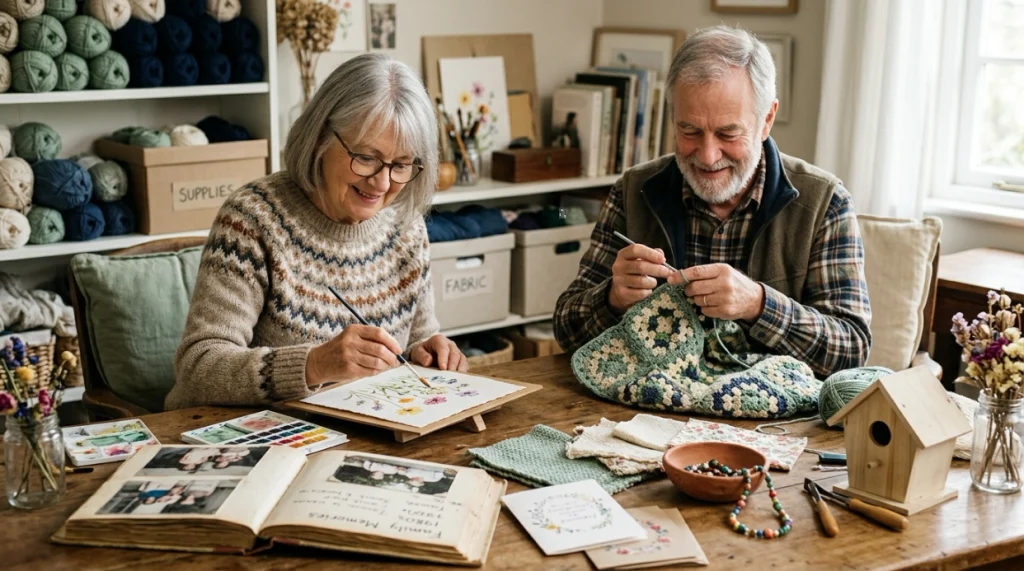
The best crafts for retired adults range from quiet tabletop activities to larger workshop projects. Here are 15 options that provide different combinations of creativity, usefulness, learning, and social interaction.
1. Watercolor painting
Watercolor is one of the easiest visual arts to try without a large investment. A basic paint set, brushes, watercolor paper, water container, and table are enough.
Flowers, landscapes, birds, simple buildings, and greeting-card designs make manageable beginner subjects.
2. Knitting
Knitting is portable and easy to divide into short sessions. Beginner projects include scarves, dishcloths, simple hats, and small blankets.
It can also become a social hobby through knitting circles, libraries, senior centers, or yarn shops.
3. Crochet
Crochet uses one hook instead of two needles, which some beginners find easier to manage. Small squares, coasters, scarves, and simple bags provide clear starting projects.
4. Handmade cards
Card making combines paper, stamps, colored pens, photographs, ribbon, and simple decorative pieces. The finished cards can be used for birthdays, holidays, thank-you notes, or family celebrations.
It also solves a common craft problem: you don’t have to find space to store every finished project.
5. Scrapbooking and memory books
Scrapbooking works especially well when you have photographs or family documents waiting in boxes. You can combine pictures with names, dates, captions, recipes, tickets, letters, and short memories.
A family-history book can become both a creative project and a keepsake for younger relatives.
6. Sewing
Sewing can be as simple as making a cushion cover or tote bag. Experienced sewists can move into clothing, home décor, repairs, or more detailed projects.
A machine is helpful but isn’t required for every project.
7. Quilting
Quilting combines fabric, color, pattern, measurement, and planning. A full bed quilt is ambitious, so beginners may prefer placemats, table runners, lap quilts, or quilted wall hangings.
Old clothing can also become part of a memory quilt.
8. Air-dry clay crafts
Air-dry clay lets you experiment with basic pottery-style projects without buying a kiln. Small bowls, ornaments, plant markers, decorative tiles, and figurines are accessible starting points.
9. Jewelry making
Beading can produce bracelets, necklaces, earrings, key chains, and gifts. Choose larger beads if tiny components are uncomfortable to see or handle.
10. Woodworking
Woodworking suits retirees who enjoy practical projects and problem-solving. Birdhouses, small boxes, shelves, picture frames, and simple planters are easier starting points than furniture.
Power tools require appropriate training, eye protection, a stable work area, and careful attention to safety.
11. Wood carving
Wood carving requires less workshop space than many woodworking projects. Simple relief designs or beginner carving blanks can help you learn tool control gradually.
12. Flower arranging
Flower arranging combines color, shape, texture, and seasonal materials. You can use garden flowers, inexpensive supermarket bouquets, dried flowers, or artificial stems.
13. Decoupage
Decoupage involves decorating objects with cut paper and an adhesive finish. Boxes, jars, trays, plant pots, picture frames, and small furniture pieces can all become projects.
14. Upcycling
Upcycling turns existing objects into something more useful or attractive. An old wooden box might become storage, while jars can become candle holders or small planters.
15. Model building
Model cars, ships, aircraft, miniature houses, and similar kits suit people who enjoy careful assembly. Choose larger-scale kits when tiny pieces or fine detail become frustrating.
Section Takeaway: The best craft isn’t the most impressive one. It’s the activity that fits comfortably into your life and makes you want to start the next project.
Which Crafts Are Easiest for Beginners?
The easiest crafts have few tools, forgiving techniques, and small projects you can finish quickly. Early success matters because a first project that takes three months can make a new hobby feel like work.
Start with one of these
- Card making: Create one card in 20 to 45 minutes.
- Collage: Use magazines, photographs, paper, scissors, and glue.
- Watercolor: Try a simple leaf, flower, or landscape study.
- Air-dry clay: Make a small dish or plant marker.
- Basic crochet: Practice one stitch before attempting a complete pattern.
- Decoupage: Decorate a small box, jar, or picture frame.
Avoid buying a professional supply collection on day one. A small beginner kit can tell you whether you enjoy the process before you spend more.
I also recommend choosing a first project that can survive mistakes. Slightly uneven stitches or an imperfect watercolor can still produce something you enjoy.
What Crafts Work With Limited Hand Strength or Mobility?
Many crafts can be adapted when gripping, reaching, sitting, vision, or hand dexterity becomes difficult. The goal is to change the tools or scale of the project rather than automatically giving up the activity.
The Arthritis Foundation’s needlework guidance suggests adaptations such as rubberized crochet hooks, larger handles, circular knitting needles, sharp ergonomic cutting tools, and smaller projects.
Make crafting more comfortable
- Use larger tools: Thick brushes, large crochet hooks, and wide pens may require less precise pinching.
- Choose bigger materials: Larger beads, thicker yarn, and larger model pieces are easier to manipulate.
- Raise the work surface: A comfortable table height can reduce leaning and reaching.
- Use task lighting: Direct light can make detailed work easier to see.
- Shorten sessions: Several 20-minute sessions may feel better than one long session.
- Reduce project weight: Small quilts and lightweight projects place less load on the hands and wrists.
Stop when an activity causes persistent pain, numbness, or unusual discomfort. A doctor or occupational therapist can suggest individual adaptations when a health condition affects crafting.
Health note: General craft adaptations aren’t a substitute for medical or occupational-therapy advice tailored to your condition.
Which Crafts Are Best for Social Connection?
Knitting, crochet, quilting, pottery, painting, woodworking, and community craft classes all work well when you want creativity plus regular contact with other people.
The CDC’s guidance for older adults specifically includes crafts such as knitting and woodworking, along with painting and ceramics, among activities people can enjoy with others.
Ways to make a craft social
- Join a weekly knitting or crochet circle.
- Take a pottery or painting class.
- Attend a community-center craft session.
- Invite a friend for a monthly project afternoon.
- Work on quilts or decorations for a charity.
- Teach a skill you already know to grandchildren or friends.
You don’t need to turn every hobby into a group activity. Some retirees prefer quiet crafting most days and one social session each week.
How Much Do Retirement Crafts Cost?
Many crafts can start cheaply, while others require equipment or workshop space. The ranges below are practical beginner estimates rather than fixed retail prices.
| Craft | Typical Starter Cost | Space Needed | Beginner Session | Social Potential |
|---|---|---|---|---|
| Watercolor | $15–$40 | Small table | 20–45 minutes | Medium |
| Knitting | $10–$30 | Very little | 20–30 minutes | High |
| Card making | $15–$35 | Small table | 30–60 minutes | Medium |
| Air-dry clay | $10–$30 | Small table | 30–60 minutes | Medium |
| Jewelry making | $20–$50 | Small table | 30–60 minutes | Medium |
| Basic woodworking | $50+ | Dedicated work area | 60+ minutes | Medium |
Use materials you already own when possible. Fabric scraps, old photographs, jars, boxes, magazines, leftover yarn, and unused picture frames can all become inexpensive craft supplies.
How Do You Choose the Right Craft?
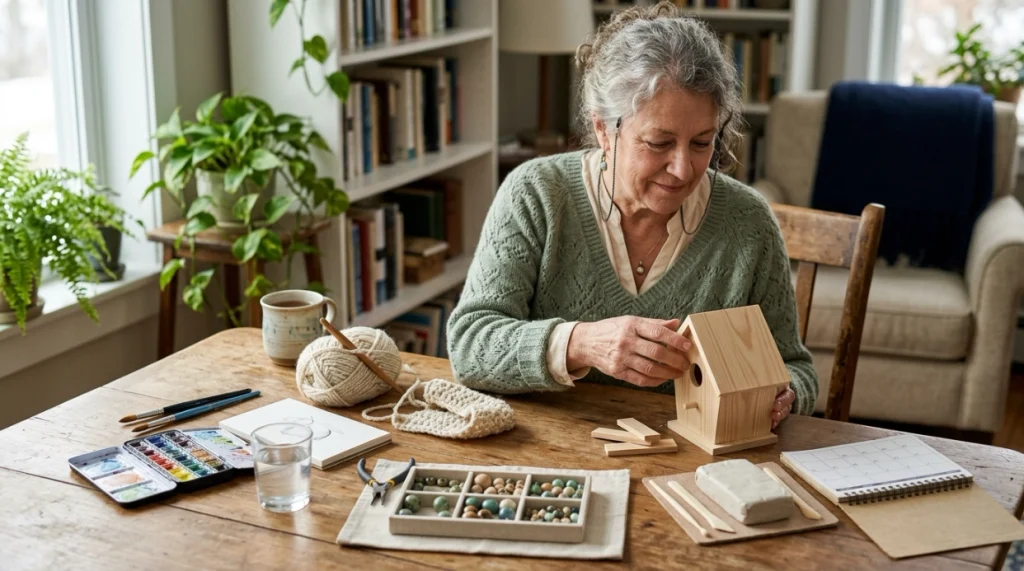
Choose a craft by deciding what you want the hobby to add to your retirement. Some people want quiet concentration, while others want company, practical projects, or a new skill to master.
Use this five-question test
- Do I enjoy making things with my hands? If yes, consider knitting, clay, woodworking, sewing, or jewelry.
- Do I want more social contact? Look for quilting groups, craft clubs, studio classes, or community workshops.
- How much space do I have? Apartment-friendly crafts include watercolor, crochet, cards, scrapbooks, and jewelry.
- What feels comfortable physically? Match the materials, tools, work height, and session length to your abilities.
- How much do I want to spend? Test inexpensive supplies before buying specialized equipment.
I prefer a two-week experiment rather than committing immediately. Pick one craft and complete two or three small sessions before deciding whether it belongs in your routine.
Don’t judge yourself by the first project
Your first scarf may have uneven edges. Your first clay bowl might lean slightly to one side.
That is normal learning, not failure. Improvement is one of the reasons a craft stays interesting.
Keep the hobby if you find yourself thinking about the next project. That is a better signal than whether the first result looks professional.
Frequently Asked Questions
What is the easiest craft for a retired beginner?
Card making, collage, watercolor, and air-dry clay are among the easiest starting points. They require relatively little equipment and allow you to complete a small project quickly without mastering complicated techniques first.
What crafts can retired adults do at home?
Good home crafts include knitting, crochet, watercolor painting, drawing, card making, scrapbooking, sewing, jewelry making, model building, and decoupage. Most need only a comfortable chair, good lighting, and a small table or storage area.
What are inexpensive crafts for retirees?
Drawing, collage, paper crafts, crochet, basic knitting, decoupage, and upcycling can all start on a modest budget. Reusing jars, boxes, fabric, photographs, magazines, and leftover materials can reduce costs even further.
What crafts are suitable for retired men?
Craft interests aren’t determined by gender. Woodworking, carving, model building, leatherwork, painting, pottery, photography-based crafts, metalwork, and restoration projects are popular possibilities, but the best choice is whatever the individual genuinely enjoys.
What crafts are good for retired couples?
Couples can try pottery classes, furniture restoration, seasonal decorations, woodworking, scrapbooking, painting, mosaics, or upcycling. Choose projects with separate tasks so both people can contribute without needing identical skills.
Can crafting be a social retirement hobby?
Yes. Knitting circles, quilting groups, community art classes, pottery studios, woodworking clubs, senior centers, and charity craft groups combine creative work with conversation and regular social contact.
How many crafts should I try after retirement?
Start with one or two rather than filling your schedule immediately. Try each activity several times, then keep the crafts you genuinely anticipate doing again and drop the ones that feel like another obligation.
Ready to Start Crafting?
The best crafts for retired adults aren’t defined by age. They are projects that match your interests, abilities, budget, space, and the kind of retirement you want to create.
Choose one small project this week. Buy only the basic supplies, give yourself permission to be a beginner, and see whether you look forward to doing it again.
A handmade card, slightly uneven scarf, painted flower, wooden birdhouse, or family scrapbook doesn’t need to be perfect. If you enjoyed making it, the craft has already done its job.