
High School Senior Letters Examples

Navigating life after high school requires strong communication skills. This guide provides concrete examples and templates for every essential letter a high school senior needs, from college recommendations to job inquiries. Learn the structure, tone, and key elements that make your correspondence professional and impactful. Avoid common pitfalls and use our samples to confidently reach your goals.
So, you’re a high school senior. The cap and gown are on the horizon, and the big question looms: What’s next? Whether you’re heading to college, starting a job, or taking a gap year, you’re about to enter a world where your ability to communicate in writing matters more than ever. One of the most powerful tools in your post-graduation toolkit is a well-crafted letter. But let’s be honest—knowing *how* to write a letter that actually works can feel overwhelming. That’s where this guide comes in. We’re diving deep into real, practical high school senior letters examples. Think of this as your personal blueprint for any situation. We’ll break down the anatomy of a winning letter, walk through step-by-step examples for the most common scenarios, and highlight the mistakes you absolutely must avoid. By the end, you won’t just have examples; you’ll have the confidence and know-how to write letters that open doors.
First, a quick note on terminology. When we say “senior letters,” we are talking about letters *from* a student in their final year of high school. This is distinct from the term “senior citizen,” which refers to older adults, typically over 65 (you can read more about what age is considered a senior citizen). Don’t let the shared word confuse you—your mission is to communicate as a young adult on the cusp of your future. Mastering this skill now will serve you for a lifetime, whether you’re writing a cover letter for an entry-level job or, years from now, a letter of inquiry for a senior director role. The fundamentals remain the same: clarity, respect, and purpose.
Key Takeaways
- Purpose Dictates Format: A scholarship letter differs from a job inquiry; always tailor your structure and content to the specific goal.
- Personalization is Non-Negotiable: Generic letters get ignored. Research the recipient and mention specific details to show genuine interest.
- Professional Tone & Format: Use a formal business letter format, proper salutations, and a respectful, confident tone throughout.
- Clarity and Conciseness Win: Get to the point quickly. Respect the reader’s time with clear paragraphs and a focused message.
- Proofreading is Part of the Process: Typos and grammatical errors signal carelessness. Always proofread yourself and have someone else review your letter.
- Follow-Up Shows Initiative: A polite follow-up email or call one to two weeks later can reinforce your interest and keep you top of mind.
📑 Table of Contents
- Why High School Senior Letters Matter More Than You Think
- Types of High School Senior Letters You’ll Need
- Essential Components of a Winning Letter
- High School Senior Letters Examples in Action
- Common Mistakes to Avoid at All Costs
- Final Tips for Letter Writing Success
- Conclusion: Your Letter is Your Voice
Why High School Senior Letters Matter More Than You Think
You might be thinking, “Can’t I just email or fill out a form?” In many cases, yes. But a deliberate, thoughtful letter cuts through the digital noise. It shows maturity, initiative, and a level of professionalism that many of your peers might lack. It’s a direct line to a decision-maker—a professor, a scholarship committee, a hiring manager—and your chance to make a memorable, positive impression that a resume or application alone cannot.
Building Real-World Skills That Last
Writing these letters is not just a task; it’s training. You’re practicing articulation, persuasion, and etiquette. These are the same skills needed for college essays, internship applications, and eventually, full-time job searches. The process of researching a recipient, tailoring your message, and editing for perfection builds a muscle for professional communication. When you practice asking a teacher for a college recommendation letter, you’re learning how to advocate for yourself respectfully. When you draft a job inquiry letter, you’re practicing how to sell your unique value proposition. This is practical, hands-on education that textbooks can’t provide.
Opening Doors to Unique Opportunities
Many opportunities aren’t advertised. A speculative letter—one you send to a company you admire, even without a posted opening—can create an opportunity where none existed. It demonstrates passion and drive. For scholarships, a compelling personal letter can be the deciding factor between two candidates with similar grades and test scores. It transforms you from a list of stats into a relatable, motivated person. A single, well-placed letter can lead to an internship, a mentorship, or a scholarship that changes your educational path. It’s a low-effort, high-potential action that far too few students take.
Types of High School Senior Letters You’ll Need
Not all letters are created equal. The “what” and “why” dictate the “how.” Here are the most common types you’ll encounter as a high school senior, each with its own conventions and goals.
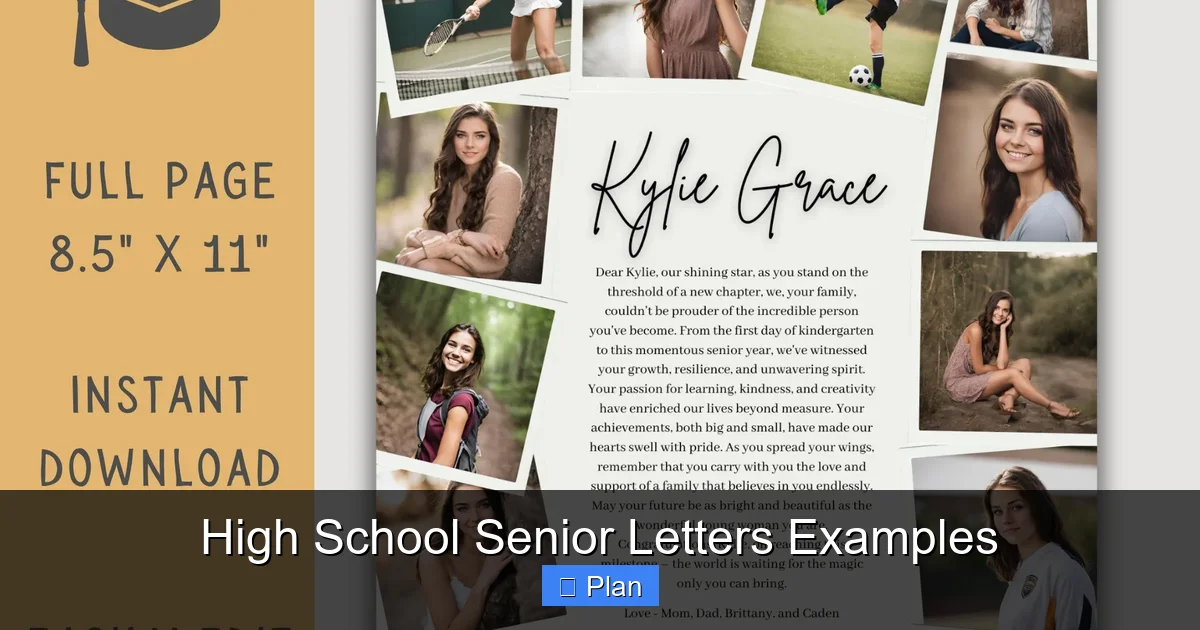
Visual guide about High School Senior Letters Examples
Image source: i.etsystatic.com
College Application Letters (Cover Letters & Supplementals)
While the Common App essay is famous, many colleges require or allow supplemental essays or letters of continued interest. These are your chance to speak directly to an admissions officer. The goal is to connect your specific interests to that specific school. Mention professors you’d like to study with, research labs you hope to join, or unique programs that excite you. Show you’ve done your homework. A generic “I’m so excited about your beautiful campus” will not resonate. Be specific, be enthusiastic, and tie it back to your own goals.
Scholarship Request & Application Letters
Scholarship committees review hundreds, sometimes thousands, of applications. Your letter is your elevator pitch. It must succinctly answer: Why do you deserve this money? How will you use it? How does it align with your past achievements and future goals? This is where you blend humility with confidence. Acknowledge the generosity of the scholarship, but also firmly state your qualifications. If the scholarship is for a specific field (e.g., engineering, arts), use jargon and examples that prove your passion and competence in that area.
Job Inquiry & Application Letters
Whether it’s a part-time job at the local library or a summer internship at a tech startup, a cover letter is often required. This letter must immediately show you understand the role and the company. Don’t just say “I need a job.” Say, “I am excited to apply for the Social Media Intern position because I have followed [Company Name]’s innovative campaigns for two years and have successfully grown my own photography Instagram to 5,000 followers.” Quantify your achievements when possible. If you’re targeting competitive fields, research typical roles. For instance, understanding the landscape of a senior software engineer salary can help you frame your value if applying for a tech role, even as an intern. It shows you’re thinking about career paths.
Thank You Notes (Post-Interview, Post-Meeting)
This is non-negotiable. After any interview, meeting with a teacher about recommendations, or a scholarship interview, send a personalized thank-you email within 24 hours. It’s a simple, professional courtesy that reinforces your interest and gratitude. Mention one specific thing you discussed or enjoyed about the conversation. “Thank you for your time today. I particularly enjoyed learning about the team’s project on renewable energy, and it solidified my desire to contribute to your sustainability initiatives.” This small act significantly boosts your likability.
Apology and Explanation Letters
Sometimes, you need to own a mistake. Maybe you missed a deadline, performed poorly on an assignment, or need to withdraw an application. A sincere apology letter can repair relationships and demonstrate integrity. The formula is: acknowledge the specific mistake, take full responsibility (no excuses), explain how you will prevent it from happening again, and state your desire to make amends if possible. Keep it brief, humble, and forward-looking. This shows you are accountable and mature.
Essential Components of a Winning Letter
Every effective letter, regardless of type, shares a core skeleton. Master this structure, and you can adapt it to any situation.

Visual guide about High School Senior Letters Examples
Image source: i.pinimg.com
The Perfect Opening: Salutation and First Sentence
Always attempt to find a specific name. “Dear Hiring Manager” is a last resort. Use LinkedIn, call the company’s main line, or ask a network contact. “Dear Ms. Chen” or “Dear Dr. Rodriguez” is infinitely better. Your first sentence should state your purpose immediately and compellingly. Avoid weak openings like “I am writing to apply for…” Instead, try: “With a passion for molecular biology and hands-on lab experience from my AP course, I am thrilled to apply for the Summer Research Internship at the Genomic Institute.” This version starts with your value and enthusiasm.
Body Paragraphs That Shine: The “Show, Don’t Just Tell” Rule
The body is where you make your case. Use the STAR method (Situation, Task, Action, Result) as a guide for providing evidence. Don’t write “I am a hard worker.” Write: “As captain of the debate team, I was tasked with reversing our two-year losing streak (Situation/Task). I initiated daily practice sessions, created a new research database, and mentored two freshmen (Action). This led to our first tournament win and a 50% increase in team membership (Result).” This is concrete, credible, and memorable. Each paragraph should have one main point supported by a specific example.
Closing with Confidence: The Call to Action
Your closing paragraph should reiterate your enthusiasm and, most importantly, state what you want to happen next. This is your call to action (CTA). Be polite but clear. “I am confident that my skills in data analysis and my dedication to community service align perfectly with the requirements of the Youth Program Coordinator role. I have attached my resume for your review and welcome the opportunity to discuss my application in an interview at your convenience.” Then, use a formal closing: “Sincerely,” “Respectfully,” or “Best regards,” followed by your full name, contact information, and any relevant links (e.g., portfolio, LinkedIn).
High School Senior Letters Examples in Action
Theory is great, but examples are where the learning happens. Below are five common letters a high school senior needs, complete with full templates and breakdowns of why they work.

Visual guide about High School Senior Letters Examples
Image source: wordtemplatesonline.net
Example 1: College Recommendation Request Letter (to a Teacher)
This letter is not for the college itself, but for the teacher you are asking to write your recommendation. Its purpose is to make their job easy and to give them rich material to write about.
Subject: Recommendation Request – [Your Name] – [Class Name]
Dear Mr. Davies,
I hope you are having a good week. I am writing to respectfully ask if you would be willing to write a strong letter of recommendation for my college applications. I am applying to several universities with a focus on environmental science, and I can think of no better person to speak to my passion and work ethic in the sciences than you.
Your AP Environmental Science class fundamentally shaped my academic interests. I particularly enjoyed our unit on water conservation, which inspired my semester-long independent project on local watershed health. I’ve attached a summary of that project, along with my resume and a list of my target colleges and their deadlines, to provide helpful context.
I understand you are incredibly busy, so please let me know by next Friday if you feel you can write me a supportive letter. I am, of course, happy to provide any additional information you might need.
Thank you for your consideration and for an inspiring year in your class.
Sincerely,
[Your Name]
[Your Contact Info]
Why This Works: It’s specific, appreciative, and considerate of the teacher’s time. It provides all necessary materials upfront (resume, project summary, deadline list). The student takes responsibility for making the process easy, which a busy teacher greatly appreciates. It also reminds the teacher of a specific positive interaction (the watershed project), jogging their memory for anecdotes.
Example 2: Scholarship Application Cover Letter
This accompanies a scholarship application form and essay. Its job is to frame your entire package.
[Your Name]
[Your Address]
[Date]
[Scholarship Committee Name]
[Scholarship Organization Name]
[Organization Address]
Dear [Scholarship Committee Name or Specific Contact if known] Members,
I am writing with great enthusiasm to apply for the [Scholarship Name], as advertised on [Website Name]. This scholarship’s focus on supporting students committed to community stewardship resonates deeply with my own experiences and future goals in urban planning.
For the past three years, I have volunteered with [Local Organization], where I helped redesign their community garden layout to increase accessibility for seniors. This project taught me practical skills in spatial design and the profound impact thoughtful infrastructure can have on quality of life. My academic record in mathematics and drafting courses supports my ability to succeed in a rigorous urban planning program.
Receiving this scholarship would allow me to reduce my work hours at [Your Job] and dedicate more time to my studies and a capstone project on sustainable housing. I am confident that my proven commitment to community-focused design makes me a strong candidate to represent the values of the [Scholarship Name].
Thank you for your time and consideration. I have attached my application form, transcripts, and essay for your review and look forward to the possibility of contributing to your organization’s mission.
Sincerely,
[Your Name]
Why This Works: It connects the student’s past action (garden project) directly to their future goals (urban planning) and the scholarship’s mission. It mentions a tangible need (reducing work hours) to show financial impact. The tone is professional yet passionate, and it clearly directs the reader to the attached materials.
Example 3: Job Inquiry Letter for an Internship (No Posting)
This is a speculative letter sent to a company you admire, even if they haven’t posted an internship. It’s about creating an opportunity.
Dear Ms. Patel,
As a senior at [Your High School] with a dedicated interest in digital marketing, I have long admired [Company Name]’s creative campaigns, particularly the recent “Reimagine Retail” series. While I do not see a formal internship posting on your careers page, I am writing to express my proactive interest in contributing to your marketing team this summer in any capacity.
I have built practical experience through managing the social media accounts for our school’s drama club, where I increased follower engagement by 40% and designed promotional graphics using Adobe Creative Suite. My coursework in marketing principles and statistics has given me a foundation in campaign analysis.
I am a quick learner, highly organized, and eager to support your team’s ambitious goals. I have attached my resume for your consideration and would welcome a brief conversation to discuss how I might be of value to [Company Name].
Thank you for your time and for the inspiring work your team does.
Sincerely,
[Your Name]
[Phone] | [Email] | [Link to Portfolio/LinkedIn]
Why This Works: It shows initiative and genuine fandom (“long admired”). It provides concrete, quantifiable achievements (40% increase). It directly addresses the lack of a posting and turns it into a strength (proactive interest). The closing is a soft call to action for a “brief conversation,” which is a low-commitment ask for the recipient. If you’re interested in the corporate structure of such companies, researching roles like a senior director can give you insight into the types of teams and projects you might support, even as an intern.
Example 4: Post-Interview Thank You Note
This is an email, not a formal letter, but the principles are identical. Speed and specificity are key.
Subject: Thank You – [Your Name] – [Position Title] Interview
Dear [Interviewer Name],
Thank you so much for your time today discussing the Marketing Coordinator Intern position. I truly enjoyed learning more about the team’s collaborative approach and the upcoming launch of the Eco-Friendly Product Line.
Our conversation about the importance of authentic storytelling in sustainability marketing solidified my excitement about the possibility of joining [Company Name]. My experience creating content for our school’s environmental club has taught me how to translate complex topics into engaging narratives, and I am eager to apply that skill to your campaigns.
I am very enthusiastic about the opportunity and remain confident that my skills in social media content creation and analytics would be a strong asset to your team this summer. Please let me know if I can provide any additional information.
Best regards,
[Your Name]
Why This Works: It’s sent within 24 hours. It references a specific topic from the interview (“Eco-Friendly Product Line”), proving active listening. It reiterates a key qualification (storytelling) and connects it to the company’s work. It’s warm, professional, and reinforces interest without being desperate.
Example 5: Apology Letter for a Missed Deadline
Suppose you missed a scholarship application deadline due to a family emergency. This letter accompanies a late submission (if allowed) or is a standalone explanation.
Dear [Scholarship Committee or Contact Person],
I am writing to sincerely apologize for my failure to submit my application for the [Scholarship Name] by the March 15th deadline. This was entirely my error due to a miscommunication on my part regarding the date, and I take full responsibility for this oversight.
I have attached my completed application materials for your review, should you still be able to accept late submissions. I understand this is a significant breach of the stated guidelines and that you are under no obligation to consider my application. However, my commitment to [University/Field of Study] and alignment with your scholarship’s mission remain unwavering.
I deeply regret the inconvenience this has caused and appreciate your understanding. Thank you for your time.
Sincerely,
[Your Name]
Why This Works: It’s direct and owns the mistake without making excuses (“miscommunication” is still taking responsibility). It acknowledges the committee’s authority (“under no obligation”). It attaches the materials, showing the intent was still there. It’s humble and professional, which can sometimes salvage a situation. Never blame a teacher, parent, or technology.
Common Mistakes to Avoid at All Costs
Even with great examples, it’s easy to trip up. Here are the critical errors that will get your letter tossed aside.
Being Too Vague or Generic
“I am a hard worker and a team player.” Every applicant says this. What does it *mean*? Use the STAR method from earlier to replace clichés with stories. “As the team manager for the robotics club, I coordinated a team of 10 students and resolved a major software conflict two days before our regional competition, ensuring we could compete.” That shows you’re a leader and a problem-solver.
Forgetting the Proofreading Step
A single “their” vs. “there” error can undermine your entire message. It suggests you are careless or rushed. Read your letter aloud—your ear will catch errors your eyes miss. Use a spellcheck, but don’t rely on it. Then, have a parent, teacher, or friend review it. A fresh set of eyes is invaluable. This is especially crucial for scholarship applications, where committees are looking for any reason to narrow the pile.
Using an Inappropriate Tone
Strike the balance between formal and friendly. Avoid slang (“Hey,” “What’s up,” “My bad”) and overly stiff, archaic language (“To Whom It May Concern,” “I beseech you”). “Dear [Name]” and “Sincerely” are safe bets. Be confident, not arrogant. “I am the best candidate” is arrogant. “I believe my skills in X and Y make me a strong candidate” is confident. If you’re writing about a field like healthcare, understanding the professional landscape can help. For example, knowing what medical insurance for senior citizens covers might be relevant if you’re applying for a health-related internship, showing broader industry awareness.
Final Tips for Letter Writing Success
With the structure and examples in hand, here’s how to integrate this into your senior year workflow.
Start Early and Batch Them
Don’t wait until the week a scholarship is due. Brainstorm and draft your core letters (general college interest, job inquiry) over the summer. Then, in the fall, customize them for each specific opportunity. This prevents burnout and ensures quality. Create a simple spreadsheet to track deadlines, recipients, and follow-up dates.
Seek Feedback from the Right People
Don’t just ask, “Is this good?” Ask specific questions: “Does my opening sentence grab you?” “Is my main point clear?” “Does the tone sound professional?” Ask an English teacher for grammar and style, a counselor for content and strategy, and a mentor in your target field for industry relevance. Their combined perspective is powerful.
Keep a Template Library
As you write, save successful drafts as templates. You’ll have a “Job Inquiry Template,” a “Scholarship Template,” a “Thank You Template.” When a new opportunity arises, you’re not starting from a blank page. You’re 80% done and just need to customize the details. This saves immense time and reduces stress. Just remember: never copy-paste without thorough customization for each recipient.
Conclusion: Your Letter is Your Voice
The high school senior letters examples in this guide are more than just samples—they are a framework for your emerging adult voice. In a world of automated applications and quick clicks, a deliberate, personal letter is a signal of your character, your work ethic, and your genuine interest. It tells people you are not just another applicant; you are a thoughtful, prepared, and motivated individual ready to contribute. Whether you are asking for a chance, thanking someone for their time, or explaining a misstep, your words carry weight. Use them wisely. Start now. Draft a letter for one opportunity this week. Use the templates, follow the structure, and send it with confidence. That one letter could be the first step toward your college acceptance, your dream internship, or a scholarship that makes your education possible. Now, go write the next chapter of your story—one powerful letter at a time.
Frequently Asked Questions
How long should a high school senior letter be?
Aim for one page, typically 300-500 words. Be concise and respect the reader’s time. For emails like thank-you notes, 150-200 words is sufficient. Every sentence should serve a purpose—if it doesn’t, cut it.
What’s the best way to address a letter if I don’t know the recipient’s name?
>First, try to find the name. Search the organization’s website, LinkedIn, or call and ask the receptionist. If you absolutely cannot find a specific name, use a relevant title like “Hiring Manager for the Marketing Department” or “Scholarship Committee.” Avoid “To Whom It May Concern” if at all possible, as it feels impersonal.
Should I use a formal or informal tone?
Always default to formal. Use proper grammar, complete sentences, and professional salutations/closings. You can be warm and enthusiastic within that formal framework. For example, “I am thrilled to apply” is professional and shows excitement. “I’m so pumped to apply” is too informal. When in doubt, err on the side of formality.
When is the best time to send these letters?
For applications, send them as soon as you have a strong draft, but always before the deadline. For job inquiries, send them early in the week (Tuesday-Thursday morning) when inboxes are less cluttered than Monday. For thank-you notes, send them within 24 hours of the interview or meeting.
How do I follow up after sending a letter?
Wait 7-10 business days. Send a brief, polite email to the same address. Subject: “Following Up: [Your Name] – [Position/Opportunity].” In the body, state you are following up on your [date] letter, reiterate your strong interest, and offer to provide any additional information. Keep it to 3-4 sentences. Do not call unless the posting specifically requests it.
Can I use the same letter for multiple applications?
Never send the exact same letter. Use a strong template, but you must customize it for each recipient. Change the company/school name, the recipient’s name, and 2-3 sentences to reflect why you are interested in that specific place. Generic letters are easily spotted and dismissed. Personalization shows effort and genuine interest.