
Best Bed Rails for Seniors: 5 Safe Options for 2026


Portable Wheelchair

Automatic Can Opener

Quad Cane for Seniors
Getting in and out of bed can become harder with age. A good bed rail can provide a firm place to hold while sitting up, standing, or changing position.
But the right choice depends on the person and the bed. Some rails are mainly transfer aids, while others also provide a longer barrier against rolling out of bed. Mattress thickness, bed type, rail position, and installation all matter.
We compared current options for stability, ease of use, adjustability, senior-friendly design, and safety. Here are five worth considering.
Best Overall: Stander EZ Adjust Bed Rail
The Stander EZ Adjust is a strong all-around choice for seniors who need both a handhold and some nighttime protection.
Its rail adjusts between 26, 34, and 42 inches. It can also fold down when the user needs easier access to the bed. The frame attaches to the bed with a safety strap, and the rail supports up to 300 pounds. It fits traditional beds with mattresses 12 to 16 inches thick.
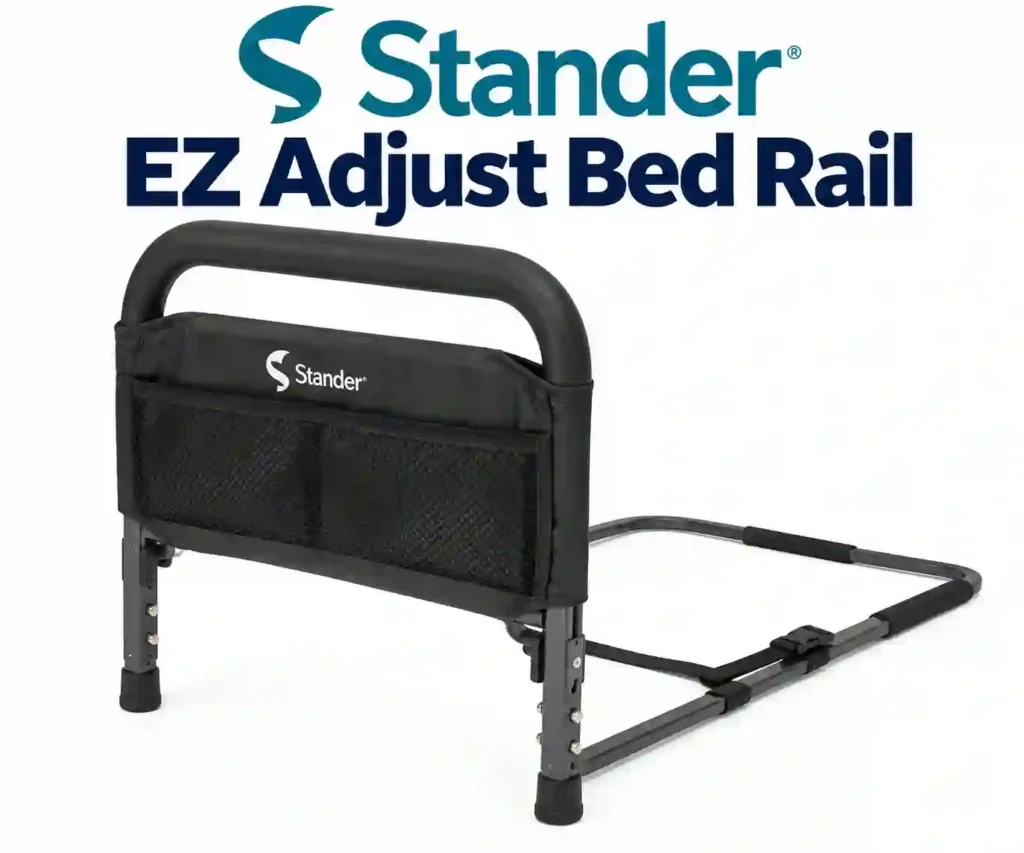
The adjustable length is useful because different users need different amounts of support. A shorter setting can make transfers easier, while a longer setting provides more rail coverage.
One limitation is important. Stander says this model is not intended for adjustable beds or extra-soft mattresses. That makes checking the bed before buying essential.
Product Overview
The EZ Adjust is made for traditional beds and attaches to the bed frame with its safety strap. It weighs 14 pounds and has a 300-pound weight capacity. Its height is 22 inches.
| Specification | Details | Why It Matters |
|---|---|---|
| Rail width | 26–42 inches | Lets you choose the amount of coverage |
| Weight capacity | 300 lb | Supports many adult users |
| Mattress height | 12–16 inches | Check before ordering |
| Mounting | Bed-frame safety strap | Helps keep the rail in position |
| Bed type | Traditional beds | Not for adjustable beds |
Pros And Cons
The biggest strength is versatility, but the bed must meet the manufacturer’s fit requirements.
| Feature | Pro | Con |
|---|---|---|
| Adjustable length | More flexible coverage | More moving parts |
| Folding design | Easier bed access | Must be used correctly |
| 300-lb capacity | Suitable for many users | Not a bariatric rail |
| Safety strap | Helps secure the rail | Proper installation is essential |
| Bed compatibility | Works with many traditional beds | Not for adjustable beds |
Who Should Consider This Product
This rail suits an alert senior who needs a sturdy handhold and additional protection from rolling out of a traditional bed.
It may not be the best choice for someone using an adjustable bed or an extra-soft mattress. A person with significant confusion or uncontrolled movement also needs professional guidance before using a portable bed rail.
Best For: Most alert seniors using traditional beds
Not Ideal For: Adjustable beds or users who may be at high risk of entrapment
Best For Longer Coverage: Stander Wonder Pivot Bed Rail Tall
The Stander Wonder Pivot Tall is a good choice when a senior needs more nighttime rail coverage but still wants a handle for getting out of bed.
The rail extends to 38.5 inches and pivots down 180 degrees. It supports up to 300 pounds and fits traditional beds with mattresses 8 to 16 inches thick. Stander also states that this model passed the ASTM F3186-17 safety standard.
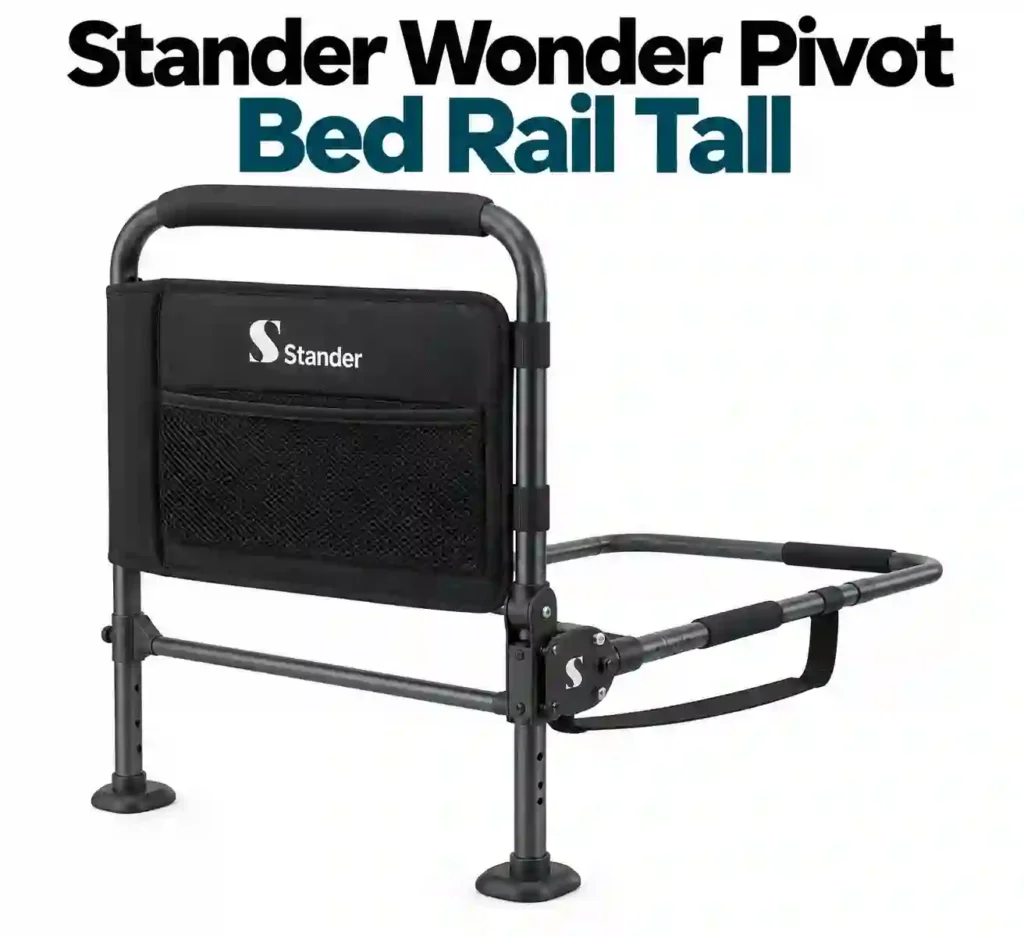
The taller design is especially useful for thicker mattresses. The rail stands 22 inches above the mattress base, giving it a different fit from the standard Wonder Pivot.
The trade-off is that it is heavier than the Able Life option and still cannot be used with an adjustable base bed.
Product Overview
This model combines a longer railing with a pivoting design. The rail can be moved out of the way when it is not needed.
| Specification | Details | Why It Matters |
|---|---|---|
| Rail length | 26–38.5 inches | Gives more nighttime coverage |
| Weight capacity | 300 lb | Suitable for many adult users |
| Mattress height | 8–16 inches | Works with a broad range of traditional mattresses |
| Rail height | 22 inches | Useful with thicker mattresses |
| Bed type | Traditional beds | Not for adjustable bases |
Pros And Cons
Its longer rail is useful, but it takes up more space beside the bed.
| Feature | Pro | Con |
|---|---|---|
| Long rail | More coverage | Takes up more bedside space |
| Pivoting design | Folds away for access | Requires correct operation |
| Mattress range | Fits 8–16-inch mattresses | Still requires careful measurement |
| Safety strap | Attaches to bed frame | Installation must be secure |
| 300-lb capacity | Good general capacity | Not designed for higher weights |
Who Should Consider This Product
Consider it if nighttime rolling is a concern and the senior uses a traditional bed with a mattress in the supported range.
It is less suitable for adjustable beds or rooms where the longer rail could interfere with nearby furniture.
Best For: Seniors who want longer nighttime rail coverage
Not Ideal For: Adjustable beds or very tight bedside spaces
Best Adjustable Option: Able Life Bedside Extend-A-Rail
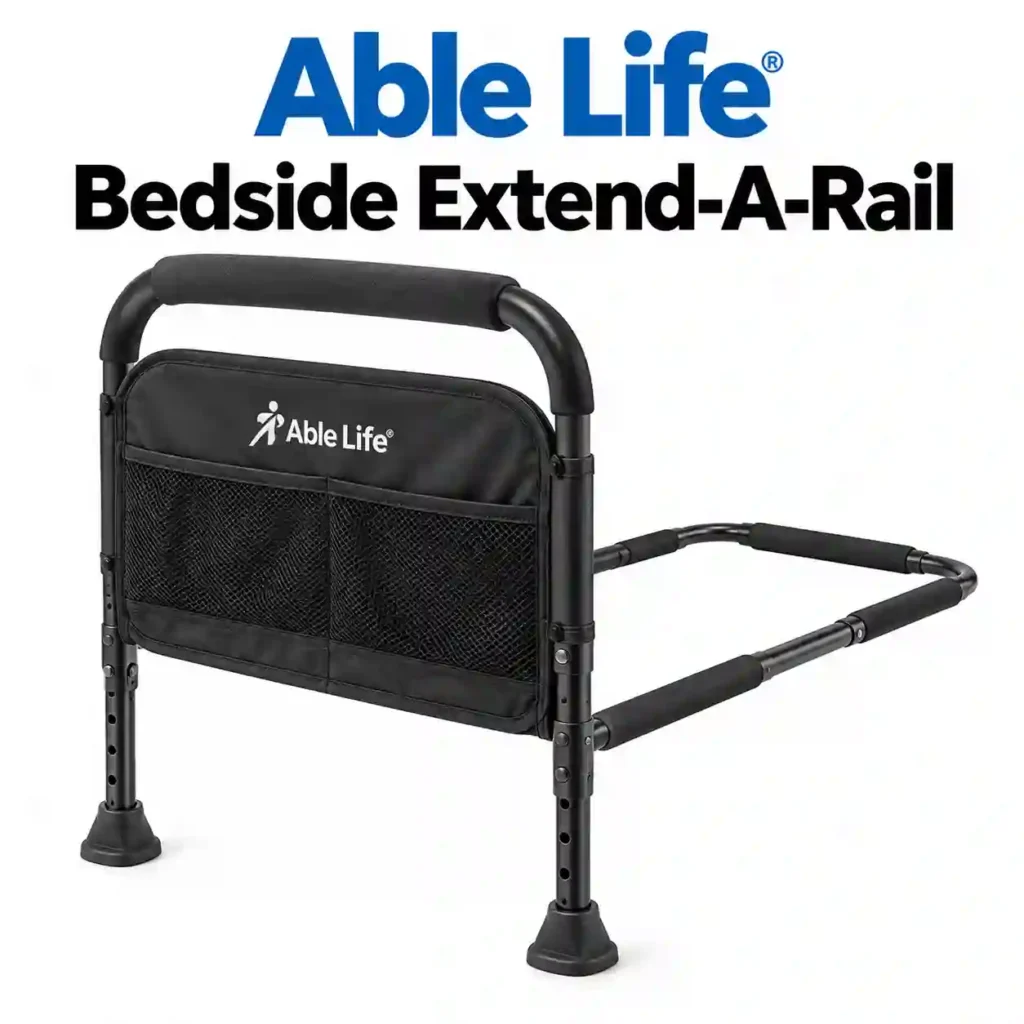
The Able Life Bedside Extend-A-Rail stands out because its length can change after installation.
With a push of a button, the rail extends from 20 to 30 inches. In the shorter position, it works more like a transfer handle. Extended, it provides more coverage at night. The rail supports up to 300 pounds and is designed for mattresses 8 to 15 inches thick.

At only about 8 pounds, it is also lighter than the two Stander rails above. That can make handling and installation easier for a caregiver.
The main limitation is bed compatibility. Able Life says it is intended for traditional beds and should not be used on adjustable or hospital beds.
Product Overview
The Extend-A-Rail is a useful middle ground between a short assist handle and a longer safety rail.
| Specification | Details | Why It Matters |
|---|---|---|
| Rail length | 20–30 inches | Changes between transfer and nighttime use |
| Weight | 8 lb | Easier for caregivers to handle |
| Weight capacity | 300 lb | Suitable for many adult users |
| Mattress height | 8–15 inches | Measure the mattress first |
| Installation | Safety strap | Helps anchor the rail |
Pros And Cons
Its low weight and adjustable length are the main reasons to consider it.
| Feature | Pro | Con |
|---|---|---|
| Adjustable length | Flexible use | Less coverage than very long rails |
| Lightweight | Easy to handle | May feel less substantial |
| Transfer support | Useful for getting up | Not a substitute for clinical mobility support |
| 300-lb capacity | Good general capacity | Not for bariatric use |
| Traditional-bed fit | Broad compatibility | Not for adjustable beds |
Who Should Consider This Product
This is a good option for an older adult who wants one device for getting out of bed and nighttime support.
It is especially appealing when a caregiver wants a lighter rail that can be adjusted without removing it.
Best For: Seniors who want adjustable coverage in a lightweight design
Not Ideal For: Adjustable or hospital beds
Best For Multiple Grip Positions: Drive Medical M-Rail
The Drive Medical M-Rail is slightly different from the other picks. It is primarily a bed assist handle rather than a long protective side rail.

That distinction matters. Its M-shaped design provides several hand positions for sitting up, repositioning, standing, and transferring. It supports up to 300 pounds and uses a safety strap around the mattress or box spring.
For a senior whose main problem is getting up from bed, this can make more sense than buying a longer rail that provides coverage they may not need.
It should not be treated as a full barrier against falling out of bed. The manufacturer’s instructions describe it as an assistive balance handrail rather than something intended to support a person’s full body weight.
Product Overview
The M-Rail uses multiple crossbars and a padded grip, giving users several places to hold.
| Specification | Details | Why It Matters |
|---|---|---|
| Design | M-shaped handle | Offers multiple grip positions |
| Weight capacity | 300 lb | General adult capacity |
| Product weight | About 9 lb | Relatively easy to handle |
| Material | Powder-coated steel | Durable and easy to clean |
| Bed fit | Single through king | Useful for many standard beds |
Pros And Cons
The biggest benefit is its focus on transfers rather than a large barrier.
| Feature | Pro | Con |
|---|---|---|
| M-shaped design | Multiple hand positions | Not a long fall barrier |
| Multiple crossbars | Easy grip at different heights | More structure to clean |
| Safety strap | Helps secure the handle | Correct setup is important |
| Pouch | Keeps small items nearby | Adds little safety value |
| 300-lb capacity | Good general capacity | Not for supporting full body weight |
Who Should Consider This Product
Choose it when the main challenge is sitting up, standing, or transferring from the bed.
If the main concern is rolling out of bed during sleep, look at a longer rail designed for that purpose instead.
Best For: Seniors who mainly need help getting up and transferring
Not Ideal For: People who need a long side barrier
Best Lightweight Rail: Able Life Bedside Safety Handle
The Able Life Bedside Safety Handle is another compact option for seniors who want a firm bedside grip without a large rail.
It weighs 8 pounds and supports up to 300 pounds. Its height adjusts from 13 to 20 inches from the bottom of the mattress, and it is designed for mattresses 6 to 14 inches thick.
Its compact design makes it easier to use in smaller bedrooms. It can also help with transfers to a walker, rollator, wheelchair, or bedside commode.
Like the other traditional-bed options, it is not intended for adjustable beds.
Product Overview
This model focuses on balance and transfer support while taking up less space than a longer rail.
| Specification | Details | Why It Matters |
|---|---|---|
| Weight | 8 lb | Easy for caregivers to handle |
| Height | 13–20 inches | Lets you adjust the handle |
| Weight capacity | 300 lb | General adult capacity |
| Mattress height | 6–14 inches | Works with many standard mattresses |
| Rail length | 17 inches | Compact bedside support |
Pros And Cons
Its compact size is useful, but it does not provide the same coverage as a longer rail.
| Feature | Pro | Con |
|---|---|---|
| Compact design | Saves bedside space | Less nighttime coverage |
| Adjustable height | Better fit for different beds | Requires proper setup |
| Lightweight | Easy to move | Less substantial than long rails |
| Storage pouch | Keeps small items close | Not essential to safety |
| 300-lb capacity | Suitable for many users | Not a bariatric model |
Who Should Consider This Product
This is a practical choice for seniors who primarily need a stable handhold near the side of the bed.
It may not be the right option when extensive nighttime fall protection is the main goal.
Best For: Compact bedside support and transfers
Not Ideal For: Seniors who need extensive side-rail coverage
Comparison At A Glance
The five choices serve slightly different needs. The best option depends more on the senior’s mobility and bed setup than on the number of features.
| Product | Best For | Key Trade-Off |
|---|---|---|
| Stander EZ Adjust | Overall versatility | Not for adjustable beds |
| Stander Wonder Pivot Tall | Longer nighttime coverage | Larger and heavier |
| Able Life Extend-A-Rail | Adjustable coverage | Traditional beds only |
| Drive Medical M-Rail | Multiple grip positions | Mainly an assist handle |
| Able Life Safety Handle | Compact support | Shorter rail coverage |
How We Chose These Products
We focused on the factors that matter most when a bed rail is used by an older adult. These include fit, stability, ease of use, senior-friendly design, weight capacity, bed compatibility, and safety information.
We also checked manufacturer specifications and current safety guidance. The Consumer Product Safety Commission now has a mandatory standard for adult portable bed rails manufactured after August 21, 2023. The rule covers retention, structural integrity, entrapment, openings, labeling, and related safety requirements.
| Evaluation Factor | Why It Matters |
|---|---|
| Bed compatibility | A rail must fit the actual bed |
| Mattress fit | Thickness affects rail position and gaps |
| Stability | Important during transfers |
| Ease of use | Seniors should be able to grip and operate it |
| Safety | Entrapment hazards must be considered |
| Value | Useful features should match the user’s needs |
We did not rank products simply by popularity. We gave more weight to practical fit and the type of support each product provides.
What To Look For When Buying
Start with the bed, not the product listing. Measure the mattress thickness and identify whether the bed is a standard, platform, slatted, adjustable, or hospital-style bed.
A rail that works well on a traditional bed may not be appropriate for an adjustable base. Manufacturer instructions should always take priority.
Measure The Mattress
Mattress thickness is one of the easiest details to overlook. A rail designed for an 8-to-12-inch mattress may not provide the intended fit on a much thicker mattress.
Check The Bed Frame
Some rails attach to the bed frame with a safety strap. Others use different mounting systems. Make sure the mounting method is compatible with your bed.
Decide Between A Rail And An Assist Handle
Ask what the senior actually needs.
If the problem is getting from lying to sitting or standing, a compact assist handle may be enough. If nighttime rolling is the main concern, a longer rail may be more appropriate.
Check The Weight Capacity
Never assume that every rail can support the same amount of weight. Check the manufacturer’s stated limit and follow the installation instructions.
Look At The Gaps
A rail should not create a dangerous gap between the mattress and rail. The CPSC specifically identifies entrapment zones around portable bed rails as a safety concern.
Common Buying Mistakes
A cheap rail is not necessarily a good value if it does not fit the bed or creates a safety problem.
| Mistake | Better Approach |
|---|---|
| Buying without measuring | Measure mattress thickness first |
| Assuming every rail fits adjustable beds | Check manufacturer compatibility |
| Choosing only by price | Compare fit, design, and safety |
| Treating an assist handle as a full barrier | Match the product to the actual need |
| Ignoring installation | Follow the complete installation instructions |
Safety Considerations
Bed rails can help with mobility, but they also carry real risks. The CPSC reports that adult portable bed rails can cause falls, entrapment, and serious injury or death. Its guidance recommends checking for recalls, following installation instructions, securing retention devices, and preventing hazardous gaps.
The agency also established mandatory safety requirements for adult portable bed rails manufactured after August 21, 2023. These requirements address structural integrity, retention systems, and several types of entrapment zones.
Do not assume a bed rail is appropriate for every senior. Someone with dementia, confusion, uncontrolled movement, or other conditions that affect safe movement may face a greater entrapment risk. In these situations, ask a healthcare professional or qualified mobility specialist before using a rail.
Also check the rail regularly. Make sure the strap remains secure, the rail has not shifted, and the mattress still fits as intended.
Frequently Asked Questions
Here are some of the most common questions to consider before choosing a bed rail for an older adult.
Are bed rails safe for seniors?
They can be useful when properly selected and installed, but they are not risk-free. Entrapment and falls are important safety concerns, so the rail must fit the bed and be used according to its instructions.
What is the best bed rail for most seniors?
The Stander EZ Adjust is a strong overall choice for an alert senior using a traditional bed because it combines adjustable length, transfer support, and a 300-pound capacity. It is not intended for adjustable beds.
Should I use a bed rail on an adjustable bed?
Not unless the specific rail is designed and approved by its manufacturer for that bed type. Several of the leading traditional-bed models in this guide specifically exclude adjustable beds.
Is a bed rail the same as a bed assist handle?
No. A bed assist handle mainly provides a handhold for sitting up, standing, and transfers. A longer bed rail may also provide some protection against rolling out of bed. The two products should not be treated as interchangeable.
Conclusion
For most alert seniors using a traditional bed, the Stander EZ Adjust Bed Rail is the strongest overall choice because it combines adjustable coverage with transfer support. The Stander Wonder Pivot Tall is better when longer nighttime coverage is the priority.
For a lighter and more flexible option, the Able Life Bedside Extend-A-Rail is worth considering. If getting up from bed is the main challenge, the Drive Medical M-Rail or Able Life Bedside Safety Handle may make more sense than a longer rail.
The most important step is to match the product to the senior, the mattress, and the bed frame. A properly fitted assist handle can sometimes be a better choice than a larger rail, and anyone at higher risk of entrapment should get professional advice before using a portable bed rail.