
Best Arthritis Medicine for Elderly: 5 Options


Weighted Blanket

Book Holder Stand

Page Magnifier Sheet
Arthritis pain can make walking, climbing stairs, opening jars, or getting dressed harder. For older adults, choosing a pain medicine also means thinking about other medicines, kidney or liver problems, stomach health, and heart risks.
There is no single best arthritis medicine for every senior. This guide focuses mainly on medicines used for osteoarthritis pain and compares five common options. Rheumatoid arthritis is different and may require prescription medicines that slow the disease itself.
Best Overall: Voltaren Arthritis Pain Gel
Topical diclofenac is a strong option for arthritis pain in a small number of accessible joints, especially the hands and knees.

Voltaren Arthritis Pain Gel contains diclofenac sodium 1%, a topical NSAID. Unlike an oral pain reliever, it is applied directly to the painful area. The American Academy of Orthopaedic Surgeons strongly recommends topical NSAIDs for knee osteoarthritis when they are not contraindicated.
The topical approach can be useful for older adults who want to avoid taking another pill. However, topical diclofenac is still an NSAID, so it is not risk-free. Seniors with certain kidney, heart, or other medical problems should ask a clinician or pharmacist before using it.
Product Specifications
The important details are the active ingredient, where it can be applied, and how it fits into a senior’s medication routine.
| Specification | Details | Why It Matters |
|---|---|---|
| Active ingredient | Diclofenac sodium 1% | Provides topical NSAID pain relief |
| Form | Topical gel | No pill is needed |
| Common uses | Arthritis pain in hands, wrists, elbows, feet, ankles, and knees | Useful for accessible joints |
| Application | Up to 4 times daily according to product directions | Requires a regular routine |
Pros And Cons
The main advantage is targeted topical treatment, but it still has NSAID-related precautions.
| Feature | Pro | Con |
|---|---|---|
| Topical use | Applied directly to painful joints | Can be inconvenient to apply repeatedly |
| NSAID action | Helps with arthritis pain and inflammation | NSAID warnings still apply |
| No swallowing | Helpful for people who dislike pills | Requires correct application |
| Joint coverage | Useful for several hand and lower-limb joints | Not every joint is an appropriate target |
Who Should Consider This Product
This option makes the most sense for an older adult with osteoarthritis affecting one or a few accessible joints, particularly the knee or hand.
Best For: Seniors seeking topical treatment for localized osteoarthritis pain.
Not Ideal For: People with contraindications to NSAIDs or those who need treatment for a condition that has not been properly diagnosed.
Best For Pill-Free Relief: Capzasin HP
Capsaicin cream is worth considering when an older adult wants a topical option without using an NSAID.
Capzasin HP Arthritis Pain Relief contains capsaicin 0.1%. Its label lists temporary relief of minor muscle and joint pain associated with arthritis.

Capsaicin works differently from diclofenac. It can cause a burning or warming feeling at first, which some people find unpleasant. It should not be placed on broken or irritated skin, and users should avoid contact with the eyes.
Product Specifications
These details are especially important because correct application matters with capsaicin.
| Specification | Details | Why It Matters |
|---|---|---|
| Active ingredient | Capsaicin 0.1% | Provides topical analgesic action |
| Form | Cream | Applied directly to the painful area |
| Uses | Minor muscle and joint pain associated with arthritis | Suitable for localized discomfort |
| Main precaution | External use only | Care is needed during application |
Pros And Cons
Capsaicin can be useful, but the initial skin sensation may make it unsuitable for some seniors.
| Feature | Pro | Con |
|---|---|---|
| Topical treatment | Avoids an oral medicine | Requires repeated application |
| Non-NSAID | Different option from NSAID medicines | Does not provide the same anti-inflammatory action |
| Local use | Can target a painful area | Burning may occur |
| OTC availability | Easy to find in many markets | Skin sensitivity can be an issue |
Who Should Consider This Product
Capsaicin may suit someone with localized arthritis pain who prefers a topical treatment and can tolerate the application sensation.
Best For: Seniors looking for a non-NSAID topical pain-relief option.
Not Ideal For: People with damaged skin or those who strongly dislike warming or burning sensations.
Best When NSAIDs Are Not Suitable: TYLENOL 8 HR Arthritis Pain
Acetaminophen can be an option for mild arthritis pain when an NSAID is not appropriate, but it should not automatically be considered the strongest arthritis treatment.

TYLENOL 8 HR Arthritis Pain contains 650 mg of extended-release acetaminophen per caplet. The manufacturer lists temporary relief of minor arthritis pain.
The FDA warns that taking too much acetaminophen can cause severe liver damage. It is also important to check other medicines because many prescription and OTC products contain acetaminophen.
Current evidence does not make acetaminophen a first-line medicine for osteoarthritis in every patient. Its main appeal is that it does not carry the same NSAID stomach and kidney concerns.
Product Specifications
The extended-release design can be convenient for people who prefer fewer doses during the day.
| Specification | Details | Why It Matters |
|---|---|---|
| Active ingredient | Acetaminophen 650 mg | Pain reliever and fever reducer |
| Form | Extended-release caplet | Designed for longer-lasting relief |
| Intended use | Minor arthritis pain | Appropriate for symptom relief |
| Label directions | 2 caplets every 8 hours | Follow the current package directions |
Pros And Cons
The biggest advantage is avoiding an NSAID, while the main concern is the risk of acetaminophen overdose.
| Feature | Pro | Con |
|---|---|---|
| No NSAID | Avoids NSAID-related stomach risks | Does not provide the same anti-inflammatory effect |
| Extended release | Convenient dosing | Caplets must be swallowed whole |
| Arthritis indication | Specifically marketed for minor arthritis pain | May not provide enough relief for severe pain |
| OTC option | Easy to obtain | Liver safety must be considered |
Who Should Consider This Product
This may be reasonable for an older adult with mild arthritis pain who cannot use an NSAID, provided acetaminophen is appropriate for that person.
Best For: Seniors who need an oral non-NSAID pain reliever.
Not Ideal For: People with liver disease or those already taking several acetaminophen-containing medicines without professional guidance.
Best Long-Lasting Oral NSAID: Aleve
Naproxen can provide longer-lasting relief than some other OTC pain relievers, but it deserves extra caution in older adults.
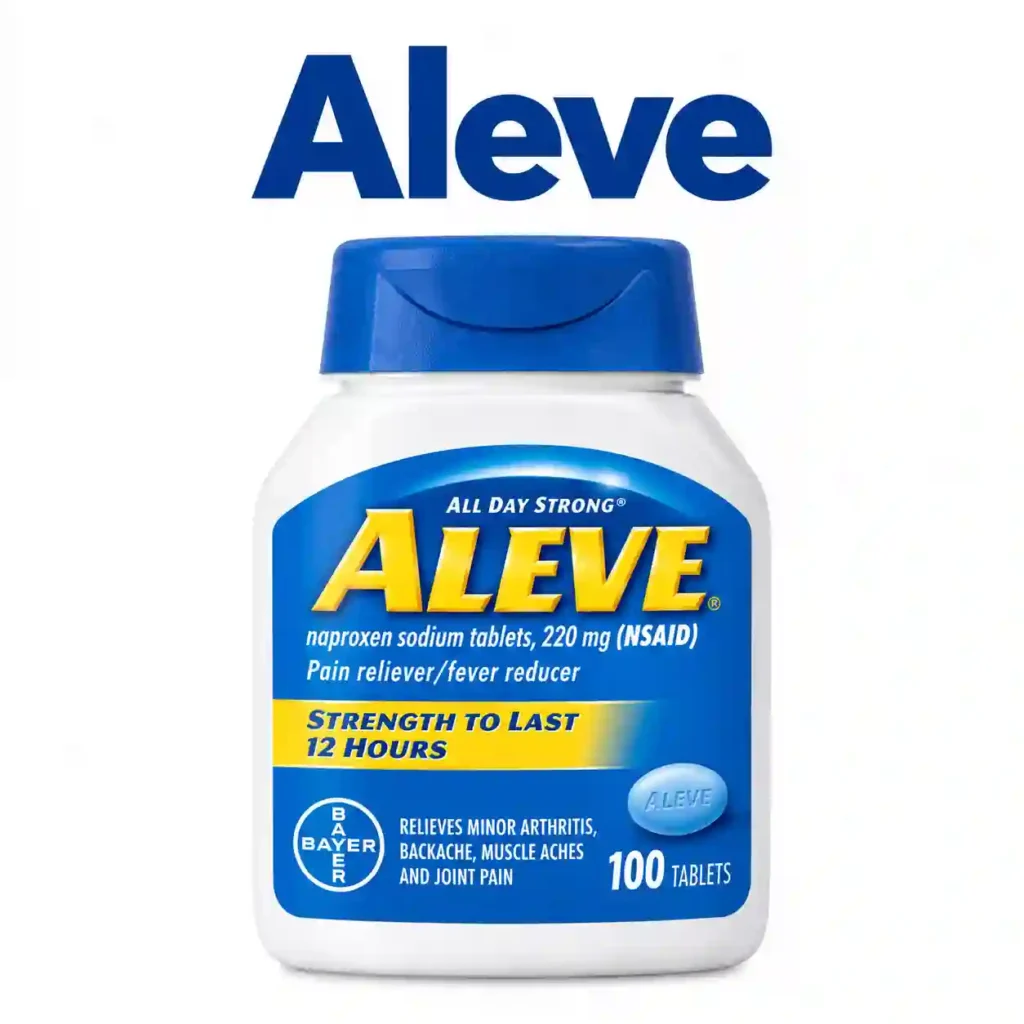
Aleve contains 220 mg of naproxen sodium per caplet. Its labeling warns that NSAIDs can cause serious stomach bleeding, with higher risk in older adults and people with certain risk factors.
Naproxen may be useful for some people with inflammatory arthritis pain, but seniors should not assume that an OTC NSAID is automatically safe simply because it is sold without a prescription.
Product Specifications
The long duration can be convenient, but safety should come before convenience.
| Specification | Details | Why It Matters |
|---|---|---|
| Active ingredient | Naproxen sodium 220 mg | Oral NSAID |
| Form | Caplet/tablet | Easy to take |
| Duration | Marketed for extended pain relief | May require fewer doses |
| Main concern | NSAID-related risks | Important for older adults |
Pros And Cons
Naproxen has useful pain-relieving properties, but its risk profile makes it a poor choice for unsupervised long-term use in many seniors.
| Feature | Pro | Con |
|---|---|---|
| NSAID action | Helps reduce pain and inflammation | Can cause serious stomach bleeding |
| Duration | Longer-lasting relief | Longer exposure can matter for some users |
| Oral form | Simple to take | Adds another systemic medicine |
| Availability | Widely available OTC | Not appropriate for everyone |
Who Should Consider This Product
Naproxen should be considered only after checking the individual’s health history and other medicines.
Best For: Adults who have been advised that an oral NSAID is appropriate for them.
Not Ideal For: Seniors with significant NSAID risk factors, especially without professional guidance.
Best Short-Term Oral NSAID: Advil
Ibuprofen is another common NSAID used for minor arthritis pain. Its shorter dosing interval can make it useful for occasional pain, but it also brings important NSAID warnings.

Advil tablets contain 200 mg of ibuprofen and are labeled for temporary relief of minor arthritis pain. The product warning specifically identifies adults age 60 and older as having a higher risk of serious stomach bleeding.
For that reason, ibuprofen should not be treated as a routine self-care medicine for every older adult.
Product Specifications
The key issue is not simply how well ibuprofen works. It is whether the person’s health history makes an NSAID reasonable.
| Specification | Details | Why It Matters |
|---|---|---|
| Active ingredient | Ibuprofen 200 mg | Oral NSAID |
| Form | Tablet/caplet | Simple oral use |
| Intended use | Temporary minor arthritis pain | Best suited to short-term symptom relief |
| Label dosing | Follow current package directions | Avoid exceeding the labeled amount |
Pros And Cons
Ibuprofen can work well for some people, but age-related risks deserve serious attention.
| Feature | Pro | Con |
|---|---|---|
| NSAID action | Reduces pain and inflammation | Can cause stomach bleeding |
| Availability | Widely available | Not suitable for everyone |
| Short-term use | Useful for occasional pain | Long or excessive use increases concern |
| Familiar product | Easy to identify | Can interact with other medicines |
Who Should Consider This Product
An older adult should first check with a healthcare professional or pharmacist if there are other medical conditions or regular medicines involved.
Best For: Seniors who have been cleared to use ibuprofen for occasional arthritis pain.
Not Ideal For: People with significant NSAID-related risks or those who need frequent long-term pain control without medical supervision.
Comparison At A Glance
The best choice depends more on the person’s health and type of arthritis than on the brand name.
| Product | Best For | Key Trade-Off |
|---|---|---|
| Voltaren Arthritis Pain Gel | Localized osteoarthritis pain | Topical NSAID risks remain |
| Capzasin HP | Non-NSAID topical relief | Can cause burning |
| TYLENOL 8 HR Arthritis Pain | Non-NSAID oral pain relief | Liver safety matters |
| Aleve | Longer-lasting oral NSAID relief | Higher concern for some seniors |
| Advil | Occasional oral NSAID relief | NSAID stomach and other risks |
How We Chose These Products
The comparison focuses on evidence, current labeling, senior usability, and important safety trade-offs rather than popularity alone.
The research considered current product labeling, government health information, clinical guidance, evidence on osteoarthritis treatment, and the specific risks that can matter more in older adults.
| Evaluation Factor | Why It Matters |
|---|---|
| Effectiveness | The medicine should have evidence or an appropriate indication for arthritis pain |
| Ease Of Use | Older adults may benefit from simple dosing and application |
| Safety | Other medicines and medical conditions can change the best choice |
| Senior Relevance | Age can affect medication risks and treatment decisions |
| Value | Cost and convenience matter for long-term symptom management |
| Product Information | Current labeling helps avoid outdated recommendations |
What To Look For When Buying
Do not choose an arthritis medicine only because it has many reviews or a familiar brand name.
Check The Active Ingredient
The active ingredient tells you more than the front of the package. Avoid accidentally combining medicines with the same ingredient.
This is especially important with acetaminophen because it appears in many prescription and OTC medicines. The FDA recommends checking labels carefully and avoiding excessive combined doses.
Think About Topical Versus Oral Medicine
A topical medicine may make sense when only one or two accessible joints hurt. An oral medicine affects the whole body and may be more convenient for widespread pain.
For knee osteoarthritis, topical NSAIDs have strong guideline support when they are appropriate for the individual.
Review Other Medicines
Blood thinners, steroids, blood-pressure medicines, and other pain relievers can affect which arthritis medicine is appropriate.
Ask a pharmacist to review the complete medication list before starting a new OTC pain medicine.
Check Kidney, Liver, Heart, And Stomach Health
Older adults are more likely to have chronic conditions that change medication safety.
NSAIDs can cause serious stomach bleeding and can contribute to kidney problems in susceptible people. Acetaminophen has a different safety concern because excessive amounts can severely damage the liver.
Common Buying Mistakes
A few simple mistakes can turn a reasonable pain-relief choice into a safety problem.
| Mistake | Better Approach |
|---|---|
| Choosing by brand name | Compare active ingredients |
| Taking several pain medicines together | Check for duplicate ingredients |
| Assuming OTC means risk-free | Review warnings and health conditions |
| Using an NSAID for months without review | Ask a healthcare professional about long-term use |
| Ignoring the type of arthritis | Get the condition properly assessed |
Safety Considerations
Safety matters even more when an older adult takes several prescription medicines or has multiple health conditions.
NSAIDs such as ibuprofen and naproxen can increase the risk of stomach bleeding and other serious problems. The risk of stomach bleeding is higher in people age 60 and older and in people taking certain other medicines.
Acetaminophen has a different major concern. Taking more than directed or combining several acetaminophen-containing products can cause severe liver damage. The FDA lists 4,000 mg as the maximum total amount for adults and children 12 and older, but individual product labels may set a lower limit. Always follow the product label and professional advice.
Do not assume that treating pain is the same as treating arthritis. Osteoarthritis medicines mainly manage symptoms. Rheumatoid arthritis is an autoimmune disease that may require disease-modifying antirheumatic drugs to slow joint damage.
Seek medical advice for new, severe, rapidly worsening, or unexplained joint pain, especially when there is major swelling, warmth, fever, injury, or loss of normal joint function.
Frequently Asked Questions
What is the best arthritis medicine for elderly people?
There is no single best medicine for every older adult. For localized osteoarthritis pain, topical NSAIDs such as diclofenac can be a useful option when they are not contraindicated. Other choices depend on the person’s health, other medicines, and type of arthritis.
Is Voltaren better than Tylenol for arthritis?
They work differently. Voltaren contains topical diclofenac, an NSAID, while Tylenol contains acetaminophen. For localized osteoarthritis pain, topical NSAIDs have stronger guideline support, but they are not suitable for everyone.
Is ibuprofen safe for seniors?
Not automatically. Ibuprofen is an NSAID, and its label warns that adults age 60 and older have a higher risk of serious stomach bleeding. A pharmacist or healthcare professional should review individual risk factors before regular use.
Conclusion
For many seniors with localized osteoarthritis pain, Voltaren Arthritis Pain Gel is the strongest overall OTC option to consider when topical NSAIDs are appropriate. Capzasin HP is a useful non-NSAID topical alternative, while TYLENOL 8 HR Arthritis Pain may be considered when an oral non-NSAID option is more appropriate.
Aleve and Advil can help with arthritis pain, but they deserve more caution in older adults because they are oral NSAIDs. The right choice depends on medical history, other medicines, the number of painful joints, and the type of arthritis.
The safest approach is not simply to find the strongest medicine. It is to find the option that provides useful pain relief without creating a bigger health risk. For regular or worsening arthritis pain, a doctor or pharmacist can help match treatment to the individual’s needs.