
Jackson County Senior Property Tax Credit Program


Weekly Pill Organizer

Jar Opener for Weak Hands

Smart Health Watch for Seniors
The Jackson County Senior Property Tax Credit Program provides direct property tax relief for qualifying older homeowners. It offers a credit against your county property tax bill, potentially saving hundreds annually. Eligibility is based on age, income, and ownership, with a specific application process and deadline each year.
Let’s have a real talk about something that weighs on many of us as we get older: property taxes. That bill shows up every year, and for folks on a fixed income, it can feel like a giant, immovable obstacle. What if I told you there’s a specific program in Jackson County designed to help? The Jackson County Senior Property Tax Credit Program is a powerful tool for eligible homeowners to lower their county property tax burden. It’s not a handout; it’s a credit for those who’ve paid into the system for decades. This guide will walk you through everything you need to know, from figuring out if you qualify to successfully filing your application. Think of it as your friendly, detailed roadmap to keeping more of your hard-earned money.
Key Takeaways
- It’s a direct tax credit, not a deferral: The program reduces the amount of county property tax you owe; it doesn’t postpone payment like some other programs.
- Strict eligibility requirements apply: You must meet age, income, and primary residency/ownership tests to qualify.
- Annual application is mandatory: You must reapply every year, even if your situation hasn’t changed, by the county’s deadline.
- Income limits are set at the state level: Your total household income must fall below the Missouri state-adjusted gross income limit for your household size.
- The credit is applied directly to your tax bill: If approved, the credit amount is subtracted from your total Jackson County property tax liability.
- Documentation is key to a successful application: Missing or incorrect paperwork is the most common reason for denial or delay.
- It supports aging in place: By lowering housing costs, this credit helps seniors remain in their long-term homes and communities.
📑 Table of Contents
- What Exactly Is the Jackson County Senior Property Tax Credit?
- Who Qualifies? Breaking Down the Eligibility Criteria
- The Tangible Benefits: How Much Can You Save?
- Your Step-by-Step Application Guide
- Common Pitfalls and How to Avoid Them
- Real-Life Impact: Who Benefits Most?
- Conclusion: Taking Action for Your Financial Future
What Exactly Is the Jackson County Senior Property Tax Credit?
First, let’s clear up any confusion. This isn’t a property tax exemption or a deferral program. It’s a credit. What’s the difference? An exemption reduces the assessed value of your home. A deferral lets you postpone paying the tax, often with interest. A credit, like this one, is a dollar-for-dollar reduction of the tax you owe after your bill is calculated. So, if your final Jackson County property tax bill is $1,200 and you qualify for a $400 credit, you only pay $800. It’s straightforward and impactful.
The Program’s Core Purpose
The program was established by the Jackson County Legislature to provide targeted relief to senior citizens facing rising property values and taxes. The philosophy is simple: long-term homeowners, particularly seniors on fixed incomes, shouldn’t be forced to sell their homes solely because of unaffordable property taxes. By offering this credit, the county aims to promote housing stability and allow seniors to age in place. It’s a recognition of your contribution to the community and a safeguard against being taxed out of your home.
How It Differs from the Missouri Senior Tax Credit
Missouri also has a statewide Senior Property Tax Credit (often called the “circuit breaker” credit), which you claim on your state income tax return. It’s crucial not to mix these up. You can often qualify for and receive both credits if you meet each program’s separate criteria. The state credit is based on rent or property taxes paid and has its own income limits. The Jackson County Senior Property Tax Credit Program is specific to county taxes and is administered directly by the county’s collection department. Always check both, as stacking them can lead to significant savings.
Who Qualifies? Breaking Down the Eligibility Criteria
This is the most critical part. Your eligibility hinges on three main pillars: age, income, and ownership/residency. You must satisfy all of them to be considered. Let’s break each one down simply.

Visual guide about Jackson County Senior Property Tax Credit Program
Image source: media.anderscpa.com
The Age Requirement
You must be 62 years of age or older by January 1st of the tax year for which you’re applying. For example, for the 2024 tax year (paid in 2025), you needed to be 62 by January 1, 2024. This is a firm cutoff. There are no early-bird applications based on turning 62 later in the year.
The Income Test
This is often the trickiest hurdle. Your eligibility is based on your total household income. The county uses the Missouri state-adjusted gross income limits, which are updated annually. For 2024, the maximum income for a household of one person is $37,800, and for a household of two, it’s $47,100. These figures can change, so you must verify the current year’s limits on the Jackson County website or by calling their office. Total household income includes all sources: Social Security, pensions, IRA withdrawals, interest, dividends, wages, etc. It’s your Missouri state income tax return’s adjusted gross income (AGI) figure, not just your Social Security.
Ownership and Primary Residency Rules
You must own and occupy the home as your primary residence. The property must be a single-family home, condominium, or townhouse located in Jackson County, Missouri. You cannot claim this credit for a rental property, a second home, or a vacant lot. You must have lived in the home for the entire calendar year for which you’re applying. If you moved into the home on July 1, 2023, you would not qualify for the 2023 credit, only for 2024 onward, assuming you meet all other criteria.
The Tangible Benefits: How Much Can You Save?
Okay, so you think you qualify. What does that actually mean for your wallet? The credit amount is not a flat sum. It’s calculated based on a formula that considers your income and the amount of county property taxes you paid.

Visual guide about Jackson County Senior Property Tax Credit Program
Image source: img1.wsimg.com
Understanding the Credit Calculation
The maximum possible credit is capped at a certain dollar amount (this cap is also set by state law and can change). For the 2023 tax year, the maximum credit was $1,100. However, not everyone gets the max. The formula essentially provides a sliding scale: the lower your income relative to the income limit, the higher the percentage of your paid taxes that can be credited, up to that maximum. If your income is at or below 50% of the state limit, you’re eligible for the full credit amount (up to the max). As your income increases toward the limit, the credit amount phases down. The county will do this math for you when you apply, but you can use their online estimator tool for a rough idea.
What the Credit Can Be Used For
This is the beautiful part. Because it’s a direct reduction on your tax bill, the savings are immediate and tangible. That extra $300-$1,100 (depending on your qualification) stays in your pocket. For a senior on a tight budget, that could mean:
- Covering a necessary home repair without taking on debt.
- Paying for a crucial prescription or medical co-pay.
- Keeping up with utility bills during a hot summer or cold winter.
- Simply having a little more breathing room in your monthly budget for groceries or other essentials.
It’s a direct injection of financial relief that supports your overall well-being and ability to stay at home. For more general strategies on lowering housing costs, you might explore resources on reduced property taxes for seniors.
Your Step-by-Step Application Guide
Applying can seem daunting, but it’s a manageable process if you’re organized. The key is to start early and have all your documents ready. The deadline is firm—typically around April 15th for the prior tax year—and missing it means you lose the credit for that year.
Visual guide about Jackson County Senior Property Tax Credit Program
Image source: data.templateroller.com
Gathering Your Documentation (The Most Important Step)
Before you even touch the form, collect these items:
- Proof of Age: A copy of your driver’s license or birth certificate.
- Proof of Ownership & Primary Residence: A copy of your deed or mortgage statement. Your Jackson County property tax bill or receipt also works.
- Proof of Income: Your most recent federal and Missouri state income tax returns (Form 1040 and MO-1040). If you don’t file taxes, you’ll need documentation for all income sources: Social Security award letter, 1099s for pensions/IRAs, bank statements showing interest, etc.
- Proof of Payment: A copy of your paid Jackson County property tax bill for the year you’re applying. You must have paid the bill in full to receive the credit; it’s not an advance payment.
Filling Out the Application Form
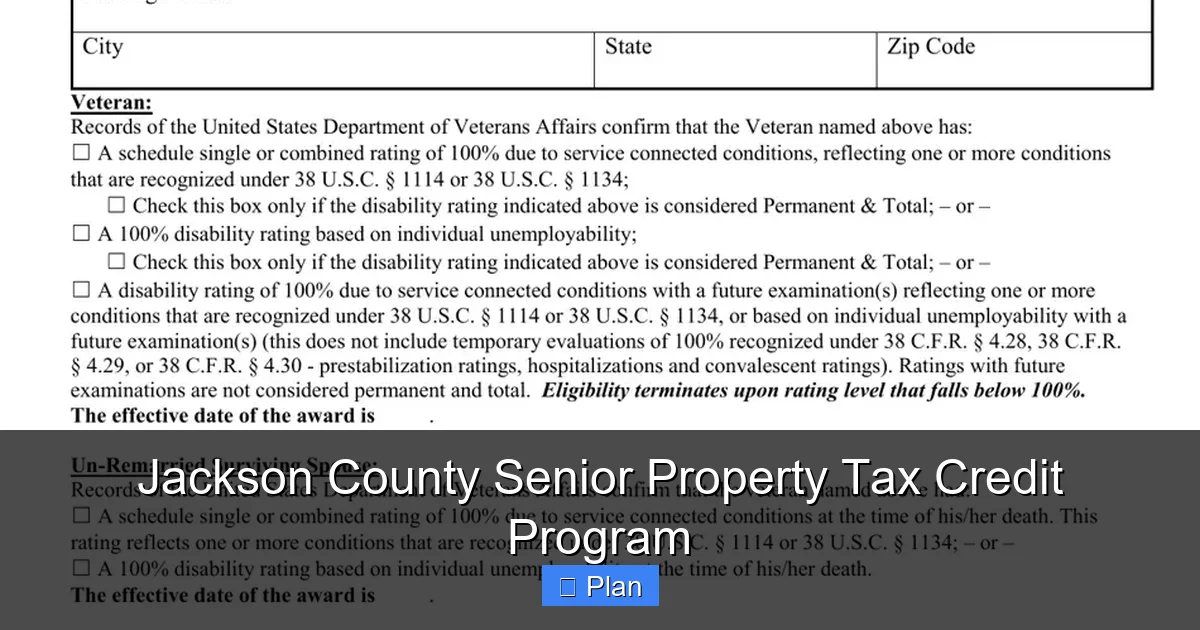
The form is called the “Application for Senior Citizen Property Tax Credit” and is available on the Jackson County official website (search under the Collector’s or Assessor’s office). It asks for basic personal information, property details (address, parcel number from your tax bill), and household income details. Be meticulous. Double-check that the name on the application matches your deed and tax bill exactly. Any discrepancies can cause a delay or denial.
Submission and What to Expect
You can typically submit by mail or in person at the Jackson County Collection Department. **Do not email** with sensitive documents unless specifically instructed. Send it via certified mail or deliver it in person to get a receipt. Once submitted, the county will review your application and documentation. This can take several weeks to a few months. If approved, you’ll receive a notification, and the credit will be applied to your tax account. If denied, you’ll receive a reason and information on how to appeal the decision. Keep copies of everything you send.
Common Pitfalls and How to Avoid Them
Even qualified applicants get tripped up. Here are the most frequent mistakes and how to sidestep them.
Missing the Deadline
This is the #1 reason for losing the credit. The deadline is non-negotiable. Mark it on your calendar in big red letters. Set a reminder for yourself to start gathering documents in January for an April deadline. Treat it with the same importance as your tax filing deadline.
Incomplete Income Documentation
Saying “I only get Social Security” isn’t enough. You must provide the official award letter from the Social Security Administration. If you have any other income—even a small amount from a part-time job, dividends, or a pension—you need the 1099 or statement for it. The county verifies every line of income against your tax return or provided documents.
Confusing Primary Residence Status
If you own a home in Jackson County but spend winters in Florida or summers with family, you must still prove the Jackson County home is your legal primary residence. This means your driver’s license, voter registration, and vehicle registration should all list that Jackson County address. If they list another address, the county may deem the home not your primary residence, disqualifying you.
Sending the Wrong Tax Bill Year
You are applying for a credit on the previous year’s paid taxes. If it’s spring 2024, you’re applying for the 2023 tax year. You must send a copy of your paid 2023 tax bill/receipt. Sending your 2024 bill (which isn’t due yet) is a common error that leads to immediate denial.
Real-Life Impact: Who Benefits Most?
Let’s put a face to this program. Imagine a retired couple, both 68, living in their home of 30 years in Kansas City. Their combined income from Social Security and a small pension is $45,000—just under the two-person limit. Their home’s value has increased over the decades, and their annual Jackson County property tax bill is now $1,800. Without the credit, that’s a significant chunk of their fixed monthly budget.
They apply correctly and receive a credit of $950. Their effective tax bill drops to $850. That $950 is money they can use for home maintenance, like fixing their aging roof, which in turn preserves their home’s value. It means they can afford their medications without skipping doses. It provides profound peace of mind. This program is designed precisely for such homeowners—people who built their community, raised families there, and want to live out their years with dignity and financial security in the place they call home. It’s about more than a number on a bill; it’s about preserving a way of life.
Conclusion: Taking Action for Your Financial Future
The Jackson County Senior Property Tax Credit Program is a valuable, yet often underutilized, benefit. It requires a bit of paperwork and diligence, but the potential reward—saving up to a thousand dollars or more every single year—is well worth the effort. Don’t assume you won’t qualify. The income limits are more generous than many people think. The most important step is to check your eligibility by reviewing the current criteria on the county website or calling their office directly.
If you meet the age requirement, gather your tax documents and take 30 minutes to fill out the application. Treat it as an essential part of your annual financial planning, just like reviewing your Medicare coverage or budget. This credit is your money, a return on your years of investment in your home and community. By securing this relief, you strengthen your financial footing, reduce stress, and make it that much more likely that you can continue enjoying the home you love for years to come. Start the process today—your future self will thank you.
Frequently Asked Questions
What is the exact age requirement for the Jackson County Senior Property Tax Credit?
You must be 62 years of age or older on January 1st of the tax year for which you are applying. For example, for the 2024 tax credit, you needed to be 62 by January 1, 2024.
Does rental income from a portion of my home affect my eligibility?
Yes. All household income is counted, including any rental income you report on your federal tax return. This income is part of your total adjusted gross income used to determine if you fall below the state-set income limit.
Can I receive this credit if I live in a senior living apartment or community?
No. The program is specifically for homeowners who own and occupy a single-family home, condo, or townhouse as their primary residence. Renters, even in senior-specific housing, are not eligible for this particular property tax credit.
How much money can I actually save with this credit?
The maximum credit amount changes periodically but is typically over $1,000. Your actual credit is calculated based on your income relative to the limit and your paid property taxes. You could receive anywhere from a few hundred dollars up to the maximum, which directly subtracts from your tax bill.
What happens if my application is denied?
The county will send a written explanation of the denial. Common reasons are missing documents, exceeding the income limit, or failing the primary residency test. You have the right to appeal the decision. The denial notice will include instructions on how to request a hearing or submit additional information for reconsideration.
Do I need to apply every year, even if nothing has changed?
Yes, absolutely. There is no “once approved, always approved” status. You must submit a new application with current documentation every year by the deadline to receive the credit for that tax year. Your eligibility must be re-verified annually.