
What Hobbies Can Help Seniors Meet People?


Weekly Pill Organizer

Bedside Commode Chair

Back Massager with Heat
Quick Answer
The best hobbies for seniors who want to meet people are walking groups, book clubs, volunteering, card and board games, gardening clubs, art classes, dancing, choirs, and lifelong-learning classes. These activities create repeated, low-pressure contact around a shared interest, which matches National Institute on Aging guidance on staying connected.
Good hobbies for making social connections
- Walking groups: Conversation develops naturally while everyone moves at a comfortable pace.
- Book clubs: The book provides an easy topic, so you never need to invent conversation from scratch.
- Volunteering: Working toward a shared goal can help acquaintances become familiar faces.
- Games and cards: Regular play creates laughter, friendly competition, and repeat meetings.
- Classes and crafts: Learning beside the same people gives relationships time to develop.
- Music groups: Choirs and community music groups combine teamwork with a shared interest.
Best first step
- Choose one activity you already enjoy and attend the same group at least three times before deciding whether it suits you.
Meeting new people can feel harder after retirement, especially when work and family routines change. The good news is that a hobby gives you a reason to be around others without making socializing feel like an assignment.
I prefer activities built around repeated contact. Seeing the same faces every week usually makes conversation easier than attending one large social event.
In This Guide
- What Makes a Hobby Good for Meeting People?
- Which Hobbies Help Seniors Meet People Most Naturally?
- How Do Different Social Hobbies Compare?
- Where Can Seniors Find Hobby Groups?
- How Can Shy or Introverted Seniors Start?
- What If Mobility, Hearing, or Transportation Is Limited?
- How Often Should You Attend Before Deciding?
- Frequently Asked Questions
- Final Takeaway
What Makes a Hobby Good for Meeting People?
A good social hobby brings the same people together regularly and gives them something specific to do. That combination removes much of the pressure from meeting someone new.
A social hobby is an enjoyable activity that creates repeated opportunities to interact with people who share an interest. It can be active, creative, educational, competitive, or community-based.
Repeated contact matters more than a crowded room
A busy event can put 100 people around you without creating one meaningful conversation. A weekly group of eight people may offer better chances to become familiar with someone.
Look for activities with a predictable schedule. Weekly or twice-monthly groups make it easier to recognize names and continue earlier conversations.
- Regular meetings: Weekly groups create more familiarity than one-time events.
- Small or medium groups: Conversation is often easier when you can recognize everyone.
- Shared tasks: Activities give you an instant topic to discuss.
- Breaks and informal time: Coffee before class or conversation after a walk can matter as much as the hobby itself.
Choose something you would enjoy even without making friends
This is one of my favorite rules. Pick an activity that still feels worthwhile when friendship develops slowly.
That keeps disappointment low. It also makes you more likely to return, and returning is what creates opportunities for connection.
The National Institute on Aging’s guidance on enjoyable activities encourages older adults to take part in meaningful social and productive activities they like.
Look for participation, not just attendance
Interactive hobbies usually make meeting people easier. Compare watching a performance with rehearsing in a community choir.
Both can be enjoyable, but rehearsing gives you reasons to speak, cooperate, learn names, and return next week.
Which Hobbies Help Seniors Meet People Most Naturally?

The strongest options create conversation automatically. You don’t have to be outgoing when the activity itself gives you something to talk about.
1. Walking groups
Walking groups are simple because people can talk side by side instead of maintaining constant eye contact. That often makes conversation feel relaxed.
Start with a short local group that matches your pace. A 20- to 40-minute walk can be enough for both movement and conversation.
2. Book clubs
A book club solves the hardest part of meeting strangers: deciding what to discuss. Everyone arrives with the same topic already prepared.
You don’t need to be a serious reader. Libraries often host relaxed groups for mysteries, history, memoirs, or general fiction.
3. Volunteering
Volunteering lets people connect while concentrating on a shared purpose. Food programs, museums, libraries, gardens, animal organizations, and community events may all need help.
I especially like recurring volunteer roles. Working with the same team every Tuesday creates more opportunity for connection than helping once at a large event.
4. Card and board game groups
Bridge, rummy, chess, dominoes, mahjong, bingo, and modern board games naturally encourage interaction. The rules keep everyone involved.
Games also create easy reasons to meet again. A weekly table can become a dependable part of your social routine.
5. Gardening clubs and community gardens
Garden groups work well for people who prefer doing something with their hands. Conversation can happen while planting, watering, swapping seeds, or comparing results.
A community garden may also involve people of several generations. That can make the social circle broader than a seniors-only activity.
6. Art and craft classes
Painting, pottery, knitting, quilting, woodworking, photography, and other crafts give people plenty to discuss. Asking about someone’s project is an easy conversation starter.
Beginner classes can be especially welcoming because everyone is learning. Nobody needs to arrive as an expert.
7. Dance classes
Line dancing, ballroom classes, folk dancing, and gentle social dance sessions combine music, movement, and repeated interaction. Some formats rotate partners, which can help participants meet several people.
Choose a class that fits your balance and mobility. Ask the instructor about pace and physical demands before attending.
8. Choirs and community music groups
Singing in a choir gives the group a common project. Rehearsals create regular contact, while performances can add a stronger sense of teamwork.
Some community choirs welcome beginners and don’t require formal musical training. Community centers and places of worship are useful places to check.
9. Lifelong-learning classes
Local colleges, libraries, community centers, and adult-education programs may offer history, language, technology, cooking, writing, or art courses. These work especially well for seniors who enjoy learning.
Choose a multiweek class rather than a single lecture when social connection is the goal. More meetings create more chances to turn recognition into conversation.
Section Takeaway: The easiest hobbies for meeting people combine a shared interest with repeated contact. Choose the activity you would genuinely enjoy returning to each week.
How Do Different Social Hobbies Compare?
No single activity suits everyone. The best choice depends on how much conversation, movement, structure, and commitment you want.
| Hobby | Typical Social Style | Movement Level | Easy Conversation Starter | Good Starting Rhythm |
|---|---|---|---|---|
| Walking group | Informal, side-by-side | Moderate | Routes, weather, local places | 1-2 times weekly |
| Book club | Structured discussion | Low | Book characters and ideas | Monthly |
| Volunteer team | Task-focused teamwork | Varies | Shared task or cause | Weekly or twice monthly |
| Cards and games | Small-group interaction | Low | Rules, strategy, friendly play | Weekly |
| Art class | Creative and relaxed | Low | Projects and techniques | Weekly course |
| Dance class | Interactive and energetic | Moderate to high | Steps and music | Weekly |
If you’re uncomfortable starting conversations, choose an activity with more structure. Games, classes, volunteer projects, and book discussions provide built-in reasons to speak.
If you prefer casual conversation, walking and gardening groups may feel more natural. They leave room for talking without making conversation the entire purpose.
Where Can Seniors Find Hobby Groups?
Start close to home. Local organizations often have existing groups that cost little or nothing to try.
- Public libraries: Look for book clubs, craft groups, technology classes, lectures, and writing groups.
- Senior centers: Check for games, exercise classes, art programs, music, and organized outings.
- Parks and recreation departments: Search for walking groups, gardening, sports, dance, and outdoor programs.
- Community colleges: Ask about adult education or courses available to older learners.
- Places of worship: Many offer choirs, volunteer teams, study groups, meals, and community projects.
- Community gardens: These can combine outdoor activity with regular neighborhood contact.
- Volunteer organizations: Ask specifically for recurring roles involving a regular team.
The CDC’s information for older adults also suggests doing enjoyable activities with others and visiting community places such as parks and senior centers.
Call before buying equipment
Ask whether newcomers can visit once before committing. You may discover that supplies are provided or equipment can be borrowed.
Also ask about group size, accessibility, cost, meeting length, and beginner expectations. Those details matter when deciding whether you’ll want to return.
How Can Shy or Introverted Seniors Start?
You don’t have to become outgoing to make new connections. A structured hobby can do much of the social work for you.
Arrive with one simple conversation opener
You don’t need a clever introduction. Ask something connected to the activity.
- “How long have you been coming here?”
- “Is this your first class too?”
- “Which book did you like best so far?”
- “Do you usually walk with this group?”
- “What would you recommend for a beginner?”
These questions are easy to answer and don’t feel intrusive. They also give the other person room to continue the conversation.
Give yourself a small social goal
Don’t make “find a new best friend” the goal of your first meeting. Try learning one person’s name instead.
At the second meeting, say hello to that person again. Small repeated interactions are often more comfortable than forcing a long conversation.
Choose activity-centered groups
Some people dislike events built entirely around mingling. That’s fine.
A puzzle club, craft table, cooking class, or volunteer shift gives your attention somewhere else to go. Conversation can develop around the task.
What If Mobility, Hearing, or Transportation Is Limited?
Social hobbies can be adapted around many practical limitations. The key is choosing the format as carefully as the activity itself.
For limited mobility
- Try seated craft, painting, writing, or game groups.
- Look for chair-based exercise or music programs.
- Choose accessible community centers with nearby parking.
- Consider online classes that include live discussion.
- Ask whether a community garden has raised beds.
For active hobbies, choose a pace that matches your abilities. It’s reasonable to ask an instructor how much standing or walking a session requires.
Health note: If a new hobby involves exercise and you have health or mobility concerns, ask your own healthcare professional what level of activity is appropriate for you.
For hearing difficulties
Smaller groups may be easier than noisy social halls. Activities arranged around a table can also make faces easier to see during conversation.
Tell the instructor what helps. A quieter seat, written instructions, or facing the speaker may improve the experience.
For transportation problems
Look first at libraries, recreation centers, neighbors, and groups within a short distance. Ask organizations whether participants commonly arrange rides.
Online hobby groups can supplement local activities when travel is difficult. Live video classes, book groups, genealogy clubs, and language exchanges can still create repeated contact.
The CDC’s social connection resources note that community spaces and access to places where people can interact can support social connection.
How Often Should You Attend Before Deciding?
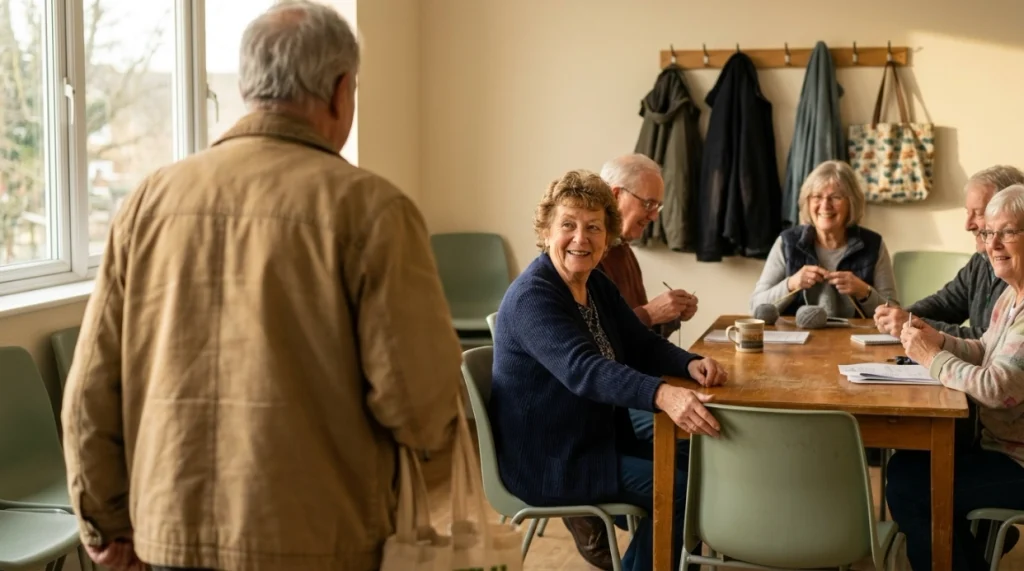
Try the same group about three times before deciding it isn’t for you, unless something makes you uncomfortable or unsafe. First visits often feel different because everyone else already knows the routine.
The second visit is easier. By the third, you may recognize faces and people may recognize you.
- First visit: Learn the activity and observe the group.
- Second visit: Greet someone you met before and learn another name.
- Third visit: Notice whether conversation feels easier and whether you look forward to returning.
After several visits, ask yourself a few simple questions. Enjoyment matters as much as social opportunity.
- Do I like the activity itself?
- Do people seem welcoming?
- Am I beginning to recognize participants?
- Does the schedule fit my life?
- Would I choose to come again next week?
As of 2026, technology gives seniors more ways to find groups, but the basic friendship process hasn’t changed much. Familiarity still grows through repeated, positive contact.
Don’t measure success only by how many phone numbers you collect. A familiar face, a regular conversation, or someone saving you a seat is meaningful progress.
Frequently Asked Questions
What is the easiest hobby for seniors to meet new people?
Walking groups, card games, and beginner classes are among the easiest choices because conversation develops around the activity. Pick a recurring group where you’ll see many of the same people each week.
What hobbies are good for seniors who live alone?
Book clubs, volunteering, community gardening, group exercise, crafts, choir, and adult-learning classes can add regular social contact. The best choice is one that feels enjoyable enough to become part of your routine.
Can seniors make friends through volunteering?
Yes. Volunteering can make conversation easier because everyone is working toward a shared goal. Recurring positions with the same small team usually provide more opportunities to build familiarity than one-time events.
What are good social hobbies for introverted seniors?
Try book clubs, crafts, photography walks, gardening, puzzles, card games, or small classes. These hobbies provide a topic or task to focus on, so you don’t need to spend the entire session making conversation.
Are online hobbies useful for meeting people?
They can be, especially when transportation or mobility makes local activities difficult. Look for live groups with regular participants, such as online book clubs, language groups, genealogy meetings, classes, or craft sessions.
How can an older adult make friends after retirement?
Start by joining one recurring activity based on something you genuinely enjoy. Attend consistently, learn a few names, ask simple activity-related questions, and allow relationships to develop gradually instead of expecting instant friendship.
How often should seniors socialize?
There isn’t one correct schedule for everyone. A better goal is regular contact that feels supportive rather than exhausting, whether that means a weekly club, several walks with friends, volunteer shifts, phone calls, or other meaningful interactions.
Final Takeaway
The best hobbies for seniors to meet people are the ones that make interaction feel natural. Walking groups, games, volunteering, classes, gardening, book clubs, music, and other recurring activities all give people something to share.
Start with one group rather than filling your calendar. Go back several times, learn a name or two, and let familiarity do its work.
You don’t need dozens of new friends. One enjoyable weekly activity and a few familiar faces can make your routine feel far more connected.