
What Hobbies Are Good for Mental Stimulation? 15 Ideas for Seniors


Non-Slip Slippers

Foot Massager Machine

Bedside Commode Chair
Quick Answer
Good hobbies for mental stimulation include puzzles, reading, learning a language, playing music, photography, gardening, chess, writing, crafts, and dancing. The best choices make you learn, remember, solve problems, create, or interact with other people, which fits the National Institute on Aging’s advice on meaningful activities for older adults.
Strong choices for an active mind
- Problem-solving: Try chess, Sudoku, crosswords, jigsaw puzzles, or strategy games.
- New learning: Study a language, take a class, or learn an instrument.
- Creativity: Paint, write, sew, photograph, cook, or make crafts.
- Memory: Read, study family history, play cards, or practice music.
- Social thinking: Join a book club, game group, choir, or volunteer project.
An easy way to start
- Choose one hobby that feels interesting and try it for 15 to 30 minutes several times this week.
When people ask me what hobbies are good for mental stimulation, I don’t look for one magical brain game. I look for activities that keep giving the mind something fresh to do.
The most useful hobbies mix curiosity with enjoyment. As of 2026, there are plenty of options for almost every mobility level, budget, and personality.
In This Guide
- What makes a hobby mentally stimulating?
- Which hobbies are best for mental stimulation?
- Which hobbies challenge memory and problem-solving?
- Which creative hobbies stimulate the mind?
- Do physical and social hobbies count as mental stimulation?
- How do you choose the right mentally stimulating hobby?
- How often should you do mentally stimulating hobbies?
- Frequently asked questions
- Final takeaway
What Makes a Hobby Mentally Stimulating?
A mentally stimulating hobby asks your brain to do more than repeat an automatic routine. It may involve learning, remembering, planning, concentrating, solving problems, making decisions, or creating something new.
Definition: A mentally stimulating hobby is an enjoyable activity that regularly challenges one or more thinking skills, such as attention, memory, reasoning, language, creativity, or problem-solving.
The key word is challenge. Something can be pleasant without asking much from your brain.
For example, watching a familiar television show may be relaxing. Discussing the story afterward, predicting what happens next, or reviewing it can involve more active thinking.
Novelty matters
Learning something unfamiliar forces you to pay attention. That is one reason a new recipe may offer more mental engagement than cooking a meal you’ve made 100 times.
The same idea applies to music, art, photography, games, and technology. You can increase the challenge as your skills improve.
- Learning: Understand new information or techniques.
- Memory: Recall rules, words, patterns, or instructions.
- Planning: Decide what to do and in what order.
- Attention: Stay focused long enough to complete a task.
- Problem-solving: Work through mistakes or unexpected results.
- Creativity: Make choices without one fixed correct answer.
The National Institute on Aging’s brain health resources discuss learning and mentally engaging activities as part of caring for cognitive health. That doesn’t mean one hobby can guarantee protection from age-related decline.
Think of hobbies as one useful part of a broader healthy lifestyle. Enjoyment matters too.
Which Hobbies Are Best for Mental Stimulation?
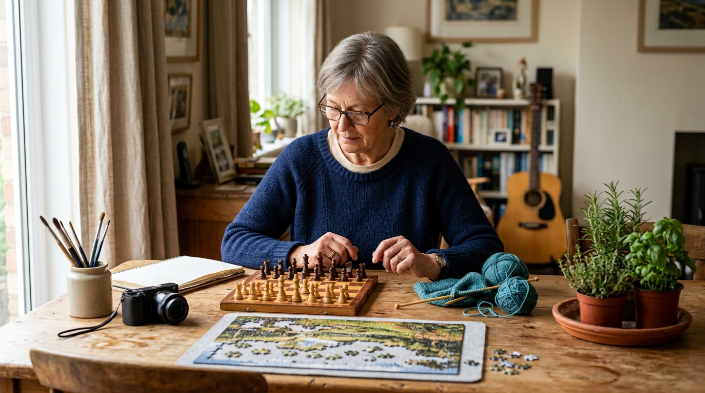
The best hobbies challenge several thinking skills while remaining enjoyable enough to repeat. Reading, puzzles, music, languages, games, photography, writing, gardening, crafts, and dancing are strong starting points.
I prefer activities that can grow with you. A hobby shouldn’t become useless once you’ve learned the basics.
| Hobby | Main mental challenge | Easy starting session | Social option |
|---|---|---|---|
| Crosswords or Sudoku | Recall and reasoning | 10–20 minutes | Low |
| Learning a language | Memory and language | 10–15 minutes | High |
| Playing music | Attention and coordination | 15–20 minutes | Medium |
| Chess or card games | Strategy and memory | 20–40 minutes | High |
| Photography | Observation and creativity | 15–30 minutes | Medium |
| Gardening | Planning and recall | 15–30 minutes | Medium |
| Painting or crafts | Creativity and attention | 20–30 minutes | Medium |
You don’t need the hobby with the highest difficulty. You need one that makes you think without making you dread doing it.
15 mentally stimulating hobbies to consider
- Crossword puzzles
- Sudoku
- Jigsaw puzzles
- Chess
- Card games
- Reading
- Creative writing
- Learning a language
- Playing a musical instrument
- Painting or drawing
- Photography
- Knitting, crochet, or quilting
- Gardening
- Genealogy
- Dancing
There isn’t one winner here. Different hobbies exercise different skills.
Which Hobbies Challenge Memory and Problem-Solving?
Games, puzzles, language learning, music, reading, and genealogy are especially useful when you want an activity built around remembering information and solving problems. The challenge should feel manageable, not exhausting.
Puzzles and strategy games
Crosswords ask you to retrieve words and connect clues. Sudoku relies more on logic, patterns, and working through possibilities.
Chess adds planning because your decision changes what happens next. Many card games also ask you to remember rules, track play, and make choices.
- Crosswords: Good for vocabulary and word recall.
- Sudoku: Good for logic and sustained attention.
- Chess: Good for planning and strategic decisions.
- Jigsaw puzzles: Good for visual matching and patience.
- Card games: Good for rules, memory, and social interaction.
Learning a language
A new language gives the brain an ongoing challenge. You learn vocabulary, sounds, sentence patterns, and meaning.
Start small. Ten minutes of practice is more approachable than setting a goal to study for an hour every day.
Learning an instrument
Music combines several tasks at once. You may read notes, remember patterns, listen for mistakes, and coordinate your hands.
I like music as a long-term hobby because there is always another song to learn. Progress can stay interesting for years.
The National Institute on Aging advises caution around claims that commercial brain-training programs improve general thinking abilities. A challenging hobby can be worthwhile without needing to market itself as a medical treatment.
Which Creative Hobbies Stimulate the Mind?
Painting, photography, writing, crafts, cooking, and music can all create mental challenges because you must make choices. There often isn’t one correct answer.
That freedom matters. Creativity turns you from a passive observer into an active participant.
Photography
Photography can start with a phone. The mental work comes from noticing light, shapes, people, colors, and small details you might normally miss.
Give yourself a simple assignment. Photograph five interesting textures, five signs of autumn, or five objects that tell a family story.
Painting and drawing
You don’t need formal art training. Choosing colors, arranging shapes, and deciding what to change all require attention.
A beginner watercolor or pencil sketch can take 20 minutes. That’s enough to create a useful challenge without turning the hobby into a chore.
Writing and family stories
Writing combines memory, language, structure, and creativity. Memoir writing can also turn old experiences into something children or grandchildren can keep.
- Describe your first job.
- Write down a favorite family recipe.
- Tell the story of your childhood neighborhood.
- Describe a memorable trip.
- Write a letter to your younger self.
If a blank page feels intimidating, answer one question at a time. Small prompts are easier.
Knitting, crochet, and quilting
Fiber crafts involve patterns, counting, sequencing, and hand coordination. A familiar pattern can also become calming after you’ve practiced it.
You can keep adding complexity when you want more challenge. New stitches, colors, or designs give you something fresh to learn.
Do Physical and Social Hobbies Count as Mental Stimulation?
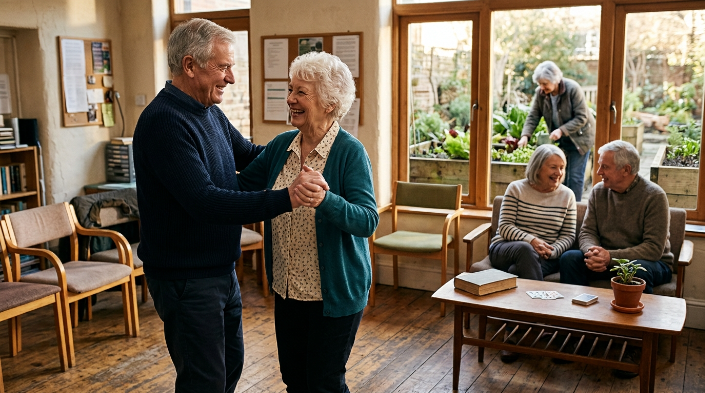
Yes. Many physical and social hobbies also involve memory, attention, timing, planning, conversation, and decision-making.
This is why I wouldn’t limit “brain hobbies” to sitting at a table with a puzzle book. Some of the richest activities combine the mind with movement or people.
Dancing
Dancing asks you to remember steps and respond to rhythm. Partner dancing adds another layer because you also react to someone else’s movements.
Beginners can start with simple routines or seated movement. Safety and comfort should come first.
Gardening
Gardening involves more planning than it first appears. You decide what to grow, where to place it, when to water, and how to respond when something goes wrong.
Container gardening can offer the same problem-solving on a smaller scale. A windowsill or patio may be enough.
Book clubs and group games
A book club turns reading into a social activity. You read, remember details, form opinions, and explain your thoughts to other people.
Group games work in a similar way. They add conversation and quick decisions to the rules of the game.
The CDC’s social connection resources describe social connection as an important part of health and well-being. Older adults may face a greater risk of isolation, so a social hobby can serve more than one purpose.
- Book clubs: Reading, recall, discussion, and connection.
- Choirs: Music, memory, timing, and group participation.
- Volunteering: Planning, purpose, communication, and problem-solving.
- Dance classes: Movement, sequencing, attention, and company.
- Game groups: Strategy, memory, conversation, and fun.
Health note: Choose physical activities that fit your current mobility, balance, and medical needs. Ask your health care professional if you’re unsure what level of activity is appropriate for you.
How Do You Choose the Right Mentally Stimulating Hobby?
Choose a hobby that is challenging enough to hold your attention but enjoyable enough to repeat. Personal interest matters more than picking the activity that sounds most impressive.
I use a simple test: would you willingly do it again next week? If the answer is no, another hobby may suit you better.
Start with the skill you want to use
- Memory: Languages, music, cards, reading, or genealogy.
- Problem-solving: Chess, Sudoku, gardening, or woodworking.
- Creativity: Painting, writing, photography, cooking, or crafts.
- Focus: Jigsaw puzzles, drawing, sewing, or model building.
- Social thinking: Book clubs, volunteering, cards, or group classes.
Match the hobby to everyday life
A hobby must fit your available space, money, energy, mobility, eyesight, and hearing. An activity that looks ideal on paper may be inconvenient in real life.
Adaptation is fine. Audiobooks can replace small print, raised planters can make gardening easier, and larger playing cards can make games more comfortable.
Don’t buy everything on day one
Try the smallest version first. Borrow supplies, take one class, or use equipment you already own.
I have seen enthusiasm disappear after someone turns a new interest into a shopping project. Learn whether you enjoy the activity before investing heavily.
How Often Should You Do Mentally Stimulating Hobbies?
There is no proven schedule that makes one hobby a guaranteed brain-health treatment. A practical goal is simply to engage regularly enough that the activity becomes part of your life.
For many people, 15 to 30 minutes at a time is an easy place to begin. You can increase that naturally if you’re enjoying yourself.
Try a mixed weekly routine
Variety can keep hobbies fresh. It also lets you use different skills instead of repeating the exact same task.
- Monday: 15 minutes of a crossword or Sudoku.
- Tuesday: 20 minutes learning music or a language.
- Wednesday: Gardening, photography, or a walk.
- Thursday: Read a book or write in a journal.
- Friday: Play cards, chess, or another social game.
- Weekend: Try a class, club, creative project, or volunteer activity.
You don’t need to follow that schedule literally. It simply shows how mental, creative, physical, and social activities can fit together.
Keep increasing the challenge gently
A hobby becomes less mentally demanding as it becomes automatic. Add a small new challenge when you notice that happening.
- Try a harder puzzle.
- Learn a new song.
- Read a different genre.
- Cook an unfamiliar recipe.
- Photograph a new subject.
- Play against a new chess opponent.
- Learn another knitting pattern.
Don’t make every session difficult. Enjoyment is one of the reasons hobbies are worth keeping.
Frequently Asked Questions
What hobby is best for keeping your mind active?
There is no single best hobby for everyone. Activities such as language learning, music, chess, reading, writing, photography, crafts, and puzzles are useful because they can challenge memory, attention, reasoning, or creativity.
Are puzzles good mental stimulation for seniors?
Puzzles can challenge attention, recall, visual skills, and problem-solving. Try varying the type and difficulty instead of doing only familiar puzzles that no longer require much thought.
Is reading considered mental stimulation?
Yes. Reading asks you to follow ideas, understand language, remember information, and make connections.
You can make reading more interactive by taking notes or discussing a book with someone else.
What is the best hobby for improving memory?
No hobby is proven to improve everyone’s memory. Activities that require active recall, such as learning a language, playing music, reading, card games, and genealogy, can provide regular memory challenges.
Can learning something new help keep the brain active?
Learning a new skill naturally requires attention, practice, memory, and adjustment. Languages, musical instruments, photography, crafts, cooking, and technology lessons are all practical choices.
Are computer brain games worth doing?
They can be entertaining, but be cautious about broad claims that commercial brain-training games prevent cognitive decline or dementia. The National Institute on Aging notes that evidence for lasting benefits from many commercial programs remains limited.
What mentally stimulating hobbies work for seniors with limited mobility?
Good options include audiobooks, puzzles, writing, genealogy, language lessons, music, drawing, card games, online classes, knitting, and seated crafts. Choose tools with comfortable print sizes, controls, and grips when needed.
Final Takeaway
If you’re wondering what hobbies are good for mental stimulation, start with something that asks you to learn, remember, plan, solve, create, or communicate. It doesn’t need to feel like a brain exercise.
For many seniors, the best approach is a mix. Try one hobby for learning, one creative or active hobby, and one activity that connects you with other people.
Most important, choose something you want to return to. A simple hobby you enjoy for years is more useful than a complicated one you abandon after a week.