
Four Point Cane Explained: Uses, Fit & Safety


Electric Jar Opener

Back Massager with Heat

Foot Massager Machine
Quick Answer
A four point cane, also called a quad cane, is a walking aid with four contact points at its base. It provides a broader support base than a traditional single-tip cane and may help people who need extra stability while walking. Correct sizing, proper technique, and placing all four tips securely on the ground are essential for safe use.
A four point cane can be useful when an ordinary walking cane does not provide enough stability. Its four-legged base offers more contact with the floor, which may help some people with balance difficulties, leg weakness, or mobility limitations.
However, four contact points do not automatically make a cane suitable for everyone. The design can be heavier and more awkward to move than a single-point cane, and people who need substantial weight-bearing support may require a walker instead.
What Is a Four Point Cane?
A four point cane is a handheld mobility aid with a handle, a vertical shaft, and a base that ends in four separate feet. These feet usually have rubber tips that grip the floor and help prevent slipping.
The device is also called a quad cane or four-pronged cane. Unlike a conventional cane that touches the ground at one point, a quad cane spreads its contact points across a wider base.
This design can improve stability for people who have difficulty maintaining balance while standing or walking. It may be recommended during rehabilitation or for certain long-term mobility needs.
How does its four-legged base work?
The four feet create a broader support area around the cane’s shaft. When all four tips rest firmly on a suitable, level surface, the base can provide a more stable contact point than a single rubber tip.
That benefit depends on correct positioning. If the cane is tilted so that one or more feet lift off the floor, the base may not provide the intended support. The user must also be able to grip, position, and advance the cane safely.
Who May Benefit From a Four Point Cane?
A quad cane may suit someone who needs more stability than a single-point cane provides but can still walk with a relatively small mobility aid.
Possible reasons a healthcare professional may recommend one include:
- Balance difficulties: A wider base may provide an additional stable contact point during walking.
- Leg weakness: The cane can offer limited support while moving with a weaker leg.
- Recovery after an injury or stroke: Some people benefit from a quad cane during rehabilitation, depending on their strength, coordination, and balance.
- Joint pain or mobility limitations: A properly fitted cane may help reduce some of the load on an affected leg.
- Difficulty using a single-tip cane: A broader base may be worth considering when a clinician determines that additional stability is appropriate.
A four point cane is not automatically the right choice for every person with a balance problem. If someone has severe weakness, frequent falls, difficulty standing upright, or trouble controlling the cane, a walker or another mobility aid may be safer.
For a broader overview of cane types, sizing, and walking technique, see the guide to walking canes and their safe use.
Four Point Cane vs. Single Point Cane: What Is the Difference?
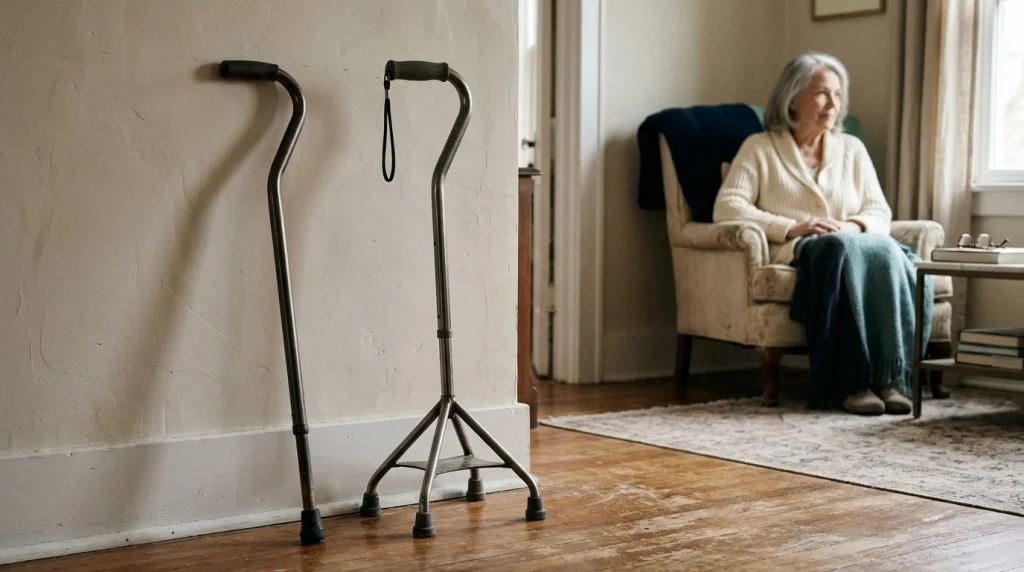
The main difference is the number of ground-contact points. A four point cane has a wider base, while a single-point cane has one tip and is generally easier to move through a natural walking rhythm.
| Feature | Four Point Cane | Single Point Cane |
|---|---|---|
| Ground contact | Four tips | One tip |
| Support base | Wider | Narrower |
| Movement | Can require more careful positioning | Generally easier to advance |
| Weight and handling | Often heavier and bulkier | Usually lighter and simpler |
| Potential use | People who need additional stability | People needing modest support |
The best choice depends on the user’s actual mobility needs, not simply the number of tips. A physical therapist can assess whether the additional base stability is helpful or whether the extra weight and positioning demands make a quad cane less suitable.
How Should a Four Point Cane Fit?
The handle should generally reach the crease of your wrist when you stand upright with your arms relaxed at your sides. When you grip it, your elbow should remain slightly bent rather than locked straight or excessively flexed.
A poor fit can make the cane uncomfortable and interfere with posture and balance. Use these checks as a starting point:
- Wear your usual walking shoes. Shoe height affects the position of your hand relative to the floor.
- Stand upright on a level surface. Keep your shoulders relaxed and let your arms hang naturally.
- Check the handle height. The handle should be near your wrist crease.
- Check your elbow. Grip the handle and make sure your elbow has a comfortable, slight bend.
- Inspect the adjustable shaft. Confirm that the height-setting button or locking mechanism is fully engaged.
- Test the walking position with help if needed. A healthcare professional can check whether the cane is appropriately positioned for your gait.
The base also needs to be suitable for your walking environment. A larger base may be more difficult to position in narrow spaces or on stairs, so do not assume every quad cane works equally well in every setting.
How Do You Walk With a Four Point Cane Safely?
If one leg is weaker or painful, a cane is commonly held in the hand opposite that leg. The cane and affected leg generally move forward together, followed by the stronger leg. Follow any different sequence prescribed for your particular condition.
Use this basic sequence only if your healthcare professional has confirmed that a cane is appropriate for you:
- Stand balanced before moving. Hold the cane securely on the stronger side and keep your posture upright.
- Move the cane forward a short distance. Avoid reaching too far ahead, which may make the cane harder to control.
- Place all four tips on the floor. Check that the base is stable before relying on it for support.
- Advance the weaker leg. Move it forward alongside the cane according to your prescribed walking pattern.
- Transfer your weight carefully. Use the cane and your legs as instructed, without leaning heavily on an unstable base.
- Step forward with the stronger leg. Move through in a controlled manner and prepare the cane for the next step.
- Repeat slowly. Keep your eyes forward where possible and avoid rushing, twisting, or taking unusually long steps.
Practice in a clear area with supervision if you are new to the device or have a history of falls. A physical therapist can demonstrate the correct sequence and check that you can place the base securely at each step.
Warning
Do not take a step while the quad cane is tilted or one or more feet are lifted from the floor. If you cannot position the base reliably, stop and ask a qualified professional to reassess your technique or mobility aid.
Can You Use a Four Point Cane on Stairs?
Stairs can be challenging with a quad cane because its four feet need enough room to sit securely on each step. Some bases may not fit safely on a narrow tread, and the cane may be difficult to maneuver while holding a handrail.
Do not assume you can use your usual walking technique on stairs. Ask a physical therapist to demonstrate the correct method for your specific cane and ability, and check whether the base fits securely on each step.
When a clinician confirms that stairs are appropriate:
- Use a secure handrail whenever one is available.
- Move slowly and take one step at a time.
- Follow the prescribed sequence for your weaker and stronger legs.
- Do not proceed if the cane’s base cannot rest securely on the step.
If you cannot use the handrail and cane safely together, or you feel unstable on stairs, ask for another mobility plan rather than attempting the steps alone.
What Are the Common Mistakes When Using a Quad Cane?
Even a well-designed cane may be unsafe when it is poorly fitted, incorrectly positioned, or used on an unsuitable surface. These are common issues to watch for:
- Using the wrong hand: Holding the cane on the weaker side may reduce the intended support pattern. Follow your clinician’s instructions for your specific condition.
- Lifting a foot off the ground: A tilted base may not provide the expected stability.
- Choosing the wrong height: A cane that is too high or too low can affect posture and control.
- Walking too quickly: Rushing makes it harder to position the four feet accurately.
- Ignoring worn rubber tips: Damaged or hardened tips may provide less reliable traction.
- Using the cane as a substitute for a walker: A cane is not designed to meet every level of balance or weight-bearing need.
- Trying unfamiliar stairs alone: Stair technique and base clearance need specific attention.
Wet floors, loose rugs, clutter, poor lighting, and uneven ground can also increase fall risk. Clear your walking route and wear supportive footwear with non-slip soles.
How Do You Maintain a Four Point Cane?
Regular inspection helps you spot damage that could compromise the cane’s stability. Check the device before use if it has been dropped, stored for a long time, or used on rough surfaces.
- Rubber feet: Look for cracks, loose fittings, uneven wear, or missing tread.
- Height adjustment: Make sure the button engages fully and the shaft does not slide.
- Frame and joints: Check for bending, looseness, or visible damage.
- Handle: Confirm that it is secure and provides a comfortable grip.
- Base: Ensure all four feet are firmly attached and contact the floor as intended.
Replace worn tips with compatible parts and follow the manufacturer’s maintenance instructions. If the shaft is bent, the locking mechanism fails, or the base feels unstable, stop using the cane until it has been checked or replaced.
When Should You Consider a Walker Instead?

A walker may be a better option if you need more support than a cane can safely provide. This can apply when you have substantial weakness, significant balance problems, difficulty walking upright, or repeated falls despite using a cane correctly.
A cane generally offers support from one side, while a walker provides a broader frame of support. However, the right device depends on your strength, coordination, environment, and ability to use it correctly.
Seek an assessment if you are unsure which aid is appropriate. New or worsening weakness, dizziness, repeated falls, or a sudden change in walking ability also warrants prompt medical attention. Sudden weakness accompanied by facial drooping, speech difficulty, or other possible stroke symptoms requires emergency care.
Key Insight
The safest walking aid is not necessarily the one with the most contact points. It is the device that matches your support needs and that you can position, control, and use correctly.
For practical guidance on cane selection and use, the MedlinePlus guide to using a cane explains basic fitting, walking technique, and when to seek help choosing a different mobility aid.
Related Product
Four Point Walking Canes
Compare quad cane designs, adjustable heights, handle styles, and base configurations after confirming which type is suitable for your mobility needs.
As an Amazon Associate, we earn from qualifying purchases.
Frequently Asked Questions
Is a four point cane better than a regular cane?
A four point cane offers a wider base than a single-point cane and may help people who need additional stability. A regular cane is often lighter and easier to move. The better choice depends on your balance, strength, walking pattern, and professional assessment.
Does a four point cane stand on its own?
Many quad canes can stand upright on a suitable level surface when their four feet are positioned correctly. This feature depends on the cane’s design and the surface, so it should not be treated as a guarantee that the cane cannot tip over.
Which hand should hold a four point cane?
When one leg is weaker or painful, the cane is generally held in the opposite hand. This allows the cane and affected leg to move together during a common walking pattern. Follow your therapist’s instructions if your condition requires a different technique.
Can a four point cane support full body weight?
No. A quad cane is generally intended to provide balance assistance and limited support, not to carry a person’s full body weight. If you need substantial support, ask a healthcare professional whether a walker or another mobility device is more appropriate.
Are four point canes suitable for outdoor use?
Some quad canes can be used outdoors on suitable, reasonably even surfaces, provided the manufacturer permits it. Wet ground, gravel, steep slopes, and uneven paths can make secure placement difficult. Check the cane’s instructions and avoid surfaces where all four feet cannot rest securely.
When should a four point cane be replaced?
Replace worn rubber tips and stop using a cane with a bent shaft, loose base, damaged handle, or faulty height lock until it has been repaired or replaced. If the cane no longer feels stable, have it checked before relying on it for walking.
Conclusion
A four point cane, or quad cane, provides four ground-contact points and a wider base than a traditional single-tip cane. It may improve stability for people with certain balance or mobility difficulties, but safe use depends on proper fit, correct technique, and secure placement of all four feet.
Choose a cane based on your individual support needs rather than its design alone. If you feel unsteady, struggle with stairs, experience repeated falls, or need more support than the cane provides, seek a professional assessment. The right mobility aid should help you move more safely and confidently through everyday activities.