
DeWalt vs Ryobi Tire Inflator for Seniors: Which?


Adjustable Walker with Wheels
Spill-Proof Adult Cup

Hearing Aid Cleaning Kit
DeWalt vs Ryobi tire inflator for seniors is a useful comparison if you want a cordless tool for checking and adding air to car tires. Both can reach up to 160 PSI and use a digital pressure display with automatic shutoff.
The main difference is size and versatility. The DeWalt DCC020IB is a larger inflator with three power options and both high-pressure and high-volume modes. The Ryobi PCL001B is much smaller and lighter, with a simple high-pressure design aimed at tires, bikes, and sports balls.

Quick Comparison
For most seniors who want a small and easy-to-carry tire inflator, the Ryobi PCL001B has a clear practical advantage because its listed tool weight is 1.4 lb.
The DeWalt DCC020IB makes more sense when versatility matters. It can run from a 20V MAX battery, 12V DC, or 110V AC and also includes a high-volume inflation and deflation function.
The simpler choice is not always the less capable choice. For many everyday tire top-ups, a compact tool can be easier to handle.
DeWalt vs Ryobi At a Glance
Here is the basic difference between the two specific models used in this comparison.
| Feature | DeWalt DCC020IB | Ryobi PCL001B |
|---|---|---|
| Maximum pressure | Up to 160 PSI | Up to 160 PSI |
| Tool weight | 7.2 lb | 1.4 lb |
| Pressure display | Digital gauge | Digital gauge |
| Auto shutoff | Yes | Yes |
| Power options | 20V battery, 12V DC, 110V AC | 18V ONE+ battery |
| High-volume mode | Yes | No |
| Accessory storage | Yes | Yes |
| Best fit | Versatile home and vehicle use | Simple tire inflation |
The weight figures come from current product listings, while the operating features come from the manufacturers.
DeWalt DCC020IB for Senior-Friendly Use
The DeWalt DCC020IB is built as a versatile portable inflator rather than a tiny tire pump. It has a digital gauge, automatic shutoff, a threaded chuck, onboard accessory storage, and an LED light.
Ease of Use
The digital gauge lets you set the desired pressure before inflation. Once the preset pressure is reached, the inflator automatically stops. That can reduce the need to watch the gauge continuously.
The threaded chuck also provides a secure connection to the inflation valve. DeWalt includes a 12V DC power cord and several inflation accessories.
The main issue is its size and weight. Home Depot lists the tool at 7.2 lb, so carrying it around a vehicle may require more effort than a compact inflator.
Key Strengths
- Three power-source options
- Digital pressure gauge
- Automatic shutoff
- High-pressure inflation mode
- High-volume inflation and deflation
- LED light
- Onboard accessory storage
- 3-year limited warranty from DeWalt
Potential Drawbacks
- Much heavier than the Ryobi PCL001B
- Battery and charger are sold separately for the tool-only version
- Larger design takes more storage space
- More features may be unnecessary for simple tire top-ups
Ryobi PCL001B for Simple Tire Inflation
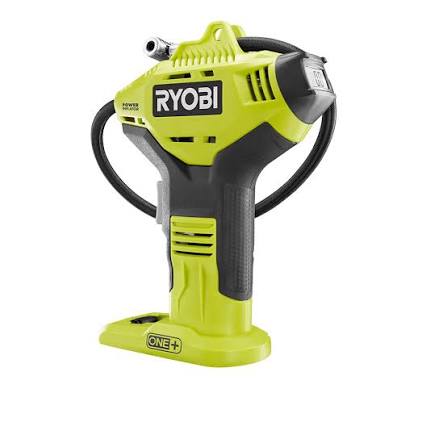
The Ryobi PCL001B takes a more compact approach. It is an 18V ONE+ high-pressure digital inflator designed for car, bike, and other small tires and sports balls.
Ease of Use
Ryobi lists a digital pressure gauge, onboard accessory storage, and automatic shutoff. The display shows the pressure, while the automatic shutoff stops inflation when the selected PSI is reached.
The biggest practical advantage is its size. Home Depot lists the PCL001B at 1.4 lb and about 5.4 inches deep, 4.9 inches high, and 2.9 inches wide.
That compact design may be easier for seniors who want something that is simple to carry from a garage to a vehicle.
Key Strengths
- Very light 1.4-lb tool weight
- Compact design
- Digital pressure gauge
- Automatic shutoff
- Up to 160 PSI
- Onboard accessory storage
- Works with the Ryobi 18V ONE+ battery system
- 3-year manufacturer warranty
Potential Drawbacks
- No high-volume inflation or deflation function
- Requires an 18V ONE+ battery
- Tool-only versions do not include a battery or charger
- Less versatile than the DeWalt for broader inflation tasks
Which Is Easier for Seniors to Use?
For simple tire inflation, the Ryobi has the physical advantage because it is far lighter.
A 1.4-lb tool is easier to lift, carry, and position than a 7.2-lb inflator. This can matter when the inflator must be moved around a car or stored on a shelf.
Both models offer digital pressure control and automatic shutoff. So the basic inflation process is similar: connect the hose, set the desired pressure, and let the tool handle the stopping point.
For seniors who value low weight and simple handling, Ryobi is the more practical fit.
DeWalt is more appealing when the user wants one machine for several types of inflation and values flexible power options.
Performance Comparison
Both inflators are rated for pressures up to 160 PSI. That means maximum PSI alone does not create a major difference between them.
The larger difference is function.
| Performance Area | DeWalt DCC020IB | Ryobi PCL001B |
|---|---|---|
| Tire inflation | Yes | Yes |
| Maximum pressure | 160 PSI | 160 PSI |
| High-volume inflation | Yes | No |
| Deflation | Yes | No |
| Sports balls | Yes | Yes |
| Digital pressure control | Yes | Yes |
DeWalt is the more versatile option because its high-volume hose can inflate and deflate larger inflatables. Ryobi’s PCL001B is designed mainly around high-pressure applications such as tires and sports balls.
Comfort, Accessibility, and Senior-Friendly Design
The biggest senior-focused difference is not maximum PSI. It is physical handling.
Ryobi’s compact 1.4-lb body may be easier to carry and position. DeWalt’s 7.2-lb listed weight gives it a much larger physical footprint.
Both have digital pressure displays and automatic shutoff. These features can make the inflation process more straightforward because the user can select the target pressure instead of manually stopping at the exact number.
For a senior with no issue handling heavier tools, DeWalt’s extra size may not matter. For someone who prefers lightweight equipment, Ryobi’s design is more appealing.
Features Comparison
The two models share several important features, but their purposes are different.
| Feature | DeWalt DCC020IB | Ryobi PCL001B |
|---|---|---|
| Digital gauge | Yes | Yes |
| Auto shutoff | Yes | Yes |
| LED light | Yes | Not listed |
| Accessory storage | Yes | Yes |
| High-volume function | Yes | No |
| Power flexibility | 3 options | 18V battery |
| Threaded chuck | Yes | Air hose and valve adaptor |
DeWalt’s three power sources are particularly useful for vehicle owners who want flexibility between battery, 12V DC, and household AC power.
Ryobi focuses more on portability and the convenience of the ONE+ battery platform. Ryobi states that the ONE+ system includes more than 300 products using the same battery platform.
Price, Maintenance, and Long-Term Value
Current listed prices can change, so they should be treated as snapshots rather than permanent prices.
At the time of checking, DeWalt’s DCC020IB tool-only listing at Home Depot was $169. Ryobi’s PCL001B tool-only listing was $39.97 on both Ryobi’s site and Home Depot.
| Cost Factor | DeWalt | Ryobi |
|---|---|---|
| Tool-only listed price checked | $169 | $39.97 |
| Battery included | No | No |
| Charger included | No | No |
| Battery platform | 20V MAX | 18V ONE+ |
| Warranty | 3-year limited | 3-year manufacturer warranty |
These prices can change with promotions and kit options. Both brands also sell versions bundled with batteries.
For someone who already owns compatible batteries, the value calculation changes. A DeWalt 20V MAX owner may prefer DeWalt, while someone already invested in Ryobi ONE+ tools may find the Ryobi easier to add.
Who Should Choose DeWalt?
DeWalt may make more sense for seniors who:
- Want more than a basic tire inflator.
- Need high-volume inflation or deflation.
- Want battery, 12V DC, and AC power options.
- Already own DeWalt 20V MAX batteries.
- Prefer a larger, more substantial tool.
- Want an LED light for use in darker areas.
- May use the inflator for tires and larger inflatables.
The extra versatility is the main reason to consider DeWalt.
Who Should Choose Ryobi?
Ryobi may be a better fit for seniors who:
- Want a lightweight inflator.
- Mainly need to inflate vehicle tires.
- Want a compact tool for garage or trunk storage.
- Prefer a simple high-pressure design.
- Already own Ryobi 18V ONE+ batteries.
- Want to spend less on the tool itself.
Its small size and low weight are the standout advantages.
DeWalt vs Ryobi Tire Inflator — Final Verdict
For most seniors focused on everyday tire inflation, the Ryobi PCL001B is the simpler option to consider. Its 1.4-lb listed tool weight, compact body, digital gauge, and automatic shutoff make it easy to carry and straightforward to operate.
DeWalt is the better fit for someone who wants a more versatile inflator. Its three power options, high-pressure and high-volume modes, LED light, and accessory storage make it useful beyond basic tire maintenance.
Best for Most Seniors
Ryobi PCL001B — especially when low weight and simple tire inflation are the main goals.
Best for Versatility
DeWalt DCC020IB — especially for users who want high-volume inflation and multiple power options.
Best for Ease of Carrying
Ryobi PCL001B — its listed 1.4-lb tool weight is much lower than DeWalt’s 7.2 lb.
Best for Multi-Purpose Use
DeWalt DCC020IB — its high-volume inflation and deflation functions give it a wider range of uses.
Scoring Summary
A simple score can help show the practical difference, but it should not replace the user’s own needs.
| Category | DeWalt DCC020IB | Ryobi PCL001B |
|---|---|---|
| Ease of Use | 8/10 | 9/10 |
| Senior-Friendly Design | 7/10 | 9/10 |
| Performance | 9/10 | 8/10 |
| Versatility | 10/10 | 7/10 |
| Portability | 6/10 | 10/10 |
| Value | 7/10 | 10/10 |
These scores are editorial assessments based on the documented differences above, not manufacturer ratings or laboratory test results.
How We Evaluate Products
This comparison focuses on the factors that can matter most during everyday senior use.
We look at:
- Ease of operation
- Physical handling
- Portability
- Pressure controls
- Automatic shutoff
- Practical performance
- Versatility
- Maintenance
- Battery requirements
- Long-term value
The comparison uses current manufacturer information and product specifications. It does not claim hands-on testing or laboratory testing.
Senior-Specific Buying Considerations
Before choosing a tire inflator, look beyond maximum PSI.
Physical Effort
Consider how much weight you are comfortable carrying from storage to the vehicle. The difference between these two models is substantial.
Controls
A digital gauge and automatic shutoff can make pressure setting simpler. Both models provide these features.
Battery
Check whether you already own the correct battery platform. A tool-only inflator may look inexpensive until the cost of a battery and charger is added.
Storage
A compact inflator can be easier to keep in a garage, trunk, or utility cabinet.
Setup
Think about the hose connection, pressure setting, battery installation, and access to the tire valve. A simpler routine can be useful for regular tire checks.
Common Buying Mistakes
Avoid these common mistakes when choosing between the two.
- Choosing based only on maximum PSI.
- Ignoring the weight of the tool.
- Forgetting the cost of a battery and charger.
- Buying the larger DeWalt when only basic tire inflation is needed.
- Choosing Ryobi when high-volume inflation is important.
- Ignoring the battery platform already used at home.
The best match depends on what you actually plan to inflate and which battery system you already have.
Safety
Tire inflation deserves some care. Always use the vehicle or tire manufacturer’s recommended pressure rather than simply choosing a higher PSI because the inflator can reach it.
Both models provide automatic shutoff, but the user should still connect the hose correctly and monitor the process. DeWalt’s manual also notes that the pressure reading can change slightly after inflation and includes safety instructions concerning accessories and over-inflation.
Do not use a high-pressure inflator for applications outside its intended design. Ryobi specifically states that the PCL001B is intended for high-pressure applications and is not designed for pool tubes or other high-volume uses.
Conclusion
The DeWalt DCC020IB and Ryobi PCL001B take different approaches to portable tire inflation. DeWalt offers more power-source flexibility and broader inflation functions, while Ryobi focuses on a compact, lightweight design for high-pressure inflation.
For a senior who mainly wants an easy-to-carry tire inflator, Ryobi’s lighter design is a strong practical advantage. For someone who wants one inflator for tires plus larger inflatables and different power sources, DeWalt offers more flexibility.