
Duties and Responsibilities of Senior Accountant


Lightweight Vacuum Cleaner

Sudoku Puzzle Book

Motion Sensor Night Lights
The senior accountant plays a vital role in maintaining financial integrity within organizations. From preparing accurate reports to guiding junior staff, their expertise supports sound decision-making and regulatory compliance. This position blends technical accounting knowledge with leadership and communication skills. Understanding these responsibilities helps both aspiring professionals and hiring managers align expectations and drive success.
If you’ve ever wondered what it takes to climb the ladder from an entry-level bookkeeper to someone who shapes financial strategy, let me tell you—being a senior accountant isn’t just about balancing the books. It’s about owning the big picture while keeping your eyes on the details. This role sits at the intersection of numbers, people, and strategy. You’re no longer just recording transactions; you’re interpreting them, guiding others, and helping leadership make smart decisions based on solid financial foundations.
The senior accountant is often seen as the backbone of the finance department. With years of experience under their belt, they bring credibility, precision, and judgment to complex situations. Whether preparing quarterly earnings reports, managing year-end audits, or mentoring new hires, their work directly impacts organizational health and investor confidence. In many companies, especially mid-sized ones without a full CFO team, the senior accountant steps into a hybrid role that includes both hands-on accounting and strategic oversight.
Let’s break down exactly what this means day-to-day—what you’ll actually do, how you’ll lead, and why your contribution matters far beyond spreadsheets.
Key Takeaways
- Financial Reporting Accuracy: Senior accountants ensure all financial statements comply with GAAP or IFRS standards, providing stakeholders with reliable data for analysis.
- Team Leadership & Mentorship: They supervise junior accountants, review work for errors, and foster professional development through training and feedback.
- Compliance & Risk Management: These professionals monitor adherence to tax laws, auditing requirements, and internal controls to minimize legal and financial risks.
- Budgeting & Forecasting Support: Senior accountants contribute to annual budgets and long-term financial forecasts used by executives and department heads.
- Process Improvement: They identify inefficiencies in accounting workflows and recommend automation or procedural changes to enhance productivity.
- Stakeholder Communication: Whether presenting to management or liaising with external auditors, clear communication is essential for transparency and collaboration.
- Technology Proficiency: Mastery of ERP systems like QuickBooks, SAP, or Oracle enables efficient data handling and real-time financial insights.
📑 Table of Contents
- 1. Overseeing Financial Statement Preparation and Compliance
- 2. Leading Accounting Teams and Providing Mentorship
- 3. Managing Internal Controls and Audit Readiness
- 4. Supporting Budgeting, Forecasting, and Financial Analysis
- 5. Leveraging Technology and Process Optimization
- 6. Interfacing with External Stakeholders
- 7. Ethical Judgment and Professional Integrity
- Conclusion: More Than Just Numbers
1. Overseeing Financial Statement Preparation and Compliance
At the core of a senior accountant’s job is ensuring that financial statements are accurate, timely, and compliant with relevant regulations. That includes balance sheets, income statements, cash flow statements, and footnotes—all prepared according to Generally Accepted Accounting Principles (GAAP) or International Financial Reporting Standards (IFRS), depending on where you work.
What This Looks Like in Practice
You might be responsible for consolidating data from multiple departments into one master report before the end of each month. For example, if your company has three regional offices, you’ll gather revenue, expense, and asset data from each location, reconcile discrepancies, and present a unified statement to upper management. Mistakes here can trigger regulatory scrutiny or mislead investors—so attention to detail is non-negotiable.
Why Compliance Matters
Non-compliance isn’t just a risk—it can lead to fines, restatements, or even criminal liability in extreme cases. Senior accountants must stay updated on changes in tax codes, SEC filings (for public companies), and industry-specific rules. For instance, healthcare organizations face strict HIPAA-related financial disclosure requirements, while tech firms must navigate evolving R&D capitalization rules.
To stay ahead, many senior accountants attend webinars, subscribe to accounting journals, or join professional associations like the AICPA. Keeping abreast of these shifts isn’t optional—it’s part of being trustworthy in your field.
Pro Tip:
Always document your assumptions and methodologies when preparing complex entries—this protects you during audits and shows due diligence.
2. Leading Accounting Teams and Providing Mentorship
While individual contributors can shine, true impact comes from lifting others up. As a senior accountant, you’re likely asked to lead small teams—maybe two to four junior accountants or recent grads fresh out of school.
Mentoring Junior Staff
Part of your job is reviewing journal entries, approving reconciliations, and giving constructive feedback. Imagine a new hire submits a depreciation schedule with incorrect useful life estimates—you catch it, explain why it matters, and show them how to adjust it next time. That’s mentorship in action.
Delegation Without Micromanagement
Good leaders know when to step back. You delegate tasks based on skill level and workload, but you also check in regularly. Weekly one-on-ones help build trust and uncover hidden issues early. For example, if a team member seems overwhelmed during tax season, you might reassign some tasks or suggest temporary process tweaks.
Performance Reviews & Goal Setting
In larger firms, you may participate in formal performance evaluations. Use these moments to highlight strengths and set growth goals—like encouraging someone to pursue CPA certification or learn advanced Excel functions.
Remember: great teams aren’t built overnight. Your patience, clarity, and willingness to share knowledge define your legacy as a leader.
3. Managing Internal Controls and Audit Readiness

Visual guide about Duties and Responsibilities of Senior Accountant
Image source: i.pinimg.com
Internal controls are the safeguards that prevent fraud, errors, and misuse of assets. As a senior accountant, you design, implement, and monitor these systems across the organization.
Common Controls Include:
- Segregation of duties (no single person handles all aspects of a transaction)
- Approval hierarchies for expenditures over $5,000
- Regular bank reconciliations performed by someone other than the preparer
- Password policies and access restrictions in accounting software
Preparing for External Audits
When auditors arrive, you’re usually the go-to person for documentation requests. You’ll pull invoices, contracts, bank statements, and prior-year working papers. Being audit-ready means having everything organized, labeled, and accessible—not scrambling last minute.
Tip: Keep a digital folder updated monthly instead of waiting until audit season. It saves stress and reduces errors.
Risk Assessment
Periodically assess where your processes are vulnerable. Maybe your petty cash system lacks receipts? Or your vendor payment approvals skip key checks? Identifying these gaps allows you to fix them proactively.
By embedding control thinking into daily routines, you protect the company—and your own peace of mind.
4. Supporting Budgeting, Forecasting, and Financial Analysis
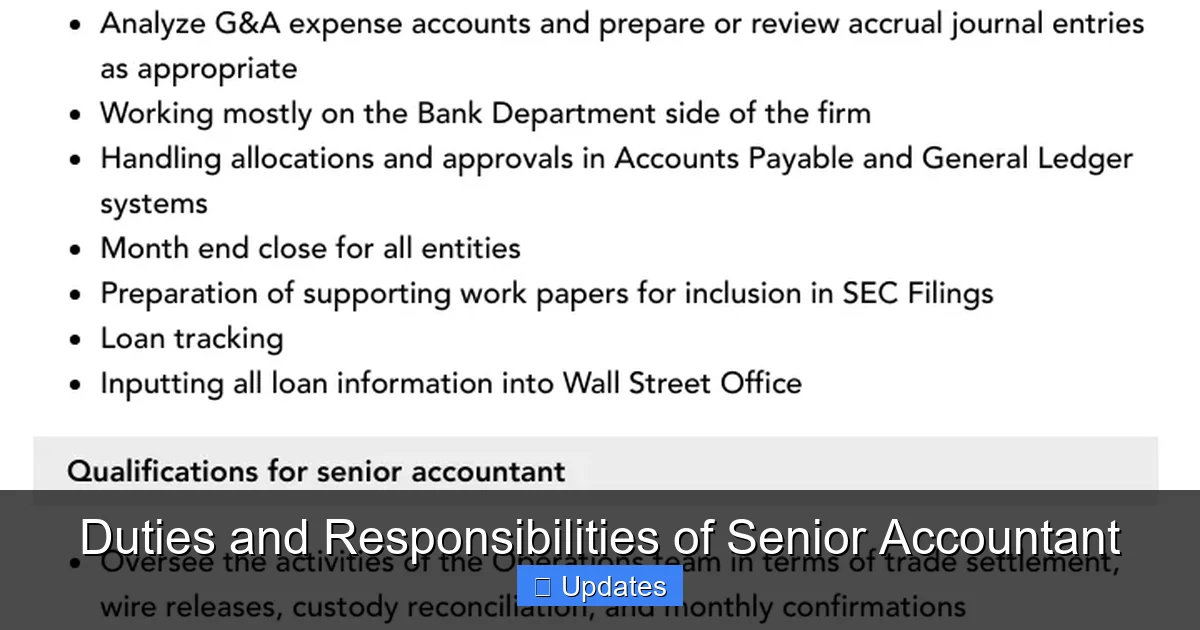
Visual guide about Duties and Responsibilities of Senior Accountant
Image source: asset.velvetjobs.com
Numbers alone don’t tell stories—context does. Senior accountants translate raw data into meaningful insights for decision-makers.
Budget Development
You collaborate with department managers to project next year’s expenses. If marketing wants a 20% increase in ad spend, you’ll analyze past campaign ROI and historical spending patterns to advise whether that’s realistic. Your input helps shape fiscal responsibility across the board.
Variance Analysis
After the quarter ends, you compare actual results against projections. Did office supplies cost 15% more than expected? Why? Was it due to inflation, poor procurement practices, or unexpected travel needs? Digging into variances helps improve future forecasting accuracy.
Scenario Planning
During economic uncertainty, senior accountants model best-case, worst-case, and most-likely scenarios. For example, if interest rates rise, how would that affect loan repayments? What if a key supplier raises prices? These exercises prepare leadership for various outcomes.
Real-World Example:
A retail chain noticed declining margins in Q2. The senior accountant traced it back to higher logistics costs caused by fuel surcharges. Armed with this insight, the CEO renegotiated carrier contracts and avoided deeper cuts later.
Your analytical rigor turns chaos into clarity.
5. Leveraging Technology and Process Optimization
Gone are the days of manual ledger books. Today’s senior accountant must be fluent in modern tools like QuickBooks Enterprise, Xero, SAP, or NetSuite.
Automation Opportunities
Instead of manually entering 500 invoice lines every week, you configure your system to auto-import from email attachments or vendor portals. This frees up hours for higher-value tasks like trend analysis.
ERP System Upgrades
Sometimes, outdated software slows everything down. As a senior accountant, you advocate for upgrades or integrations—like connecting CRM data to billing modules—that streamline operations company-wide.
Data Security Best Practices
With cloud-based platforms, protecting sensitive financial data is critical. Ensure multi-factor authentication, regular backups, and role-based permissions are enabled. Train your team on phishing scams too—human error causes many breaches.
Continuous Learning
Take online courses on Power BI or Tableau to create dynamic dashboards. The more you know about visualization, the better you can communicate findings to non-finance folks.
Tech-savviness isn’t just nice—it’s essential for staying competitive.
6. Interfacing with External Stakeholders
Your work doesn’t happen in a vacuum. You regularly interact with auditors, tax authorities, lenders, and sometimes even regulators.
Auditor Relations
External auditors appreciate clarity and cooperation. When they ask questions, respond promptly and professionally. Avoid defensive language—even if you disagree with their interpretation, discuss it respectfully.
Tax Filing Coordination
For corporate income taxes, sales tax returns, or payroll filings, you compile necessary documents and deadlines. Missing a state filing deadline could mean penalties. Double-check dates using IRS or state portals.
Lender Presentations
Banks and investors often request financial summaries before approving loans. You distill complex reports into executive summaries highlighting liquidity ratios, debt service coverage, and growth trends.
Clear, concise communication builds credibility—both inside and outside your organization.
7. Ethical Judgment and Professional Integrity
Accountants hold public trust. When ethical dilemmas arise—say, pressure from management to inflate revenues—you must stand firm.
Following the Code of Conduct
Adhere to standards set by bodies like the AICPA or IMA. If you witness misconduct, follow whistleblower protocols rather than turning a blind eye.
Tough Conversations
Sometimes, saying “no” is your most important duty. If a colleague asks you to backdate an invoice, politely decline and explain the risks. Protecting the integrity of financial records benefits everyone in the long run.
Self-Care and Burnout Prevention
High-pressure roles like this can lead to stress. Set boundaries, take breaks, and seek support when needed. Your well-being affects your judgment and reliability.
Ethics isn’t just policy—it’s practice.
Conclusion: More Than Just Numbers
Being a senior accountant is about much more than crunching figures. It’s about stewardship, leadership, and foresight. You’re the guardian of financial truth, the bridge between departments, and the quiet force behind informed decisions. Whether you’re preparing for a promotion to controller or simply aiming to excel in your current role, embracing these responsibilities will elevate your career—and the organizations you serve.
If you’re considering this path, remember: experience builds confidence, but curiosity drives mastery. Stay humble, keep learning, and never underestimate the power of doing things right.
For those ready to dive deeper into career strategies, check out our guide on how to become a senior accountant. And if you need a quick reference, download our comprehensive PDF summary of duties and responsibilities.
Frequently Asked Questions
What qualifications do I need to become a senior accountant?
Most employers require a bachelor’s degree in accounting or finance, plus 4–7 years of relevant experience. A CPA license significantly boosts job prospects and earning potential. Some roles may also expect knowledge of specific software like QuickBooks or SAP.
How does a senior accountant differ from a controller?
A senior accountant typically focuses on day-to-day operations, financial reporting, and team supervision within a department. A controller oversees the entire finance function, sets strategy, manages external relationships, and reports directly to the CFO or CEO.
Can a senior accountant work remotely?
Yes—many companies offer remote or hybrid options, especially post-pandemic. However, roles involving direct coordination with auditors or physical document handling may require occasional onsite presence.
What industries value senior accountants most?
Senior accountants are needed everywhere—but particularly in finance, healthcare, manufacturing, tech startups, and government contracting, where complex regulations and high transaction volumes demand expertise.
Is overtime common for senior accountants?
It depends on timing. Month-end, quarter-end, and tax-season deadlines often require extra hours. Reputable employers should offer compensation or time-off-in-lieu to prevent burnout.
How can I advance beyond senior accountant?
Consider pursuing a master’s degree, obtaining advanced certifications (like CMA or CPA), or transitioning into roles such as accounting manager, finance director, or CFO. Leadership and strategic thinking skills open doors faster.