
How to Become a Senior Accountant


Toilet Safety Rails

Hands-Free Neck Magnifier

Digital Blood Pressure Monitor
Becoming a senior accountant requires a blend of formal education, professional certifications, and hands-on experience. With the right skills and dedication, you can advance from an entry-level accounting role into a leadership position that offers higher pay and greater responsibility.
So, you’re thinking about becoming a senior accountant? That’s a smart move. The accounting field isn’t just stable—it’s evolving, and senior accountants are in high demand across industries. Whether you’re fresh out of college or looking to level up your career, this guide will walk you through everything you need to know: from degrees and certifications to real-world experience and leadership skills.
But first, let’s get one thing straight: being a senior accountant isn’t just about balancing books or crunching numbers all day. It’s about taking ownership, guiding teams, managing complex financial data, and helping businesses make smarter decisions. And yes—it comes with more responsibility, better pay, and a seat at the table where big-picture strategy happens.
If you’ve ever dreamed of leading financial projects, mentoring junior staff, or even shaping fiscal policy within your organization, then keep reading. We’ll break down each step so you can map out your journey with confidence.
Key Takeaways
- Education is foundational: Most senior accountants hold at least a bachelor’s degree in accounting or finance, though some roles require a master’s degree.
- Certifications boost credibility: Earning credentials like CPA (Certified Public Accountant) or CMA (Certified Management Accountant) significantly increases job prospects and salary potential.
- Gain relevant work experience: Typically, 5–7 years of progressive accounting experience is needed before qualifying for senior roles.
- Develop technical and soft skills: Master software like QuickBooks, Excel, and ERP systems while improving communication, leadership, and problem-solving abilities.
- Network strategically: Join professional organizations such as the AICPA or local accounting groups to build relationships and learn about opportunities.
- Stay current with regulations: Continuously update your knowledge of tax laws, financial reporting standards (like GAAP), and industry trends.
- Consider specialization: Focusing on areas like forensic accounting, auditing, or corporate finance can help you stand out in competitive markets.
📑 Table of Contents
- What Does It Mean to Be a Senior Accountant?
- Step 1: Earn the Right Education
- Step 2: Obtain Professional Certifications
- Step 3: Gain Practical Work Experience
- Step 4: Develop Essential Skills for Senior Accountants
- Step 5: Network and Build Your Professional Brand
- Step 6: Stay Updated and Keep Learning
- Overcoming Common Challenges
- Conclusion: Your Path to Becoming a Senior Accountant
What Does It Mean to Be a Senior Accountant?
Before diving into how to become one, it helps to understand what the role actually entails. A senior accountant is typically someone who has moved beyond routine bookkeeping and payroll tasks. They handle more complex responsibilities such as preparing financial statements, managing audits, overseeing budgets, and ensuring compliance with regulations like GAAP (Generally Accepted Accounting Principles).
Unlike entry-level accountants who follow procedures set by others, senior accountants often create those procedures. They might lead month-end close processes, analyze variances between budgeted and actual spending, or advise management on cost-saving strategies. In many companies, they also supervise junior accountants and interns, acting as both a mentor and project manager.
In short, a senior accountant blends technical expertise with leadership and strategic thinking. It’s a respected role that signals deep knowledge and trustworthiness—especially important in today’s regulatory-heavy business environment.
Step 1: Earn the Right Education

Visual guide about How to Become a Senior Accountant
Image source: resources.thesaasjobs.com
Your educational foundation starts here. While some employers may accept an associate degree or certificate in accounting, most senior positions require at least a bachelor’s degree. But don’t stop there—many firms prefer candidates with advanced degrees or specialized coursework.
Bachelor’s Degree in Accounting or Finance
Look for programs accredited by bodies like AACSB International (Association to Advance Collegiate Schools of Business). These ensure your curriculum meets high academic standards and covers key topics such as:
– Financial accounting
– Managerial accounting
– Taxation
– Auditing
– Corporate finance
If possible, choose electives in areas that interest you—like international accounting or forensic accounting. This early exposure can shape your future specialization.
Master’s Degree: When Is It Worth It?
While not always required, a master’s in accounting (M.Acc.) or MBA with a finance concentration can give you an edge. Some employers even offer tuition reimbursement for graduate studies, especially if you’re working toward certification. Plus, certain states allow you to sit for the CPA exam after completing 150 credit hours—something only achieved through a master’s program.
For example, Sarah started as an accounting clerk with a bachelor’s degree but struggled to land interviews for mid-level roles. After enrolling in a part-time online M.Acc., she gained access to networking events, research opportunities, and—most importantly—the extra credits needed to qualify for the CPA exam. Within two years, she was promoted to senior accountant.
Online vs. Traditional Programs
Flexibility matters, especially if you’re working full time. Many reputable universities now offer hybrid or fully online accounting degrees. Just make sure any program you pick is regionally accredited—this affects eligibility for federal aid and employer sponsorship later on.
Step 2: Obtain Professional Certifications
Visual guide about How to Become a Senior Accountant
Image source: careersidekick.com
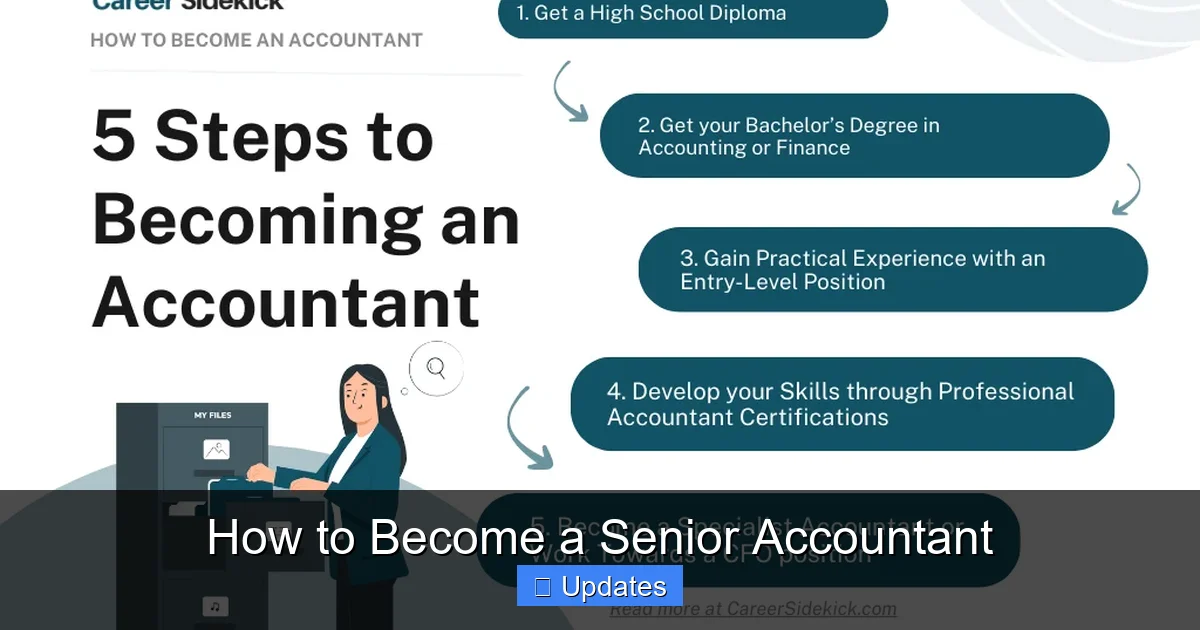
Certifications aren’t just nice-to-haves—they’re gateways to advancement. For aspiring senior accountants, the gold standard is the Certified Public Accountant (CPA) credential. Other valuable options include the CMA (Certified Management Accountant) and CIA (Certified Internal Auditor).
Why Get Certified?
– Increased earning potential: According to the Bureau of Labor Statistics, CPAs earn significantly more than non-certified peers.
– Expanded job opportunities: Many senior roles explicitly require CPA status.
– Credibility with clients and employers: Certification shows commitment to ethical practices and continuous learning.
How to Become a CPA
The path varies slightly by state, but generally includes:
1. Completing 150 semester hours of college credit (including specific accounting/finance courses).
2. Passing the four-part Uniform CPA Exam (FAR, AUD, REG, BEC).
3. Gaining supervised work experience (usually 1–2 years under a licensed CPA).
4. Applying for licensure through your state board.
Tip: Start studying for the CPA exam early—even before graduation. Use free resources like Becker or Wiley CPAexcel, which offer structured study plans and practice tests.
Alternatives: CMA and Other Credentials
If you lean more toward managerial or internal financial analysis, consider the CMA. Administered by IMA (Institute of Management Accountants), it focuses on decision support, performance management, and strategic planning—skills highly valued in senior accounting roles.
Other certifications worth exploring:
– ACCA (Association of Chartered Certified Accountants): Great if you’re interested in global careers.
– CFF (Certified in Financial Forensics): Ideal for fraud investigation or litigation support roles.
Step 3: Gain Practical Work Experience

Visual guide about How to Become a Senior Accountant
Image source: pridestafffinancial.com
No amount of theory beats real-world application. Employers want to see that you can handle ambiguity, meet deadlines, and communicate clearly under pressure.
Start Small—But Think Big
Begin in entry-level roles such as staff accountant, junior auditor, or accounts payable specialist. These positions teach you the daily rhythms of accounting: reconciliations, journal entries, invoice processing, and client interactions.
As you grow, seek out projects that challenge you:
– Volunteer to lead the annual audit prep.
– Propose process improvements to reduce closing time.
– Offer to train new hires during onboarding.
For instance, James worked at a mid-sized firm for three years before requesting a transfer to the tax department. His initiative led to a streamlined filing system that saved the company $50K annually. Six months later, he was offered a senior accountant role—not because he demanded it, but because his contributions spoke volumes.
Look Beyond Traditional Firms
While public accounting (Big Four included) offers great training, don’t overlook corporate, nonprofit, or government settings. Each environment develops different skill sets:
– Corporate: Budget forecasting, cost allocation, internal controls.
– Nonprofit: Grant reporting, donor compliance, fund accounting.
– Government: Public sector audits, grant management, transparency reporting.
Step 4: Develop Essential Skills for Senior Accountants
Technical knowledge gets you in the door—but soft skills keep you there. Senior accountants must juggle multiple stakeholders, explain complex concepts simply, and stay calm during crises.
Top Technical Skills
– Proficiency in accounting software: QuickBooks, Xero, NetSuite, SAP.
– Advanced Excel: PivotTables, VLOOKUPs, macros.
– Understanding of ERP systems: Oracle, Microsoft Dynamics.
– Knowledge of tax codes and compliance: IRS regulations, state filings.
Critical Soft Skills
– Leadership: Guide teams without micromanaging.
– Communication: Translate financial jargon into plain English for executives.
– Problem-solving: Diagnose discrepancies and propose solutions quickly.
– Time management: Juggle deadlines across departments during peak seasons (e.g., year-end closing).
Pro tip: Ask for feedback regularly. If your manager says you struggle with delegation, try assigning small tasks to interns and coaching them gently. Growth happens outside your comfort zone.
Step 5: Network and Build Your Professional Brand
You don’t have to shout from the rooftops—just show up consistently. Attend conferences, join LinkedIn groups, and participate in webinars. Share insights on social media (thoughtful commentary > self-promotion).
Join organizations like:
– American Institute of CPAs (AICPA)
– National Society of Accountants (NSA)
– Local chapters of regional CPA societies
These connections often lead to referrals, mentorship, and hidden job opportunities. Remember: people hire those they know, like, and trust.
Also, consider finding a mentor—someone already in a senior accountant role who can offer advice, review your resume, or introduce you to their network. You can find mentors through alumni networks, professional associations, or even casual coffee chats.
Step 6: Stay Updated and Keep Learning
Accounting rules change constantly. What was acceptable last year could be outdated tomorrow. Make continuing education a habit.
Subscribe to newsletters like:
– Journal of Accountancy
– Accounting Today
– IRS Bulletins
Take advantage of employer-sponsored training or free webinars hosted by platforms like Coursera or edX. Many cover emerging topics like blockchain in finance, ESG reporting, or AI-driven auditing tools.
Even better: volunteer for cross-functional projects. Shadowing the CFO’s team exposes you to strategic planning, investor relations, and risk assessment—all invaluable for senior-level thinking.
Overcoming Common Challenges
Every career path hits bumps. Here’s how to navigate them:
Lack of Immediate Advancement
It’s normal to feel stuck early on. Instead of waiting for promotions, take charge of your development. Create a personal learning plan, track your accomplishments, and document how your work impacts revenue or efficiency.
Balancing Work and Study Time
If pursuing CPA or CMA, schedule study sessions like appointments. Early mornings or lunch breaks work best for many people. Apps like Anki or Quizlet help turn commutes into review time.
Imposter Syndrome
Almost everyone feels unsure sometimes. Remind yourself: you were hired because you have something valuable to offer. Celebrate small wins—completed audits, positive client feedback, mastering a new software.
Conclusion: Your Path to Becoming a Senior Accountant
Becoming a senior accountant isn’t a sprint—it’s a marathon with pit stops for learning, growing, and adapting. It starts with solid education, fuels up with certifications, builds strength through experience, and sharpens your edge with ongoing learning.
But remember: this career is about more than spreadsheets. It’s about integrity, insight, and impact. When you combine technical mastery with emotional intelligence and curiosity, you don’t just fill roles—you transform them.
So whether you’re just starting out or ready to leap forward, take it one step at a time. Seek mentors, embrace challenges, and never stop asking “why?” The path to senior accountant status rewards persistence, passion, and purpose.
And who knows? Maybe someday, you’ll be the one mentoring the next generation of financial professionals. The journey begins now—and it’s worth every mile.
Frequently Asked Questions
How long does it take to become a senior accountant?
Most people reach senior accountant status after 5–7 years of progressive experience. This includes earning a bachelor’s degree (4 years), obtaining certification (6–18 months of study), and gaining hands-on roles in accounting. Accelerated paths exist for those with master’s degrees or prior relevant work history.
Do I need a CPA to become a senior accountant?
Not always, but it’s strongly recommended. Many senior accountant jobs—especially in public accounting or large corporations—prefer or require CPA certification. Even if not mandatory, earning your CPA dramatically increases your credibility, salary potential, and eligibility for leadership roles.
Can I become a senior accountant without a degree?
In rare cases, yes—but it’s unlikely. Most employers require at least a bachelor’s degree in accounting or a related field. Some community colleges offer associate degrees combined with on-the-job training, but advancement beyond entry-level typically demands formal education.
What industries hire senior accountants?
Senior accountants work in virtually every sector: public accounting firms, healthcare, technology, manufacturing, nonprofits, government agencies, and finance startups. Specialized fields like forensic accounting or tax consulting also offer unique pathways.
Is a master’s degree necessary?
No, but it helps. A master’s in accounting satisfies the 150-credit-hour requirement needed to sit for the CPA exam in most states. It also enhances your resume and opens doors to higher-level positions earlier in your career.
How much do senior accountants earn?
Salaries vary by location, experience, and industry. As of 2024, the average U.S. salary for senior accountants ranges from $70,000 to over $110,000 annually. Those with CPA credentials or in metropolitan areas often earn at the higher end.
