
Senior Citizens League 2026 Cola Prediction


Anti-Glare Reading Glasses

Slow Cooker Crock Pot

Robot Vacuum Cleaner
The Senior Citizens League (SCL) released its annual Social Security COLA prediction for 2026, estimating a modest increase that reflects ongoing economic shifts. This forecast is especially important for senior citizens relying on fixed incomes to cover rising healthcare and living costs. Understanding these projections helps retirees plan budgets, avoid surprises, and make informed financial decisions.
Key Takeaways
- What is the SCL? The Senior Citizens League is a nonprofit advocacy group focused on protecting Social Security and Medicare benefits for older Americans.
- 2026 COLA Estimate: The league predicts a 2.1% Cost of Living Adjustment (COLA) for 2026, slightly below recent averages but still significant for fixed-income households.
- Inflation Drivers: Rising healthcare expenses, housing costs, and prescription drug prices are key factors influencing the 2026 projection.
- Impact on Benefits: Even small percentage increases can add hundreds of dollars annually to monthly Social Security checks, improving financial stability.
- Planning Ahead: Seniors should review their budgets, consider supplemental income sources, and stay updated on policy changes affecting retirement security.
- Why It Matters: Accurate COLA predictions help retirees anticipate cost changes and avoid unexpected financial strain.
- How to Stay Informed: Follow trusted sources like the SCL and government agencies for real-time updates on Social Security adjustments.
📑 Table of Contents
- Introduction: What Is the Senior Citizens League 2026 Cola Prediction?
- Who Is the Senior Citizens League and Why Do They Matter?
- Breaking Down the 2026 COLA Forecast
- What Drives Inflation and Why It Affects Your Wallet
- Practical Tips for Maximizing Your COLA Increase
- Long-Term Planning Beyond the Next COLA
- Conclusion: Your Financial Future Starts Now
Introduction: What Is the Senior Citizens League 2026 Cola Prediction?
Have you ever wondered how much your Social Security benefits might grow next year? If you’re one of the millions of Americans counting on fixed retirement income, keeping an eye on the Cost of Living Adjustment—or COLA—is essential. That’s where the Senior Citizens League 2026 Cola prediction comes into play.
The Senior Citizens League (SCL) is a well-respected nonprofit organization dedicated to advocating for the rights and financial security of older adults in the United States. Every year, they analyze economic data, inflation trends, and government reports to forecast how much Social Security benefits will increase based on changes in the Consumer Price Index for Urban Wage Earners and Clerical Workers (CPI-W). These forecasts aren’t official, but they offer valuable insight for retirees who rely on timely updates to manage their finances.
In 2025, the SCL projected a 2.1% COLA for 2026—a number that may sound small, but it represents real money for seniors living on limited incomes. For someone receiving $1,800 per month, that extra 2.1% adds about $37 each month, or nearly $450 over the course of a year. When you consider rising costs for groceries, utilities, and especially healthcare, even modest increases can make a meaningful difference.
This article breaks down everything you need to know about the Senior Citizens League 2026 Cola prediction, including what drives these estimates, why they matter to everyday retirees, and how you can use this information to plan better for the future.
Who Is the Senior Citizens League and Why Do They Matter?

Visual guide about Senior Citizens League 2026 Cola Prediction
Image source: seniorsleague.org
Founded in 1979, the Senior Citizens League has become one of the most trusted voices in advocating for older Americans. Unlike political groups or lobbying firms, the SCL focuses specifically on preserving and enhancing Social Security and Medicare benefits. Their research is based on publicly available data from the Bureau of Labor Statistics and the Social Security Administration.
One reason the SCL’s predictions carry so much weight is their transparency. They don’t just throw out numbers—they explain how they arrive at them. For example, they look at historical CPI-W data, track inflation in categories that affect seniors most (like medical care and housing), and adjust for seasonal variations. This methodical approach gives retirees confidence that the projections are grounded in reality, not speculation.
It’s also worth noting that while the Social Security Administration makes the final call on COLA each October for the following year, many seniors find the SCL’s early forecasts helpful for budgeting and long-term planning. Think of it like checking the weather before deciding whether to bring an umbrella—you don’t want to be caught off guard by sudden rain (or in this case, a surprise drop in purchasing power).
Breaking Down the 2026 COLA Forecast
Visual guide about Senior Citizens League 2026 Cola Prediction
Image source: seniorsleague.org
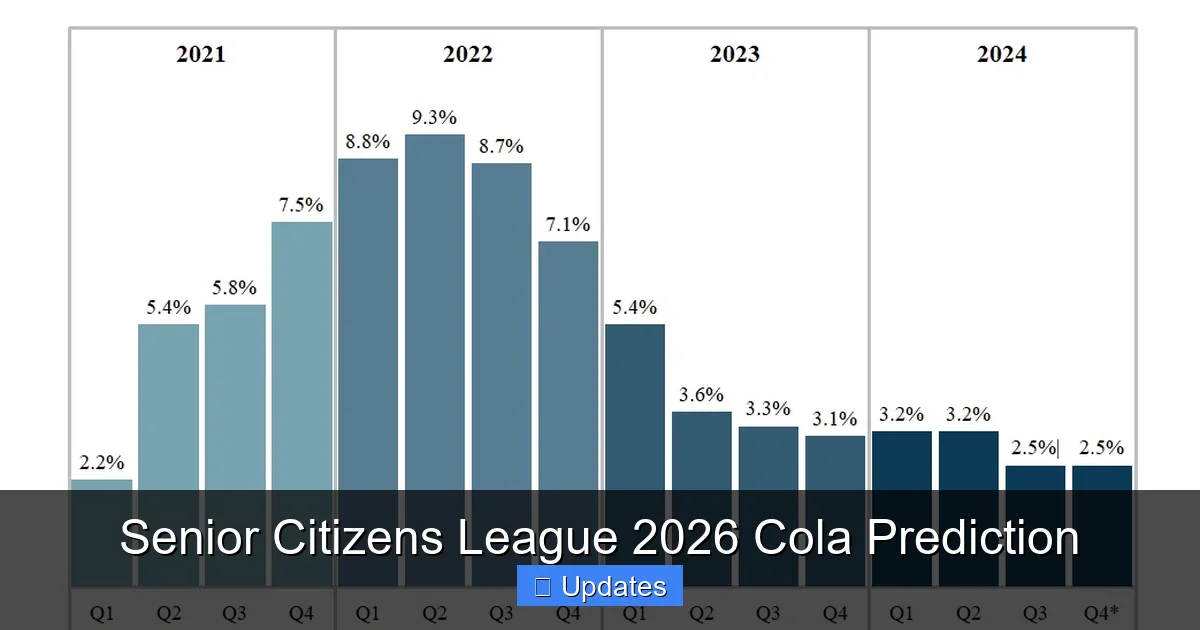
So what exactly does a “2.1% COLA” mean, and how was that number reached?
First, let’s clarify what COLA stands for: it’s an automatic adjustment to Social Security payments designed to help beneficiaries keep up with inflation. Each year, the SSA compares average CPI-W readings from July through September to those from the previous third quarter. If there’s an increase, benefits go up accordingly.
For 2026, the SCL used conservative assumptions based on recent trends. While inflation spiked dramatically during 2022 and 2023 due to supply chain disruptions and global events, it has since cooled significantly. Core inflation—which excludes volatile food and energy prices—has dropped below the Federal Reserve’s 2% target, suggesting slower price growth ahead.
That cooling trend is reflected in the SCL’s 2026 estimate. They factored in expected declines in healthcare costs (which had surged in recent years) and stable housing inflation, while still accounting for persistent pressures like prescription drugs and long-term care services. The result? A modest but realistic COLA that aligns with long-term economic forecasts.
How Does This Compare to Past Years?
To put the 2026 projection in context, here’s a quick look at recent COLAs:
– 2022: 5.9%
– 2023: 8.7%
– 2024: 3.2%
– Projected 2025: 2.8%
– Predicted 2026: 2.1%
As you can see, we’re returning to more normal levels after the pandemic-era spikes. While that’s good news in terms of sustainable inflation, it also means seniors can’t expect huge jumps in their monthly checks. Instead, the focus shifts to consistency and predictability—something the SCL’s model supports well.
Real-World Impact: How Much More Will You Get?
Let’s say you currently receive $2,200 per month in Social Security. With a 2.1% COLA in 2026, your new payment would be:
$2,200 × 1.021 = $2,246.20
That’s an extra $46.20 every month—or $554.40 over a full year. For many seniors, that covers a utility bill, a grocery run, or even a small splurge like dining out with friends.
Of course, actual amounts depend on your current benefit level, which is influenced by your work history, retirement age, and other factors. But regardless of your starting point, any increase helps stretch a fixed income further.
What Drives Inflation and Why It Affects Your Wallet
Visual guide about Senior Citizens League 2026 Cola Prediction
Image source: hadit.com
Understanding why inflation matters—and how it trickles down to your Social Security check—requires a closer look at the forces shaping the economy today.
Inflation doesn’t happen overnight. It builds slowly as prices rise across major spending categories. For seniors, certain areas hit harder than others. According to the SCL’s own research, healthcare costs have risen faster than overall inflation for years. Prescription medications alone saw double-digit hikes between 2020 and 2023, putting pressure on budgets already stretched thin.
Housing is another biggie. Even if you own your home outright, property taxes and homeowners’ insurance often climb annually. Renters face similar challenges as landlords pass along higher mortgage or maintenance costs. Utilities—electricity, gas, water—are no picnic either, especially during extreme weather events.
Food prices have stabilized somewhat since their 2022 peak, but staples like eggs, dairy, and meat remain unpredictable. And let’s not forget transportation: fuel costs fluctuate wildly, and public transit fares keep creeping upward.
All these pressures feed into the CPI-W index, which ultimately determines your COLA. So when the SCL says “2.1%,” they’re really saying “Here’s how much we think prices will climb in the next year based on what’s happening right now.”
Healthcare: The Silent Threat to Retirement Savings
If there’s one category that keeps financial planners up at night, it’s healthcare. Unlike most expenses, medical bills don’t always follow predictable patterns. A single ER visit or a new medication can wipe out weeks of savings.
That’s why the SCL pays close attention to trends in Medicare premiums, Part B and Part D costs, and out-of-pocket maximums. Even with coverage, seniors often pay thousands annually in co-pays, deductibles, and specialist fees.
Recent proposals to cap insulin prices or expand dental/vision coverage under Medicare could ease some of this burden. But until those policies take effect, rising premiums remain a top concern. That’s why accurate COLA forecasts are so crucial—they help seniors prepare for potential spikes in medical spending.
Housing and Utilities: Staying Warm and Dry Without Breaking the Bank
Imagine paying $200 more per month just to heat your home during winter. Or seeing your electricity bill jump by 15% because of outdated appliances and inefficient systems. These aren’t hypotheticals—they’re realities for many retirees.
Energy efficiency upgrades—like sealing windows, installing smart thermostats, or switching to LED lighting—can reduce bills significantly. Some local utility companies offer rebates for seniors making such improvements. Programs like LIHEAP (Low Income Home Energy Assistance Program) also provide emergency aid during crises.
But again, none of this happens automatically. It requires awareness, action, and sometimes upfront investment. That’s why knowing your expected COLA helps you decide whether to apply for assistance, shop around for cheaper providers, or prioritize home repairs.
Practical Tips for Maximizing Your COLA Increase
Now that you understand the Senior Citizens League 2026 Cola prediction, here are five practical steps to make the most of your increased benefits:
1. Review Your Monthly Budget Early
Don’t wait until December to think about your finances. Use January or February to map out where your money goes—and identify areas where the extra cash can do the most good. Prioritize essentials first: rent/mortgage, utilities, groceries, and prescriptions.
Consider using a simple spreadsheet or app like Mint or YNAB (You Need A Budget) to track inflows and outflows. Seeing your spending habits clearly makes it easier to allocate new funds wisely.
2. Automate Savings for Unexpected Expenses
Set aside a portion of your COLA increase into a separate savings account labeled “Emergency Fund” or “Medical Buffer.” Aim for at least $50–$100 per month. Over time, this cushion protects against surprise vet visits, appliance breakdowns, or temporary job loss.
Even better: open a high-yield savings account with a credit union or online bank. These typically offer rates 2–3x higher than traditional banks, meaning your emergency fund grows faster.
3. Shop Around for Cheaper Insurance Options
Medicare Advantage plans, Part D drug plans, and supplemental policies all change yearly. Use the official Medicare website (medicare.gov) to compare options during open enrollment (October–December). Small differences in premiums or coverage can save hundreds annually.
Also check if you qualify for Extra Help—a program that reduces Part D costs for low-income seniors. Eligibility depends on income and assets, so review your status annually.
4. Explore Discounts and Community Resources
Many communities offer free or subsidized services for seniors: meal delivery programs, shuttle rides, fitness classes, and legal aid clinics. Visit your local senior center or search “senior discounts near me” online.
Utilities sometimes offer reduced rates for fixed-income customers. Call your provider and ask about hardship programs or tiered pricing based on usage.
5. Avoid Scams Promising “Guaranteed” Returns
With interest rates low and inflation still present, it’s tempting to chase quick gains. But remember: anything promising guaranteed returns above 3–4% is likely a scam targeting vulnerable seniors.
Stick to FDIC-insured accounts, government bonds, or reputable financial advisors. If someone knocks on your door offering “exclusive investment opportunities,” walk away. Legitimate professionals never pressure clients or promise unrealistic results.
Long-Term Planning Beyond the Next COLA
While the Senior Citizens League 2026 Cola prediction focuses on the coming year, wise retirees think bigger. Consider these strategies for lasting financial health:
Create a Five-Year Spending Plan
Map out projected expenses for the next half-decade: travel dreams, family gatherings, home modifications, or end-of-life arrangements. Knowing what lies ahead prevents reactive spending and ensures your lifestyle remains comfortable.
Include buffer zones for inflation—not just for COLAs, but for general price hikes too. For example, if groceries typically rise 3% yearly, assume that rate continues unless evidence suggests otherwise.
Diversify Your Income Streams
Social Security shouldn’t be your only source of support. If possible, maintain part-time work, draw from retirement accounts strategically, or explore passive income ideas like rental properties or royalties.
Remember: compound interest works best when started young—but it’s never too late to begin. Even modest investments can grow substantially over time with consistent contributions.
Stay Engaged with Policy Changes
The SCL isn’t just about predicting COLAs—it’s about fighting for fair treatment. Sign up for their newsletters, attend virtual town halls, or contact your representatives about proposed legislation affecting Social Security solvency or benefit formulas.
Knowledge is power. The more you understand how policies impact your wallet, the better equipped you are to advocate for yourself.
Conclusion: Your Financial Future Starts Now
The Senior Citizens League 2026 Cola prediction isn’t just another headline—it’s a roadmap for smarter living. By understanding what drives COLA calculations, tracking inflation trends, and taking proactive steps today, you protect your hard-earned retirement years.
Whether you’re adjusting your budget, shopping for better insurance, or simply staying informed, every action counts. And remember: you’re not alone. Organizations like the SCL, nonprofits, and community centers exist to support you every step of the way.
Start small. Review your spending. Talk to a trusted advisor. Then build from there. Because when it comes to your financial security, knowledge truly is freedom.
—
Frequently Asked Questions
What does the Senior Citizens League 2026 COLA prediction mean for my Social Security check?
The SCL predicts a 2.1% Cost of Living Adjustment for 2026, which will increase your monthly Social Security payment based on your current benefit amount. This adjustment helps offset inflation and maintains your purchasing power over time.
Is the SCL’s COLA forecast official?
No, the Senior Citizens League provides estimates based on economic data and CPI trends. The final COLA is determined by the Social Security Administration each October.
How accurate are the SCL’s predictions?
Historically, the SCL’s forecasts have been within 0.2–0.3% of the actual COLA, making them highly reliable for planning purposes.
Can I appeal if my COLA seems too low?
No, COLAs are automatic and formula-based. However, you can advocate for policy changes through organizations like the SCL to improve long-term benefit growth.
What should I do with my increased COLA payment?
Prioritize essential expenses first, then consider saving a portion, paying down debt, or investing in cost-saving home improvements that boost comfort and efficiency.
Where can I get more details about the 2026 COLA?
Visit the official Senior Citizens League website or contact your local Social Security office for the latest updates and personalized advice.