
Plants by Olive Senior Analysis


Automatic Can Opener

GPS Tracker for Elderly

LED Clip Reading Light
This comprehensive analysis delves into the profound botanical imagery in Olive Senior’s work, revealing how plants serve as complex archives of Caribbean history, sites of resistance, and metaphors for identity. We examine poems like “Plants” and “Gardening in the Tropics” to uncover layers of colonial trauma, ecological wisdom, and feminist reclamation. The exploration provides essential insights for literary students and anyone interested in postcolonial ecology.
Key Takeaways
- Plants as Historical Archives: Senior uses plants not just as nature, but as living documents that store the memory of slavery, colonialism, and indigenous knowledge systems in the Caribbean.
- Weeds as Metaphors for Resistance: “Weeds” symbolize the resilient, uncontrollable spirit of the colonized, thriving despite attempts at eradication and representing cultural survival.
- Gardening as a Political Act: The act of cultivation, especially by women, becomes a subtle yet powerful form of defiance against colonial order and a way to preserve autonomy.
- Gendered Botany: Senior often links plant life to female bodies, sexuality, and wisdom, challenging patriarchal and colonial narratives that control both land and women.
- Ecology of Trauma and Healing: The Caribbean landscape is portrayed as wounded by colonial exploitation, yet its flora also holds the keys to spiritual and communal recovery.
- Intertextuality with Folk Tradition: Her plant symbolism is deeply rooted in Afro-Caribbean and indigenous folklore, connecting literary analysis to broader cultural memory.
📑 Table of Contents
- Introduction: The Silent Witnesses of History
- Chapter 1: Roots as Archives—Botanical Memory of Colonial Violence
- Chapter 2: The Weed’s Rebellion—Botanical Anarchy and Survival
- Chapter 3: The Feminist Garden—Cultivation as Subversion
- Chapter 4: The Wounded Landscape—Ecology of Trauma and Recovery
- Chapter 5: Intertextual Roots—Folklore, Myth, and the Plant Kingdom
- Conclusion: The Unfinished Business of the Garden
Introduction: The Silent Witnesses of History
When we approach the poetry of Jamaican writer Olive Senior, we encounter a mind deeply attuned to the natural world. But her relationship with plants, trees, and flowers is far from a simple pastoral appreciation. In her seminal collections, particularly Gardening in the Tropics (1986), plants become the central protagonists in a drama of historical memory and cultural identity. A plants by olive senior analysis requires us to listen to what these silent witnesses have to say about the Caribbean’s layered past. Senior’s botanical universe is one where a ginger root can hold the pain of the middle passage, a mango tree can mark a boundary of stolen land, and a stubborn weed can declare the persistence of life against all odds. This article will unpack that dense symbolism, moving from the colonial archive to the feminist garden, to understand why her plant-centric lens remains one of the most potent frameworks for postcolonial literary study.
Her work asks us to reconsider the very ground we walk on. For too long, the Caribbean landscape was seen only through the colonial gaze—as a resource to be extracted, a wilderness to be tamed, or a paradise to be consumed. Olive Senior reverses this. She makes the plants themselves the narrators. They are the keepers of secrets, the repositories of trauma, and the sources of an alternative, rooted knowledge. This analysis will show how her poetry performs an act of retrieval, digging up stories that official histories tried to bury. We will see how her precise, often scientific, naming of plants is itself a political act, reclaiming taxonomy from the colonizer’s ledger. It is a conversation between the earth and the pen, and the messages are urgent.
Chapter 1: Roots as Archives—Botanical Memory of Colonial Violence
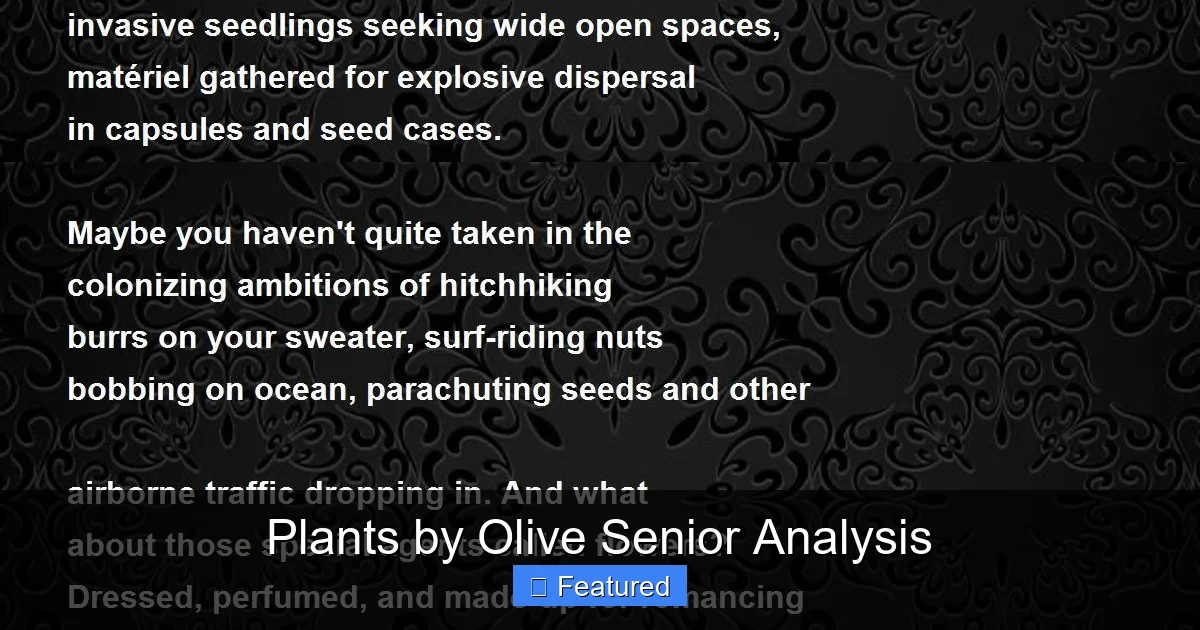
The most immediate layer in a plants by olive senior analysis is the concept of plants as historical archives. Senior does not use flora decoratively; she uses it as evidence. In poems like “The Pain Tree” and throughout Gardening in the Tropics, specific plants are tethered to specific violences of the plantation economy. The sugar cane, for instance, is never just a crop. It is the “green ghost” that stalks the land, its sweetness masking a history of blood and bone. The ginger root, often mentioned, becomes a metaphor for something buried deep, forced to sprout in darkness—a clear echo of the conditions of enslaved Africans. This is botany as testimony.
Visual guide about Plants by Olive Senior Analysis
Image source: poemhunter.com
The Ginger Root: A Buried History
In her poem “Ginger,” Senior writes of the root that “grows in the dark.” On the surface, it describes cultivation. But the subtext is unmistakable. The ginger rhizome spreads underground, hidden but expansive, much like the cultural memory and spiritual practices that enslaved people preserved and nurtured in secret. The act of digging it up is an act of recovery. When Senior’s speaker handles the ginger, she is handling a piece of that buried history. The pungent, medicinal smell of ginger also connects to Afro-Caribbean healing traditions, a knowledge system that operated alongside and in resistance to the colonial plantation’s “scientific” racism. This is where her analysis gets rich: the plant’s biological properties become a metaphor for cultural resilience and covert knowledge transmission.
This botanical archive concept extends to trees. The old, massive trees on a former plantation are not just scenery; they are witnesses. They may have provided shade for the field slaves or timber for the planter’s house. Their rings count years of both oppression and endurance. Senior’s meticulous attention to species—ackee, breadfruit, poinciana—forces the reader to stop and consider the biography of each plant. What hands planted this? What events has it weathered? Who ate its fruit, and under what conditions? This method turns the Caribbean landscape into a palimpsest, and the plants are the legible text beneath the erasures of official history. It’s a powerful tool for decolonizing the very perception of the environment.
Chapter 2: The Weed’s Rebellion—Botanical Anarchy and Survival
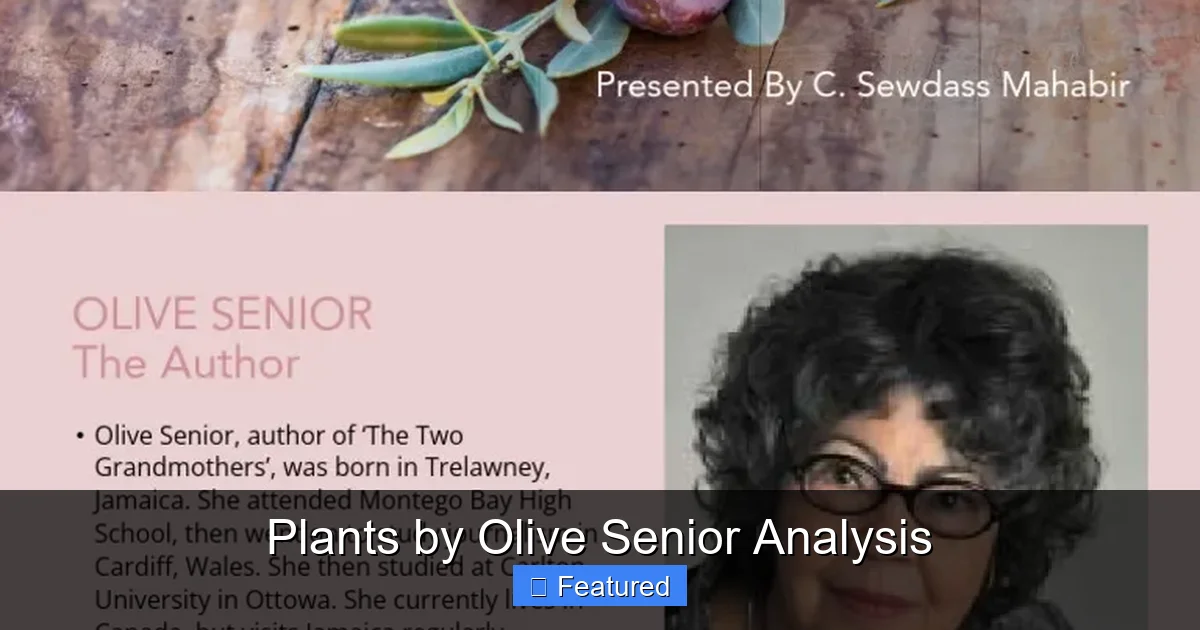
If the cash crops represent the imposed colonial order, then the weeds represent its inevitable, chaotic failure. One of the most potent symbols in a plants by olive senior analysis is the weed. Senior elevates the dandelion, the grass that cracks concrete, the vine that strangles the fence. These are not just plants; they are anarchists. In her essay “The Pain Tree,” she explicitly writes: “Weeds are the survivors.” This is a direct commentary on the Caribbean’s indigenous and African-derived populations who, like weeds, could not be fully eradicated by the brutal systems of slavery and indenture. They adapted, hybridized, and thrived in the margins.
Visual guide about Plants by Olive Senior Analysis
Image source: imgv2-1-f.scribdassets.com
An “Ecology of the Oppressed”
The weed is a master of ecology. It grows where it is not wanted, in the “cracks of the pavement” of colonial infrastructure. It reproduces aggressively, without permission. It is often medicinal, practical, and free. Senior aligns this botanical characteristic with the survival strategies of the enslaved and the peasant. Cultural practices—Obeah, folk medicine, storytelling, syncretic religion—were the “weeds” of the Caribbean mind. The colonizer’s “civilized” garden (the plantation) was constantly infiltrated by these wild, resilient elements. The very “tropical lushness” that tourists consume is, in part, the legacy of this weedy rebellion, a chaotic, beautiful mix that defies neat categorization. Senior’s poetry sings the praises of this untamed diversity. It is an argument against the monoculture of the plantation, both agricultural and cultural.
Consider the practical example: a poem describing a patch of “wild mint” growing beside a road. The colonial state might see it as a nuisance to be sprayed. The local healer sees a remedy for stomach ailments. Senior’s poetic lens sees both, but ultimately privileges the healer’s knowledge. The weed, therefore, is a site of epistemological conflict. It represents a different way of knowing and being in the world—one based on adaptation, utility, and connection to place, as opposed to the colonial logic of control, extraction, and profit. To analyze Senior’s plants is to analyze this ongoing, quiet war waged in the soil.
Chapter 3: The Feminist Garden—Cultivation as Subversion
Gardening, in the context of a plantation society, is a profoundly gendered and political act. For the enslaved woman, the small plot she might tend—the “provision ground”—was a critical space of semi-autonomy. It was where she could grow food for her family, sometimes even for a small market, and cultivate medicinal herbs. This was not just subsistence; it was an economic and spiritual lifeline outside the direct control of the plantation owner. Olive Senior, as a feminist writer, zeroes in on this space. Her Gardening in the Tropics is not a manual for colonial estate gardens; it is a testament to the knowledge and labor of women.

Visual guide about Plants by Olive Senior Analysis
Image source: playback.fm
Herbs, Healing, and Female Knowledge
The garden in Senior’s work is a pharmacy and a shrine. Plants like fever grass (lemongrass), cerasee (bitter melon), and aloe vera are not just items; they are the tools of a matriarchal healing tradition. This knowledge was passed down through generations of women, often orally and experimentally, in direct opposition to the “scientific” medicine of the colonizer, which was often inaccessible or hostile. When Senior writes about these plants, she is validating an entire epistemology that was dismissed as superstition. The act of planting, weeding, and harvesting becomes an embodied form of resistance—a way to assert control over one’s body and community’s health in a system designed to deny that control.
This connects powerfully to the theme of the body. The garden is often a metaphor for the female body. The soil, the seeds, the cycles of planting and harvest mirror fertility, sexuality, aging, and nurture. In a society that hypersexualized and brutalized the Black female body, Senior’s poetic equation of the body with a fertile, productive, and self-sustaining garden is a radical reclamation. It shifts the narrative from one of violation to one of generative power. The woman tends her garden; therefore, she tends her own existence and her community’s future. This is a crucial layer in any plants by olive senior analysis: understanding how botanical imagery is inseparably linked to her feminist politics.
Chapter 4: The Wounded Landscape—Ecology of Trauma and Recovery
Senior’s environmental vision is not purely celebratory of resilience; it is also mournful and diagnostic. She does not shy away from depicting the ecological damage inflicted by colonialism. The Caribbean landscape is shown as wounded: soil eroded from monoculture, rivers polluted, native forests cleared for export crops. The plants themselves can show signs of this trauma—stunted growth, blight, invasive species overwhelming natives. This ecological reading is central to her work. The trauma of the land is mirrored in the trauma of the people. The “sugar estates” leave behind not just social structures but a changed, often degraded, ecology that communities must now inhabit and heal.
Healing the Land, Healing the Self
But Senior is not a nihilist. Her poetry consistently looks for pathways to recovery, and they often run through the botanical. The recovery of traditional agricultural practices—the intercropping of the “home garden,” the use of organic methods—is portrayed as part of healing. Reconnecting with the specific, named flora of the islands is an act of belonging. When a character in her story “Summer Lightning” recognizes a particular tree, it signifies a rootedness that contrasts with the alienation of urban or diaspora life. The knowledge of plants—their names, their uses, their stories—becomes a form of cultural citizenship. To know the land is to claim a stake in it, to counter the colonial narrative of being uprooted or placeless.
This has practical implications for contemporary discussions about climate change and sustainable development in the Caribbean. Senior’s work, written decades ago, anticipates eco-critical thought. She suggests that environmental repair is impossible without cultural and historical repair. You cannot simply plant new trees; you must also understand the stories of the trees that were cut down. Her analysis implies that a postcolonial ecology must be rooted in local knowledge and memory, not imported scientific models that may repeat patterns of control. The garden, then, is a model for a sustainable future—diverse, polycultural, and tended with intimate, inherited knowledge. It’s a powerful counter-narrative to the extractive, monocultural past.
Chapter 5: Intertextual Roots—Folklore, Myth, and the Plant Kingdom
A full plants by olive senior analysis must venture into the rich soil of Caribbean folklore, where plants are saturated with supernatural significance. Senior’s work is deeply intertextual, constantly in conversation with Anansi stories, Obeah beliefs, and indigenous myths. The “Obeah man” or “sister” in her poems is rarely without a bundle of herbs. The “duppy” (ghost) is often associated with specific trees like the silk-cotton (kapok) tree, considered a haunted, liminal space. These are not just cultural references; they are integral to her poetic system. The plants carry the weight of these stories.
The Silk-Cotton Tree: A Portal and a Warning
The silk-cotton tree (Ceiba pentandra) is a prime example. In West African and Caribbean tradition, it is a sacred tree, a connection between the worlds of the living and the ancestors, but also a place of danger where spirits dwell. When Senior invokes it, she taps into this deep well of meaning. It becomes more than a botanical specimen; it is a symbol of spiritual power, of history that is not past but hauntingly present. To ignore this folklore is to miss half the meaning. Her poetry acts as a bridge, translating these traditional beliefs into a modern literary language while preserving their potency. This layer connects the individual plant to the collective unconscious of the diaspora.
This intertextuality also serves an archival function. Many of these plant-based folktales were dismissed by colonial ethnographers as primitive. Senior reclaims them, placing them at the center of a sophisticated literary project. She shows that this folklore is a sophisticated, if non-Western, system of ecology, ethics, and history. The story of the “jumbie” (spirit) who lives in the bamboo clump is also a lesson about respecting certain habitats. The use of specific leaves in protection spells is a form of botanical knowledge. By weaving these elements in, Senior argues that the Caribbean literary tradition must be rooted in this syncretic, plant-filled folk memory to be authentic. Her analysis is therefore also an act of cultural preservation and validation.
Conclusion: The Unfinished Business of the Garden
To conduct a plants by olive senior analysis is to engage in an act of listening—to the whispers of the ginger in the dark, to the defiant rustle of the weed, to the quiet wisdom of the herbalist, and to the haunting stories of the silk-cotton tree. Olive Senior teaches us that the Caribbean is not a passive landscape but a text written in chlorophyll and memory. Her plants are complex characters: they are victims, resistors, healers, and archivists. They hold the story of a world made by violence but sustained by an incredible, stubborn vitality. Her work is a vital corrective to any view of the tropics as merely a scenic backdrop or a simple paradise. It is a call to read the land itself as a primary source for understanding history, identity, and future.
For the reader and the scholar, Senior’s botanical lens offers a methodology. It asks us to be more attentive to the specific flora of any place we inhabit or study. What are the native plants? What are the invasive ones? What stories do they carry? Whose labor is embedded in their cultivation? How are they gendered? This approach expands literary analysis into the environmental, the historical, and the folkloric all at once. Ultimately, Olive Senior’s garden is not a finished, manicured space. It is wild, weedy, resilient, and full of secrets waiting to be unearthed. The analysis is never complete; it is an ongoing practice of digging, naming, and remembering. Her poetry ensures we will never look at a simple plant the same way again.
Frequently Asked Questions
What is the central metaphor of plants in Olive Senior’s poetry?
Plants primarily serve as living archives and metaphors for Caribbean historical memory, embodying the trauma of colonialism and slavery while also symbolizing cultural resistance, survival, and feminist knowledge. They are active participants in the narrative, not passive scenery.
How does Olive Senior connect plants to feminist themes?
Senior links gardening—traditionally women’s work—to female autonomy and knowledge. The “home garden” becomes a space of economic and spiritual independence from the patriarchal plantation system. Plants are also metaphorically connected to the female body, reclaiming it from colonial objectification and associating it with fertility, nurture, and natural power.
What is the significance of “weeds” in her work?
Weeds are powerful symbols of resilience and anarchy. They represent the cultures, practices, and peoples that the colonial system could not eradicate. They thrive in margins, adapt aggressively, and are often medicinal, embodying an “ecology of the oppressed” that defies the ordered, extractive logic of the plantation.
Does Olive Senior’s analysis of plants have a political purpose?
Absolutely. Her botanical focus is a decolonizing act. It challenges the colonial view of the Caribbean landscape as a resource to be exploited or a paradise to be consumed. By centering local plant knowledge and folklore, she validates indigenous and African-derived epistemologies and asserts a cultural identity rooted in specific place and history.
How does folklore feature in her plant symbolism?
Plants are deeply interwoven with Caribbean folklore and spiritual practices like Obeah. Trees like the silk-cotton are portals to the spirit world. Herbs are tools for healing and protection. Senior’s poetry taps into this rich symbolic reservoir, showing how folk traditions encode sophisticated ecological and historical knowledge dismissed by colonizers.
What is the overall message of Olive Senior’s “Gardening in the Tropics”?
The collection argues that gardening—understood broadly as cultivating land, knowledge, and culture—is a fundamental act of survival and identity formation for postcolonial Caribbean people. It is through this intimate, knowledgeable relationship with the land and its plants that communities can heal from historical trauma and build a self-determined future.