
What Is a Senior Associate


Sudoku Puzzle Book

Sock Aid for Seniors

Medical Alert System
A senior associate is a mid-to-senior level professional, typically in fields like law, consulting, finance, or accounting, who has gained significant experience and autonomy beyond a junior associate. They often manage complex projects, mentor junior staff, and serve as a key client or team contact. This role is a critical stepping stone toward partnership or director-level positions, requiring a blend of deep technical expertise and soft leadership skills.
Key Takeaways
- Senior Associate is a mid-senior professional title: It signifies 4-7 years of experience, placing it above junior/associate roles but below manager/partner levels.
- Core duties involve ownership and mentorship: They lead project components, manage junior staff, and handle direct client or stakeholder communication.
- The role is a critical career bridge: Performance as a senior associate directly determines promotion to manager, vice president, or partnership tracks.
- Skills required are a hybrid of expert and leader: Deep functional knowledge must be paired with project management, delegation, and client relationship skills.
- Compensation reflects increased responsibility: Salaries are significantly higher than junior associates, often with bonus structures tied to performance and revenue generation.
- Industry context matters: The exact scope and title can vary substantially between law firms, investment banks, consulting firms, and corporate departments.
[FEATURED_IMAGE_PLACEHOLDER]
📑 Table of Contents
- What Is a Senior Associate? Your 2026 Career Guide
- The Core Definition: More Than Just a Title
- A Day in the Life: What Does a Senior Associate Actually Do?
- Senior Associate vs. Other Titles: Where Does It Fit?
- The Path to Becoming a Senior Associate
- Compensation and Career Trajectory in 2026
- The Evolving Role: Senior Associates in the 2026 Workplace
- Conclusion: The Senior Associate as the Firm’s Engine
What Is a Senior Associate? Your 2026 Career Guide
You’re scrolling through job postings or updating your LinkedIn profile, and you keep seeing it: “Senior Associate.” It sounds important, more senior than just “Associate.” But what does it really mean in today’s professional landscape? Is it a manager? Is it a boss? The truth is, the title “senior associate” is a powerful and specific rank in the professional hierarchy, and understanding it is key for anyone navigating a career in fields like law, finance, consulting, or large corporate services.
Think of a professional services firm as a ladder. At the bottom, you have interns and analysts. Then come the junior associates—eager learners doing the foundational work. The next rung up? That’s the senior associate. This isn’t just someone who’s been around longer. They are the workhorses of the firm, the trusted experts who own meaningful pieces of the business. They are the first line of leadership for project teams and often the person clients start to know by name. In 2026, with hybrid work models and flattened hierarchies in some sectors, the senior associate role has evolved. It now demands more autonomy, better communication skills, and a clearer demonstration of business impact than ever before.
This guide will unpack everything. We’ll define the role in plain terms, walk through a typical day, compare it across industries, and give you the honest truth about what it takes to get there and succeed. Whether you’re aiming for this title or working with a senior associate, this is your playbook.
The Core Definition: More Than Just a Title
At its heart, a senior associate is a professional with a proven track record of expertise and increasing responsibility within their functional area. They have moved beyond the “learning” phase and are now in the “doing and leading” phase. The “associate” part of the title typically denotes that they are not yet part of the ownership group (partners, principals, managing directors) but are on a clear track toward it. The “senior” modifier is the crucial differentiator, signaling a shift from task-execution to project-ownership and mentorship.

Visual guide about What Is a Senior Associate
Image source: azmilaw.com
Experience Level: The 4-7 Year Rule
While not a strict law, a senior associate usually has between 4 and 7 years of post-graduate, relevant experience. A fresh law school graduate is a “first-year associate.” By their fourth or fifth year, if they’ve demonstrated competence, they are promoted to senior associate. In investment banking, the progression might be Analyst (2-3 years) -> Associate (2-3 years) -> Vice President. In this context, “Senior Associate” can be a formal title for a high-performing third-year associate or a standalone role before VP. The key is the consistent theme: proven ability to work independently on complex matters.
Autonomy and Scope of Work
The single biggest change from a junior associate is autonomy. A junior associate needs detailed instructions and frequent check-ins. A senior associate is given an objective and the framework to achieve it. They determine the “how” and the “when” for their portion of a project. For example:
- A junior marketing associate might draft a social media post based on a detailed brief.
- A senior marketing associate would develop the campaign strategy for a product launch, assign tasks to juniors, manage the budget, and report results to the manager.
This increased scope means their work has a more direct impact on the team’s and firm’s success. Their mistakes are costlier, but their successes are more visible.
A Day in the Life: What Does a Senior Associate Actually Do?
Forget the sterile job description. Let’s paint a picture. A senior associate’s day is a dynamic mix of deep work, collaboration, and people management. It’s rarely a 9-to-5 job, especially in client-facing fields.
Visual guide about What Is a Senior Associate
Image source: greatsenioryears.com
Project Leadership and Execution
This is the meat of the role. A senior associate is the “project manager” for their assigned workstream. They take the strategy from a manager or partner and build the execution plan. They are responsible for:
- Planning: Breaking down a large deliverable (a legal memo, a financial model, a consulting deck) into tasks with timelines.
- Delegating: Assigning those tasks to first- and second-year associates or analysts, based on skill and development needs.
- Quality Control: Reviewing all work before it goes to the manager. They are the final quality gate, catching errors and ensuring consistency.
- Problem-Solving: When a roadblock appears—a missing data point, a legal conflict, a client demand—the senior associate is the first one expected to solve it before escalating.
Mentorship and Team Development
Senior associates are the primary mentors for junior staff. This is a non-negotiable part of the job. It includes:
- On-the-fly coaching: Sitting with a junior associate to walk through a complex Excel model or explain a legal precedent.
- Formal feedback: Providing constructive performance reviews that help juniors improve.
- Career counseling: Offering advice on which cases to take, which training to pursue, and how to navigate firm politics.
- Being a role model: Their professionalism, work ethic, and client demeanor set the tone for the entire team.
Client and Stakeholder Interaction
This is a major differentiator from junior roles. Senior associates are the “face” of the team for much of the day-to-day interaction.
- They lead client update calls and meetings.
- They field questions and manage expectations directly.
- They translate complex technical details into understandable language for clients.
- They often have direct relationships with mid-level client contacts, building the network that will later become their own book of business.
Senior Associate vs. Other Titles: Where Does It Fit?
The title landscape can be confusing. “Senior Associate” exists in a specific ecosystem. Here’s how it stacks up.

Visual guide about What Is a Senior Associate
Image source: resumekraft.com
Senior Associate vs. (Junior) Associate
This is the most direct comparison. The junior associate is in a training role. Their work is heavily reviewed. They are learning the tools of the trade. The senior associate is in a production and oversight role. Their work is reviewed for high-level strategy and client alignment, not basic errors. The senior associate is responsible for the junior associate’s output.
Senior Associate vs. Manager / Vice President / Director
This is the promotion line. The manager/VP/director operates at a higher strategic level. They are more focused on:
- Business development: Originating new work, pitching to clients.
- Firm management: Budgeting for large projects, managing multiple teams, contributing to firm strategy.
- Ultimate client relationships: Nurturing C-suite relationships.
The senior associate is the right-hand person executing on the manager’s strategy. They are being groomed to take on that strategic and commercial role. A key test for promotion is whether the senior associate can start generating their own work or bringing in smaller clients.
Senior Associate vs. Specialist / Lead Consultant
In some tech or consulting firms, a “Specialist” or “Lead Consultant” might be an individual contributor track. They are the absolute technical experts but do not have direct reports. A senior associate, by contrast, almost always has some form of people management responsibility, even if it’s just for interns on a project. The senior associate path is inherently a leadership track.
The Path to Becoming a Senior Associate
This promotion is not automatic. It’s a competitive evaluation. Firms look for a specific profile.
Typical Timeline and Performance Metrics
As mentioned, the timeline is usually 4-7 years from entry-level. But time is not the main factor; performance is. Firms assess:
- Technical Proficiency: Can you do the core job flawlessly? Are you the “go-to” person for a specific complex skill?
- Workload Management: Can you juggle multiple projects with competing deadlines without dropping the ball?
- Client Feedback: Do clients specifically request you or praise your work? This is golden.
- Mentorship Impact: Are your junior team members improving because of your guidance? Do they want to work for you again?
- Commercial Instinct: Do you show an interest in the business side? Do you identify opportunities for additional work for the client?
Essential Skills for the Leap
To make the jump, you must develop skills beyond your technical expertise:
- Delegation: The hardest skill for many high-performers. You must learn to let go of tasks and trust others, even if they do it differently or slower initially.
- Influencing Without Authority: You need to get buy-in from peers, junior staff, and sometimes even managers. This requires persuasion, not commands.
- Executive Communication: Writing succinct, impactful emails and presenting confidently to senior clients and firm leadership.
- Commercial Awareness: Understanding how your work contributes to the firm’s profitability. Thinking about “what’s next” for the client.
Compensation and Career Trajectory in 2026
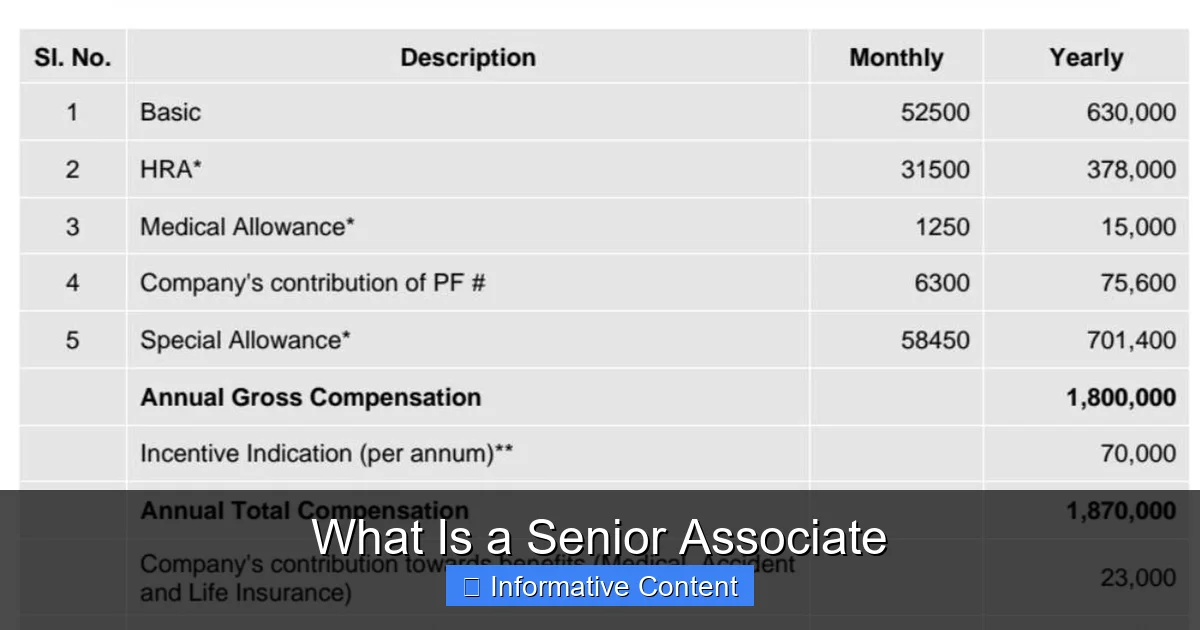
Let’s talk numbers and the future. The senior associate compensation is a significant jump from the associate level and is designed to retain top talent.
Salary and Bonus Expectations
In 2026, compensation varies wildly by industry and geography. However, as a general guide in major U.S. metropolitan areas:
- Law (BigLaw): Base salary for a 5th-year senior associate might range from $250,000 to $350,000+, with a potential bonus of 10-30% based on firm performance and individual hours.
- Management Consulting (MBB): A senior associate (or “Consultant” at some firms) can see total compensation in the $200,000 – $280,000 range.
- Investment Banking: A third-year associate (often equivalent to a senior associate elsewhere) might have a base of $175,000-$200,000 with bonuses that can double that total in a good year.
The bonus component is critical. It’s not just a gift; it’s a direct reflection of your contribution to the firm’s revenue and your utilization (billable hours or chargeable work).
The Next Steps: What Comes After Senior Associate?
This is the million-dollar question. The typical path is promotion to Manager (in consulting/corporate) or Vice President (in banking). In law firms, the next step is often “Of Counsel” or a direct push for partnership, which is a much longer and more competitive track. The key transition is moving from doing the work to originating the work. Your success will now be measured by your ability to build client relationships that generate new fees for the firm. This is where the mentorship and client skills you honed as a senior associate become your most valuable assets.
The Evolving Role: Senior Associates in the 2026 Workplace
The concept of a senior associate isn’t static. The workplace in 2026 is shaping this role in new ways.
Hybrid Work and Digital Fluency
The era of face-to-face mentorship is challenged. Senior associates in 2026 must be masters of virtual collaboration. They need to build trust and coach teams over Zoom, manage projects in Asana or Monday.com, and communicate nuance through written channels. The ability to create connection and clarity in a digital environment is a superpower.
Specialization vs. Generalization
There’s a growing trend toward hyper-specialization. A senior associate might be “the ESG regulatory expert” or “the AI implementation lead” within a general practice. This deep niche expertise can make them indispensable and command higher premiums. However, the risk is becoming too narrow. The most successful senior associates balance deep expertise with broad business acumen.
The Push for Commercial Mindset Earlier
Firms are expecting commercial awareness at the senior associate stage, not just at the manager stage. They want you to understand your client’s industry, their competitors, and their business challenges. This isn’t about sales; it’s about providing smarter, more proactive advice that strengthens the relationship and naturally leads to more work. Reading trade publications, understanding P&L statements, and having informed opinions are now part of the job description.
Conclusion: The Senior Associate as the Firm’s Engine
So, what is a senior associate? They are the indispensable engine of a professional services firm. They are the expert who has moved beyond learning to creating. They are the first leader for many junior professionals. They are the primary conduit between the strategic vision of partners and the tactical execution of the team. It is a role defined by a unique tension: the pressure to produce flawless work while simultaneously developing the next generation of talent.
For those aspiring to it, the path is clear: master your craft obsessively, but deliberately practice your leadership and communication skills. Seek out mentorship responsibilities. Start thinking about the “why” behind the “what.” For those managing with senior associates, empower them with real ownership, provide honest feedback, and start including them in commercial conversations. Investing in the growth of your senior associates is the single best investment a firm can make in its own future leadership pipeline. In 2026 and beyond, the senior associate isn’t just a title on a business card. It’s a mindset of ownership, leadership, and relentless value creation.
Frequently Asked Questions
Is a senior associate a manager?
No, a senior associate is not typically a manager. They lead project teams and mentor junior staff, but they usually report to a Manager, Vice President, or Director. The key difference is that managers have broader responsibility for multiple projects, budgeting, and direct business development, while senior associates focus on deep execution and team leadership within their domain.
How many years does it take to become a senior associate?
The typical timeline is 4 to 7 years from entry-level (after undergraduate or graduate school). However, promotion is based on performance, not just tenure. A high-performing associate may be promoted faster, while others may take longer to demonstrate the required level of autonomy, technical skill, and leadership ability.
What is the salary difference between an associate and a senior associate?
The difference is significant. For example, in major markets, a first-year associate in law might earn $215,000, while a fifth-year senior associate could earn $300,000+ in base salary, plus a substantial bonus. The increase reflects the jump in responsibility, quality of work expected, and the senior associate’s role in generating firm revenue.
Can a senior associate work directly with clients?
Yes, and they should. Direct client interaction is a core part of the senior associate role. They lead day-to-day client meetings, provide updates, answer questions, and manage expectations. This builds the client relationships that are essential for future promotion to a manager or partner track.
What are the biggest mistakes a new senior associate makes?
Common pitfalls include: 1) Failure to delegate: Trying to do all the “hard” work themselves instead of teaching juniors. 2) Poor communication: Not providing clear instructions or timely feedback to their team. 3) Isolation: Focusing only on their own work instead of building relationships across the firm and with clients. 4) Not speaking up: Failing to share ideas or flag risks in meetings with senior leadership.
Is the senior associate track a dead-end if I don’t want to become a partner?
Absolutely not. The senior associate role is a prestigious and well-compensated position in its own right. Many professionals find deep satisfaction in being the expert practitioner and team leader without the intense pressure of origination (sales) that comes with partnership or director roles. It can be a long-term, rewarding career peak for those who love hands-on, complex work.