
What Are Good Hobbies for Seniors Who Like to Make Things?


Electric Food Chopper

Electric Jar Opener
Electric Heating Pad
Quick Answer
Good hobbies for seniors who like to make things include knitting, woodworking, sewing, quilting, pottery, painting, scrapbooking, gardening, baking, card making, model building, and simple home crafts. The best choice is something enjoyable, comfortable to do, and easy to adapt to changing energy or mobility; the National Institute on Aging also encourages older adults to take part in meaningful activities they enjoy.
Good places to start
- Useful crafts: Try knitting, crochet, sewing, woodworking, or simple home projects.
- Creative projects: Painting, pottery, collage, and card making offer plenty of freedom.
- Family keepsakes: Scrapbooks, recipe books, photo albums, and memory boxes make personal gifts.
- Low-pressure options: Adult coloring, simple clay work, and flower arranging can be done in short sessions.
- Food projects: Baking, bread making, preserves, and decorating cookies combine creativity with something useful.
The easiest way to choose
- Pick one small project that can be completed without buying a room full of supplies.
Some people relax by watching television. Others feel better when their hands are busy making something they can see, use, give away, or improve.
I think that second group has an advantage in retirement because there are dozens of hobbies that can grow with your interests. As of 2026, many traditional crafts are also easier to learn through community classes, libraries, videos, and beginner kits.
In This Guide
- What makes a good making hobby for seniors?
- What are the best creative hobbies for seniors who like to make things?
- Which hobbies let seniors make useful things?
- What can seniors make for family and friends?
- How do popular making hobbies compare?
- Can creative hobbies support healthy aging?
- What hobbies work with limited mobility or hand strength?
- How should a senior start a new craft hobby?
- Frequently asked questions
- Final takeaway
What Makes a Good Making Hobby for Seniors?
A good making hobby gives you a satisfying project without turning free time into another obligation. Comfort, curiosity, and a manageable learning curve matter more than age.
Definition: A making hobby is a leisure activity where you create, build, grow, repair, decorate, cook, or assemble something with your own hands and ideas.
I like hobbies that produce visible progress. Even a small finished item can make a session feel worthwhile.
Look for these qualities when choosing:
- Comfortable setup: You can work without awkward reaching, heavy lifting, or long periods in one position.
- Small starting point: Your first project can be finished in a few sessions.
- Adjustable difficulty: You can begin simply and learn harder techniques later.
- Useful result: You can display, wear, eat, use, repair, or give away what you make.
- Reasonable cleanup: The mess and storage needs fit your home.
- Personal interest: The activity sounds enjoyable before you buy supplies.
For example, someone who once enjoyed carpentry may like small wooden boxes instead of large furniture. A former gardener might prefer tabletop herbs or container arrangements.
The idea is adaptation, not giving up the creative part.
What Are the Best Creative Hobbies for Seniors Who Like to Make Things?
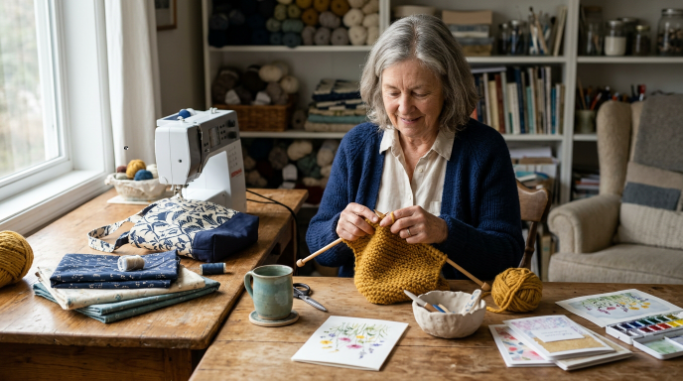
The strongest choices combine creativity with a clear finished result. They also allow beginners to improve without needing professional-level equipment.
Knitting and crochet
Knitting and crochet work well for people who enjoy repetitive, peaceful projects. Scarves, dishcloths, hats, baby blankets, and simple squares are practical beginner choices.
Start with thick yarn and a simple pattern. Large tools can also be easier to handle than tiny needles or hooks.
Sewing and quilting
Sewing can range from repairing a button to creating tote bags, cushions, clothing, or quilts. That flexibility makes it easy to match the hobby to your skill level.
Quilting is especially satisfying for people who enjoy color and pattern. Fabric from old clothes can also become part of a memory quilt.
Painting and drawing
You don’t need formal art training to enjoy watercolor, acrylic painting, sketching, or colored pencils. A small landscape or handmade card is enough for a first project.
I prefer simple subjects at the beginning. Flowers, leaves, houses, fruit, and abstract color patterns remove much of the pressure.
Pottery and air-dry clay
Clay gives you something physical to shape, which feels different from drawing on a flat page. Beginners can make small bowls, ornaments, plant markers, or decorative dishes.
Air-dry clay avoids the need for a home kiln. A local pottery class can offer more equipment when you want to go further.
Paper crafts and card making
Greeting cards, collage, paper flowers, and scrapbooking need relatively little space. They also create easy opportunities to make personal gifts.
Keep the first supply box small. Paper hobbies become cluttered quickly when every interesting sticker or tool comes home with you.
Section Takeaway: The best creative hobby is not the most impressive one. It is the one that makes you want to sit down and begin another project.
Which Hobbies Let Seniors Make Useful Things?
Some seniors enjoy creativity more when the final product has a job to do. Practical projects can make a hobby feel especially rewarding.
Woodworking
Woodworking does not have to mean building a dining table. Small shelves, birdhouses, boxes, picture frames, and simple repairs can provide plenty of challenge.
- Begin with lightweight pieces.
- Use a stable work surface.
- Choose projects with fewer cuts and joints.
- Wear suitable eye and hearing protection when using power tools.
- Avoid unfamiliar machinery until you have proper instruction.
Gardening and plant projects
Gardening is another form of making because you design, plant, shape, and care for something over time. Herb pots, succulent arrangements, window boxes, and terrariums work in small spaces.
The finished result keeps changing. That can make gardening feel less repetitive than crafts with a definite finish line.
Cooking and baking
Cooking is ideal for seniors who enjoy creating things but don’t want craft supplies around the house. Bread, soups, decorated cookies, jams, spice blends, and family recipes all offer room to experiment.
A handwritten recipe collection can become a second project. It preserves the story behind meals as well as the instructions.
Home repair and restoration
Repairing furniture, refinishing a small stool, restoring an old frame, or fixing household items can appeal to practical makers. The transformation is often more satisfying than buying something new.
Keep projects within your present strength and balance. Heavy furniture and risky electrical work are better left to someone with the right equipment and training.
What Can Seniors Make for Family and Friends?
Handmade gifts are especially meaningful because the project can carry a story. They do not need to be complicated or expensive.
Some of my favorite ideas are personal rather than elaborate:
- Family recipe book: Collect favorite recipes with short notes about who made them and when they were served.
- Photo scrapbook: Add names, dates, places, and memories beside family photographs.
- Knitted item: Make a scarf, hat, dishcloth, baby blanket, or simple throw.
- Handmade cards: Create birthday, holiday, thank-you, or blank note cards.
- Memory box: Decorate a box for photographs, letters, tickets, and small keepsakes.
- Wooden keepsake: Build a small frame, box, birdhouse, or sign.
- Food gift: Prepare cookies, bread, preserves, spice mixes, or another family favorite.
A project does not need perfect edges to matter. Small imperfections often make handmade objects feel more personal.
Teaching the skill can be part of the gift too. A grandparent and grandchild making the same recipe or craft creates something beyond the finished object.
How Do Popular Making Hobbies Compare?
The right hobby depends on what kind of making you enjoy and what your home comfortably supports. This comparison can narrow the field before you purchase supplies.
| Hobby | Good First Project | Hand Detail Needed | Space Needed | Best For |
|---|---|---|---|---|
| Knitting | Dishcloth or scarf | Medium | Very little | Quiet, repeatable projects |
| Painting | Simple watercolor | Low to medium | Small table | Creative freedom |
| Woodworking | Birdhouse or box | Medium | Moderate to large | Practical builders |
| Sewing | Tote bag or cushion | Medium to high | Small to moderate | Useful fabric projects |
| Air-dry clay | Small bowl | Low to medium | Small table | Hands-on shaping |
| Scrapbooking | One photo page | Medium | Small table | Family memory projects |
| Baking | Bread or cookies | Low to medium | Kitchen | Edible creations |
If you dislike clutter, painting or knitting may be easier to contain than woodworking. If you want something practical, cooking, sewing, gardening, or repair projects may feel more satisfying.
Can Creative Hobbies Support Healthy Aging?
Creative hobbies can be part of a healthy, engaged lifestyle, although no craft should be treated as a medical treatment. Enjoyment, learning, movement, and social contact are the more realistic benefits to look for.
The CDC describes healthy aging as maintaining physical, mental, and social health and well-being as we grow older. A hobby can touch several of those areas at once.
Learning keeps the activity interesting
A hobby usually asks you to remember techniques, solve small problems, and make decisions. Those challenges can turn an ordinary afternoon into active learning.
The National Institute on Aging’s cognitive health guidance notes research in which older adults learning quilting or digital photography showed memory improvement. It also cautions that evidence around long-term cognitive benefits is not definitive.
Creative activities may support well-being
The NIA has also reviewed research on participation in arts and healthy aging. Findings in areas such as music and visual arts are promising for well-being and social engagement, but researchers continue to study the effects.
That distinction matters. I would choose a hobby because you enjoy it, not because someone promises it will prevent a disease.
Making things can create social opportunities
A woodworking club, knitting group, pottery class, or community garden gives the hobby another dimension. You can compare ideas, ask for help, teach a technique, and share finished projects.
Health note: If a new hobby causes persistent pain, dizziness, numbness, unusual shortness of breath, or balance problems, stop and discuss the activity with your healthcare professional.
What Hobbies Work With Limited Mobility or Hand Strength?
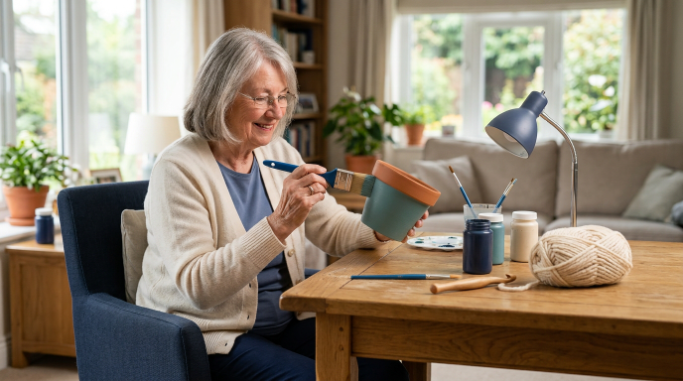
Limited mobility does not automatically rule out making hobbies. Changing the setup is often more useful than abandoning the activity.
Choose larger materials
Large brushes, thicker pens, chunky yarn, large crochet hooks, and bigger craft pieces can reduce the need for tiny movements. A magnifying task lamp can also make detailed work easier to see.
Bring the project to a comfortable height
A project should not require constant bending or reaching. A sturdy table, supportive chair, and supplies kept within easy reach can make a noticeable difference.
Use shorter sessions
A hobby session does not need to last two hours. Ten to twenty minutes can be enough to add a row of stitches, paint one section, or sort photographs.
- Break large projects into small stages.
- Pause repetitive hand work before discomfort builds.
- Use lightweight containers for supplies.
- Try voice-to-text when writing long captions or family stories.
- Choose seated versions of crafts when standing is tiring.
- Ask for help with cutting, lifting, or other difficult preparation steps.
The creative decisions should still belong to the person doing the hobby. Assistance works best when it removes a barrier without taking over the project.
How Should a Senior Start a New Craft Hobby?
Start smaller than you think you need to. Buying professional equipment before finishing one beginner project is one of the easiest ways to turn curiosity into expensive clutter.
- Choose one hobby. Pick the activity you feel most curious about today.
- Choose one small project. A scarf, card, painted flowerpot, birdhouse, or recipe is enough.
- Buy only basic supplies. Borrow tools or take a class before investing heavily.
- Try a short first session. Twenty or thirty minutes is enough to test the setup.
- Notice comfort and enjoyment. Change the chair, lighting, tools, or project size when needed.
- Finish something simple. Completion builds confidence faster than starting several complicated projects.
- Decide whether to continue. A hobby is optional; you don’t owe it loyalty if you dislike it.
Where can seniors learn a new making hobby?
Libraries, community centers, senior centers, craft stores, adult-education programs, makerspaces, and local clubs often offer beginner instruction. Online videos can also help when leaving home is difficult.
For tool-based hobbies such as woodworking, in-person instruction is especially useful. A knowledgeable teacher can demonstrate safe equipment setup before you practice alone.
What if the first hobby is not enjoyable?
Try something else. Finding a hobby is not a test you can fail.
I would rather see someone sample three inexpensive activities than force themselves to continue one they dread. The goal is to create a reason to look forward to the next session.
Frequently Asked Questions
What are easy crafts for seniors to make?
Easy choices include handmade cards, simple watercolor paintings, air-dry clay ornaments, knitted dishcloths, photo collages, decorated flowerpots, and scrapbooks. Start with a project that uses only a few materials and can be completed in one or two short sessions.
What are good hobbies for seniors who enjoy working with their hands?
Woodworking, knitting, crochet, sewing, gardening, pottery, model building, baking, painting, and furniture restoration are strong options. The best choice depends on hand comfort, available space, tool experience, budget, and whether the person prefers decorative or practical projects.
What can an elderly person make at home?
At home, an older adult can make cards, photo albums, knitted items, paintings, small clay projects, baked goods, recipe books, container gardens, floral arrangements, and simple woodworking projects. Choose activities that fit the home’s available workspace and storage.
Are creative hobbies good for retired people?
Creative hobbies can give retirement structure, enjoyment, learning opportunities, and a visible sense of progress. They can also become social through classes or clubs, but the hobby should be chosen for enjoyment rather than treated as a guaranteed way to prevent health problems.
What hobbies are suitable for seniors with arthritis or weaker hands?
Depending on individual comfort, options may include painting with larger brushes, collage, photography, flower arranging, chunky-yarn crafts, simple clay work, gardening with lightweight tools, and voice-assisted memory projects. Adaptive grips and shorter sessions may also help reduce unnecessary hand strain.
What are inexpensive hobbies for seniors who like making things?
Drawing, paper crafts, hand sewing, collage, simple baking, container gardening from cuttings, recycled-material crafts, and basic knitting can be inexpensive. Libraries, community centers, and shared workshops may also provide instruction or equipment without requiring a large upfront purchase.
Can seniors learn woodworking or sewing later in life?
Yes. Older adults can continue learning new skills, and both hobbies can be scaled from simple beginner projects to more advanced work. Start with appropriate tools, good lighting, a comfortable workstation, and hands-on instruction when machinery or unfamiliar equipment is involved.
Final Takeaway
Good hobbies for seniors who like to make things are the ones that turn time into something tangible. That might be a loaf of bread, a watercolor, a scarf, a repaired chair, a scrapbook, or a pot of herbs.
Start with one small project and basic supplies. If you enjoy coming back to it, you have probably found a hobby worth keeping.
