
Why Are Hobbies Important After Retirement? 7 Benefits That Matter


Lightweight Vacuum Cleaner

Back Massager with Heat

Adaptive Eating Utensils
Quick Answer
Hobbies are important after retirement because they can restore structure, provide a sense of purpose, encourage movement, keep your mind engaged, and create regular opportunities for social connection. The National Institute on Aging also encourages older adults to participate in meaningful activities they enjoy as part of healthy aging.
Why retirement hobbies matter
- Daily structure: Regular activities give your week comfortable routines without recreating a work schedule.
- Sense of purpose: Projects, learning, volunteering, and creative goals give you meaningful things to work toward.
- Mental engagement: Reading, music, crafts, games, and classes give your brain something interesting to practice.
- Social connection: Clubs, classes, volunteering, and group hobbies can replace some of the everyday contact lost after leaving work.
- Healthy movement: Walking, gardening, dancing, swimming, and similar hobbies can make physical activity more enjoyable.
A simple way to begin
- Choose one activity you genuinely enjoy and try it regularly for two to four weeks before deciding whether it belongs in your retirement routine.
Retirement gives you more control over your time, but that freedom can feel unfamiliar after decades of schedules and responsibilities. A good hobby helps turn open time into something you genuinely anticipate.
I don’t think retirees need to fill every hour. The better goal is to build a life with enough curiosity, movement, connection, and personal meaning to make ordinary days satisfying.
In This Guide
- Why do hobbies matter so much after retirement?
- Can hobbies give retirement more structure and purpose?
- How do hobbies keep your mind engaged?
- How can hobbies help retirees stay socially connected?
- Do active hobbies support physical health after retirement?
- What kinds of hobbies provide the most benefit?
- How do you choose a retirement hobby you’ll keep doing?
- Frequently asked questions
- Final takeaway
Why Do Hobbies Matter So Much After Retirement?
Hobbies matter because retirement changes more than your employment status. It may also change your routine, social network, responsibilities, and the ways you measure personal progress.
A retirement hobby is a voluntary activity you practice regularly for enjoyment, learning, creativity, movement, connection, or personal fulfillment. It doesn’t need to produce money or impress anyone.
Retirement can create an unexpected gap
Work provides built-in structure for many people. There are mornings to start, tasks to finish, coworkers to speak with, and problems to solve.
Once those routines disappear, even a welcome retirement can leave large stretches of unplanned time. Hobbies give some of that time a comfortable shape.
- Monday: Tend the garden or work on a home project.
- Wednesday: Meet friends for a walking group or card game.
- Friday: Attend an art, cooking, music, or technology class.
- Weekend: Spend an hour on photography, woodworking, reading, or another personal interest.
This isn’t about making retirement busy. It’s about having a few dependable reasons to look forward to tomorrow.
Enjoyment has value of its own
Retirement hobbies don’t need to become achievements. You can paint without becoming an artist and garden without producing perfect vegetables.
That freedom is part of their value. You can explore interests because they make your life richer, not because someone is evaluating the result.
Can Hobbies Give Retirement More Structure and Purpose?
Yes. A hobby can give you recurring plans, small goals, responsibilities, and visible progress without creating the pressure of a full-time job.
Purpose doesn’t have to mean finding one enormous mission for the rest of your life. Small commitments can matter too.
Hobbies create useful milestones
Many satisfying hobbies naturally contain a next step. That might be finishing a book, growing tomatoes, learning a song, completing a model, or walking a new trail.
Each step creates a modest sense of progress. That can be especially welcome when promotions, deadlines, and other workplace milestones disappear.
- Creative goal: Finish one watercolor painting this month.
- Learning goal: Practice a language for 15 minutes four days a week.
- Social goal: Attend one club meeting each week.
- Service goal: Volunteer two mornings each month.
- Outdoor goal: Visit one new park or walking route each month.
A schedule can stay flexible
One advantage of retirement is that hobbies don’t have to happen at rigid times. You can build routines around your preferred energy level, appointments, family responsibilities, and travel.
I prefer what I call a “light structure.” Pick two or three recurring activities, then leave enough open space for rest and spontaneity.
The National Institute on Aging recommends finding a balance because enjoyable activities should support your life rather than become stressful obligations.
How Do Hobbies Keep Your Mind Engaged?
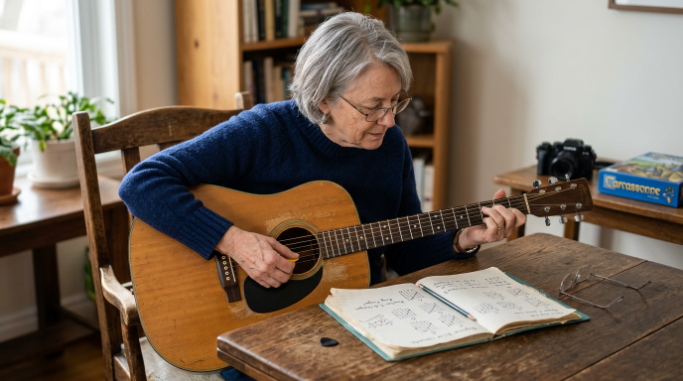
Hobbies can introduce new information, decisions, skills, and problems to solve. Activities such as music, reading, games, crafts, photography, and classes give you reasons to keep learning.
The goal isn’t to find a magical hobby that guarantees protection from cognitive decline. Think of mental hobbies as enjoyable ways to stay curious and engaged.
Learning something new creates useful challenge
A familiar activity can be relaxing, while a new activity asks you to concentrate differently. Both can belong in a healthy retirement routine.
- Learn five chords on a guitar or ukulele.
- Take a beginner photography class.
- Study conversational phrases before a trip.
- Try chess, bridge, Sudoku, or another strategy game.
- Research family history and organize old photographs.
- Learn basic smartphone or computer skills.
The National Institute on Aging discusses research suggesting that meaningful social, creative, physical, and mentally stimulating activities may support well-being as people age.
Being a beginner can be refreshing
Many working adults spend years doing things they’re already expected to know. Retirement gives you permission to be inexperienced again.
I’ve found that the most approachable hobbies provide quick signs of progress. Learning one song or completing one small craft often feels better than starting with an ambitious six-month project.
Health note: Hobbies can support an active lifestyle, but they aren’t treatments for memory problems or cognitive conditions. Discuss noticeable changes in memory or thinking with a qualified healthcare professional.
How Can Hobbies Help Retirees Stay Socially Connected?
Social hobbies create repeated opportunities to see people who share an interest. That can be important when retirement reduces everyday conversations with coworkers.
The Centers for Disease Control and Prevention describes supportive social connections as important for physical and emotional well-being.
Shared activities make conversation easier
Meeting people can feel awkward when there’s no obvious reason to talk. A hobby gives everyone a topic from the moment they arrive.
- Book clubs create regular discussions.
- Walking groups combine conversation with movement.
- Community gardens encourage neighbors to work together.
- Choirs and music groups create shared goals.
- Art classes provide relaxed conversation around a project.
- Card and board-game groups offer recurring social contact.
Volunteering combines connection with contribution
Volunteering is especially useful for retirees who miss feeling needed. A regular role can create both social contact and a clear reason to show up.
Libraries, museums, schools, parks, food programs, community groups, and animal organizations are possible starting points. Choose a cause that fits your interests and energy.
Social hobbies don’t have to be crowded
Not everyone enjoys large groups. One walking partner, a weekly craft session, or a small photography club can provide meaningful connection without becoming overwhelming.
The best social hobby should match your personality. Introverts don’t need to become extroverts to benefit from regular contact.
Do Active Hobbies Support Physical Health After Retirement?
Active hobbies can make movement feel like recreation instead of another item on a health checklist. Walking, gardening, dancing, swimming, cycling, and similar interests can all contribute to an active lifestyle.
For adults 65 and older, CDC physical activity guidance recommends at least 150 minutes of moderate-intensity aerobic activity each week, plus muscle-strengthening activities on two days and activities that improve balance.
You don’t have to turn exercise into a sport
Some retirees enjoy competitive golf, pickleball, cycling, or tennis. Others prefer a morning walk, light gardening, dancing, or water exercise.
What matters most is choosing movement that fits your ability and that you’re willing to repeat. Consistency usually matters more than choosing the most impressive activity.
- Walking: Easy to scale by pace, distance, and terrain.
- Gardening: Combines outdoor time with bending, reaching, carrying, and walking.
- Dancing: Adds movement while also offering music and social interaction.
- Swimming: Provides a different movement option for people who enjoy the water.
- Tai chi: Combines controlled movement, concentration, and balance practice.
Adapt the hobby rather than abandoning it
A physical limitation doesn’t always mean giving up an interest. Raised garden beds, seated exercises, shorter walking routes, lightweight equipment, and accessible venues can make hobbies easier to continue.
Start at a level that feels manageable. Increase time or difficulty gradually rather than trying to match what you did years ago.
Health note: If you have a medical condition, significant mobility limitation, recent surgery, dizziness, chest symptoms, or concerns about falling, ask your healthcare professional what activities are appropriate for you.
What Kinds of Hobbies Provide the Most Benefit?
There isn’t one best retirement hobby for everyone. The strongest choices usually fit at least one of four areas: movement, learning, creativity, or connection.
A single hobby can cover several areas. Gardening, for example, may provide movement, outdoor time, learning, routine, and opportunities to talk with other gardeners.
| Hobby Type | Examples | What It Adds | Simple Beginner Rhythm |
|---|---|---|---|
| Creative | Painting, photography, knitting, woodworking | Expression, concentration, visible progress | 30–60 minutes, 1–2 times weekly |
| Active | Walking, gardening, dancing, swimming | Movement, routine, outdoor or recreational time | Start with 10–30 minute sessions |
| Social | Book clubs, cards, choir, hobby groups | Conversation, belonging, recurring contact | One recurring meeting weekly or monthly |
| Learning | Languages, music, history, technology | Curiosity, new skills, mental challenge | 15–30 minutes, 3–4 times weekly |
| Service | Volunteering, mentoring, community projects | Purpose, contribution, social contact | Start with 1–2 hours weekly or twice monthly |
The beginner rhythms above aren’t medical recommendations. They’re practical starting points you can adjust to your energy, schedule, and enjoyment.
Try the three-hobby approach
If one hobby can’t meet everything you want from retirement, don’t force it. Choose a small mix instead.
- One for your body: Walking, gardening, swimming, or dancing.
- One for your mind: Reading, languages, music, photography, or puzzles.
- One for connection: Volunteering, clubs, games, classes, or group activities.
This combination gives your week variety. It also makes it easier to switch activities when weather, mobility, travel, or energy changes.
How Do You Choose a Retirement Hobby You’ll Keep Doing?

Choose a hobby based on enjoyment first, then check whether it fits your physical ability, budget, available space, transportation, and preferred level of social contact.
A hobby that’s perfect on paper isn’t useful if you constantly avoid doing it.
Ask five practical questions
- Would I enjoy doing this when nobody is watching? Genuine interest makes consistency easier.
- Can I start small? Avoid buying expensive equipment before you’ve tested the activity.
- Does it fit my current abilities? Look for adaptations rather than comparing yourself with younger participants.
- Do I want company or quiet? Decide whether you want a solo hobby, group hobby, or a mixture.
- Will I still want to do it next month? Repeatability matters more than novelty.
Run a four-week experiment
Give yourself permission to test hobbies instead of making permanent choices. Four weeks is enough to learn whether you’re curious to continue.
- Pick one or two low-cost activities.
- Schedule them at least once each week.
- Notice how you feel before and after each session.
- Keep the activity you anticipate with pleasure.
- Drop or modify anything that feels like another obligation.
As of 2026, retirees can explore interests through libraries, recreation centers, community colleges, senior centers, online classes, local clubs, and virtual groups. You don’t need to depend on one type of program.
Cost matters too. Reading, walking, birdwatching, journaling, puzzles, photography with a phone, and volunteering can all have low entry costs.
Frequently Asked Questions
Why is having a hobby important when you retire?
A hobby can provide routine, enjoyment, personal goals, mental engagement, movement, or social interaction after workplace routines end. It also gives you something chosen for your own interest rather than something required by a job.
Can hobbies help with loneliness after retirement?
Social hobbies can create regular contact with people who share your interests. Walking groups, clubs, classes, volunteering, choirs, community gardens, and games provide natural reasons to meet repeatedly and develop relationships over time.
What hobbies are best for keeping the mind active?
Reading, learning a language, music, photography, chess, puzzles, crafts, writing, and educational classes all involve concentration or learning. Choose something challenging enough to stay interesting without making the experience frustrating.
What are good hobbies for a newly retired person?
Walking, gardening, photography, cooking, painting, volunteering, reading, woodworking, music, and community classes are approachable options. Start with interests you’ve postponed rather than selecting activities simply because they’re popular with other retirees.
How many hobbies should you have in retirement?
There is no ideal number. One meaningful hobby may be enough, while other retirees enjoy several. A practical combination is one activity for movement, one for mental or creative engagement, and one that provides social connection.
What if I lose interest in a retirement hobby?
Change it. Retirement hobbies aren’t obligations, and interests can shift over time. Try a different difficulty level, join a group, move the activity outdoors, or replace it with something that better suits your current energy and lifestyle.
Are hobbies still useful for retirees with limited mobility?
Yes. Reading, audiobooks, writing, crafts, music, puzzles, genealogy, online learning, photography, container gardening, and accessible social groups can all be adapted. Focus on what you can enjoy comfortably rather than what you can no longer do.
Final Takeaway
Hobbies are important after retirement because they give your time shape without turning retirement into another job. They can create purpose, encourage learning, support social connection, add enjoyable movement, and give you something meaningful to anticipate.
You don’t need to discover a lifelong passion on your first attempt. Start with one activity that sounds enjoyable, give it a few weeks, and see whether you look forward to doing it again.
The best retirement hobby isn’t necessarily the most productive or impressive. It’s the one that makes your life feel a little more interesting, connected, and personally yours.