
Senior .net Developer Interview Questions


Goodbaby No-Touch Forehead Thermometer for Adults and Kids

CallToU Caregiver Pager with 2 Wireless Call Buttons for Elderly

Amazfit Bip 6 Smart Watch, 1.97" AMOLED Display, GPS
Senior .NET Developer interviews go beyond coding basics—they test deep architecture knowledge, performance optimization, and real-world problem-solving skills. Expect tough questions on C# advanced features, Entity Framework, REST APIs, and cloud platforms like Azure. Strong emphasis is placed on debugging, scalability, and team leadership experience.
This guide walks you through the most common and challenging questions, giving you practical examples and strategies to stand out in your next interview. Whether you’re preparing for a mid-level upgrade or a senior role switch, mastering these topics will set you apart from other candidates.
If you’re gearing up for a senior .NET developer interview, you’re probably already deep in the trenches of C#, ASP.NET, and SQL Server. But here’s the truth: passing a senior-level interview isn’t just about knowing syntax. It’s about proving you can architect scalable systems, debug complex issues under pressure, and lead development efforts with confidence.
In this article, we’ll walk you through the most important senior .NET developer interview questions—from core language concepts to advanced system design. We’ll also share practical tips, real-world examples, and insider advice so you can walk into that interview feeling prepared and confident.
Whether you’re transitioning from a mid-level role or aiming for a senior position at a top tech company, understanding what interviewers really care about will make all the difference.
Let’s dive in.
Key Takeaways
- Technical depth matters: Senior roles require more than writing code—expect in-depth discussions on system design, performance tuning, and architecture patterns.
- C# and .NET expertise is non-negotiable: Focus on async/await, LINQ, garbage collection, delegates, events, and version differences across .NET frameworks.
- Database and data access are critical: Be ready to explain Entity Framework, Dapper, stored procedures, indexing, and transaction management in SQL Server.
- Cloud and DevOps awareness is expected: Interviewers look for familiarity with Azure, CI/CD pipelines, Docker, and containerized deployments.
- Problem-solving and communication skills are tested: You’ll likely face behavioral questions about mentoring, conflict resolution, and handling legacy systems.
- System design and scalability come into play: Prepare to design solutions using microservices, load balancing, caching (Redis), and message queues (RabbitMQ, Azure Service Bus).
- Code reviews and best practices matter: Demonstrate clean code principles, SOLID design, unit testing, and adherence to team coding standards.
📑 Table of Contents
What Makes a Senior .NET Developer Role Different?
A mid-level .NET developer writes functional code. A senior .NET developer shapes how that code fits into the bigger picture. That means designing maintainable, high-performance applications while mentoring junior developers and collaborating with product managers.
During an interview, expect to be grilled not only on your technical skills but also on your ability to make smart trade-offs, communicate complex ideas clearly, and take ownership of large-scale projects.
Here are some key areas interviewers focus on:
– Deep knowledge of the .NET ecosystem (C#, .NET Core/.NET 5+, ASP.NET MVC/Web API)
– Experience with databases (SQL Server, EF Core, performance tuning)
– Cloud integration (Azure or AWS)
– System architecture and scalability
– Code quality and testing
– Leadership and collaboration
Don’t treat this like a routine job search. Think of it as a chance to showcase your expertise and vision.
Core C# and .NET Questions
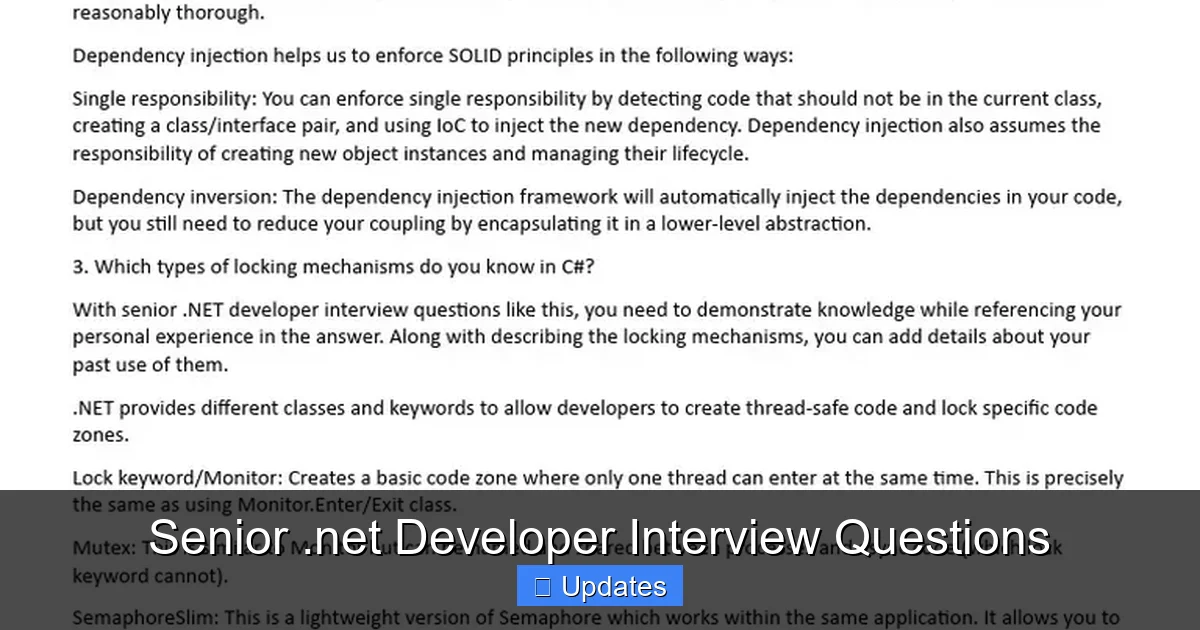
Visual guide about Senior .net Developer Interview Questions
Image source: imgv2-2-f.scribdassets.com
At the heart of every .NET application is C#. For senior roles, you need to speak the language fluently—and even better, understand what’s happening behind the scenes.
Explain the difference between value types and reference types.
Value types store data directly in memory (e.g., int, bool, struct), while reference types store a pointer to where the data lives (e.g., class, string, array). This affects performance and behavior—for example, when you pass a value type to a method, a copy is made; with reference types, you’re passing a reference.
Understanding this helps avoid bugs like unintended mutations and memory bloat.
What is the difference between
Frequently Asked Questions
What are the most important topics for a senior .NET developer interview?
Focus on C# advanced features, ASP.NET Core, Entity Framework, cloud deployment (Azure), system design, and database optimization. Also prepare for behavioral questions about leadership and problem-solving.
How many years of experience do you need to be considered for a senior .NET role?
Typically 5+ years of professional .NET development experience, with increasing responsibility in architecture, mentoring, and cross-team collaboration.
Should I expect live coding during the interview?
Yes, especially in technical screens. Be ready to write clean, tested code on a shared editor while explaining your thought process aloud.
How much do senior .NET developers earn?
Average salaries range from $110K–$160K+ depending on location, company size, and cloud expertise. Senior roles with architecture responsibilities often exceed $170K.
Can I get a senior role without formal leadership experience?
Yes, if you’ve taken ownership of major features, led technical initiatives, mentored others informally, or driven process improvements.
Where can I practice system design for .NET interviews?
Study resources like Grokking the System Design Interview, LeetCode, and Microsoft Learn. Practice designing APIs, caching layers, and distributed systems using .NET technologies.