
Walker vs Crutches: Which Is Better for Seniors?


Large Print Keyboard

Book Holder Stand

Sudoku Puzzle Book
Walker vs Crutches is a common comparison when someone needs extra support while walking. Both can help with mobility, but they work in very different ways.
A walker gives support from several points around the body. Crutches require more balance, arm strength, and coordination. The right choice depends on why the aid is needed, how much support is required, and how comfortable the user feels with it.
Quick Comparison
For many seniors who need steady support while walking, a walker may be easier to manage. It provides a broad base of support and can be easier to use when balance is a concern. MedlinePlus notes that a walker may be a better option than crutches for people with significant weakness or balance problems.
Crutches can be useful when a person needs to keep some or all weight off one foot, ankle, or leg. They can also work well for people who have enough upper-body strength and balance to use them safely.
Walker vs Crutches At a Glance
Both aids can support walking, but their use is quite different.
| Feature | Walker | Crutches |
|---|---|---|
| Stability | High | Moderate |
| Balance demand | Lower | Higher |
| Upper-body effort | Moderate | Higher |
| Weight off one leg | Limited by type and use | Very useful |
| Learning curve | Usually easier | Usually harder |
| Indoor use | Often convenient | Can be harder |
| Stairs | Requires training | Can be useful with training |
| Best suited for | Steady support | Reduced weight on a leg |
Walker Review for Senior Use
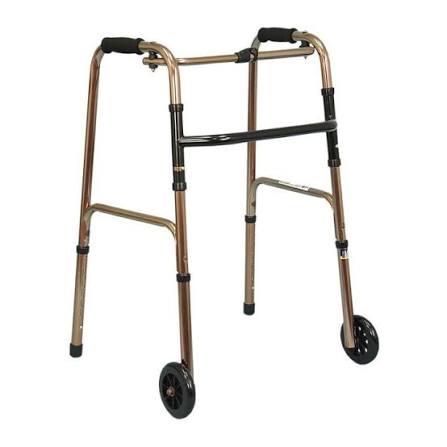
A walker is designed to provide support while a person moves forward. Standard walkers have four contact points. Some models have two or four wheels, brakes, a seat, or storage features.
For seniors who want steady support, the wide base can be helpful.
Ease of Use
A walker can be fairly simple to learn. With a standard walker, the user lifts it and places it ahead before taking a step. Wheeled models can be pushed forward.
The handles should be adjusted to the user’s height. The elbows should stay slightly bent while holding the handles.
Key strengths
- Broad support base
- Useful for balance problems
- Can work well indoors
- Many designs are available
- Some models include seats or baskets
- Does not require the same hopping or swinging motion as crutches
Potential drawbacks
- Can be bulky
- May be harder to use in narrow spaces
- Standard models require lifting
- Wheels and tips need regular checking
- Stairs can be difficult without proper training
Crutches Review for Senior Use
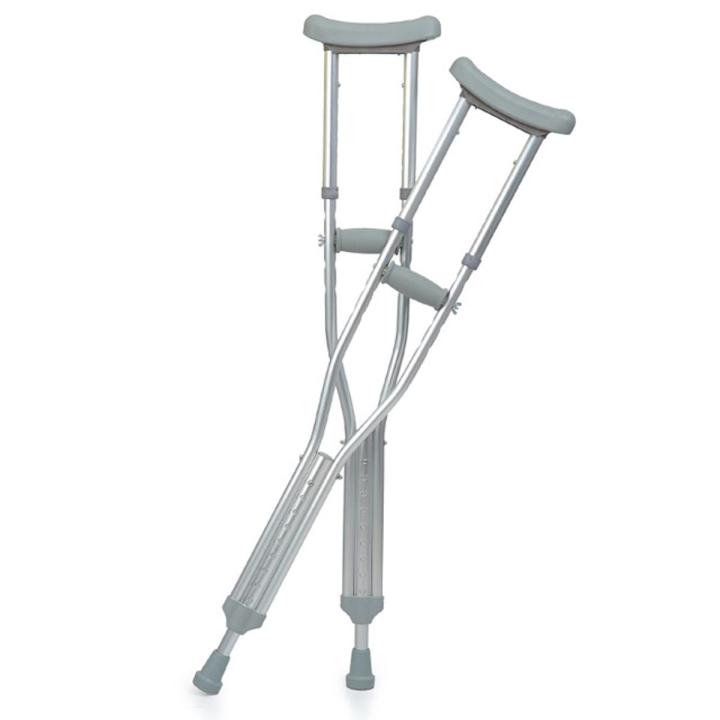
Crutches support the body through the hands and arms. They can be useful when someone needs to reduce weight on an injured or weak leg.
They demand more coordination than a walker. Good balance and upper-body strength are important.
Ease of Use
Crutches take practice. The user must move the crutches and body in the correct order. They also need to maintain balance while moving.
Proper fitting is important. MedlinePlus advises keeping the crutch tips slightly away from the feet and placing body weight through the hands rather than the armpits.
Key strengths
- Good for reducing weight on one leg
- Useful after some leg injuries or surgery
- Easier to carry than many walkers
- Can work well on stairs with proper training
- Allow a more natural walking space than a wide walker
Potential drawbacks
- Require more balance
- Require more arm and hand strength
- Can be tiring during long periods of use
- More difficult for some users to learn
- Incorrect use can cause discomfort or injury
Which Is Easier for Seniors to Use?
For many seniors, a walker is easier when the main need is stability. A walker gives support through multiple contact points and can reduce the balance demand during normal walking.
Crutches may be easier for a senior who has good balance and upper-body strength but needs to keep weight off one leg.
| Need | More Suitable Option |
|---|---|
| Extra balance support | Walker |
| Less upper-body effort | Walker |
| Keeping weight off one leg | Crutches |
| Simple indoor walking | Walker |
| Frequent stairs | Depends on training |
| Strong arms and good balance | Crutches may work well |
The important point is that age alone should not decide the choice. A senior’s strength, balance, injury, home layout, and walking needs all matter.
Performance Comparison
The two aids perform best in different situations.
A walker is mainly about stability and support. It can be useful when a person needs help staying steady while walking.
Crutches are mainly about weight management. They can allow a person to keep some or all weight away from an affected leg, depending on the instructions from a healthcare professional.
| Performance Area | Walker | Crutches |
|---|---|---|
| Stability | Strong | Moderate |
| Weight relief | Moderate | Strong |
| Balance support | Strong | Moderate |
| Mobility on stairs | More difficult | Possible with training |
| Walking on flat floors | Usually easier | Requires more coordination |
Comfort, Accessibility, and Senior-Friendly Design
Comfort depends heavily on proper fit.
A walker should be adjusted so the handles sit at the right height. Crutches also need proper adjustment. Poorly fitted mobility aids can be uncomfortable and may be unsafe.
A walker may be more comfortable for someone who wants continuous support while standing and walking. Crutches may be more comfortable for someone who needs to protect one leg but has enough strength to support the body with the arms.
The best mobility aid is not simply the one with more support. It is the one that matches the user’s actual mobility needs and can be used safely.
Features Comparison
The most useful features depend on the type of mobility aid.
| Feature | Walker | Crutches |
|---|---|---|
| Adjustable height | Common | Common |
| Wheels | Available on some models | No |
| Seat | Available on some models | No |
| Storage | Available on some models | Limited |
| Folding design | Common | Some models |
| Hand grips | Yes | Yes |
| Replacement tips | Yes | Yes |
A walker with wheels may reduce the need to lift the frame. A rollator may also include brakes and a seat, but users need to learn how to use these features correctly.
Crutches are usually simpler in construction, but their simplicity does not mean they are easier to use.
Price, Maintenance, and Long-Term Value
Prices vary widely by model, material, and features. A basic walker and basic crutches can both be relatively simple mobility aids, while advanced walkers may cost more.
Maintenance is usually straightforward.
For walkers:
- Check rubber tips and wheels.
- Keep moving parts clean.
- Check brakes on wheeled models.
- Make sure the frame remains stable.
For crutches:
- Check the rubber tips.
- Look for worn tread.
- Check adjustment points.
- Keep grips clean and secure.
MedlinePlus recommends checking walker tips and wheels and checking crutch tips regularly.
Who Should Choose a Walker?
A walker may be a better fit if:
- Balance is the main concern.
- The user wants a broad support base.
- Standing and walking feel unstable.
- The user does not have strong upper-body strength.
- Most walking happens on flat indoor surfaces.
- A seat or storage basket would be useful.
Who Should Choose Crutches?
Crutches may be a better fit if:
- The user needs to reduce weight on one leg.
- Upper-body strength is good.
- Balance is adequate.
- The user can learn the required movement pattern.
- The mobility problem is temporary.
- Stairs are part of daily movement and the user has received proper training.
Walker vs Crutches — Final Verdict
Best for steady support: Walker
Best for keeping weight off one leg: Crutches
Best for users with balance concerns: Walker
Best for users with good upper-body strength: Crutches may be suitable
There is no single mobility aid that works best for every senior. A walker usually makes more sense when stability is the main need. Crutches can be more useful when protecting one leg is the priority.
Scoring Summary
Scores can be misleading because the two products solve different problems. A simple category comparison is more useful here than pretending one aid is universally better.
| Category | Walker | Crutches |
|---|---|---|
| Stability | Strong | Moderate |
| Weight Relief | Moderate | Strong |
| Ease of Learning | Usually easier | Usually harder |
| Upper-Body Demand | Moderate | Higher |
| Everyday Indoor Use | Strong | Moderate |
These comparisons are based on the typical function of each aid, not on laboratory testing or hands-on testing.
How We Evaluate Products
This comparison focuses on factors that matter in daily senior use:
- Ease of use
- Stability
- Physical effort
- Comfort
- Accessibility
- Safety
- Maintenance
- Portability
- Practical everyday use
The comparison does not claim personal testing or laboratory results. Mobility aids should also be properly fitted and used according to professional guidance when needed.
Senior-Specific Buying Considerations
Physical Effort
Think about how much lifting, pushing, gripping, and balancing the user can comfortably manage.
Crutches can place more demand on the arms and hands. A walker may require less balance during normal walking.
Controls
A basic walker has few controls. A wheeled walker with brakes has more to learn.
Crutches are mechanically simple, but the walking technique takes practice.
Maintenance
Check tips, wheels, grips, and adjustment points regularly.
Storage
A folding walker can be useful when storage space is limited. Crutches generally take less floor space.
Setup
Proper height adjustment matters for both aids. A healthcare provider or physical therapist can help with fitting when needed.
Safety
Remove loose rugs, cords, and clutter from walking areas. Keep floors dry and use shoes with non-slip soles. These basic home changes can reduce trip hazards.
Common Buying Mistakes
Avoid these common mistakes:
- Choosing based only on price
- Ignoring the user’s balance
- Ignoring upper-body strength
- Buying the wrong size
- Forgetting about home space
- Choosing a device without learning how to use it
- Ignoring worn tips or wheels
A mobility aid that looks simple can still be difficult to use if it does not match the user’s needs.
Safety
Mobility aids should be used with care, especially after an injury or surgery.
A walker should have all its contact points on the ground before weight is placed on it. Crutch users should place body weight through the hand grips rather than leaning heavily on the armpits.
Stairs require extra care. If someone has not been trained to use a walker or crutches on stairs, professional instruction is a safer approach.
If there is significant pain, weakness, or difficulty with balance, the choice of mobility aid should be discussed with a healthcare provider or physical therapist.
Conclusion
Walker vs Crutches comes down to the type of support the user needs. A walker is generally more focused on stability and steady everyday walking, while crutches are designed to help reduce weight on an affected leg.
For seniors who need more balance support, a walker may be easier to manage. For someone with good strength and balance who needs to protect one leg, crutches may be the better fit. Proper fitting and training are important with either option.