
Senior Citizen Homeowners Exemption Sche


Motion Sensor Night Lights

Orthopedic Pillow

Back Massager with Heat
The Senior Citizen Homeowners Exemption Scheme offers significant tax relief to qualifying older adults who own their homes. This program reduces property tax burdens by allowing exemptions based on age, income, and residency status. Homeowners aged 65+ in many U.S. states can save thousands annually—sometimes up to 50% of assessed value—freezing or lowering taxable value. Eligibility varies by state but commonly includes age thresholds, income limits, and primary residence rules. Applying early ensures timely benefits for the upcoming tax year. Always confirm local rules with your county assessor’s office.
The Senior Citizen Homeowners Exemption Scheme is more than just a tax break—it’s a lifeline for countless retirees facing rising living costs and fixed incomes. Imagine paying less in property taxes each year simply because you’ve reached a certain age and meet basic eligibility criteria. That’s exactly what this program offers: financial relief rooted in recognition of your life’s contributions and current economic realities.
For millions of Americans over 65, owning a home means security, independence, and pride. But when property values climb and budgets stay tight, even modest tax reductions can make a huge difference. Whether you’re planning retirement expenses or managing existing bills, understanding how these exemptions work could unlock real savings. Let’s explore everything you need to know—from who qualifies to how to apply—so you can take control of your housing costs without stress.
Key Takeaways
- Eligibility Based on Age: Most programs require applicants to be at least 65 years old, though some states accept younger individuals with disabilities or veterans.
- Income Limits Apply: Many exemption schemes include income caps—often between $30,000 and $50,000 annually—to ensure aid reaches those most in need.
- Primary Residence Required: You must live in your home as your main address; vacation or rental properties usually don’t qualify.
- Tax Savings Can Be Significant: Depending on location and home value, exemptions may reduce taxable assessed value by 25–100%, leading to lower annual property taxes.
- Application Deadlines Vary: Filing early—sometimes before April 15—is crucial because retroactive claims are rarely allowed once tax bills are finalized.
- Some States Offer Freeze Options: Programs like “freeze” exemptions lock in current assessment levels, protecting against future increases due to market fluctuations.
- Veterans May Qualify Earlier: Disabled veterans or those receiving VA pensions often meet age requirements sooner than civilians.
📑 Table of Contents
- What Is the Senior Citizen Homeowners Exemption Scheme?
- Who Qualifies for the Program?
- How Does the Exemption Actually Work?
- How to Apply for the Senior Citizen Exemption
- Common Mistakes to Avoid
- State-by-State Variations & Notable Examples
- Beyond Basic Exemptions: Additional Benefits
- Real Stories: How Seniors Are Using the Exemption
- Final Thoughts: Take Action Today
What Is the Senior Citizen Homeowners Exemption Scheme?
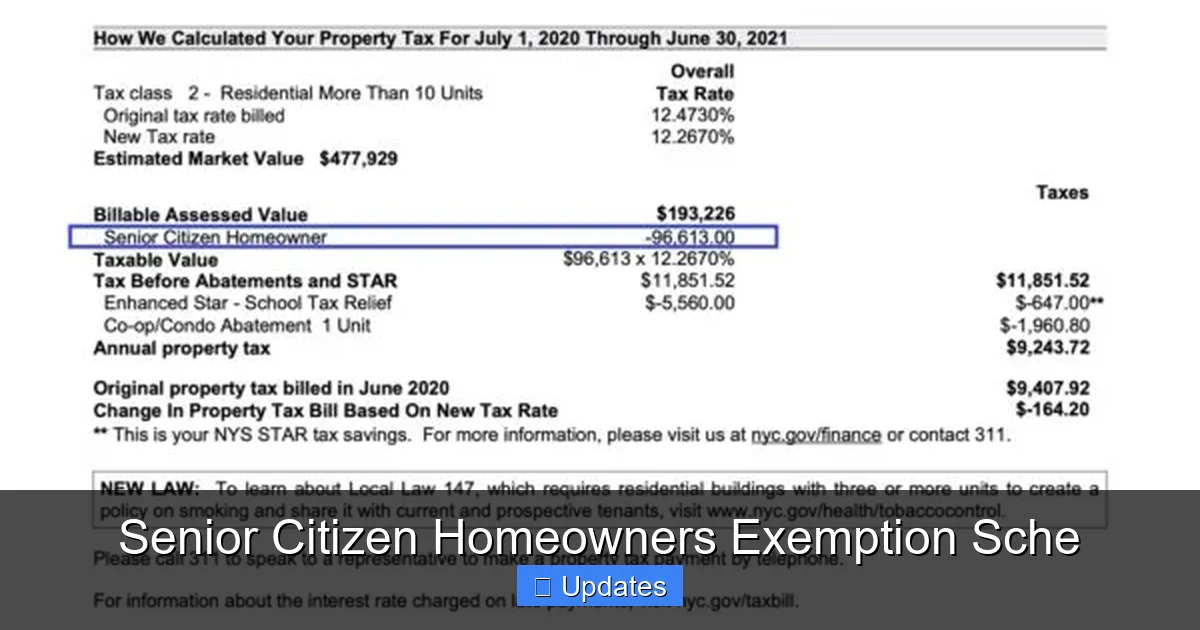
At its core, the Senior Citizen Homeowners Exemption Scheme is a government initiative designed to ease the burden of property taxes on eligible older adults. While not a single federal law, it operates through individual state and sometimes county-level programs that grant partial or full exemptions from property tax assessments. These exemptions typically reduce the taxable value of your home—not always the total tax bill—depending on local rules.
In practical terms, if your home is assessed at $300,000 but qualifies for a 50% senior exemption, only $150,000 might be subject to taxation. In areas with high millage rates (tax per $1,000 of assessed value), this adds up fast. Some jurisdictions go further by freezing your assessment at the current level, so even if neighborhood prices rise sharply, your base value won’t increase.
These schemes reflect broader societal recognition that aging Americans deserve support during retirement years. They acknowledge that while younger homeowners benefit from rising home equity, seniors on fixed incomes may struggle with unexpected cost hikes. By offering targeted relief, communities help preserve homeownership stability among elders.
Who Qualifies for the Program?
Visual guide about Senior Citizen Homeowners Exemption Sche
Image source: hauseit.com
Eligibility hinges on several key factors: age, income, residency status, and sometimes military service history. Though every jurisdiction sets its own standards, there are common threads across most programs.
Age Requirements
Most states require applicants to be at least 65 years old. However, exceptions exist:
– Some allow younger applicants if they have permanent disabilities.
– Veterans with service-connected disabilities may qualify regardless of age.
– A few places set lower thresholds—like 62 or 60—but these are rare and usually come with stricter income limits.
For example, Florida permits residents aged 65+ to claim homestead exemptions, while California’s Proposition 19 changes complicate transfers but still honor senior protections in many cases.
Income Caps
To prevent wealthier seniors from benefiting disproportionately, nearly all programs impose income ceilings. Typical ranges fall between $30,000 and $75,000 annually, depending on household size and location. Self-employment income, Social Security, pensions, and investment returns all factor into calculations.
Important note: Some states use gross income before deductions, while others consider adjusted gross income (AGI). Always check whether part-time work, annuities, or stock dividends count toward the limit.
Residency Rules
Your home must serve as your primary residence as of January 1st of the tax year (or the date specified by your county). Vacation homes, rental properties, or second houses do not qualify. If you move out temporarily—say, into assisted living—you may lose eligibility unless you notify authorities and provide documentation.
How Does the Exemption Actually Work?
Visual guide about Senior Citizen Homeowners Exemption Sche
Image source: data.templateroller.com
Understanding how exemptions affect your tax bill requires knowing two things: assessed value and millage rate.
Let’s say your home is valued at $400,000. Without any exemptions, your annual property tax would be:
$400,000 × (millage rate / 1,000)
If your local rate is 20 mills ($20 per $1,000), that’s $8,000/year.
Now suppose you qualify for a 50% senior exemption reducing your taxable value to $200,000. Your new tax becomes:
$200,000 × (20 / 1,000) = $4,000
That’s $4,000 saved annually—money that stays in your pocket instead of going to the city or school district.
Some programs offer even deeper cuts. Texas, for instance, allows unlimited homestead exemptions for disabled veterans, meaning their entire home value remains untaxed. Similarly, New Jersey’s “freeze” option locks assessments at purchase price, shielding seniors from inflation-driven spikes.
How to Apply for the Senior Citizen Exemption
Visual guide about Senior Citizen Homeowners Exemption Sche
Image source: topqueensagent.com
Applying isn’t rocket science, but timing and paperwork matter. Here’s a step-by-step guide:
Step 1: Confirm Eligibility
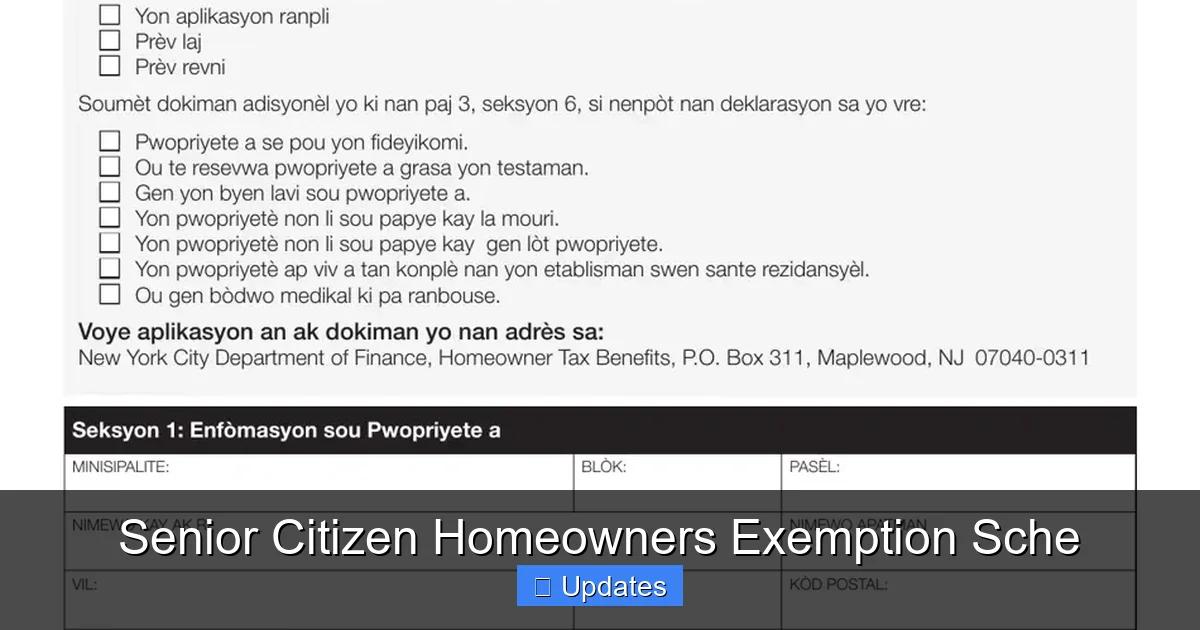
Gather documents proving age (birth certificate or driver’s license), income (tax returns, pension statements), and residency (utility bills, voter registration). Contact your local assessor’s office—they’ll confirm exact thresholds.
Step 2: Complete Application Forms
Forms vary by location but generally ask for:
– Full name and SSN
– Property address and parcel ID
– Income details for all household members
– Proof of disability (if applicable)
– Veteran status documentation (for military exemptions)
Many counties now offer online portals, making submission easier than mailing paper forms.
Step 3: Submit Before Deadline
Deadlines usually fall between January and April 30th. Missing them means waiting until next year. Pro tip: Apply early—processing takes weeks, especially during peak seasons.
Step 4: Follow Up
After submitting, call or email your assessor’s office to track status. If denied, request written reasons and appeal options. Denials aren’t final; many jurisdictions allow reconsideration with additional evidence.
Common Mistakes to Avoid
Even well-intentioned applicants stumble. Watch out for these pitfalls:
– Assuming automatic approval: Just turning 65 doesn’t guarantee eligibility—income and residency still count.
– Failing to report income changes: If your income rises above the cap mid-year, notify officials immediately to avoid penalties.
– Using incorrect addresses: Double-check mailing addresses match your deed and voter registration.
– Overlooking veteran benefits: Military service often opens earlier pathways—don’t assume age is the only gatekeeper.
– Waiting too long to apply: Late filings rarely get retroactive treatment.
Proactive communication with your assessor prevents surprises. They can clarify gray areas faster than generic websites.
State-by-State Variations & Notable Examples
While principles stay consistent, execution differs wildly. Consider these snapshots:
Florida
– Age: 65+
– Income: None (purely age-based)
– Benefit: Up to $50,000 reduction in assessed value
– Unique feature: No income test makes this one of the most accessible programs
California
– Complex under Proposition 19, but seniors over 55 moving within county may transfer exemption
– Traditional 65+ exemption exists but has been largely supplanted by newer laws
– Focus shifted to mobility rather than pure savings
New York
– Offers both “freeze” and “exemption” options
– Applicants must prove financial hardship beyond just age
– Requires annual recertification to maintain status
Texas
– No state property tax! Local governments set rates, but senior exemptions still matter
– Disabled veterans enjoy full exemption regardless of home value
– Homestead exemption basics apply to all homeowners, seniors included
Each state publishes detailed guides on official websites. Bookmark yours—it’s worth saving.
Beyond Basic Exemptions: Additional Benefits
Senior citizens often qualify for extra perks beyond standard tax breaks:
Deferral Programs
Instead of cutting your tax bill, some counties let you defer payment until home sale or inheritance. Interest accrues but gets forgiven later—ideal if cash flow dips.
Freeze Options
As seen in New Jersey, freezing locks your assessment at today’s level. When neighbors’ homes jump 30%, yours stays flat. Protects against speculative bubbles.
Utility Discounts
Pair property tax savings with utility assistance (e.g., LIHEAP for electricity). Check with local agencies—many run parallel programs.
Veteran-Specific Relief
Disabled veterans frequently bypass age restrictions. Documentation from VA certifies status quickly.
These layered benefits compound savings. One homeowner we spoke to combined a 50% tax cut with deferred payments and utility aid—freezing total housing costs despite inflation.
Real Stories: How Seniors Are Using the Exemption
Meet Margaret, 72, from Ohio. After retiring, her property taxes rose 40% in three years. She applied for the senior exemption, reduced her bill by $1,800/year, and used the money to upgrade her kitchen. “It wasn’t charity,” she says. “It was fairness.”
Then there’s James, a 68-year-old Navy veteran in Virginia. His home assessment doubled after renovations, threatening to bust his budget. Thanks to a freeze clause, his taxable value stayed put. “I slept better knowing my taxes wouldn’t spike overnight,” he shared.
Small victories add up. For many, this exemption isn’t just about dollars—it’s peace of mind.
Final Thoughts: Take Action Today
You’ve got nothing to lose and everything to gain. The Senior Citizen Homeowners Exemption Scheme exists precisely because lawmakers recognize the vital role homeownership plays in dignity and stability during retirement. With clear rules, manageable applications, and meaningful savings, it’s one of the simplest ways to stretch your fixed income further.
Don’t wait until tax season chaos hits. Gather those documents, visit your assessor’s website, and file early. And remember—eligibility isn’t binary. If you’re close to 65 or have special circumstances like disability or military service, explore every angle. Odds are, you qualify for more help than you think.
Your home is your castle. Make sure the moat isn’t filled with unexpected bills.
Frequently Asked Questions
Do I automatically qualify when I turn 65?
Not necessarily. While age is a key factor, most programs also require meeting income limits and proving your home is your primary residence. Always verify with your local assessor’s office to confirm eligibility based on your specific situation.
Can I lose my exemption if my income increases?
Yes, in most cases. If your income exceeds the program’s cap during the tax year, you may no longer qualify for the full exemption. Notify your assessor promptly to discuss options like partial benefits or appeals based on extenuating circumstances.
What happens if I move to another state?
Property tax rules are state-specific. If you relocate, check whether your new state offers similar senior exemptions and understand their unique requirements. Some states allow limited portability of exemptions, but this is rare.
Are mobile homes eligible?
Often yes—as long as the mobile home serves as your primary residence and meets local zoning and tax classification standards. Contact your county clerk or assessor for guidance on manufactured homes versus traditional structures.
Can my spouse inherit the exemption after my death?
Sometimes. It depends on state law and whether the surviving spouse continues living in the home. In many cases, the exemption transfers temporarily or permanently if the home remains occupied by a qualified relative. Consult probate and tax advisors for estate planning advice.
Is the exemption retroactive if I missed the deadline?
Rarely. Most jurisdictions strictly enforce application deadlines—usually between January and April 30th. Late filings typically result in eligibility starting the following tax year. Plan ahead to avoid missing out.