
Is Knitting a Good Hobby for Retirees?


Rollator Walker with Seat

Sock Aid for Seniors

Reading Light for Bed
Quick Answer
Yes, knitting can be an excellent hobby for retirees because it’s creative, flexible, portable, and easy to enjoy at home or with other people. The National Institute on Aging encourages enjoyable and meaningful activities as one part of healthy aging.
Why knitting works well in retirement
- Easy to start: Basic knitting only requires yarn, needles, and a few beginner stitches.
- Flexible schedule: You can knit for 15 minutes or settle into a longer project.
- Visible progress: Each row adds something you can see, touch, use, or give away.
- Social options: Knitting circles, senior centers, yarn shops, and online groups can add companionship.
- Adaptable: Larger needles, lighter projects, and shorter sessions can make knitting more comfortable.
Retirement gives you more freedom, but filling that time meaningfully isn’t always simple. I like knitting as a retirement hobby because it can be as quiet, social, simple, or ambitious as you want.
You don’t need artistic talent or years of experience. You can begin with one stitch, one ball of yarn, and a small project that gives you a reason to return tomorrow.
In This Guide
- Why is knitting a good hobby for retirees?
- What benefits can knitting offer retirees?
- Is knitting hard to learn after retirement?
- What do you need to start knitting?
- Is knitting or crochet better for retirees?
- Can knitting become a social hobby?
- How can retirees knit comfortably?
- What should a beginner retiree knit first?
- Frequently asked questions
- Final takeaway
Why Is Knitting a Good Hobby for Retirees?
Knitting fits retirement well because it gives free time a gentle sense of structure without creating another obligation. You can choose when to start, when to stop, and how challenging the next project should be.
Simple definition: A retirement knitting hobby is the regular practice of creating fabric from yarn using knitting needles for enjoyment, creativity, learning, connection, or practical projects.
That flexibility matters. A hobby shouldn’t make retirement feel like another full-time job.
It works around your schedule
Knitting doesn’t require a reservation, good weather, or a full afternoon. A small project can stay beside your favorite chair until you feel like picking it up.
- Work a few rows with your morning coffee.
- Take a project while traveling.
- Knit while listening to music or an audiobook.
- Bring a small project to a social group.
- Pause for several days without losing everything you’ve learned.
You create something tangible
Many retirement hobbies provide entertainment, but knitting also produces an object. A scarf, hat, dishcloth, baby blanket, or simple throw becomes evidence of the time and patience you invested.
I think that’s one of knitting’s strongest qualities. Progress may be slow, but you can watch it grow row by row.
What Benefits Can Knitting Offer Retirees?
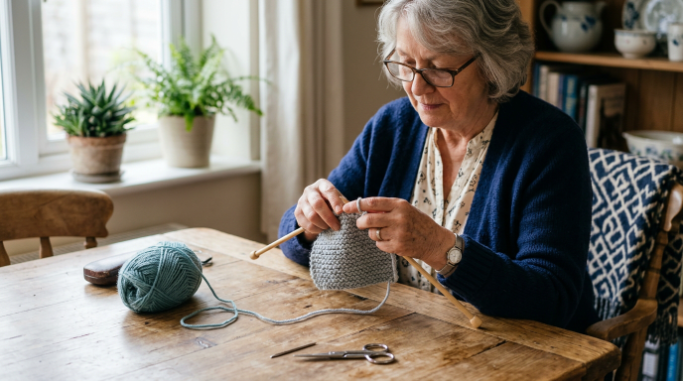
Knitting can offer creative satisfaction, mental engagement, routine, and opportunities for social contact. Those are sensible benefits to discuss without claiming that knitting is a medical treatment.
A creative challenge without much pressure
Beginners start by remembering a few movements and following simple patterns. Experienced knitters can later explore cables, colorwork, shaping, different fibers, and more complex designs.
The challenge grows with you. There’s always another technique to learn, but there’s no requirement to move beyond the level you enjoy.
A meaningful way to spend quiet time
The National Institute on Aging says meaningful activities and hobbies can support healthy aging. Its cognitive-health guidance also notes promising research around mentally engaging activities, while making clear that the evidence isn’t strong enough to promise lasting cognitive protection.
That’s an important distinction. Knit because you enjoy it, not because someone promises it will prevent memory loss.
A natural sense of routine
Retirement can remove schedules that once organized the week. A personal project gives you a small goal that doesn’t come with a boss or deadline.
- Finish ten rows before lunch.
- Work on a blanket each evening.
- Attend a weekly knitting group.
- Make one small gift each month.
The project can provide direction while leaving plenty of room for everything else in retirement.
Is Knitting Hard to Learn After Retirement?
No, age alone doesn’t make you too old to learn knitting. Most beginners need patience with a handful of basic movements before the process starts feeling natural.
Learn these skills first
- Cast on: Put the first row of loops onto the needle.
- Knit stitch: Learn the basic stitch used in countless patterns.
- Purl stitch: Add the second major stitch after you’re comfortable knitting.
- Bind off: Secure the final row so the project doesn’t unravel.
Don’t try to learn everything on the first day. I would rather see a beginner make an uneven practice square than abandon knitting while attempting a complicated sweater.
Practice with forgiving materials
Medium-weight yarn is easier to see and handle than extremely thin yarn. Light or medium colors also make individual stitches easier to distinguish.
Start with straight or circular needles that feel comfortable in your hands. You can experiment with sizes and materials after you understand the basic motion.
Beginner tip: Make a practice square before starting a real project. Mistakes feel less frustrating when the square exists only for learning.
What Do You Need to Start Knitting?
You don’t need a room full of yarn to begin knitting. A first practice project needs only a few basic items.
- Knitting needles: Choose a size recommended on your yarn label.
- Yarn: Medium-weight, smooth yarn is usually easier for beginners to see.
- Scissors: Any comfortable pair that cuts yarn cleanly will work.
- Yarn needle: This blunt needle helps weave in loose yarn ends.
- Simple pattern: Pick something that uses one or two basic stitches.
Don’t buy everything immediately
Knitting shops can be tempting because there are needles, stitch markers, bags, gauges, counters, organizers, and thousands of yarn choices. Most of those things can wait.
Try one small project first. If you enjoy the process, you can gradually buy tools that solve problems you actually have.
Choose the yarn before the needle
A pattern usually tells you the required yarn weight and suggested needle size. Following those recommendations makes a first project much easier than choosing supplies at random.
Save delicate fibers and novelty yarns for later. Smooth yarn lets you see where each loop enters the next stitch.
Is Knitting or Crochet Better for Retirees?
Neither hobby is automatically better for retirees. Knitting often appeals to people who enjoy two-handed rhythm and soft, flexible fabric, while crochet uses one hook and keeps only one main loop active.
| Feature | Knitting | Crochet |
|---|---|---|
| Main tools | Two needles | One crochet hook |
| Active stitches | Many stitches stay on the needle | Usually one main active loop |
| Common beginner projects | Scarves, dishcloths, simple hats | Granny squares, scarves, dishcloths |
| Undoing work | Dropped stitches may need careful repair | Often straightforward to unravel to an error |
| Finished fabric | Often soft, stretchy, and draping | Often thicker and more structured |
If you can’t decide, try both. A single beginner lesson can tell you more than hours spent comparing the two online.
Some retirees enjoy both crafts and switch between them depending on the project. There isn’t a rule requiring you to choose one permanently.
Can Knitting Become a Social Hobby?
Yes. Although knitting works perfectly well as a solo activity, it can also give retirees an easy reason to meet people regularly.
As of 2026, the CDC’s guidance for older adults includes crafts such as knitting among activities people can enjoy with others to strengthen social connections.
Where can retirees find knitting groups?
- Senior and community centers
- Libraries
- Local yarn shops
- Community education programs
- Faith communities
- Craft clubs
- Online knitting communities
A group also gives beginners somewhere to ask small questions. Someone sitting across the table may spot a twisted stitch faster than a thirty-minute video can explain it.
Knitting can create opportunities to give
Some knitters enjoy making hats, blankets, scarves, or other items for relatives and community organizations. Others prefer knitting entirely for themselves.
Both are valid. A hobby doesn’t need a charitable purpose to deserve space in your retirement.
How Can Retirees Knit More Comfortably?

Comfort matters because knitting uses repeated hand and finger movements. Stop and change your setup if you develop persistent pain, numbness, swelling, or other concerning symptoms.
Use a comfortable position
Sit in a supportive chair and avoid hunching toward your work. Keeping the project supported in your lap can reduce the need to hold its full weight with your wrists.
- Keep shoulders relaxed.
- Support your forearms when helpful.
- Use good lighting.
- Take regular movement breaks.
- Change position instead of staying still for hours.
What if you have arthritis in your hands?
Arthritis doesn’t automatically mean giving up needlework. The Arthritis Foundation’s needlework guidance suggests adapting tools, supporting the arms, and taking regular joint breaks when hand arthritis affects knitting.
Lightweight bamboo or birch needles may feel more comfortable for some knitters. Knitting flat pieces on circular needles can also let more of a larger project rest in your lap.
Health note: Persistent or worsening hand pain shouldn’t be pushed through. Ask your doctor, occupational therapist, or another qualified clinician about adjustments that fit your condition.
Don’t turn relaxation into an endurance contest
It’s easy to say, “I’ll finish one more row,” ten times. Setting a timer can remind you to stand, stretch, walk around, and rest your hands.
Comfort will help you keep knitting longer than racing through one project.
What Should a Beginner Retiree Knit First?
Your first project should be simple enough to finish. Completing something small builds more confidence than spending six months fighting with an ambitious sweater.
Good first knitting projects
- Practice square: Ideal for learning how stitches look and feel.
- Dishcloth: Small, practical, and forgiving of minor mistakes.
- Simple scarf: Repeats the same movements across many rows.
- Basic cowl: A manageable next step after a flat scarf.
- Simple hat: Useful once you’re ready to learn basic shaping.
A first project doesn’t need to look perfect. Uneven tension, an accidental extra stitch, and a slightly strange edge are normal parts of learning.
Choose projects that make you want to continue
If you dislike scarves, don’t knit one just because every beginner guide recommends them. Make something you’ll enjoy seeing finished.
I would also resist buying yarn for ten future projects. Finish one or two, then decide what kind of knitting keeps pulling you back.
Frequently Asked Questions
Is knitting good for people over 60?
Yes, knitting can suit adults over 60 because the activity can be done seated, adjusted to different skill levels, and practiced for short or long sessions. Choose comfortable tools and modify your routine if hand, wrist, vision, or mobility issues affect the experience.
Can you learn knitting at 70 or 80?
Yes. There’s no age at which someone becomes automatically too old to learn basic knitting, though individual vision, dexterity, memory, and health needs vary.
Start slowly with one stitch and a small practice piece. In-person instruction can also make early mistakes easier to understand.
Is knitting good for the brain?
Knitting requires attention, learning, pattern following, and repeated decision-making. The National Institute on Aging’s cognitive-health guidance says meaningful, mentally engaging activities may offer benefits, but evidence for lasting cognitive protection remains inconclusive.
Is knitting an expensive retirement hobby?
It doesn’t have to be. Beginners can start with one pair of needles, one or two balls of yarn, scissors, and a simple pattern rather than building a large yarn collection immediately.
Costs rise when you choose premium fibers, specialty tools, or large projects. Starting small helps you learn whether the hobby deserves a larger budget.
Can knitting help retirees meet people?
Yes. Libraries, senior centers, craft clubs, community organizations, and yarn shops may offer knitting circles where people work on individual projects while talking and helping each other.
You can also participate online if transportation or mobility makes in-person groups difficult.
How long should a beginner knit at one time?
There’s no required session length. Beginners may find 15- to 30-minute sessions easier while learning because shorter practice limits frustration and gives the hands regular rest.
Increase your time gradually if you’re comfortable. Stop sooner if pain or numbness develops.
What is the easiest knitting project for a retiree?
A small practice square or basic dishcloth is usually one of the easiest choices. Both let you repeat simple stitches without complicated shaping, sizing, sleeves, or pattern changes.
Final Takeaway: Is Knitting Worth Trying in Retirement?
Yes, knitting is worth trying if you want a creative hobby that’s flexible, practical, and easy to enjoy at your own pace. It can fill quiet time, provide a satisfying learning challenge, and open the door to new social connections.
You don’t need to commit to becoming an expert. Buy enough supplies for one simple project and see whether you enjoy the rhythm of making one row after another.
If it becomes something you look forward to, keep going. That’s usually the clearest sign you’ve found a retirement hobby worth keeping.
