
Dentures vs Bridges: Which Is Better for Seniors?

Medication Reminder Alarm

Raised Toilet Seat

Lap Desk for Reading
Dentures vs Bridges is a common choice when one or more teeth are missing. The two options work in very different ways. Dentures are removable. Bridges are usually fixed in place.
For seniors, the better choice is not simply the one that looks or costs better. Daily care, comfort, the number of missing teeth, and the health of the teeth around the gap all matter.
Quick Comparison
A bridge may be a better fit when only a small number of teeth are missing and the nearby teeth can support it. It stays in place, so there is no need to remove it each night.
Dentures may be more suitable when several or all teeth need replacing, especially when a removable option is preferred.
The best choice depends on the individual mouth, not age alone.
Dentures vs Bridges At a Glance
Both options can replace missing teeth, but the daily experience is quite different.
| Feature | Dentures | Bridges |
|---|---|---|
| Design | Removable | Usually fixed |
| Best suited to | Several or many missing teeth | One or a few missing teeth |
| Removal | Yes | Usually no |
| Daily cleaning | Remove and clean | Clean while in place |
| Support | Gums and remaining teeth, depending on type | Usually nearby teeth or implants |
| Adjustment | May need adjustment over time | May need dental repair or replacement |
| Daily handling | More hands-on | Less handling |
Dentures: A Flexible Option for Missing Teeth
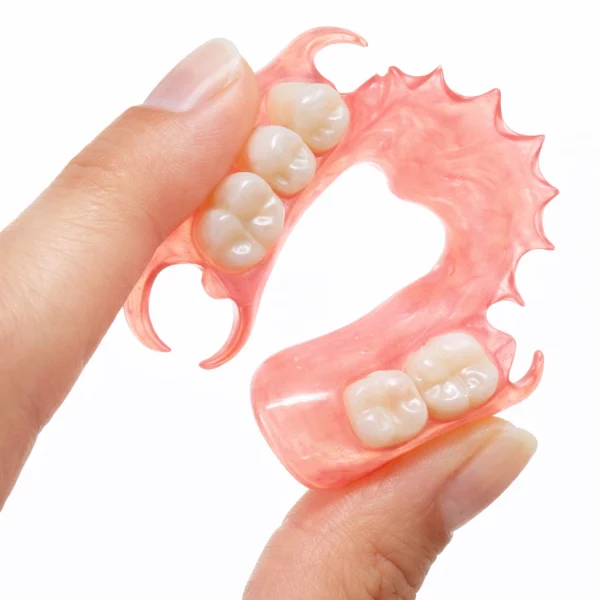
Dentures are removable replacement teeth. A full denture can replace an entire upper or lower set, while a partial denture can replace some missing teeth.
For seniors who need to replace several teeth, dentures can offer a practical solution without requiring every missing tooth to be replaced separately.
Ease of Use
Dentures do require a routine.
They need to be removed for cleaning. They also need proper storage and regular dental checks. New users may need some time to become comfortable taking them in and out.
For someone with good hand control, this may be simple. For a person with limited finger strength or dexterity, however, repeated handling may be less convenient.
Key Strengths
- Can replace several missing teeth
- Removable for cleaning
- Can be suitable when many teeth are missing
- Does not require a permanent fixed restoration
- Can be easier to remove when cleaning is important
Potential Drawbacks
- Requires regular handling
- May take time to get used to
- Can become loose as the mouth changes
- Requires careful cleaning and storage
- May need adjustment or replacement over time
Bridges: A Fixed Way to Replace Missing Teeth
A dental bridge fills a gap with an artificial tooth or teeth. A conventional bridge is supported by nearby teeth, while other bridge designs use different forms of support.
Unlike a removable denture, a fixed bridge generally stays in the mouth.
Ease of Use
The main attraction is simple daily handling.
There is no need to remove a fixed bridge at night. There is also no separate appliance to store.
However, cleaning around and under a bridge still matters. A dentist or dental hygienist can explain the best cleaning method for the specific bridge.
Key Strengths
- Usually stays fixed in place
- No daily removal
- Can replace a small number of missing teeth
- May feel more like a permanent part of the mouth
- Less appliance handling during the day
Potential Drawbacks
- Requires suitable supporting teeth or another appropriate foundation
- Some bridge types require preparation of nearby teeth
- Cleaning around the bridge needs care
- Not suitable for every missing-tooth situation
- Dental work may be needed if the bridge becomes damaged or loose
Which Is Easier for Seniors to Use?
For daily handling, a fixed bridge often has an advantage.
A senior does not need to remove it, clean it separately, or remember where it was stored. That can make the routine simpler.
Dentures have a different advantage. They can be removed easily when cleaning or when a dentist recommends taking them out.
So the answer depends on the person.
A bridge may be easier for someone who wants less daily handling.
Dentures may be easier for someone who needs to replace several teeth and prefers a removable option.
Hand strength also matters. Removing and inserting a denture requires some finger control. A caregiver may need to help if handling becomes difficult.
Performance Comparison
Both options can help replace missing teeth, but they are designed for different situations.
A bridge is generally focused on filling a smaller gap with a fixed restoration. Dentures can replace multiple missing teeth and can also replace a full set of teeth.
The condition of the remaining teeth is important. A bridge usually depends on suitable supporting teeth. If those teeth are weak or unhealthy, a bridge may not be appropriate.
Dentures do not depend on the same type of tooth support in every case.
This is why a dental examination is important before choosing between the two.
Comfort, Accessibility, and Senior-Friendly Design
Comfort is personal.
A bridge may feel simpler because it stays in place. There is no removable plate to handle during the day.
Dentures offer flexibility, but they require more routine care. They also need to fit properly.
For seniors, a few practical questions are worth asking:
- Can you comfortably remove and insert the denture?
- Can you clean it without help?
- Do you have enough hand control for daily handling?
- Would a fixed option make your routine simpler?
- Are the teeth supporting a bridge healthy enough?
- Can you maintain good oral hygiene around either option?
Aging alone does not determine the answer. Individual dental health and daily ability matter more.
Features Comparison
The biggest difference is not a special feature. It is how each option fits into daily life.
| Feature | Dentures | Bridges |
|---|---|---|
| Removable | Yes | Usually no |
| Separate cleaning | Yes | No, but surrounding areas need cleaning |
| Handling | Regular | Minimal |
| Multiple missing teeth | Often useful | More limited |
| Fixed feel | No | Yes |
| Support | Depends on denture type | Requires an appropriate foundation |
Price, Maintenance, and Long-Term Value
Cost can vary widely based on the type of restoration, materials, dental work required, location, and individual needs.
Because of that, it is not useful to declare one option universally cheaper.
Dentures can involve future adjustments, relining, repairs, or replacement. The shape of the gums and jaw can change over time, which may affect fit.
Bridges also need long-term care. The supporting teeth and surrounding gums must remain healthy.
The better value is the option that fits the dental situation well and can be maintained properly.
Ask the dentist about:
- Initial treatment cost
- Future repair costs
- Replacement expectations
- Cleaning requirements
- Supporting teeth
- Follow-up appointments
- Other available treatment options
Who Should Choose Dentures?
Dentures may be worth discussing if:
- Several teeth are missing.
- Most teeth need replacement.
- A removable option is preferred.
- You want an appliance that can be removed for cleaning.
- A fixed bridge is not suitable.
- Your dentist recommends a partial or complete denture.
Who Should Choose Bridges?
A bridge may be worth discussing if:
- Only one or a few teeth are missing.
- Suitable teeth can support the bridge.
- You prefer a fixed restoration.
- You want less daily handling.
- You are comfortable maintaining the area around the bridge.
Dentures vs Bridges — Final Verdict
Best for many missing teeth: Dentures may be the more practical option.
Best for a smaller gap: A bridge may be suitable when the supporting teeth are healthy enough.
Best for ease of daily handling: Bridges usually have the advantage because they remain fixed.
Best for removable care: Dentures are the clear choice.
There is no universal winner. A bridge can be convenient, but it depends on suitable support. Dentures can replace more missing teeth, but they require more daily handling and care.
Scoring Summary
A fixed 10-point score would be misleading here.
Unlike a vacuum or kitchen appliance, dentures and bridges are dental treatments. Their suitability depends on the person’s teeth, gums, bite, number of missing teeth, and overall oral health.
A better comparison is:
| Category | Better Fit |
|---|---|
| Less daily handling | Bridges |
| Several missing teeth | Dentures |
| Removable cleaning | Dentures |
| Small tooth gap | Bridges |
| Flexible replacement of many teeth | Dentures |
| Fixed option | Bridges |
How We Evaluate Products
For dental comparisons, we focus on practical factors rather than marketing claims.
We consider:
- Ease of daily use
- Cleaning
- Comfort
- Maintenance
- Accessibility
- Long-term practicality
- Number of teeth being replaced
- Support requirements
- Overall value
We do not claim hands-on testing or clinical testing.
Senior-Specific Buying Considerations
Before choosing either option, consider the daily routine as well as the dental treatment.
Physical Effort
Think about whether removing and inserting a denture will be easy. Fine motor control can matter during daily handling.
Cleaning
Ask how the restoration should be cleaned. A fixed bridge still needs careful oral hygiene.
Maintenance
Find out whether future adjustments, repairs, or replacements may be needed.
Dental Support
For a bridge, ask whether the nearby teeth are strong and healthy enough to support the restoration.
Setup
Ask how many appointments are needed and what preparation is involved.
Safety
Poorly fitting dental appliances can cause discomfort and other oral problems. Contact a dental professional if a denture or bridge becomes painful, loose, damaged, or difficult to use.
Common Buying Mistakes
Avoid these mistakes when comparing dentures and bridges:
- Choosing based only on price
- Assuming fixed always means better
- Ignoring the health of nearby teeth
- Forgetting future maintenance
- Choosing based only on appearance
- Assuming the same option works for every missing-tooth situation
Safety
Dental restorations should be fitted and assessed by a qualified dental professional.
Do not try to permanently repair, reshape, or adjust a denture or bridge yourself. If a restoration becomes loose, painful, damaged, or difficult to use, ask your dentist for advice.
People with complex dental conditions may need a more detailed assessment before choosing a restoration.
Conclusion
Dentures vs Bridges is not really a question of which treatment is best for every senior. It is a question of which option fits the person’s dental needs and daily routine.
Dentures can make sense when several or many teeth need replacement and a removable solution is suitable. Bridges can be attractive when a smaller gap can be supported properly and a fixed option is preferred.
The smartest next step is to have a dentist assess the missing teeth, surrounding teeth, gums, and bite before making the final decision.
