
Denture Cleaner vs Denture Tablets: Which?


Hearing Aid Cleaning Kit

Large Display Clock with Date

Spill-Proof Travel Mug
Denture Cleaner vs Denture Tablets is not quite a straight fight. Denture tablets are one type of denture cleaner. Other cleaners can come as creams, pastes, gels, or liquid solutions.
For most seniors, the better choice depends on the cleaning routine. Tablets are simple and useful for soaking. Other denture cleaners may suit people who prefer brushing with a cream, paste, gel, or ready-made solution.
Quick Comparison
Denture tablets are often the easiest choice for a simple daily soaking routine. They can create a cleaning solution with little measuring.
A non-tablet denture cleaner may be better for someone who prefers direct brushing or wants a different cleaning format.
The key point is this: tablets are a type of denture cleaner, not a completely separate cleaning system.
Denture Cleaner vs Denture Tablets At a Glance
Both options are made for denture care, but they work in different ways depending on the product.
| Feature | Denture Cleaner | Denture Tablets |
|---|---|---|
| Format | Cream, paste, gel, liquid, or tablet | Effervescent tablet |
| Ease of use | Depends on the formula | Usually very simple |
| Soaking | Depends on product | Commonly used for soaking |
| Brushing | Often needed | Often paired with gentle brushing |
| Measuring | May be needed | Usually little measuring |
| Storage | Depends on format | Easy to store |
| Daily use | Depends on label | Many are designed for daily use |
Denture Cleaner Review for Seniors
Denture cleaner is the broader category. It includes several products made for removable dentures.
The American Dental Association notes that commercial denture cleansers can come as tablets, creams, pastes, gels, and solutions. The right choice depends on the product and its instructions.
Ease of Use
Ease depends on the type of cleaner.
A cream or paste may need to be placed on the denture and brushed. A liquid cleaner may need a soaking step. A tablet needs to be dissolved in water.
For a senior who likes a familiar brushing routine, a cream or paste may feel simple.
For someone who wants less measuring, tablets may be easier.
Key Strengths
- Many formats are available.
- Can fit different cleaning routines.
- Some products are made for soaking.
- Some are designed for direct brushing.
- Gives users more choice.
Potential Drawbacks
- Different formulas need different steps.
- Some products may require measuring.
- Instructions vary between brands.
- A cream or paste may take more hands-on effort.
- Not every cleaner is suitable for every denture material.
The easiest cleaner is the one that fits a routine the user can follow correctly every day.
Denture Tablets Review for Seniors
Denture tablets are designed to dissolve in water and create a cleaning solution. Many products are made for daily denture care.
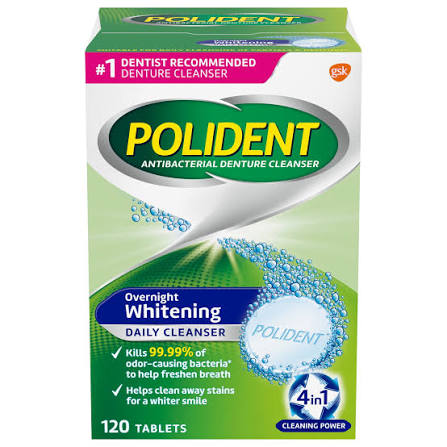
For example, Polident’s current instructions call for a tablet in warm, not hot, water, followed by soaking, gentle brushing, and thorough rinsing.
Ease of Use
Tablets can be convenient because the amount is already measured.
A typical routine is simple:
- Add the tablet to warm water.
- Place the denture in the solution.
- Soak for the time stated on the package.
- Brush gently when instructed.
- Rinse well.
- Discard the used solution.
This can be helpful for seniors who prefer a clear routine with fewer measuring steps.
Key Strengths
- Simple measured format.
- Good fit for soaking routines.
- Easy to store.
- Often designed for daily use.
- Can help with stains, plaque, and odor when used as directed.
Potential Drawbacks
- Requires a container for soaking.
- Requires water for each use.
- The soaking time varies by product.
- The solution must be discarded after use for products that require this.
- Tablets should never be placed directly in the mouth.
Which Is Easier for Seniors to Use?
For many seniors, denture tablets have an advantage in routine simplicity.
There is usually no need to squeeze out a measured amount of cream or estimate how much liquid cleaner to use. The tablet provides a set dose.
However, this does not mean tablets are best for every person.
A senior who prefers brushing the denture directly may find a cream or paste easier. A caregiver may also prefer a liquid or paste if that fits an established cleaning routine.
The biggest factor is not age. It is how easy the cleaning steps are for the individual to follow safely and consistently.
Performance Comparison
Both types can help clean removable dentures, but performance depends on the actual formula.
Denture cleaning should remove food particles and help control plaque, stains, and odor. The ADA recommends daily cleaning with an effective, nonabrasive denture cleanser.
| Performance Area | Denture Cleaner | Denture Tablets |
|---|---|---|
| Food debris | Depends on formula | Helps after soaking and rinsing |
| Stain removal | Varies by product | Many formulas target stains |
| Odor control | Depends on formula | Many formulas target odor |
| Plaque removal | Depends on use | Can help when used as directed |
| Soaking | Product dependent | Common method |
| Brushing | Often part of routine | Often used after soaking |
Do not judge performance by the word “cleaner” alone. The exact product formula and instructions matter.
Comfort, Accessibility, and Senior-Friendly Design
A good denture routine should not create unnecessary effort.
Tablets may be useful for someone who wants a repeatable process. A tablet, glass, warm water, soak, rinse, and brush can form a clear routine.
Creams and pastes may work well for someone with a strong brushing habit.
For seniors with limited hand strength or dexterity, handling small tablets can also be a consideration. If picking up a small tablet is difficult, a different cleaner format may be easier.
Caregivers should also consider how simple the routine is to supervise.
Features Comparison
The main difference is the cleaning format rather than a simple difference in cleaning power.
| Feature | Denture Cleaner | Denture Tablets |
|---|---|---|
| Product choice | Wide range | Tablet-based |
| Dose | May need measuring | Usually pre-measured |
| Soaking | Depends on product | Common |
| Brushing | Depends on product | Often recommended |
| Routine | Varies | More standardized |
| Storage | Depends on format | Compact and dry |
Price, Maintenance, and Long-Term Value
Price varies widely by brand, package size, and formula. It is better to compare the cost per cleaning than the price of one package.
Tablets may be convenient because each cleaning uses a defined amount. But daily use means the tablets become a recurring consumable.
Other cleaners may offer different costs per use.
Long-term value also depends on how well the product fits the user’s routine. A cheaper cleaner is not good value if it is difficult to use correctly.
Also check the product instructions before using it with partial dentures, metal components, retainers, or other removable appliances.
Who Should Choose Denture Cleaner?
Choose a non-tablet denture cleaner if:
- You prefer a cream, paste, gel, or liquid.
- You like brushing the denture directly.
- You already have a simple cleaning routine.
- Measuring the product is not a problem.
- You want more format choices.
- A dentist or dental professional has recommended a specific type.
Who Should Choose Denture Tablets?
Choose denture tablets if:
- You want a simple soaking routine.
- You prefer a pre-measured format.
- You want an easy daily process.
- You are comfortable handling small tablets.
- You want a compact product for storage or travel.
- You prefer soaking followed by gentle brushing.
Denture Cleaner vs Denture Tablets — Final Verdict
Best for a simple soaking routine: Denture tablets
Best for format choice: Denture cleaner
Best for easy measuring: Denture tablets
Best for direct brushing: Depends on the specific cleaner
Best overall: Denture tablets for seniors who want a simple, repeatable soaking routine
The important detail is that denture tablets are not really an alternative to denture cleaners. They are one form of denture cleanser. The better choice depends on the format, instructions, and cleaning routine that work best for the user.
Scoring Summary
Scores are only useful when they reflect the practical differences discussed above.
| Category | Denture Cleaner | Denture Tablets |
|---|---|---|
| Ease of Use | 8/10 | 9/10 |
| Senior-Friendly Routine | 8/10 | 9/10 |
| Performance | 8/10 | 9/10 |
| Maintenance | 8/10 | 9/10 |
| Value | 8/10 | 8/10 |
These scores are broad category ratings, not laboratory test results. Exact performance depends on the individual product.
How We Evaluate Products
We compare denture cleaners based on practical factors that matter during everyday use.
These include:
- Ease of use
- Accessibility
- Cleaning routine
- Maintenance
- Safety
- Storage
- Performance
- Long-term value
We do not treat marketing claims as proof of performance. Product instructions and the specific formula should always be checked before use.
Senior-Specific Buying Considerations
The best choice should fit the user’s daily routine.
Physical Effort
Consider whether the cleaner requires squeezing, measuring, brushing, or handling a small tablet.
Controls and Steps
Tablets can reduce measuring, but they still require soaking and rinsing.
Maintenance
The cleaning container should be easy to wash and store.
Storage
Keep cleaning products dry and away from children and pets.
Setup
A simple routine is easier to repeat. Choose a product with instructions that are clear and manageable.
Safety
Never put denture cleaner or cleaning solution in the mouth. Follow the product label carefully.
Also avoid hot or boiling water. The ADA warns that hot water can warp dentures.
Common Buying Mistakes
Avoid these mistakes when choosing a denture cleaner.
- Choosing only by package price.
- Assuming every denture cleaner works the same way.
- Ignoring the soaking time.
- Using too much or too little product.
- Using household bleach or abrasive cleaners.
- Using hot water.
- Forgetting to rinse the denture well.
- Choosing a product without checking its instructions.
The ADA specifically advises against bleach and powdered household cleansers because they may damage dentures.
Safety
Denture cleaners are meant to clean removable appliances, not the mouth.
Use warm water rather than hot or boiling water. Follow the label for soaking time, dilution, and rinsing.
For tablet cleaners, do not swallow the tablet or cleaning solution. Polident’s instructions also say to rinse the appliance thoroughly before putting it back in the mouth and to discard the used solution after cleaning.
If a denture causes persistent pain, irritation, or fit problems, talk with a dentist rather than trying to solve the problem by changing cleaning products.
Conclusion
Denture Cleaner vs Denture Tablets is mainly a comparison of cleaning formats. Denture tablets are a type of denture cleaner, while the wider cleaner category also includes creams, pastes, gels, and solutions.
For seniors who want a simple soaking routine with little measuring, tablets are often the easier choice. For people who prefer direct brushing or another cleaning format, a non-tablet cleaner may fit better. The safest approach is to follow the product instructions and use a nonabrasive cleaner made for the denture or appliance.