
Amazon Senior Manager Interview Questions


Compression Socks

Folding Walking Stick with Seat

Slow Cooker Crock Pot
Preparing for an Amazon Senior Manager interview? This guide reveals the exact questions, behavioral expectations, and leadership frameworks used by Amazon’s hiring managers. You’ll learn how to demonstrate ownership, customer obsession, and operational excellence—the core pillars of Amazon’s management principles. Whether you’re aiming for L5/L6 or L7, this article gives you the roadmap to stand out.
Amazon Senior Manager interview questions go far beyond technical expertise—they’re designed to assess whether you embody Amazon’s leadership principles and can scale impact across complex, fast-moving environments. As a Senior Manager at Amazon (typically L5–L7), you’re expected not only to manage day-to-day operations but also to drive strategy, mentor high-performing teams, and deliver measurable business results.
Unlike entry-level interviews focused on skills and knowledge, Amazon’s senior leadership interviews dive deep into your leadership philosophy, operational acumen, and ability to navigate ambiguity. You’ll face behavioral questions rooted in the 14 Leadership Principles, scenario-based challenges that mirror real Amazon dilemmas, and detailed discussions about financial stewardship and team development.
In this comprehensive guide, we’ll walk you through the most common Amazon Senior Manager interview questions, explain what interviewers are truly looking for, and provide actionable examples so you can craft confident, authentic responses. Whether you’re interviewing for a role in Product Management, Operations, Supply Chain, Marketing, or Engineering, these insights will help you stand out as a leader who delivers results while staying true to Amazon’s culture.
Key Takeaways
- Amazon prioritizes leadership principles over technical skills. Your answers must reflect behaviors aligned with Amazon’s 14 Leadership Principles—especially Ownership, Customer Obsession, and Deliver Results.
- STAR method is essential. Use Situation, Task, Action, Result consistently in behavioral interviews to structure compelling, outcome-driven stories.
- Operational metrics matter. Expect deep dives into P&L, efficiency gains, team productivity, and process improvements tied to real business outcomes.
- Leadership style assessment is critical. Interviewers evaluate how you motivate teams, handle conflict, delegate, and develop talent during cross-functional projects.
- Scenario-based questions test decision-making. Be ready to walk through ambiguous problems using data, experimentation, and stakeholder alignment.
- Internal mobility and career progression are emphasized. Show how your past roles prepared you for scaling impact at Amazon’s fast-paced environment.
- Asking smart questions signals strategic thinking. Prepare thoughtful inquiries about team challenges, growth opportunities, and performance metrics.
📑 Table of Contents
- What Makes Amazon Senior Manager Interviews Unique?
- Top Behavioral Questions for Amazon Senior Managers
- Technical and Operational Deep Dives
- Scenario-Based Problem Solving
- How to Answer Using the STAR Method
- Practical Tips to Ace Your Amazon Senior Manager Interview
- Conclusion: Stand Out by Owning Your Story
What Makes Amazon Senior Manager Interviews Unique?
Amazon’s interview process for senior leaders is intentionally rigorous and culturally specific. While many companies ask about your resume or technical background, Amazon uses a framework called Bar Raiser—a cross-functional interviewer who ensures every candidate meets Amazon’s baseline standards. For Senior Managers, this means demonstrating consistent track records of scaling teams, improving processes, and driving revenue or cost savings.
One key differentiator is the emphasis on Leadership Principles. Every answer you give should tie back to one of these values:
– Customer Obsession: Prioritizing customer needs above internal politics.
– Ownership: Taking end-to-end responsibility for outcomes.
– Deliver Results: Meeting commitments even under pressure.
– Earn Trust: Being transparent and reliable.
– Insist on Highest Standards: Raising quality relentlessly.
Interviewers aren’t just checking if you know these principles—they want to see them in action. A vague statement like “I care about customers” won’t cut it. Instead, expect follow-up probes: “Tell me about a time you went above and beyond to solve a customer problem.”
Another unique aspect is the focus on operational depth. At senior levels, Amazon wants evidence you understand financials, metrics, and scalability. You might be asked how you’d optimize a $10M budget or reduce delivery times by 20%. These aren’t hypotheticals—they reflect real-world pressures Amazon faces daily.
Top Behavioral Questions for Amazon Senior Managers
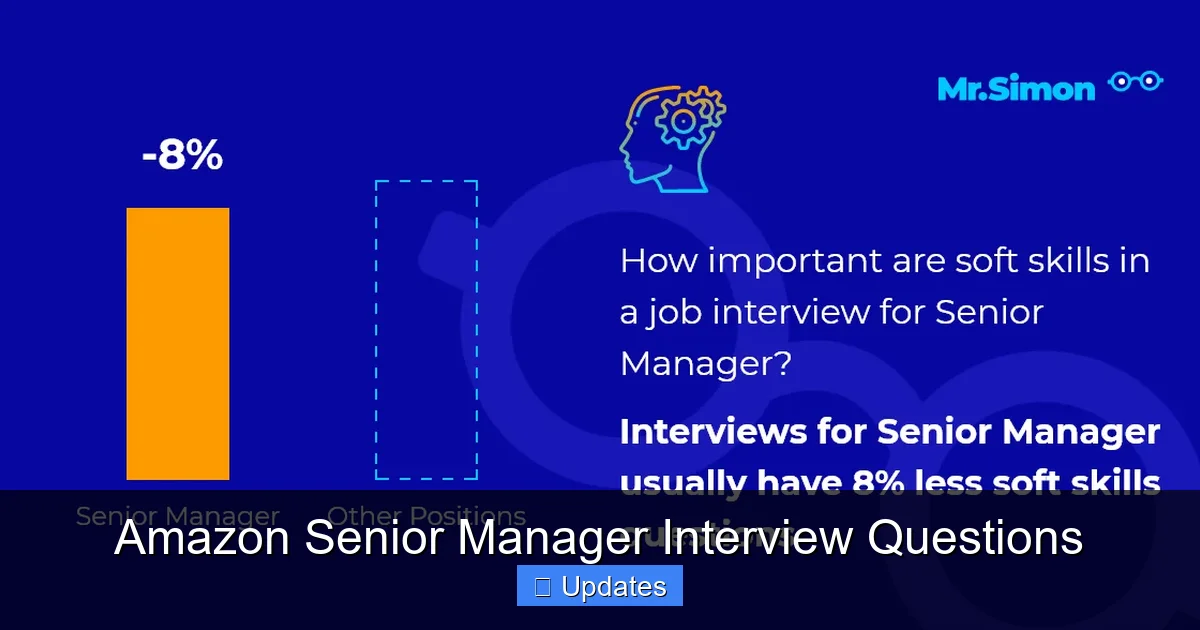
Visual guide about Amazon Senior Manager Interview Questions
Image source: mrsimon.ai
Behavioral questions form the backbone of Amazon’s senior interviews. They reveal how you’ve handled real situations and whether your approach aligns with Amazon’s expectations. Below are the most frequently asked ones—along with tips on structuring strong answers.
1. Tell me about a time you failed to meet a goal. What did you learn?
This question tests resilience and self-awareness. Amazon expects leaders to own mistakes and extract lessons without making excuses.
Example response structure:
– **Situation**: Launched a new logistics system with aggressive timelines.
– **Task**: Ensure on-time delivery despite tech delays.
– **Action**: Diagnosed root cause, reallocated resources, communicated transparently with stakeholders.
– **Result**: Missed deadline by two weeks; implemented buffer protocols that reduced future delays by 35%.
Pro tip: Quantify impact wherever possible. Instead of “we improved something,” say “reduced customer complaints by 25%.”
2. Describe a situation where you had to influence without authority.
At Amazon, senior managers often lead cross-functional initiatives without direct reporting lines. This question evaluates your persuasion skills and emotional intelligence.
Good answer elements:
– Identified a bottleneck affecting multiple teams.
– Built consensus through data and empathy.
– Secured buy-in from skeptical stakeholders.
– Achieved alignment within two weeks.
Red flag: Saying “I just told people what to do” suggests poor collaboration.
3. How have you developed junior team members?
Amazon invests heavily in leadership pipeline development. Show you actively coach others and create growth opportunities.
Strong example:
– Created a monthly mentorship program pairing juniors with senior engineers.
– Set clear OKRs for skill development (e.g., “Complete AWS certification”).
– Tracked promotion rates—team promotions increased by 40% YoY.
4. Share an experience where you made a tough call with incomplete information.
Ambiguity is constant at Amazon. Demonstrate how you gather data, consult stakeholders, and decide confidently.
Sample story:
– Faced supply chain disruption during peak season.
– Used historical data + supplier feedback to estimate risks.
– Decided to shift inventory sources—avoided $2M in lost sales.
5. Tell me about a time you optimized a process for efficiency.
Operational excellence is non-negotiable for Senior Managers. Pick a concrete example involving cost, speed, or quality.
Effective response includes:
– Baseline metric (e.g., “handled 100 tickets/week manually”).
– Improvement (e.g., “automated triage with AI, cutting resolution time by 50%”).
– Business impact (e.g., “saved 10 engineer-hours weekly”).
Technical and Operational Deep Dives
Visual guide about Amazon Senior Manager Interview Questions
Image source: jobtestprep.co.uk
Beyond behavior, Amazon Senior Manager interviews include technical or domain-specific questions. These vary by role but always center on measurable outcomes and scalability.
Financial Acumen Questions
You’ll likely be quizzed on budgeting, forecasting, and ROI analysis. For example:
“How would you justify investing $500K in a new warehouse automation tool?”
Ideal approach:
1. Define success metrics (e.g., “reduce picking errors by 30%”).
2. Project payback period (e.g., “18 months via labor savings”).
3. Outline risk mitigation (e.g., “pilot first in one facility”).
Bonus points: Mention sensitivity analysis or scenario planning.
Metrics and KPIs
Be ready to discuss how you define and track performance. Common topics:
– Customer satisfaction scores (CSAT, NPS)
– Operational efficiency ratios (OTIF, fulfillment accuracy)
– Team velocity or output per headcount
Example: “We improved our order accuracy rate from 92% to 98% by implementing barcode scanning and daily audits—resulting in 30% fewer customer service escalations.”
Scaling Challenges
Senior Managers must think beyond their current scope. Expect questions like:
“If your team grew from 10 to 50 people, what would change in your leadership approach?”
Strong answer components:
– Shift from hands-on execution to delegation.
– Invest in scalable systems (documentation, tools).
– Expand feedback loops and 1:1 frequency.
– Reassess priorities to avoid micromanagement.
Scenario-Based Problem Solving
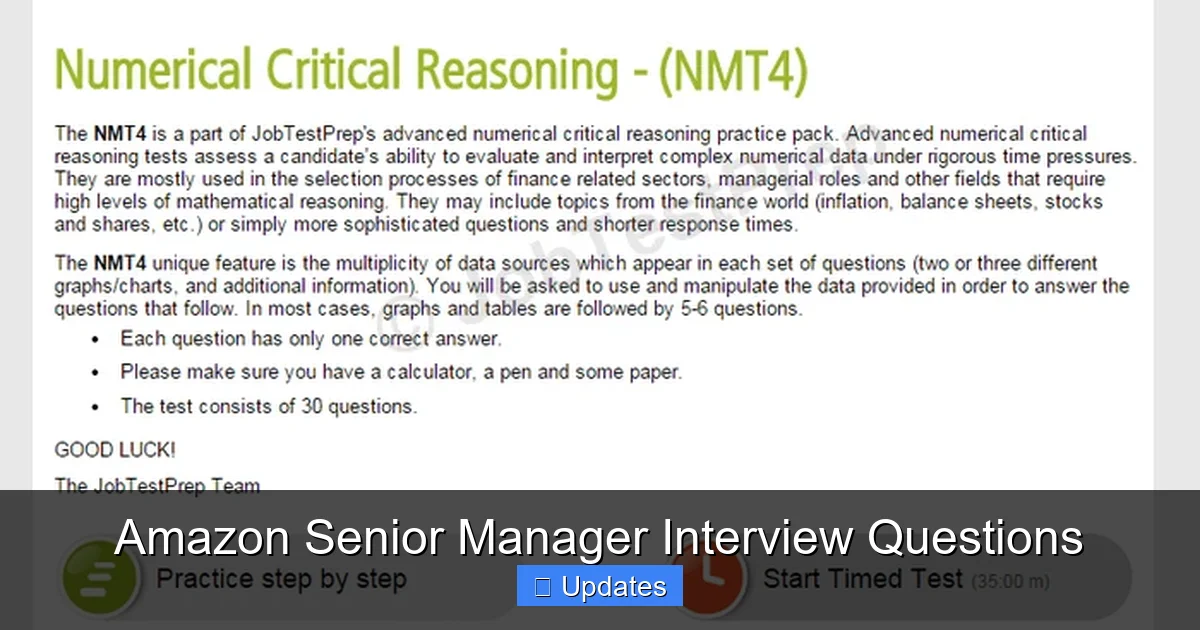
Visual guide about Amazon Senior Manager Interview Questions
Image source: jobtestprep.co.uk
Amazon uses case studies to simulate real leadership challenges. These may come from product launches, supply chain disruptions, or organizational redesigns.
Sample Scenario: Declining Product Performance
Prompt: “Your team manages a legacy product with declining revenue. Sales dropped 15% QoQ. What’s your plan?”
Step-by-step thinking:
1. **Diagnose**: Run root cause analysis (market shifts? UX issues? pricing?).
2. **Prioritize**: Focus on highest-leverage fixes first.
3. **Experiment**: Test small changes before full rollout.
4. **Communicate**: Align stakeholders on urgency and next steps.
5. **Measure**: Track impact weekly; pivot if needed.
Key insight: Amazon loves data-driven experimentation. Say “Let’s run A/B tests” rather than “I’ll make a guess.”
Organizational Design Questions
You might be asked to restructure a team or clarify reporting lines. Example:
“How would you organize a newly acquired team into functional units?”
Recommended framework:
– Map roles to Amazon’s existing org structure.
– Identify integration risks (culture clash? duplicated efforts?).
– Propose interim leads during transition.
– Plan for cultural assimilation within 90 days.
How to Answer Using the STAR Method
The STAR framework (Situation, Task, Action, Result) is your secret weapon. It keeps answers concise, structured, and results-oriented.
Situation: Set the context clearly.
Task: State your responsibility.
Action: Detail what YOU did (not your team).
Result: Quantify outcomes with numbers.
Bad vs. Good STAR:
– *Weak*: “Our team struggled with delays.”
– *Strong*: “In Q3 2022, our support team took 72 hours average to resolve tier-2 tickets—below the 48-hour target. I led a process redesign that automated ticket routing, reducing avg. resolution time to 38 hours (+47% improvement).”
Practice writing 5–10 STAR stories before your interview covering:
– Handling missed deadlines
– Resolving inter-team conflicts
– Driving innovation under constraints
Practical Tips to Ace Your Amazon Senior Manager Interview
Here’s how to prepare like a pro:
1. Research the Role and Team
Before your interview, review the job description and LinkedIn profiles of your interviewers. Understand their recent projects and challenges. Ask clarifying questions like:
“What’s been the biggest challenge for this team in the last quarter?”
2. Practice with Real Examples
Gather 3–5 detailed stories from your past roles. Each should showcase:
– A significant business impact
– A leadership principle in action
– Measurable results
Store them in a cheat sheet with STAR formatting.
3. Master Amazon’s Leadership Principles
Map each principle to a personal example. For instance:
– Customer Obsession: “I once stayed late to fix a bug reported by a VIP client, preventing a $500K contract loss.”
– Ownership: “I owned the migration of our billing system to AWS, saving $200K annually in infrastructure costs.”
4. Prepare Smart Questions to Ask
Ending with insightful questions shows engagement. Try these:
– “What does success look like for this role in the first 90 days?”
– “How does this team measure impact versus output?”
– “What’s one thing you wish someone had told you when they joined here?”
Avoid generic queries like “What’s the salary range?”—save those for later stages.
5. Simulate High-Pressure Scenarios
Practice answering tough questions out loud. Record yourself to check clarity, pacing, and body language. Partner with a friend to role-play interviews.
6. Embrace Feedback Loops
Amazon values continuous learning. If you don’t know an answer, say:
“That’s outside my immediate experience, but here’s how I’d approach researching it…”
Conclusion: Stand Out by Owning Your Story
An Amazon Senior Manager interview isn’t just about proving you’re qualified—it’s about demonstrating you’re the right kind of leader for Amazon’s demanding, innovative culture. By aligning every answer with the Leadership Principles, grounding responses in real data, and showing humility alongside confidence, you’ll signal readiness to scale impact.
Remember: Amazon doesn’t hire just managers—they hire owners. So own your stories, own your metrics, and own the opportunity. With preparation, authenticity, and a customer-first mindset, you’ll not only pass the interview—you’ll thrive in it.
Now go ace that interview!
Frequently Asked Questions
What are Amazon’s 14 Leadership Principles?
Amazon’s Leadership Principles guide decision-making and behavior across all levels. The 14 include Customer Obsession, Ownership, Invent & Simplify, and Earn Trust. During senior manager interviews, every answer should reflect these values—especially Deliver Results and Insist on Highest Standards.
How should I structure my answers during an Amazon Senior Manager interview?
Use the STAR method: Situation, Task, Action, Result. Keep answers concise, focus on YOUR contributions, and quantify outcomes with numbers. For example: “We reduced delivery errors by 30% by implementing X—I owned the rollout and trained 50+ staff.”
Are technical skills less important than leadership for Amazon Senior Managers?
No—but leadership principles outweigh pure technical depth. You need enough domain expertise to speak intelligently, but your primary value comes from managing teams, driving strategy, and delivering business results aligned with Amazon’s culture.
Can I ask questions during the Amazon Senior Manager interview?
Yes! Asking thoughtful questions demonstrates engagement. Examples: “What’s the biggest challenge facing this team right now?” or “How do you measure success for this role?” Avoid asking about salary or benefits too early.
What if I don’t know the answer to a tough question?
It’s okay to pause and say: “That’s outside my immediate experience, but here’s how I’d research it…” Amazon values curiosity and problem-solving over memorized answers. Show willingness to learn and collaborate.
How long is the Amazon Senior Manager interview process?
Typically 3–5 rounds over 2–4 weeks. Early stages include phone screens and live interviews covering behavioral, technical, and leadership topics. Final rounds involve Bar Raisers who assess alignment with Amazon’s baseline standards.