
Walking Cane Wrist Strap Explained: Purpose, Fit, and Safe Use


Adjustable Bed Wedge Pillow

Digital Thermometer

Reading Light for Bed
Quick Answer
A walking cane wrist strap is a small loop attached near the cane handle. It helps keep the cane close if you briefly loosen your grip, but it is not designed to support body weight or prevent a fall. Correct cane height and technique remain more important, as explained in the National Institute on Aging fall-prevention guidance.
What the wrist strap should do
- Keep the cane nearby: The strap can stop a dropped cane from rolling or sliding out of easy reach.
- Allow brief hand movement: It can help when opening a door or adjusting clothing for a moment.
- Fit comfortably: The loop should sit around the wrist without squeezing, rubbing, or restricting movement.
- Stay secondary: Your hand should control the cane through its handle, not through the wrist loop.
- Remain in good condition: Fraying, damaged stitching, or a loose attachment means the strap should be repaired or replaced.
Most important safety point
- Never treat a wrist strap like a safety harness or use it to pull your body against the cane.
A cane wrist strap looks simple, yet its purpose is often misunderstood. Some people expect the loop to improve balance, while others never use it because they are unsure how it should fit.
I find it more useful to think of the strap as a cane-retention accessory. This guide explains what it does, how to use it, and when it can become more trouble than help.
In This Guide
- What Is a Walking Cane Wrist Strap?
- What Does a Cane Wrist Strap Actually Do?
- How Should a Walking Cane Wrist Strap Fit?
- How Do You Use a Cane Wrist Strap Correctly?
- Which Type of Cane Wrist Strap Is Best?
- Can a Cane Wrist Strap Be Unsafe?
- When Should You Replace a Cane Wrist Strap?
- Frequently Asked Questions
- Final Takeaway
What Is a Walking Cane Wrist Strap?
A walking cane wrist strap is a loop of cord, fabric, webbing, leather, or elastic attached near the cane handle. You place your hand through the loop before holding the handle normally.
Its main purpose is retention. If your fingers release the handle, the cane may remain hanging near your hand instead of falling to the floor.
Is the wrist strap part of the cane’s support system?
No. A wrist strap should not be considered a weight-bearing part of a walking cane.
The cane supports you through the handle, shaft, and rubber tip or base. Your grip controls where that support is placed.
- Handle: Transfers pressure from your hand into the cane.
- Shaft: Carries the load toward the floor.
- Ferrule or cane tip: Provides contact and traction against the walking surface.
- Wrist strap: Helps you retain the cane when your grip briefly opens.
This difference matters. Pulling upward on the wrist loop does not give the same stable support as pressing through a correctly positioned handle.
Where is the strap normally attached?

Most straps attach through a small hole or fitting close to the handle. Some replacement straps use a loop, buckle, clip, or collar around the cane shaft.
Whatever the design, the attachment should feel secure. A strap that slides down the shaft can become distracting during walking.
What Does a Cane Wrist Strap Actually Do?
A cane strap mainly solves one everyday problem: keeping the cane within reach when you momentarily release the handle. It is a convenience feature, not a replacement for balance support.
That distinction becomes clearer during ordinary daily activities.
When can a wrist strap be useful?
- Opening a door: You may need your fingers briefly while keeping the cane nearby.
- Reaching into a pocket: The strap can prevent the cane from dropping while your hand moves.
- Adjusting clothing: A scarf, coat, or sleeve may require a quick hand movement.
- Standing at a counter: The cane can remain attached to your wrist rather than being leaned somewhere unstable.
- Travel: A strap can make a folding or lightweight cane easier to keep track of.
A strap is especially convenient when a dropped cane would be difficult to retrieve. Bending toward the floor can be challenging for someone with reduced balance.
The NHS walking-aid guidance emphasizes choosing a properly fitted walking stick. The strap should be treated as an accessory to that properly fitted aid.
What does the strap not do?
- It does not correct an improperly adjusted cane.
- It does not compensate for a worn rubber tip.
- It does not make a single-point cane equal to a quad cane or walker.
- It does not prevent your wrist from being injured during a fall.
- It does not guarantee that the cane remains safely positioned.
If you regularly depend on the strap to catch or support the cane while walking, the underlying setup deserves another look.
How Should a Walking Cane Wrist Strap Fit?
A cane wrist strap should feel secure without feeling tight. You should be able to grip and release the handle naturally without the loop squeezing your wrist.
There is no single medical wrist-loop measurement that fits every user. Cane designs, hand size, clothing, and strap materials all differ.
What does a comfortable fit feel like?
Start by placing your hand through the loop. Then hold the cane handle exactly as you normally would.
- The loop should rest comfortably around your wrist.
- Your wrist should move without being pulled sideways.
- The strap should not cut into your skin.
- Your sleeve should not bunch tightly under the loop.
- You should be able to remove your hand deliberately without struggling.
A strap that is too loose may slide toward your hand or snag nearby objects. An excessively tight loop can become uncomfortable and harder to release.
Check the cane height before worrying about strap length
Correct cane setup matters more than strap adjustment. Patient guidance from South Tees Hospitals NHS Foundation Trust advises setting the hand grip around wrist height.
When standing upright with your arm relaxed, check where the handle sits. A cane that is obviously too high or low should be corrected before focusing on accessories.
- Too high: Your shoulder may rise as you place the cane.
- Too low: You may lean or bend more than necessary.
- Correctly positioned: Your arm can remain relaxed with comfortable elbow movement.
Safety note: If you are uncertain about cane height, walking pattern, or which side should hold the cane, ask a physical therapist, occupational therapist, or other qualified clinician.
How Do You Use a Cane Wrist Strap Correctly?
Use the wrist strap before you begin walking, not after you need it. The process should take only a few seconds.
- Inspect the strap. Check the loop and attachment point for obvious damage.
- Place your hand through it. Let the loop settle naturally around your wrist.
- Grip the cane handle. Your palm and fingers should control the cane normally.
- Walk using your usual cane technique. Do not pull against the strap.
- Release only when appropriate. Let the strap retain the cane during brief, controlled tasks.
Should the cane hang from the strap while walking?
No. During normal walking, your hand should remain on the handle.
Letting the cane swing from your wrist can cause the tip to strike your foot, furniture, or another person. It also places the cane in the wrong position for immediate support.
What about stairs?
Stairs deserve extra caution. A wrist loop does not make stair climbing automatically safer.
When a secure handrail is available, follow the cane technique provided by your therapist or clinician. Do not sacrifice a stable rail grip just to keep tension on the wrist strap.
- Move slowly and avoid rushing.
- Keep the cane tip clear of the step edge.
- Use the handrail when appropriate.
- Make sure the strap cannot wrap around the rail.
- Stop if the cane or strap feels awkward.
The key is simple: the strap follows your safe cane technique. Your technique should never be changed merely to accommodate the strap.
Which Type of Cane Wrist Strap Is Best?
The best wrist strap is the one that stays comfortable, remains secure, and works with your cane’s attachment point. Different materials feel noticeably different in daily use.
| Strap Type | Adjustment | Main Advantage | Main Limitation | Best Suited For |
|---|---|---|---|---|
| Cord loop | Often fixed | Light and simple | Thin cord may feel less comfortable | Lightweight everyday canes |
| Webbing strap | Often adjustable | Broad contact area | Can absorb moisture | Frequent daily use |
| Elastic loop | Stretch-based | Easy to slip over the hand | Elastic may weaken with age | Users wanting easy entry |
| Leather strap | Fixed or adjustable | Firm feel and traditional appearance | May stiffen if poorly maintained | Wooden or traditional canes |
| Clip-on replacement | Varies by model | Can be replaced easily | Clip must match the cane securely | Canes without a built-in loop |
What should you look for when buying a replacement?
- Attachment compatibility: Check how the original strap connects to your cane.
- Adjustability: A slider can help when switching between bare wrists and bulky sleeves.
- Soft edges: Rough seams can irritate thin or sensitive skin.
- Secure stitching: Loose threads near the attachment point deserve attention.
- Simple design: Extra clips and decorations can create snag points.
Do not choose a strap only because it looks stronger. A thick strap still does not turn the wrist loop into a body-support device.
Can a Cane Wrist Strap Be Unsafe?
A wrist strap can create problems when it is misused, damaged, or allowed to snag. Most concerns come from treating the loop as something it was never designed to be.
Common cane wrist-strap mistakes
- Pulling against the loop: Body support should come through the handle and cane tip.
- Wearing it extremely tight: A restrictive loop can become uncomfortable and difficult to remove.
- Ignoring damage: Frayed cord or loose stitching can fail unexpectedly.
- Letting the cane swing: A hanging cane may strike your legs or nearby objects.
- Wrapping the strap around your hand: Extra wrapping can make deliberate release harder.
- Using it instead of a handrail: A strap cannot replace stable support on steps.
What if you are at high risk of falling?
The wrist strap should not be the main solution. A broader fall-risk assessment may be more valuable.
The CDC’s older-adult fall-prevention guidance notes that falls can have several contributing factors. Walking difficulty, balance problems, medications, vision, footwear, and home hazards may all matter.
- Tell your healthcare provider if you feel unsteady.
- Ask whether your walking aid is appropriate for your current needs.
- Keep pathways free of clutter and loose rugs.
- Use supportive footwear with good traction.
- Check the cane tip and shaft regularly.
A person needing substantial weight-bearing support may require a different mobility aid. A clinician can help determine whether a quad cane, walker, or another device fits better.
Safety note: Seek professional advice after a new fall, sudden balance change, dizziness, weakness, or a significant change in walking ability.
When Should You Replace a Cane Wrist Strap?
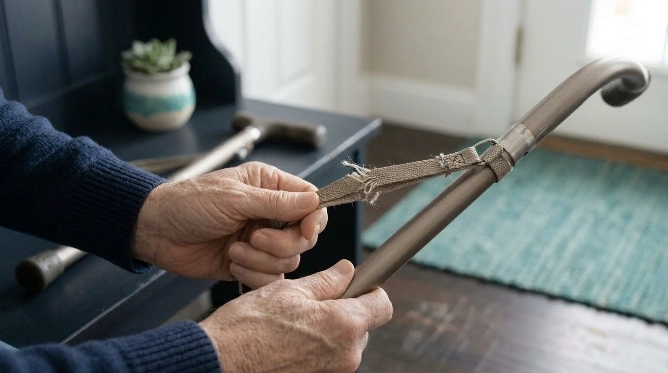
Replace the strap when wear affects its comfort, attachment, or reliability. There is no reason to wait until the loop breaks completely.
Check these areas regularly
- Fraying: Fibers are separating along the loop or attachment cord.
- Loose stitching: Seams are opening near the connection point.
- Cracking: Leather or synthetic material is becoming brittle.
- Stretched elastic: The loop no longer returns to its original shape.
- Damaged hardware: A clip, buckle, or slider is bent or unreliable.
- Persistent odor or moisture damage: The strap no longer cleans or dries properly.
While checking the strap, inspect the whole cane. The wrist loop is only one small part of the walking aid.
A simple 2026 cane safety check
- Confirm the handle feels solid.
- Check that adjustable sections lock securely.
- Look for bends or cracks in the shaft.
- Inspect the rubber tip for wear or splitting.
- Check the wrist strap and its attachment.
- Make sure the cane still feels correctly sized.
If the cane suddenly feels less stable, stop and inspect it before continuing. Small maintenance problems are easier to address before they become walking hazards.
Frequently Asked Questions About Cane Wrist Straps
Do you have to use the wrist strap on a walking cane?
No. A wrist strap is an optional retention accessory on most walking canes. If you can use the cane safely without it, you do not need to keep your wrist inside the loop.
Should a cane wrist strap be tight?
No. It should sit comfortably around your wrist without squeezing or limiting normal wrist movement. It should also be possible to remove your hand deliberately without struggling.
Can a wrist strap stop me from falling?
No. A cane wrist strap is not a fall-arrest device. Balance support comes from correct cane placement, a secure grip, proper cane height, a sound rubber tip, and appropriate walking technique.
Can I add a wrist strap to a cane that did not include one?
Often, but compatibility matters. Use a replacement designed to attach securely without interfering with the handle, height-adjustment system, folding mechanism, or your normal grip.
Which hand should hold a walking cane?
People using a cane for one weaker or painful leg are commonly taught to hold it on the opposite side. Individual needs differ, so follow instructions from your physical therapist or healthcare professional.
Why does my cane strap keep sliding off my wrist?
The loop may be too large, too slippery, or positioned poorly. An adjustable webbing strap may provide a more secure fit, but it should never be tightened enough to restrict comfortable movement.
Is a wrist strap useful on a folding cane?
Yes. It can help keep a lightweight folding cane nearby during brief tasks or travel. Check that the strap does not become trapped between folding sections when the cane is collapsed.
Final Takeaway
A walking cane wrist strap has one straightforward job: help keep your cane close when your hand briefly releases the handle. It is useful, but it is not a substitute for correct cane setup or safe walking technique.
Keep the loop comfortable, inspect it for wear, and avoid pulling your body against it. Your hand should control the cane through the handle whenever you are walking.
- Use the strap for retention, not body support.
- Make sure the loop feels comfortable and easy to remove.
- Check the attachment point for wear or looseness.
- Keep the cane tip, shaft, and handle in good condition.
- Ask a clinician for help if the cane no longer provides enough stability.
If the strap ever makes the cane harder to control, remove it and address the problem. A useful accessory should make cane management simpler, not more complicated.