
Walking Cane Locking Mechanism Explained


Anti-Slip Shower Stickers

Electric Kettle with Auto Shutoff

Heated Blanket
Quick Answer
A walking cane locking mechanism keeps an adjustable or folding cane from changing length or separating while you use it. Most adjustable canes combine a spring-loaded push button with a locking collar or ring, while folding canes also rely on connected shaft sections that must seat securely. Proper adjustment is important for safe cane use, as explained in Mayo Clinic’s cane fitting guidance.
How the lock works
- Push button: A spring-loaded pin pops through a hole in the outer tube and establishes the selected cane height.
- Locking collar: A threaded ring tightens around the shaft and helps reduce unwanted movement or rattling.
- Adjustment holes: These preset positions allow the cane to be shortened or lengthened in controlled increments.
- Folding joints: Folding cane sections fit together under tension and must be completely seated before walking.
- Safety check: The button should protrude fully, the collar should be secure, and the shaft should not slide when downward pressure is applied.
A walking cane can look simple from the outside, but the locking system does an important job. It keeps the shaft at the correct height and helps prevent the cane from shifting when you put pressure on it.
I find it easiest to understand the system as two layers of protection. One part chooses the height, while another part helps secure the cane at that setting.
In This Guide
- What Is a Walking Cane Locking Mechanism?
- How Does a Walking Cane Locking Mechanism Work?
- What Types of Cane Locking Mechanisms Are Used?
- How Do You Adjust and Lock a Walking Cane?
- How Can You Tell If the Cane Is Locked Correctly?
- Why Does a Walking Cane Lock Become Loose?
- How Is a Folding Cane Lock Different?
- How Should You Maintain the Locking Mechanism?
- Frequently Asked Questions
- Final Takeaway
What Is a Walking Cane Locking Mechanism?
A walking cane locking mechanism is the hardware that prevents an adjustable cane shaft from moving after you select its height. On folding models, the term can also describe the parts that keep the assembled sections firmly connected.
Definition: A cane locking mechanism is a mechanical system that secures movable cane components in their intended position during use.
The main parts you’ll usually see
An adjustable aluminum cane commonly uses several simple components working together. Their exact names vary between manufacturers.
- Inner adjustment tube: Slides inside the main cane shaft.
- Outer tube: Contains a series of adjustment holes.
- Spring button or snap button: Pops outward through the selected hole.
- Locking collar or ring: Tightens around the shaft after adjustment.
- Handle and tip: Transfer your hand pressure through the secured shaft to the floor.
The push button normally provides the primary positive height stop. The collar often acts as an additional stabilizing feature rather than replacing the button.
That distinction matters. Tightening a collar shouldn’t be treated as a substitute for making sure the adjustment pin is fully engaged.
Why the mechanism matters
A cane must maintain a predictable height when pressure is applied. Unexpected movement can change your posture and reduce the support you expected from the device.
The National Library of Medicine’s MedlinePlus guidance on using a cane recommends adjusting the handle around wrist level while keeping a slight elbow bend.
How Does a Walking Cane Locking Mechanism Work?
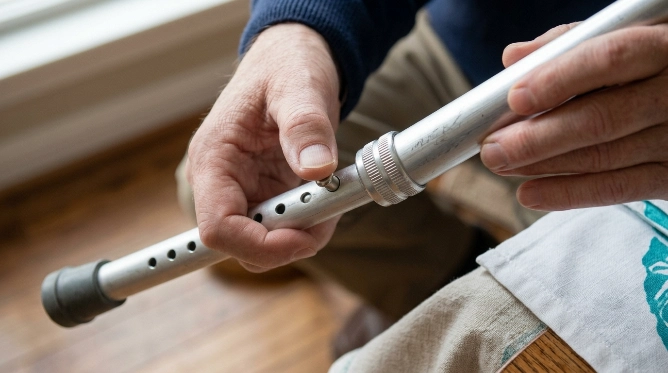
Most adjustable cane locks work by combining a spring-loaded pin with a row of holes in two telescoping tubes. The pin physically prevents one tube from sliding freely through the other.
The process is straightforward once you can identify the parts.
- The user loosens the locking collar if the model has one.
- The spring button is pressed inward.
- The inner tube slides up or down inside the outer shaft.
- The button aligns with the desired adjustment hole.
- The spring pushes the button outward through that hole.
- The locking collar is tightened according to the manufacturer’s instructions.
- The cane is checked for secure engagement before walking.
What the push button actually does
The button is usually attached to a small spring clip inside the shaft. When you press it, the pin moves inward far enough for the tubes to slide.
Once a hole reaches the correct position, spring tension pushes the pin outward again. Many designs make an audible click when this happens.
The important detail isn’t the sound itself. You should visually confirm that the pin protrudes completely through the selected hole.
What does the locking collar do?
The collar is usually a threaded plastic or metal ring around the adjustable part of the shaft. Turning it tightens the connection between the two tubes.
Depending on the cane, the collar may reduce shaft movement, rattling, or rotation. Some manufacturers describe it as a locking ring, locking collet, anti-rattle collar, or adjustment collar.
| Part | Main Job | What to Check |
|---|---|---|
| Push button | Selects and holds the height position | Button protrudes fully through the hole |
| Locking collar | Secures or stabilizes the adjustable shaft | Collar is tightened as the manual specifies |
| Adjustment holes | Provide preset height positions | Hole isn’t visibly damaged or enlarged |
| Folding joints | Connect collapsible shaft sections | Every section is completely seated |
Section Takeaway: The push button usually establishes the height, while the collar helps secure the telescoping shaft. Check both before putting your weight through the cane.
What Types of Cane Locking Mechanisms Are Used?
Not every cane locks in exactly the same way. The design depends on whether the cane is fixed, adjustable, folding, or built with specialized features.
Push-button adjustment lock
This is one of the most recognizable mechanisms on adjustable aluminum canes. A metal pin moves through a row of pre-drilled holes.
- Easy to see whether the pin is engaged
- Allows repeatable height settings
- Requires enough finger strength to depress the button
- Should be checked if the button sticks or fails to spring outward
Push button plus threaded collar
Many adjustable canes combine the button with a secondary collar. This gives the shaft another point of stabilization after the height is selected.
I like to think of this as a two-step check: click first, secure second. The exact direction used to tighten the collar can differ by model, so follow the cane’s instructions rather than assuming every collar turns the same way.
Flip-lock or lever-style collar
Some adjustable mobility aids use a lever that clamps around the shaft. Opening the lever releases pressure, while closing it grips the tube.
A lever lock shouldn’t require extreme force. If it closes too easily or won’t grip securely, the mechanism may need adjustment or professional inspection.
Folding section connections
Folding canes typically contain an elastic cord running through several shaft sections. The cord helps draw the pieces together when the cane unfolds.
The cane isn’t ready simply because the pieces look straight. Each joint should be fully inserted and firmly seated.
How Do You Adjust and Lock a Walking Cane?
Adjusting a cane should be done while you’re stationary on a firm, level surface. Don’t attempt to change the height while using the cane for balance.
Step-by-step adjustment
- Stand safely: Use a stable surface or another person’s help if balance is limited.
- Loosen the collar: Follow the manufacturer’s specified turning direction.
- Press the adjustment button: Push it completely into the shaft.
- Move the tube: Slide the shaft slowly to the desired height.
- Align the button: Let it emerge completely through an adjustment hole.
- Check the position: Make sure the button isn’t sitting halfway between holes.
- Tighten the collar: Secure it according to the instructions for your cane.
- Test the shaft: Apply controlled downward pressure before walking.
How high should the cane be?
Cane fit depends on the individual, but widely used clinical guidance places the handle near the wrist crease while you’re standing upright with your arm relaxed. Your elbow should remain slightly bent while gripping the handle.
Cleveland Clinic’s cane-use guidance also recommends fitting the handle around the wrist crease and maintaining a slight elbow bend.
If a cane feels awkward even after careful adjustment, a physical therapist or other healthcare professional can check the fit. The correct mobility aid also depends on how much support you need.
Health note: A cane isn’t appropriate for every balance or mobility problem. Ask a healthcare professional to assess new weakness, repeated falls, major balance changes, or uncertainty about the right mobility aid.
How Can You Tell If the Cane Is Locked Correctly?
A properly secured adjustable cane shouldn’t suddenly shorten, extend, or rotate when normal downward pressure is applied. You should check the mechanism before first use and after every height adjustment.
Use this quick safety check
- Look at the button: Confirm the metal pin is fully visible outside the shaft.
- Check alignment: The shaft should appear straight rather than caught between settings.
- Feel the collar: Confirm it is secure without forcing it beyond the manufacturer’s instructions.
- Test for sliding: Press down carefully on the handle while the tip stays on a firm floor.
- Check for unusual movement: Excessive twisting or telescoping movement needs attention.
- Inspect the tip: A secure shaft won’t compensate for a badly worn rubber cane tip.
Is a little movement normal?
A small amount of mechanical play can occur on some telescoping canes. That isn’t the same as the shaft visibly slipping between adjustment positions.
If movement has increased noticeably, stop and inspect the button, collar, shaft, and adjustment holes. Don’t rely on repeated tightening if a component appears damaged.
Why Does a Walking Cane Lock Become Loose?
Loose locking mechanisms can develop from incomplete adjustment, wear, contamination, or damaged components. Identifying the cause is more useful than simply tightening everything harder.
The button isn’t fully engaged
The most immediate possibility is that the push button never reached the center of an adjustment hole. It may look almost correct while still sitting partly inside the shaft.
Release pressure, readjust the cane, and confirm full engagement before using it.
The collar wasn’t secured after adjustment
Some canes can feel loose or rattle if their locking collar remains open. Follow your model’s instructions to secure it.
Avoid excessive force. Overtightening a plastic part may damage the threads.
The adjustment hole is damaged
Repeated movement around one setting can eventually reveal wear on a heavily used cane. A distorted hole may prevent the pin from seating as intended.
Visible shaft damage is a reason to stop using the cane until it can be evaluated or replaced.
The spring button sticks
Dirt, corrosion, physical damage, or a failing spring can keep the pin from moving freely. A healthy adjustment button should retract and return reliably.
- Don’t force a jammed pin with sharp tools.
- Don’t tape the shaft as a replacement for a working lock.
- Don’t drill new adjustment holes into the cane.
- Don’t keep using a shaft that slips under pressure.
Those improvised fixes can change how forces travel through the cane. Replacement or manufacturer-approved repair is the safer approach.
How Is a Folding Cane Lock Different?
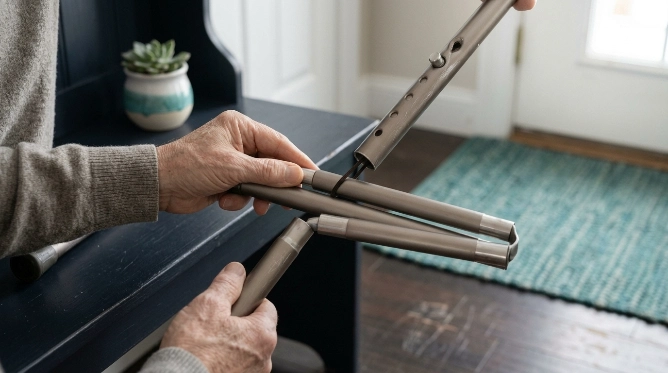
A folding cane has more connections to check because its shaft separates into several sections for storage. An internal elastic cord commonly keeps those sections connected.
The elastic cord isn’t the main structural support
The cord helps pull the sections together. The rigid metal joints provide the structure once the cane is fully assembled.
That means every shaft section needs to slide completely into the adjoining section. A partially seated joint may look assembled while remaining unstable.
Folding and height adjustment are separate systems
Many folding canes are also height adjustable. In that design, you’ll normally check two different areas before walking.
- Folding joints: Make sure each shaft segment is fully seated.
- Height button: Confirm the adjustment pin is fully engaged.
- Locking collar: Secure it if the cane includes one.
- Elastic cord: Check for obvious fraying, cutting, or loss of tension.
Never pull folding sections farther apart than necessary. Excessive stretching can put unnecessary stress on the internal cord.
Section Takeaway: A folding cane may have both joint connections and a separate height lock. Check the complete shaft, not only the adjustment button.
How Should You Maintain the Locking Mechanism?
Regular inspection is simple and takes little time. It also gives you a chance to notice small changes before they become bigger problems.
Before walking
- Confirm the button is completely engaged.
- Check that the collar or lever is secure.
- Verify that folding joints are fully seated.
- Look for cracks, bending, or loose parts.
- Make sure the cane tip has usable tread.
During regular maintenance
Keep the mechanism clean and dry according to the manufacturer’s instructions. Dirt around a push button or telescoping tube can interfere with smooth operation.
Avoid applying oils or lubricants unless the manufacturer specifically recommends them. Some products can attract dirt or affect plastic components.
Know when to stop using the cane
Stop using the cane if its shaft slips, a locking pin won’t engage, a folding joint won’t seat, or a structural component looks damaged. A mobility aid should work predictably every time.
The CDC’s older adult fall-prevention resources emphasize that fall risks can be addressed and that people who feel unsteady should take preventive action.
If your balance or walking ability has changed, don’t assume the cane itself is the only issue. A healthcare professional can determine whether the device and its current setup still match your needs.
Health note: Seek professional advice if you have repeated falls, sudden balance problems, dizziness, new weakness, or difficulty using your usual mobility aid.
Frequently Asked Questions
What locks an adjustable walking cane in place?
Most adjustable canes use a spring-loaded metal button that protrudes through one of several holes in the shaft. Many models add a threaded locking collar around the tube to improve stability and reduce movement after the height is selected.
Should the cane button stick all the way out?
Yes. On a push-button adjustable cane, the pin should normally protrude completely through the selected adjustment hole. If it remains partly inside the shaft, don’t use the cane until the mechanism engages correctly.
Why does my walking cane keep clicking or rattling?
Some noise can come from small amounts of movement between telescoping tubes. Check whether the adjustment button is fully engaged and whether the locking collar is secure. Increasing noise or visible movement may indicate wear that needs inspection.
Can I use a cane if the locking collar is broken?
Don’t assume the cane remains safe just because the push button still works. The collar may be an intended part of the manufacturer’s locking system. Stop using a damaged cane and check its instructions or contact the manufacturer about repair or replacement.
How do folding walking canes stay together?
Folding canes commonly use an internal elastic cord to draw rigid shaft sections together. The metal sections must fit fully into each other before use. The cord helps assembly but shouldn’t be treated as the cane’s main structural support.
How do I know the correct cane height?
A common fitting method places the handle near your wrist crease while you stand upright with your arms relaxed. Your elbow should have a slight bend when holding the grip. A physical therapist can check the fit if you’re unsure.
What should I do if the cane slips after I lock it?
Stop using it. Recheck the adjustment button and collar without putting your balance at risk. If the shaft still slips, or any locking part appears worn or damaged, replace the cane or have it evaluated rather than attempting a makeshift repair.
Final Takeaway
A walking cane locking mechanism is simple, but every part has a specific job. The push button usually establishes the height, while a collar or lever helps keep the adjustable shaft secure.
Folding canes add another concern because every shaft section must be completely seated. Checking the joints, locking pin, collar, shaft, and cane tip takes only a moment.
Make that inspection part of your normal routine in 2026 and beyond. If a cane changes height, slips, bends, or refuses to lock reliably, stop using it until the problem is corrected.
Most importantly, match the cane to the person using it. Correct fit, a dependable locking system, and proper walking technique all work together to provide safer support.