
Walking Cane Handle-to-Shaft Connection Explained


Adaptive Eating Utensils

Toilet Safety Rails

Puzzle Book for Seniors
Quick Answer
A walking cane handle-to-shaft connection is the joint that secures the handgrip to the cane’s supporting shaft. Depending on the design, it may use a threaded connector, fitted tenon, adhesive bond, mechanical fastener, or one-piece construction. The connection must remain firm because it transfers pressure and steering forces from your hand into the shaft. If the handle twists unexpectedly, wobbles, separates, or shows cracking around the joint, stop using the cane until it has been properly assessed.
How Does a Walking Cane Handle Connect to the Shaft?
The handle sits at the top of a walking cane, while the shaft extends downward toward the ground-contact tip. On a cane with a separately attached handle, the connection joins these components into a functional supporting structure.
When you press downward on the grip, force passes through the handle, across its connection, and into the shaft. The connection also experiences twisting and sideways forces as you reposition the cane or lean slightly during walking.
That means the joint must do more than prevent the handle from falling off. It must maintain alignment and resist movement during normal use.
A basic cane has several related structural components:
- Handle: The surface your hand grips and presses against.
- Connection joint: The mechanical or bonded interface between handle and shaft, when these are separate parts.
- Collar: A fitting that may reinforce, cover, or secure a connection, depending on its design.
- Shaft: The main structural section that transfers forces toward the ground.
- Rubber tip: The component that contacts the walking surface and provides traction.
For a broader explanation of the supporting structure, see our guide to walking cane shafts.
Not every cane has a separate handle joint. Some traditional wooden crook canes are shaped from one continuous piece, eliminating the need for an independently attached grip.
The Main Types of Handle-to-Shaft Connections
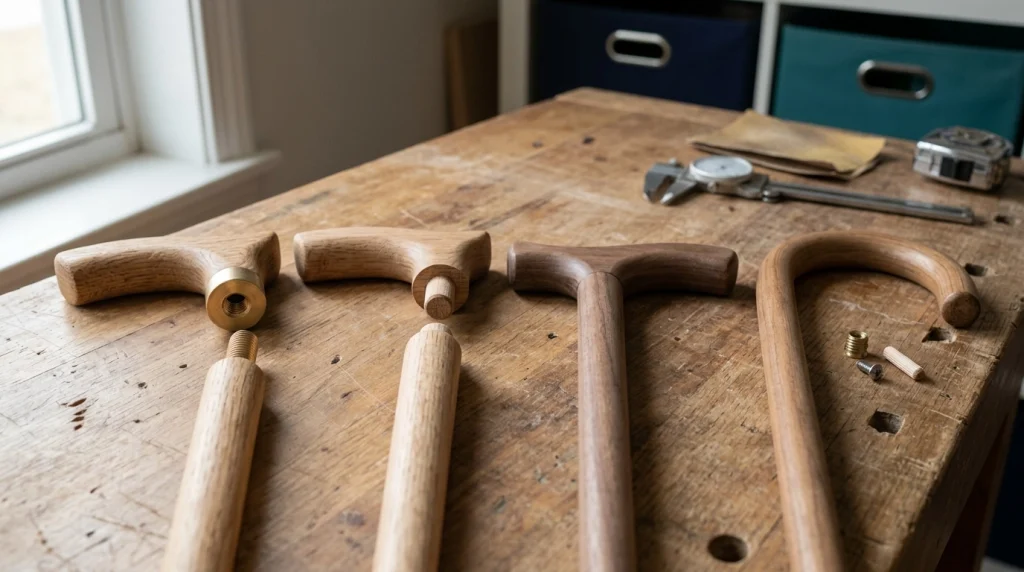
Different cane constructions require different joining methods. Understanding the connection type helps explain why some handles can be removed while others are intended to remain permanently attached.
1. Threaded Connections
A threaded connection uses a screw, threaded rod, or insert to join the handle to the shaft. The connector may be built into one component and engage a matching fitting in the other.
Some interchangeable-handle canes use this arrangement, allowing compatible grips to be removed or replaced. Other threaded connections are permanently secured during manufacturing.
The advantage is a defined mechanical attachment. However, repeated twisting, damaged threads, or an improperly seated connector can allow movement.
Threads are not universal. A replacement handle must match the manufacturer’s thread specification, geometry, engagement depth, and intended cane model.
2. Tenon and Socket Connections
A tenon is a projecting section of material designed to fit inside a corresponding opening. In cane construction, a shaped wooden or composite projection may fit into a handle socket.
The joint relies on its geometry, close fit, and sometimes adhesive for security. A metal collar may also be used to reinforce the surrounding material.
Fit matters because large gaps or damaged mating surfaces can undermine the connection. The presence of adhesive alone does not establish that a damaged joint is safe.
3. Adhesive-Bonded Connections
Some handles are bonded to shafts using an adhesive selected for the materials and joint design.
Bonded construction can provide a clean appearance without an exposed fastener. It may also help keep a properly fitted joint from shifting.
However, bonding performance depends on surface preparation, material compatibility, joint geometry, manufacturing quality, and environmental conditions.
A loose bonded handle should not automatically be repaired with household glue. A cane used for balance needs a connection whose safety can be established, not merely one that feels temporarily firm.
4. Pinned or Mechanically Fastened Connections
Some designs use a cross-pin, screw, or another mechanical fastener to secure the handle or a connecting component.
Such hardware may prevent separation or rotation, but its effectiveness depends on the condition of the fastener and the surrounding material.
A missing pin, enlarged hole, cracked shaft, or loose screw can compromise the attachment. Do not substitute random hardware without confirming the original design requirements.
5. One-Piece Construction
With a one-piece cane, the handle and shaft are continuous rather than separately joined. Traditional crook-shaped wooden canes are a familiar example.
This removes one potential interface for loosening, but it does not eliminate structural risks. Cracks, splits, damage around the curved grip, and weakened material still require attention.
One-piece construction is therefore different from a reinforced separate joint, not automatically superior to every assembled cane.
How Connection Types Differ in Everyday Use
The following comparison describes typical construction characteristics, not a universal strength ranking.
| Connection | Main characteristic | Potential concern |
|---|---|---|
| Threaded | Mechanical engagement; sometimes removable | Loosening or damaged threads |
| Tenon and socket | Close-fitting shaped components | Poor fit, splitting, or joint movement |
| Adhesive-bonded | Bonded material interface | Bond deterioration or separation |
| Pinned or fastened | Additional mechanical retention | Loose hardware or damaged holes |
| One-piece | Continuous handle and shaft | Cracks or damage in the material |
No connection type guarantees safety by itself. Manufacturing quality, intended loading, structural condition, and correct assembly all matter.
Why a Secure Handle Connection Matters for Stability
A cane handle is the point where the user controls the walking aid. Any unexpected motion at its connection can interfere with that control.
For example, a handle that rotates independently of the shaft may change its position as the user applies pressure. A joint that rocks from side to side may also produce an unstable feeling even when the rubber tip remains in contact with the floor.
The amount and direction of force vary with cane design, walking technique, and how much support a person requires. A connection that appears intact while the cane is resting may still be unreliable during use.
This is why checking a cane means inspecting its assembled condition, not simply looking for obvious broken pieces.
Safety Warning
Do not continue relying on a cane with a loose, cracked, or separating handle joint. A connection can fail unexpectedly even if it appears to hold under gentle pressure. Arrange a suitable replacement or qualified inspection before using it for walking support.
How to Check a Cane Handle-to-Shaft Connection
You can perform a basic visual and non-weight-bearing inspection without dismantling the cane. These checks help identify warning signs, but they cannot prove the joint’s load-bearing strength.
- Place the cane on a stable surface. Inspect it while seated or otherwise safely supported, without depending on the cane for balance.
- Examine the junction. Look for gaps, cracks, splitting, corrosion, protruding fasteners, or damage to the collar.
- Check for unexpected movement. Gently assess whether the handle shifts relative to the shaft. Do not apply forceful twisting or bending.
- Look for alignment changes. Notice whether the grip appears tilted, displaced, or improperly seated.
- Review the manufacturer’s instructions. Some removable handles require specific assembly procedures, while permanently bonded handles are not meant to turn.
- Inspect the rest of the cane. Check the shaft, adjustment mechanism, and rubber tip for additional damage.
If movement or visible damage is present, remove the cane from service. An apparently firm joint may still have hidden deterioration, particularly after an impact.
The South Tees Hospitals walking-stick safety guidance specifically advises regular inspections, including checking that handles are not loose.
What Causes a Walking Cane Handle to Become Loose?
Looseness can result from several different problems, depending on how the handle is attached.
- Thread movement: A removable threaded connector may become insufficiently seated or develop worn threads.
- Joint deterioration: Adhesive or fitted mating surfaces may no longer maintain their original connection.
- Material damage: Wood can split, while metal or composite components can crack or deform.
- Fastener problems: Pins, screws, or inserts may loosen or damage their mounting areas.
- Impact damage: Dropping or striking a cane can affect the joint even when damage is not immediately obvious.
- Incompatible replacement parts: A handle may appear to fit without engaging the shaft in the way the manufacturer intended.
Not every noise or rattle originates at the handle. Adjustable shafts and folding sections contain separate connections that may also move.
If movement occurs lower down, the issue may involve the cane’s adjustment system rather than its handle attachment.
Can a Loose Cane Handle Be Repaired?
Sometimes, but the correct action depends on the connection design and the nature of the damage.
A manufacturer-approved removable handle may have a specified tightening or replacement procedure. If the manufacturer documents that procedure and the parts are undamaged, following those instructions may restore the intended assembly.
A cracked wooden joint, stripped threaded insert, failed permanent bond, or damaged structural fastener is different. These problems require evaluation of the connection’s ability to provide reliable support.
Do not assume that adding glue, tape, an oversized screw, or an improvised spacer is an acceptable mobility-aid repair.
The most useful decision is whether the original design can be restored and its safety established. If not, replacing the affected component or entire cane may be the more appropriate option.
Practical Tip
Before seeking a replacement handle, record the cane’s manufacturer, model, and any part number. A photograph of the connection can help the manufacturer or mobility-equipment supplier identify the correct component.
When Should You Replace the Cane Instead?
Replacement deserves strong consideration when the handle connection is structurally damaged, cannot be reliably secured, or has no compatible manufacturer-approved parts available.
Other warning signs include repeated loosening after correct assembly, visible cracks near the joint, deformed shaft material, or a previous repair whose safety cannot be established.
For someone who depends heavily on the cane to remain balanced, even occasional movement is a meaningful concern. A physical therapist or qualified mobility-aid supplier can help determine an appropriate replacement.
The Guy’s and St Thomas’ NHS guidance advises checking walking-aid handles and connecting parts for looseness or wobbling and seeking a replacement when necessary.
If a different cane is needed, our guide explaining walking cane types provides a useful starting point for understanding the available designs.
Does the Metal Collar Hold the Handle in Place?
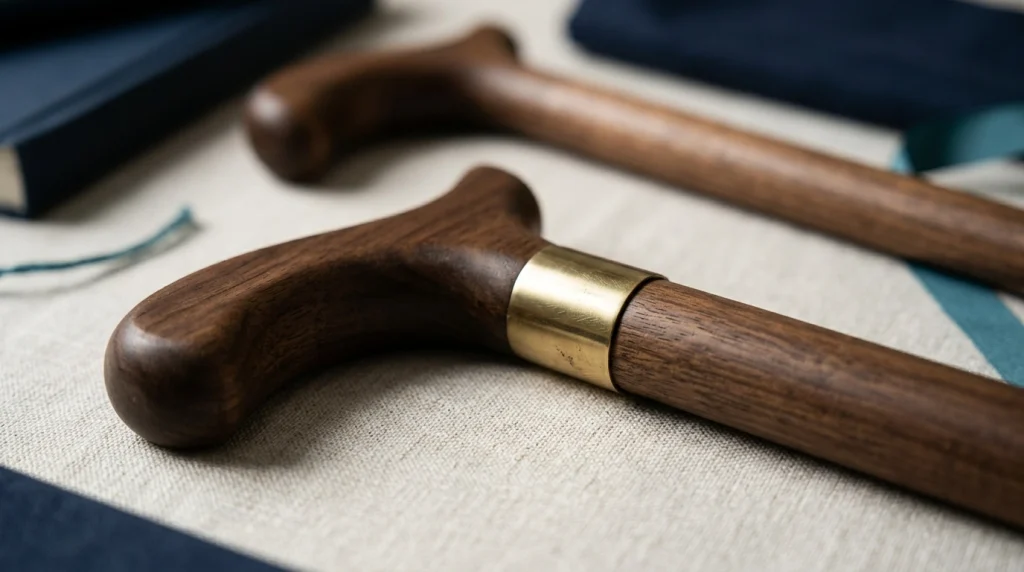
Not necessarily. A visible metal ring near the handle may act as a reinforcement, a cover, a structural fitting, or a decorative accent.
On some wooden canes, a collar reinforces the material surrounding a fitted connection. On others, it conceals hardware or simply finishes the junction neatly.
Its presence does not prove that the handle is securely attached, and a missing decorative ring does not automatically mean the structural connector has failed.
The actual role must be determined from the cane’s design. Equally, the adjustment collar on a telescoping shaft performs a different function from a handle-to-shaft joint fitting.
Frequently Asked Questions
Can a walking cane handle be replaced separately?
Yes, on some models. Replacement is practical when the manufacturer supplies a compatible handle and approves its installation. Many permanently attached or one-piece handles are not designed for separate replacement.
Should a cane handle rotate slightly?
Not unless that movement is an intentional, documented feature of the particular design. Unexpected rotation at a fixed handle-to-shaft joint is a reason to stop using the cane until it has been checked.
Are threaded cane handles universal?
No. Thread dimensions, engagement depth, connector shape, and handle geometry vary. Even two handles that look similar may not be compatible.
Can epoxy make a loose cane handle safe again?
Epoxy is used in some original cane constructions, but applying it to an unidentified damaged joint does not establish a safe repair. Follow manufacturer instructions or seek a qualified assessment rather than relying on an improvised bond.
Is a one-piece cane always stronger than an assembled cane?
No. A one-piece design eliminates a separate handle joint, but overall strength depends on material quality, dimensions, manufacturing, damage, and intended use. A properly engineered assembled cane can also provide reliable support.
How often should the handle connection be inspected?
Check it regularly and whenever the cane is dropped, starts making unusual noises, or feels different in use. A quick inspection before relying on the cane can reveal obvious movement or damage, although it cannot detect every hidden defect.
Final Thoughts
The handle-to-shaft connection is a small but essential part of a walking cane. Threaded fittings, tenons, adhesive bonds, mechanical fasteners, and one-piece construction all have different characteristics, but the shared requirement is a stable, dependable connection.
Inspect the joint regularly, follow the manufacturer’s assembly instructions, and never ignore unexpected movement. When structural damage or uncertain repair quality is involved, a properly fitted replacement cane is preferable to relying on a questionable connection.
