
Philips Sonicare vs Waterpik Electric Toothbrush for Seniors: 2026


Smart Health Watch for Seniors
Tablet for Seniors

Leg Massager for Circulation
Philips Sonicare vs Waterpik electric toothbrush for seniors is a useful comparison because both brands offer sonic brushing, but their strengths are different. Sonicare has a broad range of simple and advanced toothbrushes, while Waterpik focuses on easy brushing and, in some models, built-in water flossing.
For seniors, the better choice depends less on brand name and more on grip, controls, brushing comfort, charging, and maintenance. A simple Sonicare can be a better fit for everyday brushing, while a Waterpik Sonic-Fusion can make sense for someone who wants brushing and water flossing in one system.
Quick Comparison
For most seniors who want a simple electric toothbrush, Philips Sonicare has the edge. Many current Sonicare models offer pressure sensing, ergonomic handles, timers, and long battery life.
Waterpik becomes more interesting for seniors who value water flossing as part of the same routine. Its Sensonic toothbrushes also offer soft bristles, multiple modes, an ergonomic non-slip handle, and long battery life.
Simple brushing: Philips Sonicare
Brushing plus water flossing: Waterpik
Philips Sonicare vs Waterpik At a Glance
The two brands overlap, but they do not offer exactly the same type of experience. Model choice matters, especially with Waterpik.
| Feature | Philips Sonicare | Waterpik |
|---|---|---|
| Senior-friendly grip | Slim ergonomic designs | Ergonomic, non-slip handles |
| Pressure feedback | Available on many models | Depends on model |
| Brushing modes | Varies by model | 2 speeds on Sonic-Fusion; 3 modes on Sensonic |
| Battery life | Often about 14–21 days on current models | Up to 4 weeks on Sensonic |
| Brushing timer | Yes on many models | Yes |
| Water flossing | No | Available with Sonic-Fusion and Complete Care |
| Maintenance | Brush head replacement | Brush head replacement; flossing models add water-system care |
| Best for | Simple electric brushing | Brushing plus water flossing |
Specifications vary by model, so this table should be treated as a brand-level guide rather than a specification sheet for every toothbrush.
Philips Sonicare Review for Seniors
Philips Sonicare offers a wide range of rechargeable sonic toothbrushes. Current models include simple options such as the 3100 and more advanced models with additional modes and sensors.
Ease of Use
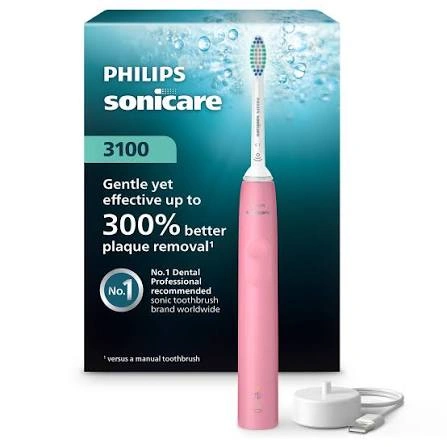
Sonicare does well for seniors who want a straightforward toothbrush. The 3100 Series, for example, has a slim ergonomic handle, a battery indicator, a simple cleaning mode, and click-on brush heads.
Its pressure sensor can also detect excessive brushing pressure and change the vibration to remind the user to ease off. That can be useful for someone who tends to press too hard.
Key Strengths
- Slim ergonomic handle
- Pressure sensor on many models
- Two-minute brushing timer
- 30-second QuadPacer on applicable models
- Easy-click brush heads
- Long battery life on many current models
- EasyStart on selected models
Philips says EasyStart can gradually increase brushing power during the first 14 sessions, which may help someone who is new to electric brushing.
Potential Drawbacks
- Features vary widely between models
- Advanced models can have more controls than some users need
- Replacement brush heads add ongoing cost
- A feature-rich model may be unnecessary for someone who only wants basic brushing
Waterpik Review for Seniors
Waterpik takes a different approach. Its current Sensonic electric toothbrush offers soft bristles, three brushing modes, a timer, a non-slip ergonomic handle, and a battery rated for up to four weeks per charge.
Ease of Use
The Sensonic is designed around a lightweight, quiet toothbrush with an ergonomic handle. That can make it appealing for seniors who value a comfortable grip and simple daily brushing.
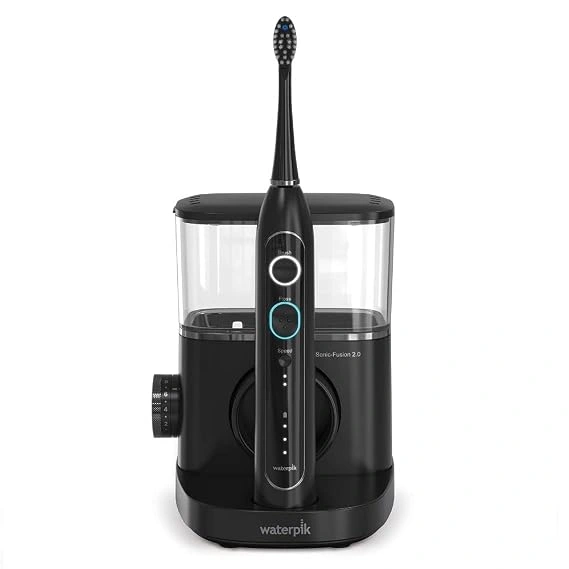
Waterpik also sells Sonic-Fusion models. These combine sonic brushing with water flossing and let the user switch between brushing, flossing, or both using buttons on the handle.
Key Strengths
- Soft-bristle Sensonic options
- Ergonomic non-slip handle
- Quiet operation
- Three Sensonic brushing modes
- Up to four weeks of battery life on Sensonic models
- Water-flossing options
- Useful all-in-one design with Sonic-Fusion
Potential Drawbacks
- Sonic-Fusion requires more setup than a normal electric toothbrush
- Water flossing adds cleaning and maintenance
- The countertop base takes more space
- More features do not necessarily mean a better choice for every senior
Which Is Easier for Seniors to Use?
For basic brushing, Philips Sonicare is the easier overall choice for many seniors because the product range includes simple toothbrushes with relatively straightforward controls.
A Sonicare 3100, for example, has one cleaning mode, a battery indicator, a pressure sensor, and a timer.
Waterpik Sensonic is also easy to hold, especially for users who prefer a non-slip handle. However, Sonic-Fusion is a different story. The user must fill a water reservoir when flossing and deal with the additional base and water system.
| Senior Need | Better Fit | Why |
|---|---|---|
| Simple brushing | Sonicare | Straightforward models are available |
| Comfortable grip | Both | Both offer ergonomic designs |
| Less setup | Sonicare | No water reservoir for normal brushing |
| Water flossing | Waterpik | Built-in water-flossing models |
| Long battery life | Waterpik Sensonic | Up to 4 weeks |
Performance Comparison
Both brands use sonic brushing technology, but the actual experience varies by model.
Sonicare offers models with pressure sensing, multiple intensities, and different brushing modes. Its 3100 Series, for example, has two intensity settings, while other models offer more settings.
Waterpik Sensonic models offer three brushing modes, while Sonic-Fusion 2.0 provides two brushing speeds and adds water flossing.
| Performance Area | Philips Sonicare | Waterpik |
|---|---|---|
| Sonic brushing | Strong range of options | Strong sonic brushing |
| Pressure control | Available on many models | Varies by model |
| Brushing modes | Varies by model | 2 speeds or 3 modes, depending on model |
| Water flossing | Not built into standard Sonicare toothbrushes | Available on Sonic-Fusion |
| Timer/pacing | Available | Available |
The main performance advantage of Waterpik is not necessarily brushing alone. It is the ability to combine brushing and water flossing in selected products.
Comfort, Accessibility, and Senior-Friendly Design
Handle design matters when a toothbrush is used twice a day. Sonicare’s 3100 Series uses a slim ergonomic design, while Waterpik Sensonic uses an ergonomic handle with a non-slip finish.
For someone with reduced hand strength, either design may be preferable to a bulky handle. However, the best choice still depends on the individual grip and model.
Sonic-Fusion requires more interaction because it combines a toothbrush with a water flosser. This may be useful for some users but unnecessary for someone who wants a quick brushing routine.
Features Comparison
The biggest difference is what each brand adds beyond basic sonic brushing.
| Feature | Philips Sonicare | Waterpik |
|---|---|---|
| Pressure sensor | Available on many models | Model dependent |
| EasyStart | Selected models | Not a core Sensonic feature |
| Brushing modes | Model dependent | 3 on Sensonic |
| Water flossing | No | Yes on Sonic-Fusion |
| Pacer/timer | Yes on many models | Yes |
| Non-slip handle | Model dependent | Sensonic has one |
Philips’ EasyStart gradually increases power during the first 14 uses, while Waterpik’s major differentiator is its water-flossing technology.
Price, Maintenance, and Long-Term Value
Price changes by model and retailer, so comparing brand-level prices can be misleading. Waterpik’s current Sensonic toothbrush is listed at $99.99 on its website, while Sonic-Fusion 2.0 models are listed higher because they combine brushing and water flossing.
Sonicare has a much wider range, so buyers can choose a simpler model instead of paying for advanced features.
Waterpik’s Sensonic replacement heads are designed to be replaced every three months. Sonic-Fusion adds water-flosser tips and reservoir cleaning to the maintenance routine.
| Cost Factor | Philips Sonicare | Waterpik |
|---|---|---|
| Entry-level choice | More options | Fewer dedicated options |
| Replacement heads | Ongoing cost | Ongoing cost |
| Water-system maintenance | No | Yes on water-flossing models |
| Long-term flexibility | High | Best if flossing is wanted |
Who Should Choose Philips Sonicare?
Choose Philips Sonicare if:
- You want a simple electric toothbrush.
- You prefer a slim ergonomic handle.
- Pressure feedback is important.
- You want several model choices.
- You do not need built-in water flossing.
- You want a straightforward daily brushing routine.
Who Should Choose Waterpik?
Choose Waterpik if:
- You want brushing and water flossing together.
- You prefer a non-slip ergonomic handle.
- You want several brushing modes on a Sensonic model.
- You value a long battery life.
- You are comfortable maintaining a water reservoir and flosser.
- You want one system for more complete oral-care tasks.
Philips Sonicare vs Waterpik — Final Verdict
For most seniors looking for a simple electric toothbrush, Philips Sonicare is the better overall fit. Its broad range makes it easier to select a model with useful features such as pressure feedback, timers, ergonomic handles, and manageable controls.
Waterpik is the stronger choice for seniors who specifically want water flossing combined with electric brushing. Sonic-Fusion is designed around that all-in-one approach, while Sensonic provides a more traditional sonic toothbrush experience.
| Category | Winner |
|---|---|
| Best for most seniors | Philips Sonicare |
| Best for simple brushing | Philips Sonicare |
| Best for water flossing | Waterpik |
| Best for long battery life | Waterpik Sensonic |
| Best for model choice | Philips Sonicare |
| Best all-in-one oral care | Waterpik |
Scoring Summary
These scores are editorial comparisons based on the available product features, not laboratory test results.
| Category | Philips Sonicare | Waterpik |
|---|---|---|
| Ease of Use | 9/10 | 8/10 |
| Senior-Friendly Design | 9/10 | 9/10 |
| Performance | 9/10 | 9/10 |
| Maintenance | 9/10 | 7/10 |
| Value | 9/10 | 8/10 |
The scores favor Sonicare for simplicity and maintenance, while Waterpik gains ground when water flossing is an important part of the buying decision.
How We Evaluate Products
We compare these toothbrushes around the things that matter in everyday senior use.
- Ease of use
- Grip and comfort
- Controls
- Pressure feedback
- Brushing performance
- Battery life
- Cleaning and maintenance
- Replacement parts
- Useful features
- Long-term value
This comparison uses manufacturer information and current product documentation. It does not claim hands-on testing.
Senior-Specific Buying Considerations
A few simple checks can make the choice easier.
Physical Effort
Look for a handle that feels secure without requiring a strong grip. An ergonomic or non-slip design may help some users.
Controls
Simple controls can be better if extra modes are unlikely to be used. Check that the buttons are easy to locate and understand.
Maintenance
Consider more than brush-head replacement. Waterpik flossing models also require attention to the reservoir, tips, and water system.
Storage
A standard electric toothbrush takes less counter space than a complete brushing and water-flossing system.
Setup
If the user wants only brushing, a conventional Sonicare or Sensonic toothbrush requires less setup than Sonic-Fusion.
Common Buying Mistakes
Avoid these mistakes when choosing between the two brands:
- Choosing the most expensive model automatically
- Ignoring handle comfort
- Buying water-flossing features that will not be used
- Forgetting replacement brush-head costs
- Ignoring cleaning and maintenance
- Choosing a complicated model when simple controls are preferred
Safety
Electric toothbrushes should be used according to the manufacturer’s instructions. Use light pressure rather than pressing hard against the teeth or gums. Waterpik also recommends light pressure when using an electric toothbrush.
A pressure-sensing Sonicare can provide feedback when excessive pressure is detected, although pressure-sensor availability varies by model.
If someone has significant dental problems, gum disease, recent dental work, or another condition that affects oral care, it is sensible to ask a dental professional which brushing approach is appropriate.
Frequently Asked Questions
Is Philips Sonicare better than Waterpik for seniors?
For simple electric brushing, Sonicare is often the better fit. Waterpik has an advantage when water flossing is also wanted.
Is Waterpik Sonic-Fusion good for older adults?
It can be useful for someone who wants brushing and water flossing in one system. However, its water reservoir and extra maintenance may make it less convenient for users who want a very simple routine.
Which has better battery life, Sonicare or Waterpik?
It depends on the model. Current Sonicare models commonly advertise around 14–21 days, while Waterpik Sensonic advertises up to four weeks per charge.
Does Philips Sonicare have a pressure sensor?
Many Sonicare models do. The feature is not universal, so check the specific model before buying.
Does Waterpik make a normal electric toothbrush?
Yes. Waterpik currently sells Sensonic electric toothbrushes as well as combination products such as Sonic-Fusion.
Which is easier to maintain?
A standard electric toothbrush from either brand is simpler to maintain than a combination brushing-and-water-flossing system. Sonic-Fusion requires additional water-system care.
Conclusion
Philips Sonicare and Waterpik can both be good choices for seniors, but they solve slightly different needs. Sonicare is the better choice for simple, comfortable electric brushing, especially when pressure feedback and straightforward operation matter.
Waterpik is the better choice for someone who wants water flossing alongside brushing. The key is to choose the model based on the user’s actual routine, grip comfort, control needs, and willingness to handle extra maintenance.
