
Oracle Senior Software Engineer Salary


Talking Clock

Electric Mobility Scooter

Medication Reminder Alarm
Oracle Senior Software Engineer salaries typically range from $120,000 to $220,000+ in total compensation, heavily influenced by location, experience, and performance. Base salary forms the foundation, but significant bonuses and stock units (RSUs) can dramatically increase total earnings, especially at higher levels. Compensation generally lags behind top-tier FAANG companies but remains highly competitive within the broader enterprise tech landscape, with strong benefits and career growth potential.
So, you’re eyeing a Senior Software Engineer role at Oracle. Smart move. It’s a company with deep roots, massive enterprise reach, and a serious cloud business that’s growing every day. But let’s be real—one of the first questions that pops into your head is about the money. What does an Oracle Senior Software Engineer salary actually look like? Is it competitive? How does it stack up against the glittering offers from Silicon Valley giants? This isn’t just about numbers on a paycheck; it’s about understanding your worth, planning your career, and making an informed decision. We’re going to break it all down, from the gritty details of base pay to the long-term game of equity and career progression. Think of this as your friendly, no-BS guide to navigating Oracle’s compensation landscape.
First, a crucial mindset shift: your title, “Senior Software Engineer,” is just the starting point. At Oracle, like many large tech firms, titles map to a granular level system (think IC4, IC5, IC6 for individual contributors). An “IC4 Senior” and an “IC5 Senior” are both seniors, but their compensation bands are worlds apart. This internal leveling is the single most important factor determining your pay. Your goal in any interview process is to not only land the job but to land at the highest possible level you can credibly justify. The interview loop is designed to assess your scope, impact, and complexity of work against a rubric for each level. Knowing this rubric is half the battle.
Key Takeaways
- Base Salary is Location-Dependent: Oracle’s base salary for Senior Software Engineers varies significantly by geography, with tech hubs like Redwood City or New York offering 20-30% more than regional offices in Austin or Denver.
- Total Compensation Extends Beyond Base: A substantial portion of earnings comes from annual performance bonuses (typically 10-20% of base) and multi-year Restricted Stock Unit (RSU) grants, which vest over 4 years and are a major wealth-building tool.
- Levels Drive Pay, Not Just Title: “Senior Software Engineer” at Oracle spans multiple internal levels (e.g., IC4, IC5). Higher levels within the senior band command significantly higher base, bonus targets, and RSU grants.
- Oracle vs. FAANG Compensation: While base salaries can be comparable, total compensation at Oracle is typically 15-30% lower than at Facebook (Meta), Google, or Netflix, primarily due to smaller RSU grants and bonus percentages.
- Negotiation is Expected and Possible: Oracle often has a salary range for a given level and location. Negotiating the initial RSU grant and securing a sign-on bonus are the most effective levers to increase your offer.
- Career Growth Impacts Earnings: Promotion to Principal Engineer (IC6) or Senior Director-level roles results in a step-change in compensation, with total pay potentially exceeding $350,000, heavily weighted toward equity.
- Skills in Cloud & Autonomous Tech are Premium: Expertise in Oracle’s core growth areas—Oracle Cloud Infrastructure (OCI), Autonomous Databases, and Fusion Cloud applications—commands a premium and can accelerate promotion timelines.
📑 Table of Contents
- Understanding Oracle’s Compensation Philosophy
- Base Salary Breakdown: The Concrete Numbers
- Total Compensation: Where the Real Money Is
- How Oracle Salaries Compare to FAANG and Other Tech Companies
- Factors That Influence Your Salary as a Senior Engineer
- Negotiation Strategies and Career Growth Path
- The Bottom Line: Is Oracle Right for You?
Understanding Oracle’s Compensation Philosophy
Before we dive into numbers, it helps to understand the “why” behind Oracle’s pay structure. Oracle operates in a fiercely competitive enterprise software market. To attract and retain top engineering talent capable of building and scaling complex cloud platforms and applications, they must offer compensation that is competitive with other large, established tech companies—think IBM, SAP, Microsoft—and increasingly, with the cloud-native players like AWS and Google Cloud.
The Balance of Cash and Equity
Oracle’s philosophy leans toward rewarding long-term commitment and company performance. Unlike some startups that offer high cash salaries, or certain FAANG companies with massive annual RSU refreshers, Oracle’s model is more traditional: a competitive base salary, a meaningful annual bonus tied to both company and individual performance, and a substantial multi-year RSU grant that vests over four years. The idea is to align your wealth creation with Oracle’s stock performance over a significant period. This means your take-home pay in year one might feel lighter than at a company with a bigger sign-on bonus, but the RSUs can become a powerful asset if the stock does well.
It’s also important to note that Oracle has a massive, global workforce. Compensation bands are set with geographic cost-of-living adjustments (COLA) in mind. An engineer in the high-cost San Francisco Bay Area will have a higher base salary range than an engineer in Oracle’s sprawling campus in Austin, Texas, even if they hold the same internal level. This is standard practice but a critical variable for you to understand when evaluating an offer or planning a relocation.
Base Salary Breakdown: The Concrete Numbers
Let’s talk cold, hard cash. The base salary is your guaranteed annual income, paid bi-weekly. It’s the foundation of your compensation and the easiest number to compare across companies. For a Senior Software Engineer at Oracle (typically IC4 or IC5), base salaries in the United States generally fall into the following ranges. Remember, these are estimates based on aggregated levels.fyi data, Glassdoor, and employee reports. Your specific offer will depend on the exact level, team, and location.

Visual guide about Oracle Senior Software Engineer Salary
Image source: ziprecruiter.com
Salary Ranges by Internal Level
- IC4 (Senior Software Engineer): This is the entry point to the senior band. Base salaries typically range from $120,000 to $160,000. At this level, you are expected to own significant features, mentor junior engineers, and operate with a high degree of autonomy within your team.
- IC5 (Senior Staff Software Engineer): This is the advanced senior role, often where the most impactful individual contributors sit for many years. Base salary ranges expand to $150,000 to $200,000+. The scope here is broader—you’re setting technical direction for multiple teams, solving complex cross-functional problems, and your work has a clear business impact.
- IC6 (Principal Software Engineer): This is the elite technical track. Base salaries start around $180,000 and can exceed $250,000. Principals are the technical leaders for major products or platforms, defining architecture and strategy for the long term.
The Geographic Multiplier
These base ranges are national medians. The real variance comes from location. Oracle applies location-based pay differentials. For an IC4 in Redwood City, CA, you might be looking at $150k-$170k base. The same IC4 in Austin, TX, might be $125k-$145k. For remote roles, Oracle typically benchmarks to a “remote” location tier, which is often a blend or based on the company’s official remote policy, which can be a complex topic in itself. Always ask the recruiter: “What is the base salary range for this level and location?”
To give you a practical example, let’s say you receive an offer for an IC5 Senior Staff Software Engineer role on the Oracle Cloud Infrastructure (OCI) team. If the role is based in Oracle’s core cloud hub of Redwood Shores, the base might be $175,000. The same role posted in Denver might have a base of $155,000. That $20,000 difference is purely the geographic adjustment. This is a key negotiation point if you have flexibility—sometimes the company will agree to a “location exception” for a highly specialized candidate, though it’s not guaranteed.
Total Compensation: Where the Real Money Is
Focusing only on base salary is a mistake. At Oracle, and in tech generally, your total compensation (TC) is the sum of Base Salary + Annual Bonus + Annualized RSU Value. The RSU component is often the largest and most volatile part, as its value fluctuates with Oracle’s stock price (ORCL).

Visual guide about Oracle Senior Software Engineer Salary
Image source: asset.velvetjobs.com
Annual Performance Bonus
Your target annual bonus is a percentage of your base salary, typically paid out in Q1 of the following year. The percentage is tied to both company performance (Oracle’s overall profitability and revenue targets) and your individual performance rating (usually on a 1-5 scale, with 1 being outstanding).
- For IC4, the target bonus is usually 10-15% of base.
- For IC5, it increases to 15-20% of base.
- For IC6, it can be 20-25%+ of base.
This is a target, not a guarantee. In a great year for Oracle and with an “Exceeds Expectations” rating, you could receive 150% of your target. In a tougher year, you might receive 50-75%. It’s variable cash that rewards strong performance and company health.
Restricted Stock Units (RSUs): The Long-Term Game
This is the cornerstone of tech compensation. Oracle grants you a number of RSUs when you join and often annually thereafter as a “refresh” grant. The grant value is expressed in dollars (e.g., a $100,000 RSU grant). That dollar amount is divided by the closing stock price on your grant date to determine the number of shares you receive. These shares vest over four years, typically with a one-year cliff (25% vests after one year) and then quarterly or monthly thereafter.
Example: You get an offer with a $80,000 RSU grant. Oracle’s stock (ORCL) is at $100/share. You receive 800 shares. After one year (the cliff), 200 shares vest. If the stock has risen to $120, those 200 shares are worth $24,000, not the original $20,000. This is how you build wealth beyond your salary. The grant value at hire is a major negotiation point. For an IC4, a new-hire grant might be $30k-$70k. For an IC5, it’s often $70k-$150k. For an IC6, it can be $150k-$300k+. These are annual grants, so your total annual compensation includes one-fourth of the new-hire grant’s annualized value plus any refresh grants from previous years.
Putting It All Together: A Sample TC Breakdown
Let’s synthesize this for a realistic IC5 scenario in Redwood Shores.
- Base Salary: $180,000
- Target Bonus (17.5%): $31,500
- New-Hire RSU Grant (Annualized): $120,000 grant / 4 years = $30,000/year
- Estimated Total Compensation (Year 1): $180,000 + $31,500 + $30,000 = $241,500
In year 2, assuming you get a refresh grant of similar value, your TC could be similar or higher. If you get a promotion to IC6, all these numbers jump. The RSU component becomes the dominant factor. This model is why senior engineers at Oracle can build significant wealth over a 4-5 year tenure, especially if the stock performs well.
How Oracle Salaries Compare to FAANG and Other Tech Companies
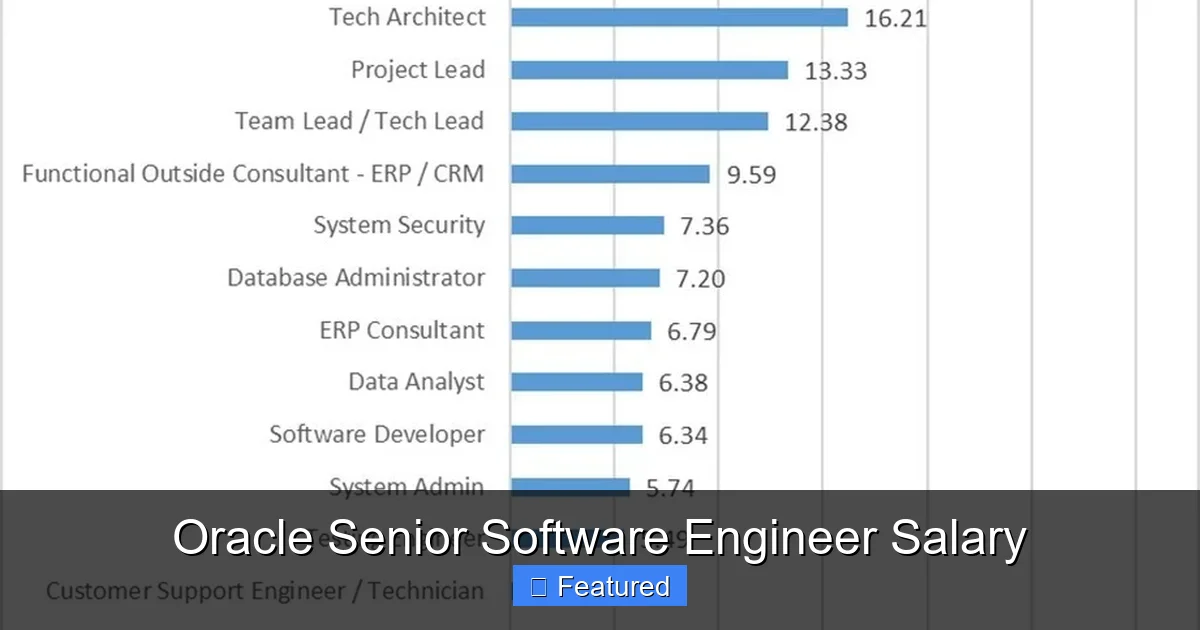
This is the billion-dollar question. How does an Oracle Senior Software Engineer salary stack up against a Google, Amazon, or Microsoft counterpart? The short answer: Oracle’s base salaries are often competitive, but total compensation is typically lower, especially at the senior and staff levels.
Visual guide about Oracle Senior Software Engineer Salary
Image source: naukri.com
The FAANG Premium
Companies like Google and Meta are known for very high RSU grants and larger cash bonuses. A Google L5 (equivalent to a senior) might see a total compensation package of $300k-$450k+, with a larger proportion coming from equity. The same is true for Netflix, which pays all-cash at a very high rate but with no bonus, or Facebook, which has massive RSU refreshers. Oracle’s equity grants, while substantial, are generally smaller in dollar value relative to base salary. The philosophy is different: Oracle is a more mature, profitable company with a lower stock volatility profile compared to a high-growth FAANG stock. The potential upside might be less dramatic, but the downside is often considered more protected.
When comparing, you must look at the “level.” An Oracle IC5 is a very strong senior engineer. A Google L5 is similar. But the Google L5 TC is often higher. An Oracle IC6 (Principal) might compare to a Google L6 (Staff). Here, the gap can narrow or even reverse depending on the specific team and stock performance, but generally, the FAANG companies still lead in raw compensation for equivalent scope roles.
Competitive Positioning in the Enterprise Tech Space
Where Oracle shines is against other large, non-FAANG enterprise tech companies. Compared to IBM, SAP, or even older semiconductor companies, Oracle’s compensation is very competitive and often higher. They are actively competing for cloud talent against Microsoft Azure and AWS. So, if your offer set is Oracle vs. a traditional enterprise software firm, Oracle is likely the financial leader. If it’s Oracle vs. Google Cloud, the gap becomes more pronounced. For a deep dive into the Google Senior Software Engineer compensation structure, which is often the benchmark for top-tier pay, you can explore our detailed guide.
Another point of comparison is benefits. Oracle offers very strong medical, dental, and vision plans, often with low employee contributions. Their 401(k) match is solid (typically 50% match on the first 6% of employee contributions). This “total rewards” package adds significant value to your overall compensation that isn’t captured in the salary headline number.
Factors That Influence Your Salary as a Senior Engineer
Now we get to the actionable part. What can you actually control? Your offer isn’t pulled from a hat; it’s the result of a complex formula. Understanding the variables gives you power.
1. Your Internal Level (The Biggest Factor)
As emphasized, this is paramount. The interview process determines your level. A candidate who demonstrates system design skills for a single team might be an IC4. A candidate who designs a platform used by multiple teams, thinks about long-term technical debt, and mentors broadly might be an IC5. Frame your past experiences to highlight scope, impact, and leadership. Use the STAR method (Situation, Task, Action, Result) to tell stories that align with the higher-level rubric.
2. Location and Cost of Labor
This is non-negotiable from Oracle’s side. They have defined pay zones. If you’re in a lower-cost zone, your range is capped. If you have a competing offer from a high-cost area, you can sometimes use that as leverage to get an exception, but it’s an uphill battle. The most straightforward path to a higher base is to target roles in high-cost locations.
3. Competing Offers
Nothing moves the needle like a competing offer. If you have a written offer from a FAANG company for $220k TC at a comparable level, Oracle will often try to match or come close, especially if they really want you. They may not match dollar-for-dollar, but they can often increase the RSU grant significantly to bridge the gap. Always be professional and transparent. “I’m very excited about Oracle, but I have another offer at X total compensation. Is there any flexibility to make this work?”
4. Critical Skills and Team Demand
Are you a Java expert with deep experience in distributed systems and cloud infrastructure? Are you skilled in Kubernetes, Go, and microservices? Are you familiar with Oracle’s own stack (OCI, Java, Database)? Skills that are in high demand and scarce within Oracle’s current workforce command a premium. If you’re interviewing for a team that’s launching a key product on OCI and they’re desperate for your specific cloud-native expertise, you have more leverage. Do your homework on the team’s mission and the technologies they use.
5. Your Current Compensation
In states where salary history is banned (like California), they can’t ask. But in many places, they still might. If you’re currently making $250k TC as a senior at another tech firm, Oracle will know they likely need to offer at least that to get you to move. If you’re making $140k at a non-tech company, your leverage is lower. Know your market value. Use sites like levels.fyi and Blind to research real, anonymized offers for your target level and location.
Negotiation Strategies and Career Growth Path
Okay, you got the offer. It’s good, but you want it to be great. Now what? And where can this job take you in 5 years?
Negotiating Your Oracle Offer
First, don’t be afraid to negotiate. It’s expected. Recruiters have a range they can offer, and they often start at the bottom of that range. Your job is to get to the top.
- Focus on RSUs First: The base salary range is often more rigid. The initial RSU grant is the most negotiable component. Ask for more. Justify it with your experience, competing offers, or the unique value you bring. “Based on my 8 years of experience and the scope of the role, I was hoping the equity grant could be closer to $X.”
- Sign-On Bonus: This is a one-time cash payment. If they can’t move RSUs or base much, ask for a sign-on bonus to compensate for lost equity at your current company (a “buyout” of unvested RSUs). This is very common.
- Relocation Assistance: If you’re moving, ensure the package includes full relocation. Sometimes this can be increased.
- Be Collaborative, Not Combative: Frame it as, “I’m really excited to join and contribute to the OCI team. To make the numbers work for me to leave my current position, I need the total compensation to be at $Y. Is there flexibility on the equity grant to get there?”
The Career Ladder: From Senior to Principal and Beyond
At Oracle, the individual contributor (IC) track is a respected, high-impact path. The typical progression is: Senior Software Engineer (IC4) -> Senior Staff Software Engineer (IC5) -> Principal Software Engineer (IC6) -> Distinguished Engineer (IC7) -> Fellow (IC8). Each step is a significant leap in scope, influence, and compensation.
Promotion timelines are not fixed but often take 2-4 years at each level for strong performers. To get from IC4 to IC5, you need to demonstrate impact beyond your immediate team—maybe leading a project across teams, mentoring more broadly, or making a key technical decision that saves cost or improves reliability. To go from IC5 to IC6 (Principal), you need to be the technical authority for a major product area, influencing strategy and architecture at the division level. Your work should be visible to senior leadership.
There is also the management track (M1, M2, etc.), but Oracle’s culture strongly values deep technical expertise. Many IC6s and IC7s have as much or more influence as directors and vice presidents. Your compensation as an IC6 Principal can easily match or exceed that of a senior manager. Looking at career paths at other large tech/healthcare firms like Medtronic can provide useful contrast on how technical leadership is structured and rewarded across industries.
The Bottom Line: Is Oracle Right for You?
Let’s bring it home. An Oracle Senior Software Engineer salary is excellent by any reasonable standard. A total compensation package of $200k-$300k is life-changing for most people. The job offers stability, incredible learning opportunities in enterprise-scale systems, and a clear path to senior technical leadership.
However, you must manage your expectations. If your primary goal is to maximize immediate cash and stock to the absolute peak of the market, a FAANG company will likely beat Oracle’s offer on day one. But if you value a balance of strong compensation, meaningful work on cloud infrastructure used by thousands of large companies, a culture that respects deep technical craft, and long-term career stability, Oracle is a phenomenal choice.
The key is to go in informed. Know your target level. Know the salary bands for your city. Know what your skills are worth. Negotiate confidently. And once you’re in, focus on the long game: build great systems, expand your scope, and climb that technical ladder. The compensation will follow.
Frequently Asked Questions
What is the average base salary for a Senior Software Engineer at Oracle?
The average base salary for a Senior Software Engineer (IC4 level) at Oracle in the U.S. typically ranges from $120,000 to $160,000, with higher figures in major tech hubs like Redwood City or New York City. For the more senior IC5 (Senior Staff) level, the base range expands to $150,000 to $200,000+.
How does Oracle’s total compensation compare to Google or Amazon?
Oracle’s total compensation for Senior Software Engineers is generally 15-30% lower than equivalent levels at top FAANG companies like Google or Amazon. This gap is primarily due to smaller RSU grants and bonus percentages. However, Oracle’s base salaries can be competitive, and its benefits and 401(k) match are considered very strong within the industry.
What factors most heavily influence my Oracle salary offer?
The three most critical factors are: 1) Your assigned internal level (IC4 vs. IC5), determined by the interview process; 2) The geographic location of the role, as Oracle uses location-based pay zones; and 3) Competing job offers, which provide leverage to negotiate higher RSU grants or sign-on bonuses.
How often do promotions and salary increases occur at Oracle?
Promotions are not on a fixed annual schedule but are typically considered every 1-2 years for high performers. The timeline to move from IC4 to IC5 often takes 2-4 years. Salary increases come with promotions and through annual performance-based bonus adjustments. Significant compensation jumps are tied to level increases, not cost-of-living adjustments.
Does working remotely affect my Oracle Senior Software Engineer salary?
Yes. Oracle adjusts base salary and compensation bands based on the official work location. If you work from a lower-cost area, your offer will be benchmarked to that region’s pay scale. If the role is designated as “remote,” the company will have a specific benchmark location (often a national average or a specific hub) that determines your pay range.
What skills are most valued for maximizing salary growth in this role?
Expertise in Oracle’s strategic growth areas—Oracle Cloud Infrastructure (OCI), Autonomous Databases, and Fusion Cloud applications—is highly valued. Deep knowledge of distributed systems, cloud-native architecture (Kubernetes, microservices), and scalability is essential. For the IC5/IC6 levels, the ability to lead cross-functional initiatives, mentor at scale, and make long-term architectural decisions is what drives promotion and compensation increases.
