
Best Chair Assist for Elderly: 5 Top Picks 2026


Non-Slip Slippers

Audiobook Player

Bathtub Transfer Bench
Getting out of a low sofa or favorite chair can become difficult when leg strength, balance, or mobility is limited. A good chair assist can provide extra support without requiring a full lift chair.
The best choice depends on how much help is needed. Some devices provide a firm handle to push against, while lifting cushions actively raise part of the user’s weight. Below, we compare five useful options for different needs, furniture types, and mobility levels.
Best Overall: Carex Upeasy Seat Assist Plus
The Carex Upeasy Seat Assist Plus is a strong choice for seniors who want portable lifting help without installing a rail on their chair. Its hydro-pneumatic system activates as the user begins to stand and provides up to 70% lifting assistance.
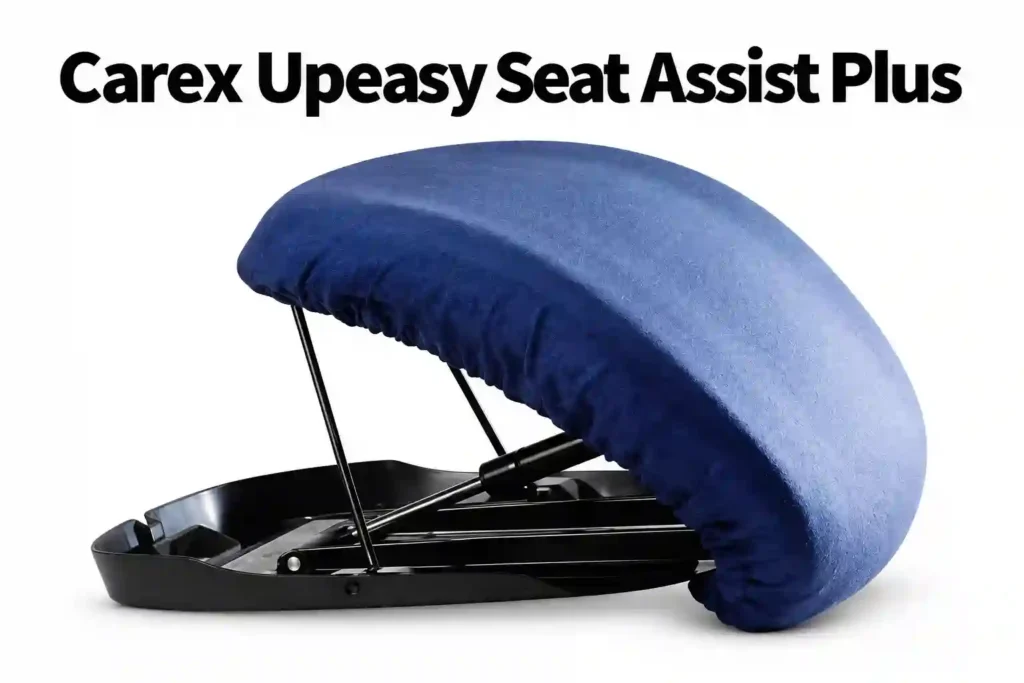
The biggest advantage is portability. At about 9 pounds, it can move between suitable chairs and sofas. It also does not need batteries or a power outlet.
Product Overview
This seat assist works more like a lifting cushion than a grab bar. The controlled upward movement can reduce the amount of force needed to rise. That makes it useful for someone who has difficulty pushing up from a chair but can still participate in the standing motion.
The manufacturer lists a maximum user weight of 340 pounds for the Plus model. The cover is washable, and the unit has a built-in carry handle.
Specifications
| Specification | Details | Why It Matters |
|---|---|---|
| Assistance | Up to 70% | Reduces effort when standing |
| Weight Capacity | Up to 340 lbs | Works for a wide range of users |
| Power | Self-powered | No batteries or outlet needed |
| Product Weight | About 9 lbs | Easier to move between chairs |
Pros And Cons
The Upeasy is convenient, but it is not the right solution for every mobility level.
| Feature | Pro | Con |
|---|---|---|
| Lifting help | Provides active assistance | User still needs to participate |
| Portability | Easy to move | Must be positioned correctly |
| Power | No electricity needed | No powered lift |
| Weight capacity | Up to 340 lbs | Check the current model specifications |
| Cleaning | Washable cover | Cushion adds height to the seat |
Who Should Consider This Product
This is a good fit for an older adult who can stand with some effort but needs additional lifting assistance. It can also suit people who use more than one chair during the day.
It may not be ideal for someone who cannot safely support themselves during a transfer. In that situation, a more substantial transfer or sit-to-stand device may be appropriate.
Best For: Portable lifting assistance
Not Ideal For: Users who need full transfer support
Best Rail: Able Life Universal Stand Assist
The Able Life Universal Stand Assist is a good choice for seniors who mainly need stable hand support rather than a powered or mechanical lift. Its dual padded handles give the user a firm place to grip while standing or sitting.
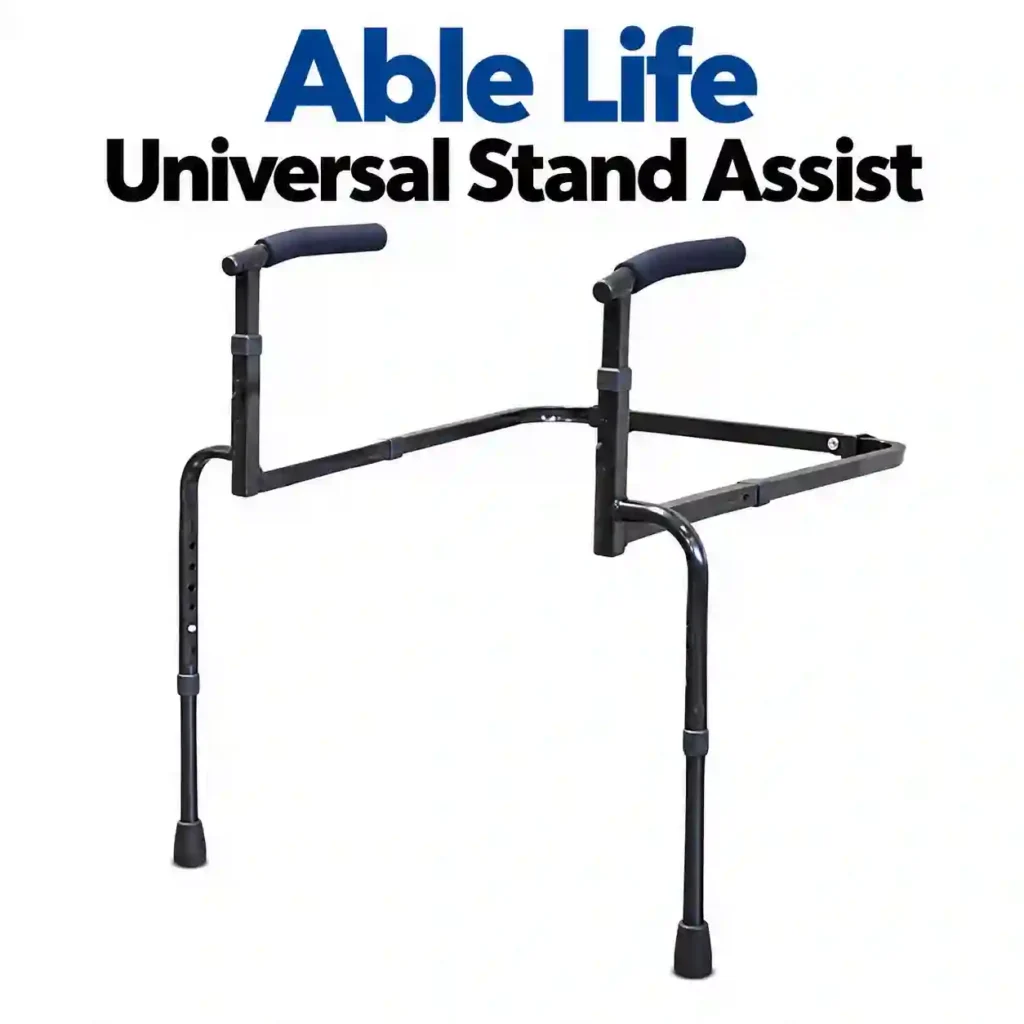
The frame is designed to fit many sofas, chairs, and recliners. It adjusts in width and depth, which makes measuring the intended chair especially important before buying.
Product Overview
The Universal Stand Assist supports up to 300 pounds and weighs about 7 pounds. The frame can adjust from 19 to 26 inches wide and from 24 to 27 inches deep.
Unlike a lifting cushion, it does not raise the user automatically. Instead, it provides leverage and support during the sit-to-stand movement.
Specifications
| Specification | Details | Why It Matters |
|---|---|---|
| Weight Capacity | 300 lbs | Supports many users |
| Product Weight | 7 lbs | Relatively easy to reposition |
| Width | 19–26 in. | Helps fit different chairs |
| Depth | 24–27 in. | Important for furniture compatibility |
Pros And Cons
Its simple design is one of its biggest strengths, but that also means it does not provide mechanical lifting assistance.
| Feature | Pro | Con |
|---|---|---|
| Handles | Dual padded grips | Requires user strength |
| Adjustability | Width and depth adjustable | Furniture must fit the range |
| Weight | Lightweight frame | Less substantial than large transfer aids |
| Installation | Works with many cushions | Correct positioning is important |
| Support | Useful for balance | Not a powered lift |
Who Should Consider This Product
Choose this type of chair assist if the user mainly needs something sturdy to hold while standing. It can be particularly useful for a favorite living-room chair or sofa.
Someone with very limited leg strength may need more than a support rail can provide.
Best For: Stable hand support
Not Ideal For: Users who cannot contribute much force to standing
Best Lightweight: Stander EZ Stand-N-Go
The Stander EZ Stand-N-Go is a useful option when low weight and a dual-handle design are priorities. It weighs about 8.5 pounds and supports up to 300 pounds.
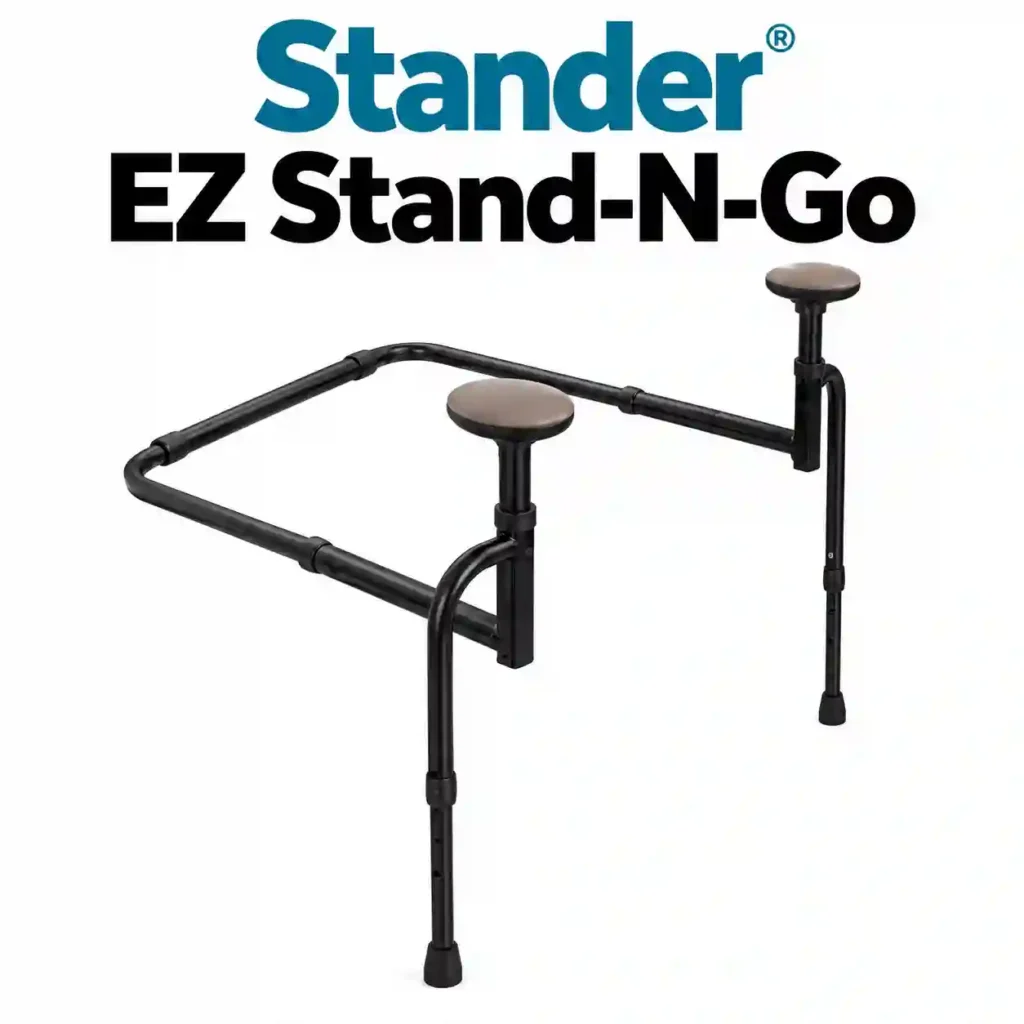
It installs under or around a chair cushion and offers adjustable height, width, and depth. That makes it more flexible than a fixed grab bar, provided the chair falls within its compatibility range.
Product Overview
The padded handles give the user two points of support when preparing to stand. The frame is designed for couches, chairs, and recliners.
The manufacturer lists compatibility with cushions about 14 to 21 inches above the floor, 19 to 26 inches wide, and 24 to 27 inches deep.
Specifications
| Specification | Details | Why It Matters |
|---|---|---|
| Weight | 8.5 lbs | Easier to handle than heavier frames |
| Capacity | 300 lbs | Suitable for many users |
| Cushion Width | 19–26 in. | Check chair measurements |
| Cushion Depth | 24–27 in. | Helps confirm proper fit |
Pros And Cons
The Stand-N-Go is compact, but compatibility should be checked carefully.
| Feature | Pro | Con |
|---|---|---|
| Handles | Two padded handles | Needs correct positioning |
| Weight | Relatively light | Not a powered lift |
| Adjustability | Height, width, and depth | Not suitable for every chair |
| Installation | Under or around cushion | Requires setup |
| Capacity | 300 lbs | User still needs standing ability |
Who Should Consider This Product
This model makes sense for someone who wants a compact standing aid that stays with one chair. It is especially useful when two handles feel more secure than relying on one armrest.
It is not intended for use as a freestanding device or on a bed.
Best For: Lightweight dual-handle support
Not Ideal For: Furniture outside the recommended size range
Best For Large Furniture: Stander CouchCane
The Stander CouchCane is designed for larger four-legged couches, chairs, recliners, and lift chairs. Instead of sitting beneath the seat cushion, its base fits beneath the furniture feet.
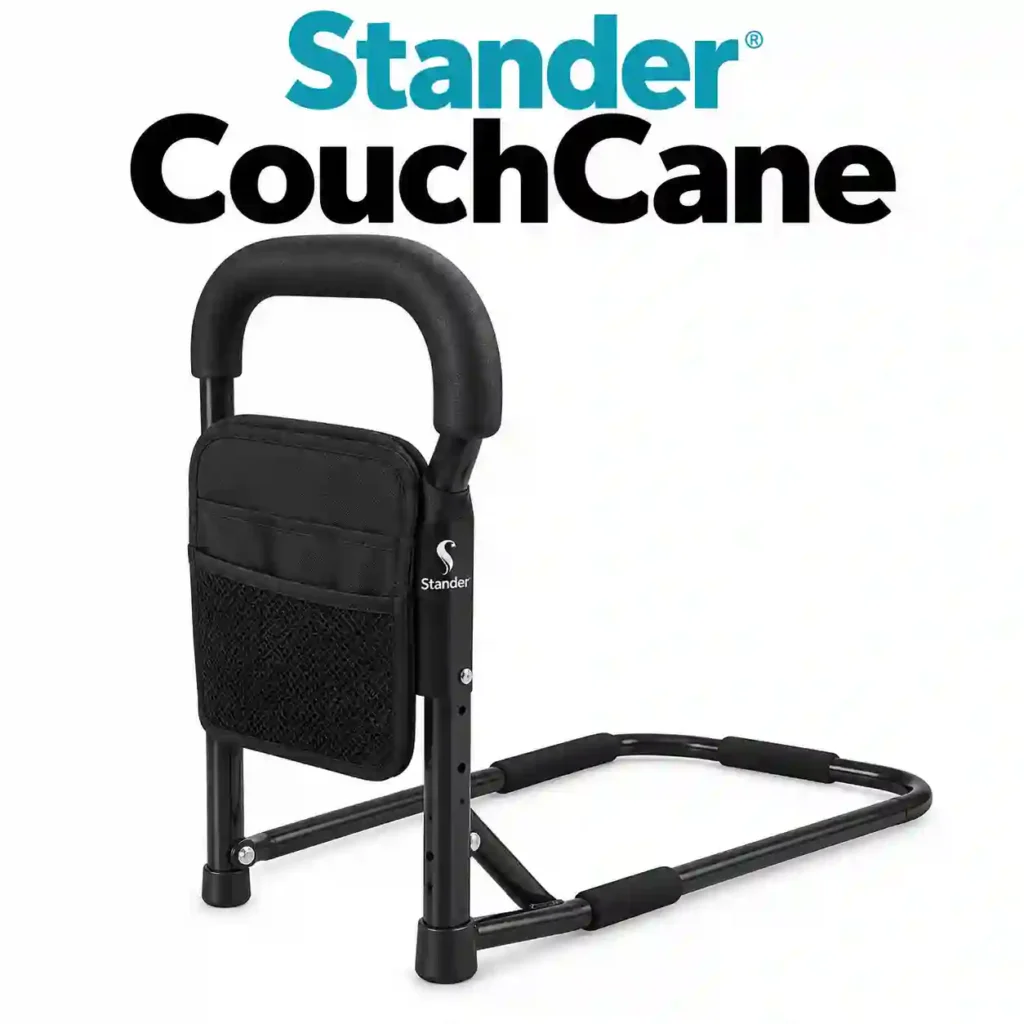
Its handle adjusts from 34 to 40 inches, while the base depth adjusts from 20 to 36 inches. It also includes a small storage bag for items such as a remote or phone.
Product Overview
The CouchCane is a good choice when a cushion-mounted stand assist does not fit the furniture. Its wide adjustment range can accommodate many larger pieces of furniture.
However, the chair or sofa must have the correct leg arrangement. It is not designed to stand independently.
Specifications
| Specification | Details | Why It Matters |
|---|---|---|
| Weight Capacity | 250 lbs | Check against user weight |
| Product Weight | 19 lbs | Heavier than cushion-mounted aids |
| Handle Height | 34–40 in. | Allows height adjustment |
| Base Depth | 20–36 in. | Useful for larger furniture |
Pros And Cons
The CouchCane offers strong furniture-based support, but its compatibility requirements are more specific.
| Feature | Pro | Con |
|---|---|---|
| Furniture fit | Works with many larger chairs | Requires four-legged furniture |
| Handle | Adjustable height | Single main handle |
| Storage | Includes storage bag | Adds some bulk |
| Construction | Steel frame | Heavier than lightweight rails |
| Capacity | 250 lbs | Lower than some 300-lb options |
Who Should Consider This Product
Consider the CouchCane when the senior uses a large recliner, couch, or lift chair and needs a sturdy handle to help with sitting and standing.
It may not be suitable for furniture with a round base or unsuitable leg spacing.
Best For: Larger four-legged furniture
Not Ideal For: Furniture without compatible legs
Best Chair Assist With Extra Support: Vive Stand Assist
The Vive Stand Assist provides two padded handrails and an adjustable aluminum frame. It is designed for couches, loveseats, and recliners and supports up to 300 pounds.
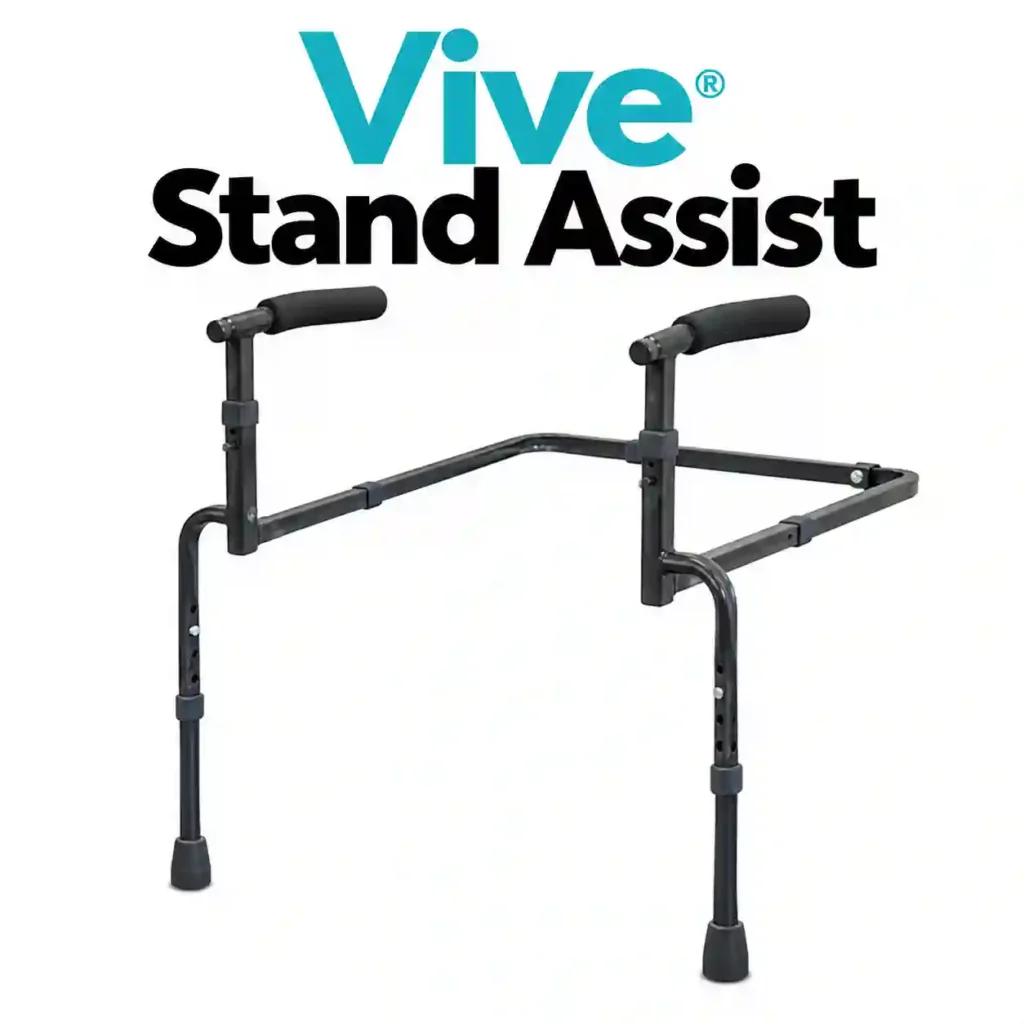
One useful feature is its ability to work with removable cushions or some fixed-cushion seating. The frame adjusts in width and depth, while the handles adjust for a more comfortable grip.
Product Overview
This is a support rail rather than a mechanical lifting device. The user pushes against the handles while rising.
That distinction matters. A senior who only needs balance support may find this type of device sufficient, while someone with very limited leg strength may need a lifting seat or professional transfer aid.
Specifications
| Specification | Details | Why It Matters |
|---|---|---|
| Capacity | 300 lbs | Covers many users |
| Frame | Aluminum | Keeps the design relatively light |
| Width | About 19.25–22.25 in. | Helps fit different seats |
| Handle Height | 9–12 in. above frame | Allows grip adjustment |
Pros And Cons
The Vive is straightforward, but it should not be treated as a device that carries the user’s full weight.
| Feature | Pro | Con |
|---|---|---|
| Handles | Two padded grips | Requires active pushing |
| Adjustability | Width, depth, and height | Fit must be checked |
| Installation | No permanent drilling | Positioning still matters |
| Weight capacity | Up to 300 lbs | Not intended as fully weight-bearing |
| Furniture use | Works with many sofas and chairs | Not suitable for every seat |
Who Should Consider This Product
This is a practical option for a senior who needs extra balance and leverage when standing from a sofa or recliner.
It is not the best choice when the user cannot safely contribute to the standing movement.
Best For: Everyday balance and standing support
Not Ideal For: Users needing powered lifting assistance
Comparison At A Glance
The five options serve slightly different needs. A lifting cushion is better when the user needs help moving upward, while a stand-assist rail is better when the user mainly needs something solid to grip.
| Product | Best For | Key Trade-Off |
|---|---|---|
| Carex Upeasy Seat Assist Plus | Active lifting assistance | Adds cushion height |
| Able Life Universal Stand Assist | Stable everyday support | Requires user strength |
| Stander EZ Stand-N-Go | Lightweight dual handles | Must fit the chair |
| Stander CouchCane | Larger furniture | Heavier and 250-lb capacity |
| Vive Stand Assist | Adjustable sofa support | Not a powered lift |
How We Chose These Products
We focused on products that directly address the main problem behind this search: helping an older adult sit down or stand up from a chair more easily.
The comparison considers manufacturer specifications, design, adjustability, weight capacity, portability, furniture compatibility, ease of use, and the level of assistance provided.
| Evaluation Factor | Why It Matters |
|---|---|
| Ease Of Use | A complicated device may be difficult to use daily |
| Stability | Good support is important during standing |
| Fit | A poor furniture match can reduce usefulness |
| Assistance Level | Different users need different amounts of help |
| Weight | Lighter products are easier to reposition |
| Value | The device should solve the problem without unnecessary features |
No single chair assist is best for every senior. The amount of strength and balance the user still has should guide the decision.
What To Look For When Buying
Start with the user’s actual difficulty. If they can stand but need something to hold, a rail may be enough. If they struggle to generate enough force to rise, a lifting cushion may be more useful.
Check The Chair Measurements
Measure the seat height, width, depth, cushion type, and furniture legs before ordering. Some products fit under cushions, while others require four-legged furniture.
Check The Weight Capacity
Never assume that two similar-looking products have the same capacity. Choose a model that meets the manufacturer’s stated limit for the intended user.
Think About Assistance Level
A stand-assist rail provides leverage. It does not lift the person. A lifting cushion can provide mechanical assistance, but the user still needs to participate in the movement.
Consider Portability
A lightweight cushion or frame can be useful if the senior moves between rooms. A furniture-mounted device may make more sense when one chair is used most of the day.
Look At Grip Design
Handles should be easy to reach and comfortable to hold. Seniors with weaker hands or reduced dexterity may benefit from padded, well-positioned grips.
Check The Furniture
A chair assist should be matched to the chair. Never assume that a product described as “universal” will fit every sofa or recliner.
Common Buying Mistakes
A chair assist can be useful, but buying the wrong type can create frustration or an unsafe setup.
| Mistake | Better Approach |
|---|---|
| Choosing by price alone | Match the device to the user’s needs |
| Skipping measurements | Measure the chair before buying |
| Assuming every rail lifts the user | Check whether it provides support or actual lift assistance |
| Ignoring weight capacity | Confirm the manufacturer’s limit |
| Using an incompatible chair | Follow the product’s furniture requirements |
| Buying more assistance than needed | Choose the simplest suitable option |
Safety Considerations
Chair assists can make standing easier, but they should not replace proper assessment when a person has significant balance or mobility problems.
Make sure the device is installed or positioned exactly as directed. Check that the chair is stable and that the assist does not slide, tip, or move during use.
Do not use a support rail as though it were a full patient lift. Products have different weight limits and intended uses. For example, some stand-assist rails are designed mainly for balance and leverage rather than supporting the user’s entire body weight.
If a senior has severe weakness, repeated falls, major balance problems, or cannot safely participate in standing, ask a healthcare professional or physical therapist about the appropriate transfer aid.
Frequently Asked Questions
What Is The Best Chair Assist For Elderly People?
For many users, a portable lifting cushion such as the Carex Upeasy Seat Assist Plus is a strong option because it provides active lifting assistance. For someone who mainly needs a stable handhold, a stand-assist rail may be better.
Is A Chair Assist The Same As A Lift Chair?
No. A chair assist is usually an accessory or portable aid used with an existing chair. A lift chair is a complete powered recliner that raises the user toward a standing position.
Do Chair Assist Devices Work With Recliners?
Many do, but compatibility varies. Always check the product’s measurements and installation requirements. Some models are designed for recliners, while others require specific cushion or leg configurations.
What Weight Capacity Should A Chair Assist Have?
Choose a model with a manufacturer-rated capacity that safely accommodates the intended user. Do not exceed the listed limit.
Are Chair Assist Rails Better Than Lift Cushions?
Neither is automatically better. Rails are useful when the user can stand but needs leverage and balance support. Lift cushions make more sense when the user needs additional upward assistance.
Conclusion
The best chair assist for elderly users depends on how much support the person needs. The Carex Upeasy Seat Assist Plus stands out when active lifting help and portability matter most, while the Able Life Universal Stand Assist is a practical choice for users who mainly need stable hand support.
For a lightweight dual-handle option, the Stander EZ Stand-N-Go is worth considering. The Stander CouchCane is better suited to compatible larger furniture, while the Vive Stand Assist offers adjustable support for many sofas and recliners.
Before buying, measure the chair, check the weight limit, and be honest about how much standing ability the user has. A simple support rail may be enough for one person, while another may need a more substantial lifting or transfer aid.