
Ergonomic Walking Cane Explained: Fit & Safety Guide


Button Hook Dressing Aid

LED Clip Reading Light

Memory Foam Seat Cushion
Quick Answer
An ergonomic walking cane is a mobility aid designed with a handle that aims to make gripping more comfortable and distribute pressure more naturally across the hand. The right design can help reduce hand fatigue and discomfort, but the cane must also fit your height, provide appropriate stability, and match your walking needs.
An ergonomic walking cane differs from a conventional cane mainly in the shape, contour, or cushioning of its handle. Instead of relying on a simple curved or straight grip, it may have a broader palm support, molded contours, a larger gripping surface, or an offset design that positions the hand more directly above the shaft.
These features can matter if your fingers become tired, your palm feels sore, or gripping a traditional handle is uncomfortable. However, an ergonomic handle does not automatically make a cane safer or suitable for every mobility problem. Height, balance, walking technique, and the amount of support you need remain essential.
What Makes a Walking Cane Ergonomic?
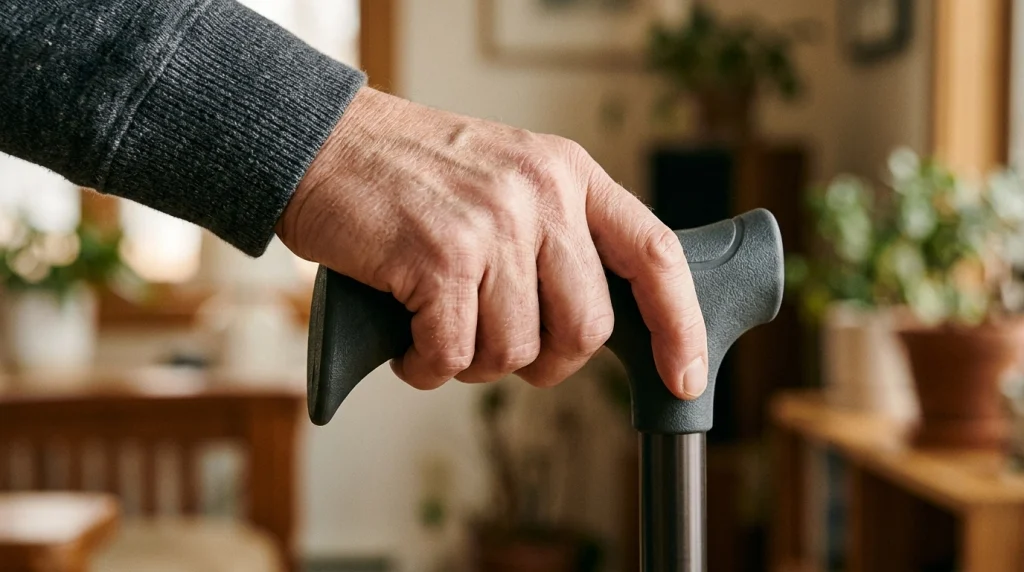
An ergonomic cane is designed around the way a person holds and loads the handle during walking. Its grip may be shaped to fit the palm, provide a wider contact area, or keep the wrist in a more comfortable position while pressure is applied.
When you lean on a cane, force travels from your hand through the handle and shaft to the tip on the ground. A handle that fits poorly can concentrate pressure on a small part of the palm or force your fingers to grip harder than necessary. A suitable ergonomic design aims to make that contact more comfortable.
Ergonomic features can include:
- Contoured grips: Shaped surfaces follow the general form of the hand.
- Wider palm supports: Spread contact across more of the palm rather than concentrating it on a narrow grip.
- Padded materials: Foam, gel, or other cushioning materials may make contact feel softer.
- Offset handles: Position the grip so the hand sits closer to being directly above the cane shaft.
- Hand-specific designs: Some grips are shaped for the left or right hand rather than being interchangeable.
Not every cane with these features will feel comfortable to every user. Hand size, finger movement, wrist mobility, grip strength, and the amount of weight placed on the cane all affect which design works best.
How Do Ergonomic Cane Handles Differ From Traditional Handles?
The main difference is how the hand contacts the grip and how comfortably the user can control the cane. Traditional handles may work well for occasional support, while more carefully shaped grips can be useful for people who find narrow or curved handles uncomfortable.
The following comparison explains common handle styles and their practical trade-offs.
| Handle type | Potential benefit | Possible limitation |
|---|---|---|
| Crook or curved | Simple design; easy to hang on a hook | The narrow curve may concentrate pressure on the hand |
| Derby | A shaped grip that many users can hold naturally | May not provide enough palm support for some users |
| Offset | Can align the hand more directly above the shaft | Still needs a suitable grip and correct height |
| Contoured ergonomic | May spread contact across the palm and fingers | The molded shape may not suit every hand |
| Palm-support grip | Provides a broader surface for supporting the hand | Can be less convenient if the design is hand-specific |
These categories can overlap. An offset cane, for example, may also have a contoured or padded handle. The label alone does not establish that one design will reduce pain or improve balance more than another.
For a useful starting point, compare the shape of the grip with the way your hand naturally rests. You should be able to hold the cane without excessive finger squeezing, awkward wrist bending, or pressure concentrated on one painful spot.
Who May Benefit From an Ergonomic Walking Cane?
An ergonomic handle may be worth considering if a conventional cane is uncomfortable to hold or causes hand fatigue during ordinary walking. The potential benefit is most relevant when the grip itself is the problem, rather than a lack of overall walking stability.
It may be useful for people who experience:
- Hand fatigue: The fingers tire from maintaining a tight grip during walks.
- Palm discomfort: Pressure on a narrow handle becomes uncomfortable.
- Reduced finger dexterity: A larger or differently shaped grip may be easier to hold.
- Wrist discomfort: A suitable handle position may make gripping more comfortable, although it will not treat the underlying cause.
- Frequent everyday cane use: Comfort becomes more noticeable when the handle is held repeatedly throughout the day.
People with arthritis or other conditions affecting their hands may find a larger, easier-to-grasp handle more manageable. However, a bulky grip can also be difficult for someone whose fingers cannot wrap around it comfortably. The actual fit matters more than the ergonomic label.
If numbness, tingling, persistent pain, or weakness develops while using a cane, do not assume that a different handle will solve the problem. These symptoms may indicate that the grip, cane technique, or an underlying health issue needs assessment.
How Should an Ergonomic Walking Cane Fit?
Correct height is just as important as handle design. A comfortable grip cannot compensate for a cane that makes you lean sideways, raise a shoulder, or bend your wrist unnaturally.
For a typical single-handled cane, use these basic fitting checks:
- Stand in your normal upright posture. Wear the shoes you usually use for walking, and let your arms hang naturally at your sides.
- Check the handle height. The top of the grip should generally line up with the crease of your wrist when the cane stands upright beside you.
- Hold the handle naturally. Your elbow should remain slightly bent, commonly around 15 to 30 degrees, rather than locked straight or sharply flexed.
- Check your posture. You should not need to hunch, lean markedly to one side, or lift your shoulder to reach the handle.
- Check the adjustment mechanism. If the cane is adjustable, make sure the locking pin is fully engaged and the sections are secure before walking.
These are general fitting guidelines, not a substitute for an individual assessment. A physical therapist or other qualified healthcare professional can check the height and technique, particularly if you have pain, weakness, or a history of falls.
Tip
Check the cane while standing in your usual walking shoes. Small height differences can change your elbow position and posture, so do not judge the fit only while sitting or wearing different footwear.
Can an Ergonomic Handle Improve Balance and Walking Safety?
An ergonomic handle may improve comfort and control, but it does not automatically provide greater balance support. Overall stability also depends on the cane’s base, your strength, the surface you walk on, and your ability to coordinate each step.
A single-tip cane is often appropriate when a person needs modest support for one-sided weakness, pain, or mild balance difficulties. A quad cane has four contact points and a wider base, which may offer additional stability in some circumstances. However, its larger base can be more awkward to position and move.
Consider the distinction carefully:
- If your hand becomes sore but your walking remains stable, a better-fitting handle may address the main discomfort.
- If the cane wobbles or slips, inspect its rubber tip and check whether the cane type suits the surface and your support needs.
- If you regularly lose balance or lean heavily on the cane, a different mobility aid may be necessary.
A cane is generally intended to provide limited support. Someone who needs substantial weight-bearing assistance, has significant weakness on both sides, or cannot control the cane safely may need a walker or another aid instead.
The MedlinePlus guide to using a cane explains basic fitting, walking technique, and situations in which a different aid may be more appropriate. Use this guidance alongside individualized instructions when they have been provided.
What Should You Check Before Choosing an Ergonomic Cane?
Focus on the characteristics that affect your actual walking needs instead of choosing a cane solely because its handle looks comfortable.
Grip shape and hand size
Choose a handle that lets your hand rest naturally. If your fingers have limited movement, check whether you can grasp and release the grip without excessive effort. If the cane has a molded left- or right-hand grip, confirm that it matches the hand you need to use.
Height adjustment and stability
Look for a height range that accommodates your measured fit. On adjustable models, inspect the locking mechanism and make sure the shaft does not slide or wobble. A folding cane also needs to be fully assembled and secured before use.
Weight and handling
A lighter cane may be easier to lift and reposition, particularly if hand strength is limited. However, low weight alone does not establish strength, durability, or suitability for your support needs. Check the manufacturer’s stated weight capacity and usage instructions.
Base and rubber tip
The tip must contact the ground reliably. Inspect it for wear, cracks, looseness, or loss of grip, and replace it when necessary. A more comfortable handle will not compensate for a damaged or slippery tip.
Ease of use in daily activities
Consider whether the handle is comfortable during the length of walks you normally take, whether you can place the cane accurately, and whether its shape interferes with moving through narrow spaces. If possible, have a qualified professional assess the cane while you walk rather than judging it by appearance alone.
How Do You Use a Cane Without Creating New Problems?

For many people with one weaker or painful leg, the usual technique is to hold the cane in the opposite hand. Move the cane forward with the affected leg, then step through with the stronger leg as appropriate to your walking pattern and prescribed instructions.
Keep the cane close enough to control without placing it directly under your feet. Move at a manageable pace, look ahead, and make turns with small steps rather than twisting suddenly. On stairs, use a handrail when available and follow the technique taught by your healthcare professional.
A few practical habits help maintain safe use:
- Wear supportive footwear with good traction.
- Check the cane’s tip and adjustment points regularly.
- Keep walking routes clear of loose rugs, cords, and clutter.
- Avoid using the cane to pull yourself up from a chair unless a professional has specifically taught you a safe method.
- Ask for guidance if the cane feels unstable or you are unsure how to manage curbs and stairs.
The American Academy of Orthopaedic Surgeons’ mobility-aid guidance also explains proper positioning and the differences between canes, walkers, and other support devices.
When Is an Ergonomic Cane Not Enough?
A more comfortable handle is not a solution for every walking difficulty. If you feel unstable even when holding the cane correctly, need to place substantial weight through your arms, or cannot coordinate the cane with your steps, you may need a more supportive device and an assessment of your mobility.
Seek prompt medical evaluation for a new or worsening walking problem, repeated falls, unexplained weakness, or persistent pain. If difficulty walking begins suddenly, particularly with facial drooping, speech difficulty, one-sided weakness, or severe dizziness, seek emergency medical care.
A healthcare professional can assess whether a cane remains appropriate, whether a walker would offer more stability, and whether pain, weakness, vision changes, medication effects, or another issue is contributing to the problem.
For broader context about choosing support, see the existing SeniorsProTalk guide to walking cane types and their uses. For concerns about a person’s ability to walk safely with assistance, the site’s guide to walking assistance and caregiver safety covers related decisions.
Related Product
Walking Canes With Ergonomic Handles
Compare grip shapes, height-adjustment ranges, base designs, and weight capacities to find a cane that suits your hand and mobility needs.
As an Amazon Associate, we earn from qualifying purchases.
Frequently Asked Questions
Is an ergonomic walking cane better than a regular cane?
It may be more comfortable if the traditional handle causes pressure or hand fatigue. However, the best option depends on grip fit, cane height, stability, and the user’s mobility needs.
Does an ergonomic cane help with arthritis?
A wider or contoured handle may be easier to grasp for some people with arthritis. It does not treat arthritis itself, and a handle that is too large or poorly shaped can still cause discomfort.
Should a walking cane handle be soft or firm?
Either can work, depending on the user’s hand and grip. Cushioning may improve comfort, while a firm, well-shaped handle can provide a more secure feel. The grip should not slip or require excessive squeezing.
How do I know if my cane is the wrong height?
If the handle does not line up near your wrist crease when you stand naturally, or your elbow is locked straight or bent excessively, the cane may need adjustment. A physical therapist can check the fit and your posture.
Can an ergonomic cane prevent falls?
A correctly selected and properly used cane may improve stability for some people, but an ergonomic handle alone cannot prevent falls. The device must match the person’s balance, strength, and walking needs.
When should I consider a walker instead of a cane?
Consider a professional assessment if you need more support than a cane provides, have substantial balance problems, or feel unsafe while walking. A walker may offer a broader support base, but the appropriate aid depends on your abilities and circumstances.
Conclusion
An ergonomic walking cane is designed to make gripping more comfortable through features such as contoured handles, broader palm supports, cushioning, or offset positioning. These features may reduce discomfort for some users, but comfort alone does not determine whether a cane is suitable.
Start by checking your grip, wrist position, elbow bend, cane height, and the condition of the rubber tip. Consider how much balance and weight-bearing support you actually need, not simply which handle looks most comfortable. If walking remains difficult, pain persists, or you feel unstable, ask a qualified healthcare professional to assess your mobility and recommend an appropriate aid.