
Heavy Duty Walking Cane Explained: Complete Guide


Talking Clock

Sudoku Puzzle Book

Smart Doorbell Camera
Quick Answer
A heavy duty walking cane is a reinforced mobility aid designed to provide walking support at a higher manufacturer-rated weight capacity than many standard canes. Also called a bariatric cane, it typically has a stronger shaft, durable handle, secure adjustment mechanism, and nonslip tip. Some models support 400, 500, or 600 pounds, but capacity varies. A stronger cane does not automatically provide better balance or replace a walker.
What Makes a Walking Cane Heavy Duty?
A walking cane is considered heavy duty primarily because of its reinforced construction and higher weight rating. The term describes the cane’s load-bearing design, not simply its thickness, appearance, or weight.
Many ordinary walking canes have manufacturer-rated capacities around 250–300 pounds. Certain heavy-duty models are rated for 400–600 pounds or more. These are examples rather than universal specifications, so the exact product rating must be checked.
The main design differences may include:
- Reinforced shaft: Stronger or thicker tubing designed for greater loading.
- Durable handle connection: Construction intended to withstand pressure through the grip.
- Secure adjustment hardware: Height settings supported by properly engaged locking components.
- Higher-rated components: Tips, joints, and fittings suited to the manufacturer’s declared capacity.
- Appropriate grip and tip: Features intended to help users hold the cane comfortably and maintain reliable floor contact.
Importantly, a heavy-duty cane can still have a single rubber tip. It does not need a four-foot base to qualify.
For an overview of cane designs and their different purposes, see our guide to walking cane types.
How Is a Heavy-Duty Cane Different From a Regular Cane?
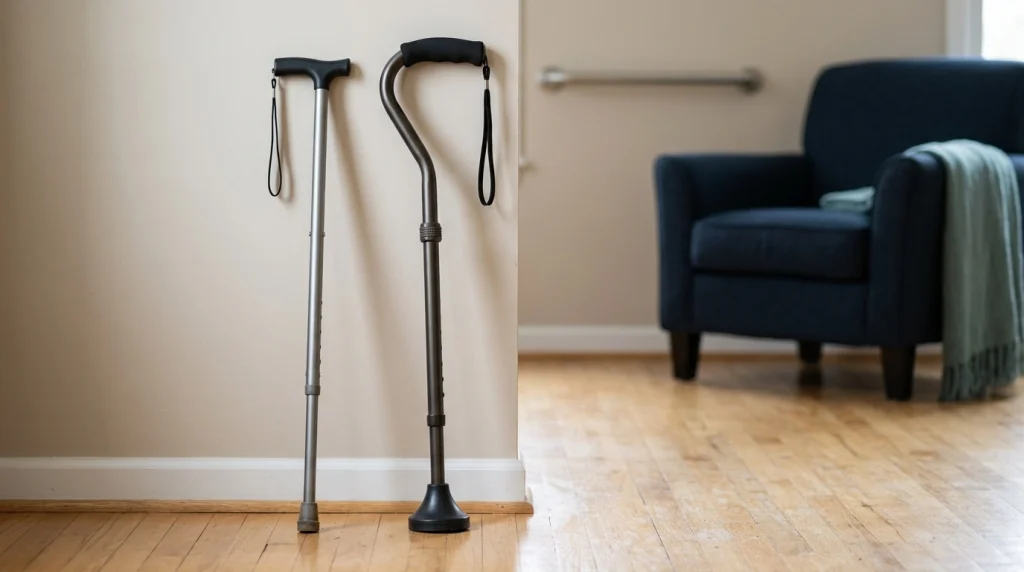
The biggest difference is the manufacturer’s approved weight capacity. Other differences depend on the model’s materials, handle, height range, and construction.
| Feature | Standard Cane | Heavy-Duty Cane |
|---|---|---|
| Weight rating | Often 250–300 lb | Some models 400–600 lb or higher |
| Shaft | Conventional construction | Often reinforced |
| Weight of cane | Often lightweight | Varies; not necessarily heavy |
| Base | Single or multiple tips | Single or multiple tips |
| Primary purpose | Walking and balance assistance | Walking assistance with higher rated capacity |
These categories overlap. A high-capacity aluminum cane may be easier to lift than a decorative solid-wood cane. Likewise, a standard quad cane may have a wider base but a lower weight rating than a heavy-duty single-point model.
Key Insight
Weight capacity and balance stability are different specifications. A 500-pound-rated single-tip cane may be stronger than a 300-pound-rated quad cane, but it does not automatically have the wider support footprint of the quad model.
Who Might Need a Heavy-Duty Walking Cane?
A heavy-duty cane may be appropriate for an adult whose body weight exceeds the capacity of a suitable standard cane, or who has been advised to use a higher-capacity mobility aid.
Possible users include:
- Adults who need a manufacturer-rated capacity above that offered by conventional canes.
- Taller or larger-framed individuals who need a compatible height range and comfortable grip.
- People with mild walking instability or one-sided leg discomfort who remain suitable for one-handed cane support.
- Adults replacing a cane whose documented weight rating is insufficient for them.
Body size alone does not determine whether a cane is the correct mobility device. Walking ability, balance, upper-body strength, pain, and the amount of support required are also important.
Someone who needs substantial assistance to remain upright may require a walker or another mobility aid, regardless of how much weight a cane is rated to support.
How Much Weight Can a Heavy-Duty Cane Support?
There is no single weight limit for all heavy-duty walking canes. The correct limit is the one published for the exact model by its manufacturer.
For example, a published Manitoba government medical-products catalog lists a conventional adjustable cane with a 300-pound capacity and a heavy-duty offset cane with a 500-pound capacity. Other manufacturers offer different ratings.
Three distinctions matter when interpreting a rating:
- User weight rating: The maximum user weight stated for that model.
- Actual load through the cane: The changing amount of force transferred through the handle while walking.
- Appropriate mobility support: Whether the cane provides enough balance assistance for that person’s needs.
A 500-pound rating does not mean every person weighing less than 500 pounds can safely rely on the cane in every situation. It also does not mean the cane can support a suspended 500-pound load or safely withstand arbitrary impact forces.
Follow the manufacturer’s intended-use instructions. Avoid operating at or beyond a stated limit, and do not assume a modified or damaged cane retains its original rating.
Which Features Actually Matter?
1. Shaft Material and Construction
Heavy-duty canes may use reinforced aluminum, steel, or other appropriately engineered materials. Steel construction can be strong but may increase the cane’s weight. Reinforced aluminum can offer substantial rated capacity while remaining relatively manageable.
Material alone is not proof of strength. The complete assembly, including joints and hardware, determines the manufacturer’s stated capacity.
2. Handle Shape and Comfort
The handle affects how pressure is transferred through the hand and wrist. An offset handle places the grip more directly above the shaft, while an ergonomic handle may spread contact pressure across more of the palm.
Comfort matters because the user must maintain a secure grip while walking. A thick padded grip is not automatically suitable for someone with limited finger movement or a small hand.
3. Height Adjustment
A strong cane adjusted to the wrong height can encourage awkward posture and make walking more difficult.
Check both ends of the adjustment range. Taller users may need a longer model, while shorter users need a cane that adjusts low enough without modification.
4. Tip and Ground Contact
The rubber tip helps the cane grip the walking surface. An appropriate tip should fit securely, remain in good condition, and match the manufacturer’s specified size.
A single-point design is generally easier to reposition in narrow spaces. A quad base provides multiple contact points but may require more deliberate placement.
5. Locking Mechanism
On adjustable models, the push button should engage completely, and any locking collar should be tightened according to the instructions.
Check for looseness, unexpected shaft movement, cracks, or damage before using the cane. Do not rely on an adjustment mechanism that fails to lock securely.
Heavy-Duty Single-Point Cane or Quad Cane?
Choose based on both the required weight rating and the type of balance support needed. Neither design is universally better.
A heavy-duty single-point cane has one ground-contact tip. It usually suits someone who needs a high-capacity cane but can walk safely with a narrow support footprint.
A heavy-duty quad cane has four feet and a broader base. It may be helpful when greater planted stability is needed, although the additional feet can be awkward around furniture, doorways, or uneven surfaces.
The wider base does not remove the need to place every foot correctly on the ground.
If you are considering four-point support, our small-base quad cane review illustrates how footprint and maneuverability influence everyday use.
The important distinction is that a cane’s number of feet does not establish its weight capacity. Always verify both characteristics separately.
How to Fit a Heavy-Duty Walking Cane Correctly
A properly fitted cane helps the user maintain an upright posture and a comfortable arm position. The same basic fitting principles apply to conventional and heavy-duty models.
- Wear your normal walking shoes. Stand upright on a level surface, with assistance if needed.
- Relax your arm at your side. The cane handle should be approximately level with your wrist crease.
- Adjust the cane height. Set the shaft to the closest appropriate position and engage its locking system fully.
- Check your elbow position. When holding the handle, your elbow should be slightly bent rather than completely straight or sharply flexed.
- Check ground contact. The tip or all quad feet should sit securely on the floor during use.
- Assess the fit while walking. Uncomfortable posture, difficulty controlling the cane, or a feeling of instability warrants reassessment.
The MedlinePlus cane-use instructions explain correct cane positioning, adjustment, and basic walking technique.
A physical therapist can help establish the correct fit when walking patterns, joint problems, or balance limitations make ordinary adjustment insufficient.
How Do You Walk Safely With One?
For someone using a cane to support one weaker or painful leg, the usual technique is to hold the cane in the hand opposite that leg. Move the cane forward with the weaker leg, then step through with the stronger leg.
Place the tip firmly on the floor before transferring pressure through the handle. Walk at a controlled pace and look ahead rather than continually looking down.
For stairs, use a secure handrail when available and follow the walking sequence recommended by your therapist. Stairs introduce additional balance demands that a higher cane weight rating cannot solve.
Safety Warning
Do not use a walking cane to compensate for an inability to stand or bear the required weight safely. A high weight rating does not make the cane a substitute for a walker, crutches, or another device prescribed for significant mobility limitations.
When Is a Heavy-Duty Cane Not Enough?
A walker may be more appropriate when someone needs greater stability than one-handed cane support can provide.
Signs that the mobility aid should be reassessed include frequent loss of balance, repeated falls, needing to grasp furniture while walking, or being unable to move safely without substantial assistance.
The NHS walking aids guide explains that walking frames provide more support than walking sticks.
Our heavy-duty cane example also illustrates why high weight capacity and a single-point base must be evaluated as separate features.
For sudden new weakness, unexplained falls, or substantial deterioration in walking ability, seek appropriate medical assessment rather than simply upgrading to a stronger cane.
Common Mistakes to Avoid
- Choosing by appearance: A thick shaft or large grip does not prove the cane has a high weight rating.
- Ignoring height range: A reinforced cane that cannot be correctly adjusted may be unsuitable.
- Confusing capacity with stability: The stronger model may still have only one ground-contact point.
- Using a worn tip: Reduced tread, cracks, or loose rubber can compromise traction.
- Forgetting the locking collar: An improperly secured adjustment can allow unwanted movement.
- Relying on a cane for transfers: Standing from a chair or bearing substantial weight through an unsuitable cane can create instability.
Inspect the cane regularly, particularly after a fall, sudden impact, or noticeable change in its feel. Follow the manufacturer’s replacement and maintenance guidance.
How to Decide Whether a Heavy-Duty Cane Fits Your Needs

Start with the support you need, then check whether a model can safely accommodate your weight and height.
- If your current cane’s rating is insufficient: Look for a model with a clearly documented higher capacity.
- If the cane is strong enough but feels unstable: Have your balance needs assessed rather than assuming another high-capacity single-tip cane will solve the problem.
- If the handle causes discomfort: Examine grip shape, fitting, and how pressure is applied through the arm.
- If you cannot adjust the handle to wrist height: Choose a different adjustment range.
- If you require support through both arms: Ask about an appropriate walker or other mobility device.
A heavy-duty walking cane is the right category only when its capacity, fit, and level of support all match the user’s needs.
Related Product
Heavy-Duty Adjustable Walking Canes
Explore higher-capacity walking canes with documented weight ratings, adjustable height, and secure grips. Confirm the exact specifications and suitability before choosing.
As an Amazon Associate, we earn from qualifying purchases.
Frequently Asked Questions
Is a heavy-duty cane the same as a bariatric cane?
Often, yes. Bariatric cane commonly refers to a walking cane designed for higher user-weight capacities. However, terminology varies between sellers, so the manufacturer’s actual specifications matter more than the label.
Are heavy-duty walking canes always made of steel?
No. Some use reinforced aluminum, while others use steel or different structural materials. The completed cane’s rated capacity, not the material name alone, determines whether it meets your requirements.
Can a 500-pound-rated cane support my entire body weight?
The stated rating normally refers to a maximum permitted user weight under the manufacturer’s intended operating conditions. It does not mean the cane is designed to suspend your entire body weight or replace a two-handed support device.
Can a heavy-duty walking cane be lightweight?
Yes. Some high-capacity aluminum canes remain reasonably light. Compare the cane’s actual product weight separately from its maximum user-weight rating.
Can I use a heavy-duty cane outdoors?
Yes, provided the manufacturer permits the intended use and the cane is appropriate for the walking surface. Wet, loose, icy, or uneven ground can still create slipping or balance hazards. A high weight rating does not make the cane all-terrain.
How often should I replace the rubber cane tip?
Replace it when the tread is worn, the rubber is cracked, the fit becomes loose, or the manufacturer recommends replacement. Wear depends on frequency of use, surfaces, and loading, so there is no single replacement interval suitable for everyone.
Final Thoughts
A heavy-duty walking cane provides a higher-rated support option for people who are otherwise suitable for cane-assisted walking. The best choice is not necessarily the thickest or highest-capacity model. It is the one that combines an appropriate weight rating, correct height, comfortable grip, reliable ground contact, and sufficient balance support.
If a cane cannot provide the stability you need, a different mobility aid may be safer than simply choosing a stronger cane.
