
Telescoping Walking Cane Explained: Fit & Safety


Page Magnifier Sheet

Bathtub Transfer Bench

Puzzle Book for Seniors
Quick Answer
A telescoping walking cane is a height-adjustable mobility aid with two or more shaft sections that slide inside each other. A spring-loaded button, locking collar, or twist-lock mechanism secures the selected length. This allows the handle to be positioned at a comfortable height without cutting the shaft. The key safety requirement is that the locking mechanism must be fully engaged before the cane supports your weight.
What Is a Telescoping Walking Cane?
A telescoping walking cane is a walking aid that changes length through overlapping, sliding shaft sections. Unlike a traditional fixed-length cane, it allows the user to adjust the handle height within a manufacturer-defined range.
The word “telescoping” describes how one section of tubing fits inside another. Extending the inner section makes the cane longer, while sliding it inward makes the cane shorter.
Most everyday adjustable mobility canes use lightweight metal tubing, commonly aluminum, with a locking mechanism near the lower shaft.
The basic construction includes:
- Handle: Provides a place to grip and apply controlled pressure.
- Outer shaft: Houses the sliding inner section.
- Inner shaft: Moves inward or outward to change the cane’s length.
- Adjustment lock: Holds the selected height.
- Locking collar: On some models, reduces movement between the tubes.
- Rubber tip: Provides ground contact and traction.
For a closer look at how these components transfer force, our guide to walking cane shafts explains their construction and function.
How Does a Telescoping Walking Cane Work?
A telescoping cane works by allowing its shaft sections to slide to a selected length, then mechanically securing them against movement.
The sliding action provides adjustability. The locking system is what makes the adjusted shaft suitable for its intended walking support.
The sliding tube mechanism
Inside the main shaft, a narrower tube overlaps with a wider tube. Moving the narrower tube changes the distance between the handle and the rubber tip.
The tubes remain partially overlapped throughout the permitted adjustment range. This overlap helps maintain alignment and transfer forces between the shaft sections.
The manufacturer determines the safe adjustment limits. Extending a cane beyond its designed range can compromise the connection, even if the sections appear to remain together.
Push-button locking mechanism
Many adjustable walking canes have a small spring-loaded metal button that engages one of several holes in the outer shaft.
Pressing the button releases the height setting. Sliding the shaft positions the button beneath another hole, where it springs outward and locks the sections together.
The button must project fully through the selected hole. A button that remains partly depressed has not established a reliable lock.
Twist locks and tightening collars
Some telescoping canes use a twist-lock mechanism that tightens around the inner shaft. Other models combine a push-button lock with a threaded collar to reduce looseness or rattling.
These systems are not interchangeable. A stabilizing collar may supplement a push-button lock rather than replace it.
Always follow the adjustment instructions for your particular cane.
How Do You Adjust a Telescoping Walking Cane?

To adjust a telescoping walking cane, release its height lock, slide the shaft to the required position, and secure the mechanism before using it.
The following process applies to common push-button adjustable canes. Twist-lock-only designs require their manufacturer’s specific procedure.
- Stand on a level surface. Wear the shoes you normally use for walking. Have a stable support or another person nearby if standing without the cane is difficult.
- Identify the locking system. Locate the adjustment button and any threaded tightening collar.
- Loosen the collar if present. Follow the manufacturer’s instructions before trying to slide the shaft.
- Press the adjustment button. Hold it inward and gently move the inner tube to the desired length.
- Engage the selected hole. Release the button and ensure it springs completely through the adjustment opening.
- Tighten the collar. If the cane includes a stabilizing collar, secure it according to its instructions.
- Check the connection. With the cane unloaded, gently check for unintended sliding, twisting, or unusual looseness.
- Confirm the fit. Check handle height and elbow position before walking.
Safety Warning
Never use an adjustable cane when its locking button is only partly engaged, its shaft slips under normal pressure, or its locking components are damaged. Stop using the cane until the problem is properly resolved.
How Do You Find the Correct Cane Height?
The usual starting point is to adjust the cane so its handle aligns with your wrist crease while you stand comfortably upright with your arms relaxed.
The Mayo Clinic cane-fitting guidance also recommends checking for a comfortable elbow bend of approximately 15 to 30 degrees while holding the cane.
Use these checks:
- Stand as upright as you comfortably can, without raising your shoulders.
- Let your arm hang naturally beside your body.
- Compare the cane handle with the crease of your wrist.
- Grip the handle and check that your elbow is slightly bent.
- Confirm that you do not have to lean sideways or lift your shoulder.
If the cane is too tall, you may have to lift your arm or shoulder unnecessarily. If it is too short, you may lean toward the cane or reach downward.
A telescoping mechanism can make fitting more convenient, but it cannot guarantee perfect positioning. Some models offer only preset adjustment holes, so the available settings may not match every person’s ideal measurement.
A physical therapist can help assess the proper height when pain, unusual posture, substantial weakness, or balance limitations complicate fitting.
Telescoping vs. Folding vs. Fixed Walking Canes
These three constructions solve different problems. Telescoping canes primarily offer adjustable height, folding canes prioritize compact storage, and fixed-length canes have no sliding height-adjustment joint.
| Feature | Telescoping | Folding | Fixed |
|---|---|---|---|
| Height adjustment | Yes | Sometimes | Usually no |
| Construction | Sliding tubes | Connected segments | Continuous shaft |
| Storage | Shortens within its adjustment range | Folds into a compact shape | Remains full length |
| Inspection focus | Lock and sliding joint | Segment joints and cord | Shaft and connections |
One important distinction is that a folding cane can also have a telescoping height-adjustment section. The terms describe different mechanical functions, not necessarily mutually exclusive products.
Our broader guide to walking cane types explains how construction, handles, and base designs differ.
What Are the Practical Benefits and Limitations?
The main benefit of a telescoping cane is adjustable fit. It can accommodate changes in required handle height without permanently altering the shaft.
Other practical benefits include:
- Flexible sizing: One model may accommodate users with different wrist-to-floor measurements, provided each person fits within its specified range.
- Convenient adjustment: Many mechanisms can be operated without cutting or replacing components.
- Travel convenience: Shortening the shaft may make storage easier, although it will not necessarily pack as compactly as a folding cane.
- Fit corrections: The height can be readjusted when needed rather than being permanently fixed.
Adjustability also introduces components that require attention. Buttons may stick, collars may loosen, adjustment holes can become damaged, and sliding sections can develop unwanted movement.
These limitations do not mean every telescoping cane is unreliable. They mean the locking system and its condition are important parts of safe operation.
How Can You Tell if a Telescoping Cane Is Safe to Use?
A properly functioning adjustable cane should retain its selected height, have a secure shaft connection, and show no structural damage or serious tip wear.
Before using the cane, check:
- The locking button is fully engaged or the specified twist lock is securely tightened.
- The shaft does not unexpectedly shorten when normal pressure is applied.
- The adjustment holes are not cracked, distorted, or excessively worn.
- The tubes are not bent, split, or visibly damaged.
- The handle is firmly attached.
- The rubber tip has adequate tread and is not split or loose.
- The manufacturer’s weight and use limits are suitable for the user.
NHS Fife’s walking-stick guidance specifically emphasizes secure push buttons, sufficient rubber-tip grip, and routine inspection of adjustment areas.
A clicking noise does not automatically prove structural failure, but any new movement or rattling should be investigated. Do not assume a tightening collar can compensate for a defective button or damaged shaft.
Common Telescoping Cane Problems and What to Do
The adjustment button will not pop out
First, remove pressure from the cane and check whether the button is aligned with an adjustment hole. If it remains stuck, do not force the cane into service. Follow the manufacturer’s instructions or arrange repair or replacement.
The shaft rattles while walking
Confirm that the main lock is fully engaged. If the design has a stabilizing collar, check whether it needs tightening. Persistent or worsening looseness may indicate wear that needs assessment.
The cane suddenly changes height
Stop using it immediately. Unexpected sliding can indicate a failed lock, improper engagement, or damaged components. Do not attempt to compensate by gripping the shaft harder.
The adjustment holes look enlarged
Deformed holes may prevent proper engagement of the locking button. Avoid drilling new holes, bending the shaft back into shape, or modifying the mechanism. Contact the manufacturer about safe replacement options.
Who Is a Telescoping Walking Cane Suitable For?
A telescoping cane may suit someone who needs ordinary one-handed walking support and benefits from an adjustable handle height.
It may be convenient for adults recovering from an injury, people with mild walking instability, or caregivers helping another person obtain the correct cane fit.
However, a telescoping design does not by itself determine how much support the cane provides. The handle, base, rated capacity, user needs, and walking technique all matter.
People who need substantial weight-bearing assistance, have frequent falls, or cannot remain steady with one-handed support may require assessment for another mobility aid.
A quad cane, for example, offers a broader contact area than a standard single-tip cane, but it also changes how the user positions and moves the base.
Some adjustable quad designs are discussed in our Medline quad cane review, which is useful for understanding the difference between height adjustment and base configuration.
Whichever design is used, the MedlinePlus cane-use instructions explain the usual walking pattern: hold the cane opposite the weaker leg and advance the cane with that leg.
Key Insight
A telescoping mechanism changes the cane’s height, not its fundamental support category. A perfectly adjusted cane can still be unsuitable if the person needs more balance assistance or weight-bearing support than that particular design provides.
How Should You Maintain a Telescoping Cane?
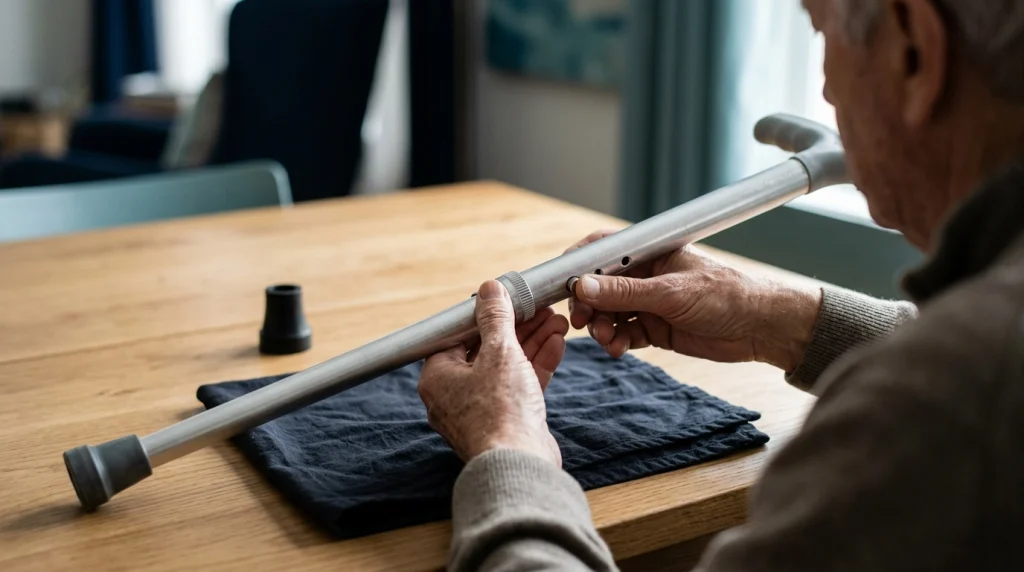
Maintenance focuses on keeping the lock functional, the sliding sections undamaged, and the ground tip in usable condition.
Inspect the locking button and collar before regular use. Periodically examine the adjustment holes and shaft for cracks, dents, bending, corrosion, or unusual movement.
Keep the cane clean using the manufacturer’s recommended method. Avoid applying oil, grease, or other lubricants to locking components unless the instructions specifically permit them, because inappropriate products may affect the mechanism.
Replace worn rubber tips with compatible replacements. After a significant impact or fall, inspect the entire cane rather than assuming an intact-looking handle means the shaft is safe.
If you cannot confidently restore secure locking, replacing a damaged cane is safer than improvising a repair.
Related Product: Height-Adjustable Walking Cane
A standard height-adjustable walking cane is a useful example of telescoping construction. Compare adjustment ranges, locking mechanisms, grip comfort, rubber tips, and manufacturer weight ratings before choosing a model.
As an Amazon Associate, we earn from qualifying purchases.
Frequently Asked Questions
1. Is a telescoping walking cane the same as an adjustable cane?
Usually, a telescoping walking cane is a type of adjustable cane. The term describes the sliding-tube construction used to change height. Not every adjustable cane necessarily uses the same locking mechanism.
2. Can a telescoping cane collapse accidentally?
Accidental shortening is possible if a lock is not fully engaged or becomes damaged. A properly functioning cane should hold its selected length during intended use. Stop using any cane that slips unexpectedly.
3. Can you adjust a telescoping cane while walking?
No. Stop in a safe, supported position, remove weight from the cane, make the adjustment, and confirm that the lock is secure before walking again.
4. Are telescoping canes suitable for heavy users?
Suitability depends on the individual model’s manufacturer-stated weight capacity, construction, and intended use. Telescoping construction alone does not establish whether a cane can safely support a particular user.
5. Can you make a telescoping cane longer than its maximum setting?
No. Do not extend the shaft beyond its designated adjustment range or modify it to create additional height settings. Choose a cane with a suitable height range instead.
6. How often should you replace a telescoping walking cane?
There is no universal replacement schedule for every model. Replace or professionally assess the cane when its shaft, locking mechanism, or other essential structural components become damaged or unreliable. Worn rubber tips may be replaceable separately.
Final Thoughts
A telescoping walking cane combines adjustable shaft length with a mechanical locking system. Its main advantage is the ability to fit the handle to the user without permanently changing the cane.
The most important considerations are correct height, secure locking, an intact shaft, a serviceable rubber tip, and suitability for the user’s support needs. Check these details regularly, and never rely on a telescoping cane with a slipping or damaged adjustment mechanism.
