
Walking Cane Terminology Guide: Parts, Types & Meanings


Electric Kettle with Auto Shutoff

Voice Assistant Smart Speaker

Rollator Walker with Seat
Quick Answer
Walking cane terminology describes the parts, shapes, support styles, and fitting features of a cane. The handle is where you grip it, the shaft is the main supporting section, and the ferrule is the replaceable tip that contacts the ground. Terms such as offset, quad, ergonomic, and adjustable describe different features—not interchangeable types of support.
Cane descriptions can sound surprisingly technical. One listing might advertise an offset grip, a telescoping shaft, and an anti-slip ferrule; another might call the same basic components a swan-neck handle, adjustable tube, and rubber foot. Knowing the vocabulary makes it easier to understand instructions, compare designs, and describe a damaged part accurately.
Walking Cane Parts: A Top-to-Bottom Glossary
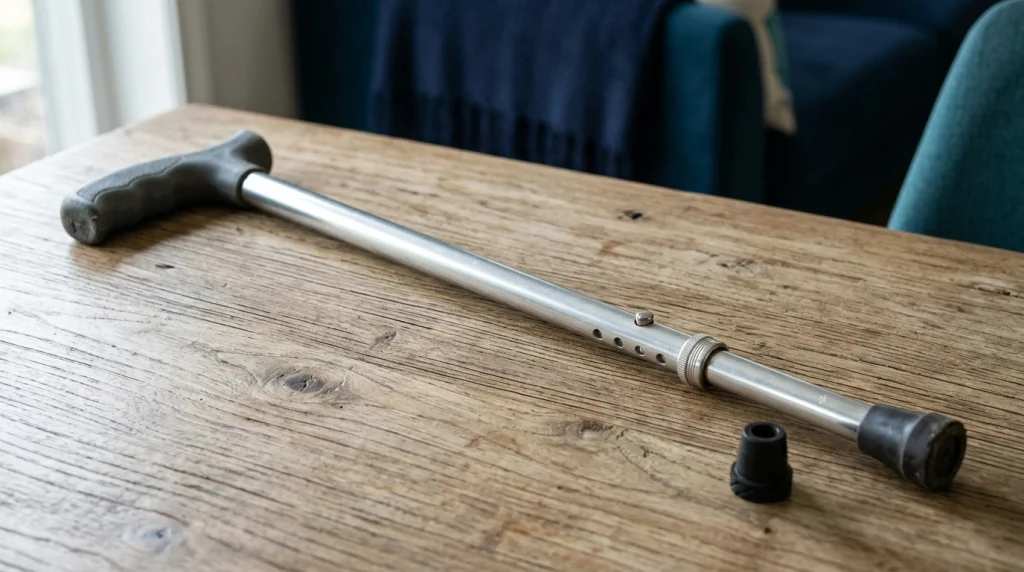
Most everyday walking canes share three essential components. Other terms name optional fittings or features built around them.
| Term | Plain-English Meaning | Why It Matters |
|---|---|---|
| Handle | The upper part held by the user | Controls grip position and comfort |
| Grip | The surface your palm and fingers contact | May affect pressure and slipping |
| Shaft | The long body connecting handle to tip | Provides structure and sets overall length |
| Ferrule / Tip | The replaceable ground-contact end | Provides traction and wears with use |
| Collar / Locking Ring | A ring around a connection or adjustment joint | May tighten a telescoping assembly |
| Push Button / Detent | Spring-loaded button that engages a height hole | Locks a selected setting when engaged |
Handle Versus Grip
The handle names the shape or assembly at the top; the grip is specifically the surface touched by the hand.
An offset cane may have a molded plastic handle with a foam grip. A one-piece wooden cane may have no separate grip covering at all. This distinction matters when a description promises an ergonomic grip but does not change the underlying handle geometry.
Shaft, Shank, and Cane Body
Shaft is the clearest general term for the upright supporting member. Some traditional descriptions use shank or body.
A shaft may be solid wood, metal tubing, or a composite; those material names are different from its construction type. For details about fixed and sectional construction, see our walking cane shaft guide.
What Exactly Is a Ferrule?
For modern mobility canes, ferrule often means the rubber or polymer tip placed over the shaft’s bottom end.
In traditional stick-making, it may instead mean a protective metal sleeve, sometimes fitted with an additional rubber end. The context explains which meaning is intended.
If you are ordering a replacement, measure the shaft diameter and check the cane maker’s compatibility instructions rather than relying on the word alone.
Handle Names and What the Shapes Mean
Handle names describe how a cane is held and where the user’s hand sits in relation to the supporting shaft. They do not, by themselves, tell you how much body weight a particular cane can support.
- Crook or Tourist Handle: A rounded, hook-shaped top, sometimes called a J-handle or shepherd’s crook. The curve can make the cane convenient to hang, but its narrow hand-contact area may not suit everyone.
- Derby Handle: A gently curved, generally horizontal grip with a shaped end. It offers a different palm position from a full crook.
- Fritz Handle: A handle with a broader, flatter upper surface and distinctive curved profile. Some users find its shape easier to hold, though fit depends on individual hand comfort.
- Offset Handle: A bent or swan-neck configuration that places the gripping area more directly above the load-bearing shaft. This describes alignment, not the number of feet.
- T-Handle: A crosswise grip resembling the letter T. Product descriptions vary, so the exact shape should be checked.
- Orthopedic or Anatomical Grip: A contoured handhold, sometimes designed for a specific hand. Confirm whether a version is left-handed, right-handed, or reversible.
What Do Single-Point, Tripod, and Quad Mean?
These terms count ground-contact points. They are different from handle style: an offset-handle cane may still have a single tip, while another offset model may have a four-foot base.
- Single-Point Cane: One ground-contact tip. It is generally light and easy to advance for people who need modest support.
- Tripod or Three-Point Cane: A base with three ends or feet. Some compact pivoting bases are marketed with similar terminology, but their mechanisms may differ.
- Quad, Quadripod, or Four-Point Cane: A base with four feet. A larger footprint can increase support for some users, but all feet need appropriate ground contact when used as designed.
- Small-Base and Large-Base Quad: Terms describing the footprint of a four-foot cane. Larger does not automatically mean more suitable for a given person’s gait, home layout, or strength.
The American Academy of Family Physicians’ mobility-aid overview distinguishes standard, offset, and quadripod designs by their support geometry.
Its terminology also shows why an offset handle and a quad base answer two different design questions. For a longer explanation of what a cane is intended to do, see our walking cane basics.
Key Insight
Handle shape, number of tips, and shaft construction are separate specifications. A cane can simultaneously be offset-handled, height-adjustable, folding, and four-point.
Adjustment and Folding Terms Decoded
Descriptions of adjustable canes often mix the mechanism that changes height with the mechanism that lets a cane fold for storage. They are not the same function.
Telescoping, Height-Adjustable, and Fixed-Length
A telescoping shaft contains sections that slide inside one another.
A push button typically engages a hole at the chosen height, and some models add a tightening ring to reduce movement or rattling.
Height-adjustable simply means the usable cane length can be changed; it does not promise continuous adjustment between marked settings.
Folding, Collapsible, and Segmented
A folding cane separates into connected sections, often held together internally by an elastic cord.
Collapsible can describe a folding or telescoping design, so check the product’s actual mechanism.
A segmented shaft means its length is built from multiple pieces rather than one continuous tube.
Common Tip and Base Terminology
A tip is a small component with an unusually important role: it is where the cane meets the walking surface. Descriptions often mention material, tread, and motion without explaining the difference.
- Non-Slip or Anti-Slip Tip: A claim about intended traction. It does not guarantee grip on wet tile, loose gravel, or ice.
- Tread: The pattern molded into the underside of a tip. A flattened or damaged tread can be a replacement signal.
- Pivoting or Articulating Base: A base that can tilt relative to the shaft. This is not the same as a fixed quad base.
- Replacement Tip: A new ground-contact part chosen for the correct attachment size and design.
Sizing, Support, and Medical Terms You May See
These are practical fitting and mobility terms rather than names of decorative cane features. Understanding them helps translate a clinician’s instructions or product specification.
- Handle Height: Vertical distance from the floor to the hand-support position when the cane is upright. Correct fitting is more important than choosing a cane only from an overall-height listing.
- Wrist Crease: A common reference point for initial cane fitting when standing upright with the arm relaxed at the side.
- Elbow Flexion: The slight bend in the elbow while holding a correctly fitted cane.
- Weight Capacity: The maker’s specified maximum user weight or load rating under its conditions. It is not a promise that the cane can replace a walker or carry the user’s full weight.
- Contralateral Hand: The hand on the opposite side from the affected leg. This is commonly the hand used for a cane when one leg is weaker or painful.
- Base of Support: The area formed by the support points in contact with the ground. A broader base can improve certain aspects of stability but can also affect maneuverability.
For typical fitting, the cane handle is positioned around the wrist crease while the elbow remains slightly bent.
The MedlinePlus cane-use instructions also explain the commonly recommended opposite-hand technique and the need to inspect worn tips.
Individual mobility restrictions and balance difficulties can change what device is appropriate.
Safety Note
A product labeled “heavy-duty,” “stable,” or “bariatric” is not necessarily suitable for someone who needs substantial assistance or has frequent falls. A physical therapist or other qualified clinician can assess whether a cane, walker, or another mobility aid fits the person’s needs.
How to Read a Cane Product Description Without Getting Misled

Consider this hypothetical description: “Ergonomic offset quad cane with adjustable aluminum shaft, non-slip ferrules, and self-standing base.” It contains several different kinds of information.
- Offset describes the handle-to-shaft alignment.
- Quad says the cane uses four support feet.
- Adjustable Aluminum Shaft identifies both its height mechanism and its principal material.
- Non-Slip Ferrules describes the ground-contact tips, but traction will still depend on the surface and their condition.
- Self-Standing means the design may remain upright when set down on a suitable surface, not that it is immune to tipping.
Related Product
Replacement Rubber Cane Tips
If this glossary helped you identify a worn ferrule, replacement rubber tips are a practical category to explore. Match the exact shaft diameter and cane design before selecting one.
As an Amazon Associate, we earn from qualifying purchases.
Frequently Asked Questions
Is a ferrule the same thing as a cane tip?
Usually, yes in modern mobility-cane listings: both name the component at the ground-contact end. In traditional cane-making, ferrule can also refer to a metal sleeve fitted near the bottom.
What is the difference between a Derby handle and a Fritz handle?
Both are shaped handholds, but their contours differ. Derby handles commonly have a curved horizontal profile; Fritz handles have a flatter, broader resting area. Neither name guarantees that the handle will fit a particular hand.
What does “quad cane” stand for?
Quad refers to the cane’s four ground-contact feet. The more formal term is quadripod cane. A quad cane may also have an offset or ergonomic handle.
Does “bariatric cane” mean the cane is safer for everyone?
No. Bariatric generally indicates a design intended for higher weight capacities, but suitability also depends on fit, stability requirements, construction, and manufacturer instructions.
What does a locking collar do on a cane?
On many adjustable models, the collar tightens around the shaft joint to limit looseness or rattling. The push button normally establishes the chosen height. Check the specific cane’s instructions for its locking mechanism.
Are “walking cane” and “mobility cane” interchangeable?
They often refer to the same general aid, although mobility cane more clearly suggests a device used for walking assistance. The words alone do not identify whether the cane has one tip, a quad base, or a particular handle.
Final Takeaway
The most useful way to understand walking cane terminology is to separate parts (handle, shaft, ferrule), shapes (crook, Derby, Fritz, offset), support bases (single-point, tripod, quad), and mechanisms (telescoping, folding, locking).
Once these categories are clear, unfamiliar descriptions become easier to interpret—and it becomes easier to ask the right questions about fit, compatibility, and safe use.
