
Walking Cane Base Explained: Types, Stability, and Safety


Easy Grip Knife Set

Shiatsu Neck Massager

Shower Chair for Elderly
Quick Answer
A walking cane base is the part at the bottom of the cane that contacts the ground. A single-tip base is usually lighter and easier to move, while a four-point quad base creates a wider support area for people who need more stability. MedlinePlus explains that single-tip and four-prong canes provide different levels of support, so the right choice depends on your balance, strength, and mobility needs.
What the cane base changes
- Ground contact: A wider base places more contact points on the floor.
- Stability: Quad bases generally provide more support than a basic single tip.
- Maneuverability: Smaller bases are easier to position during a normal walking stride.
- Weight: Large multi-point bases usually add more weight to the cane.
- Traction: Rubber tips help the cane grip the floor and need replacement when worn.
Before choosing
- If you have significant weakness, repeated falls, or major balance problems, ask a doctor or physical therapist whether a cane provides enough support.
When people compare walking canes, they often focus on the handle and forget about the part touching the floor. I think the base deserves just as much attention because it affects how the cane feels with every step.
This guide explains walking cane bases in plain language. I’ll cover the main designs, their tradeoffs, proper fitting, safety, and when a different mobility aid may make more sense.
In This Guide
- What Is a Walking Cane Base?
- How Does a Cane Base Affect Stability?
- What Types of Walking Cane Bases Are Available?
- Single-Point vs. Quad Cane Base: What Is the Difference?
- How Do You Choose the Right Cane Base?
- How Should a Cane Be Fitted and Used?
- When Should You Replace a Cane Tip or Base?
- Frequently Asked Questions
What Is a Walking Cane Base?
A walking cane base is the ground-contact section at the bottom of a cane. Depending on the design, it may be one rubber tip or a larger frame with several feet.
You may also hear a single rubber tip called a ferrule. The ferrule protects the cane shaft and creates traction between the cane and the walking surface.
- Single-point base: One tip contacts the ground.
- Quad base: Four separate feet contact the ground.
- Replacement support base: A wider accessory replaces a standard cane tip on compatible models.
- Flexible or pivoting tip: Some modern products use a broader rubber assembly that flexes as the cane angle changes.
Those last two categories vary considerably between manufacturers. They should not automatically be treated as equivalent to a medical quad cane.
Is the base the same thing as the cane tip?
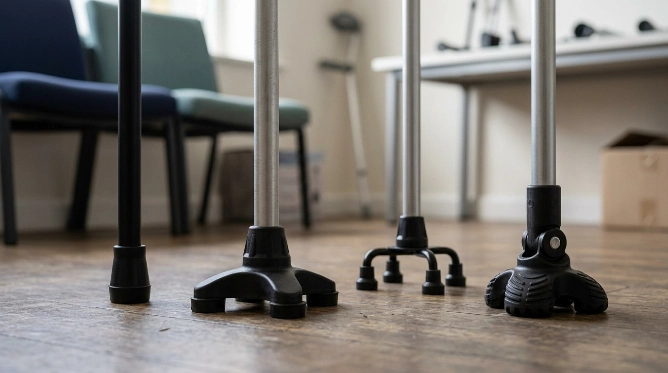
Sometimes. On a traditional single-point cane, people commonly use “base” and “tip” to describe the same bottom component.
With a quad cane, the distinction becomes clearer. The base is the metal or composite frame, while each leg normally has its own rubber tip.
Why does this small part matter?
The base is where your body’s support transfers through the cane to the floor. A damaged or poorly positioned base can therefore change how secure the cane feels.
- It affects how much floor area the cane occupies.
- It influences how easily you can reposition the cane.
- It provides traction through its rubber contact surfaces.
- It can affect the cane’s total weight and balance.
As of 2026, there are many variations marketed as self-standing, all-terrain, pivoting, or multi-tip bases. Those labels can be useful, but fit and safe technique remain more important than marketing terminology.
How Does a Cane Base Affect Stability?
A wider base can increase the cane’s support area, but wider does not automatically mean better for every user. You still need to place the cane correctly and maintain secure contact with the floor.
A standard single-point cane gives you one extra contact point with the ground. It works well for many people who need modest help with balance or mild unloading of one leg.
Why are quad bases more stable?
A quad cane has four feet arranged across a wider area. That larger support footprint can provide more stability than a traditional single-tip cane.
The American Academy of Family Physicians notes that all four points of a quad cane should contact the ground during proper use. You can read its overview of geriatric assistive devices for more background.
- Single tip: Easy to move and position quickly.
- Small quad base: Adds support without the footprint of a wide quad base.
- Wide quad base: Offers a broader support area but takes more room around your feet.
More stability can create new tradeoffs
A large base may feel reassuring while standing. During walking, however, its size can make turns and tight spaces more awkward.
The base can also become a trip hazard if it is positioned too close to your feet. This is one reason proper training matters.
- Doorways may feel narrower.
- Furniture can interfere with a wide base.
- Stairs require special care.
- Uneven surfaces can prevent every foot from sitting flat.
Section Takeaway: A larger cane base can provide more support, but only when the base is placed correctly and the design matches your walking needs.
What Types of Walking Cane Bases Are Available?
The most useful way to understand cane bases is by looking at how many contact points they create and how much space they occupy. Here are the designs you are most likely to encounter.
1. Single-point cane base
This is the familiar rubber tip found on many standard and offset canes. It offers the smallest footprint and is usually the easiest style to swing forward during walking.
I tend to think of the single tip as the “mobility-first” design. It does not try to make the cane stand alone or create a large platform.
- Lightweight
- Easy to maneuver
- Simple to replace
- Good for people needing relatively modest support
2. Small-base quad cane
A small-base quad cane has four feet spread across a compact frame. It provides a wider support area while remaining smaller than a large-base quad cane.
This design can suit someone who needs more support than a single point provides but still wants reasonable maneuverability.
3. Large-base quad cane
A wide quad base spreads four feet over a larger area. The broader footprint can feel steadier when the cane is planted correctly.
- Advantage: Broad support area.
- Tradeoff: Heavier and bulkier than a single-tip cane.
- Walking consideration: Requires enough clearance from your feet.
- Surface consideration: The feet need firm contact with the floor.
4. Multi-tip replacement bases
Some manufacturers sell wider rubber bases that fit onto an ordinary cane shaft. These products may use several small contact lobes rather than a traditional metal quad frame.
They can increase the contact area and may allow some canes to stand unsupported. However, compatibility depends on shaft diameter and product design.
5. Flexible or pivoting bases
Some replacement bases bend or pivot slightly as the shaft changes angle. Manufacturers often market this feature for smoother ground contact during a stride.
Do not assume a flexible base provides the same support as a quad cane. If stability is a medical concern, discuss the design with a physical therapist or healthcare professional.
Section Takeaway: Cane bases range from simple one-point tips to four-foot frames and newer multi-tip accessories. Choose by support needs and safe walking mechanics, not by features alone.
Single-Point vs. Quad Cane Base: What Is the Difference?
A single-point cane prioritizes easy movement, while a quad cane prioritizes a wider support footprint. Neither design is automatically right for everyone.
| Feature | Single-Point Base | Small Quad Base | Wide Quad Base |
|---|---|---|---|
| Ground contacts | 1 | 4 | 4 |
| Support footprint | Small | Moderate | Largest of these three |
| Maneuverability | Usually easiest | Moderate | More space required |
| Weight | Usually lighter | Heavier | Often heavier |
| Typical use | Light balance or support needs | More stability with a compact footprint | Greater support where extra footprint is acceptable |
Mayo Clinic notes that many people do well with a single-tip cane, while a quad cane offers a broader base of support. Its current guide also explains that quad canes can be heavier and harder to handle.
See the Mayo Clinic guide to choosing and using a cane for guidance on cane types, grip, fit, and walking technique.
How Do You Choose the Right Cane Base?
Start with the amount of support you need rather than the appearance of the cane. Someone who wants occasional balance assistance has different needs from someone with substantial leg weakness.
Ask how much support you actually need
- Light balance help: A single-point cane may be sufficient.
- More stability: A quad design may provide a broader support area.
- Major weakness: A cane may not provide enough support.
- Frequent falls: Get professional advice before relying on a new cane base.
If a cane cannot safely meet your needs, a walker or another aid may be more appropriate. More support is sometimes more useful than upgrading the cane tip.
Consider where you walk
A wide base that feels comfortable in an open hallway may behave differently in a crowded kitchen. Think about your real environment before buying.
- Narrow hallways
- Stairs and curbs
- Carpet and rugs
- Outdoor pavement
- Grass or uneven paths
- Bathrooms and other potentially wet areas
Check replacement-base compatibility
If you are buying an aftermarket base, check the cane shaft diameter specified by the manufacturer. A loose base may move, while an undersized one may not install correctly.
Never force a replacement tip onto an incompatible cane. Follow the cane and tip manufacturers’ fitting instructions.
Think beyond the cane itself
A mobility aid is only one part of fall prevention. The National Institute on Aging recommends considering proper assistive-device fit along with footwear, household safety, and professional guidance.
Its guide to falls and fractures in older adults also recommends getting help from a physical or occupational therapist when needed.
How Should a Cane Be Fitted and Used?
The best cane base will not compensate for a cane that is badly adjusted. Proper height helps you place the cane without leaning excessively or lifting your shoulder.
Check the cane height
With your arm resting naturally at your side, the top of the cane should generally sit around the wrist crease. Your elbow should remain slightly bent when gripping the handle.
Mayo Clinic describes a comfortable elbow bend of roughly 15 to 30 degrees. Individual needs can vary, so a therapist may recommend a different setup.
Which hand holds the cane?
For weakness or pain mainly affecting one leg, common clinical guidance is to hold the cane in the opposite hand. The cane then moves forward with the weaker or affected leg.
- Stand upright with the cane placed securely beside you.
- Move the cane forward with the weaker leg.
- Place the cane base firmly on the floor.
- Use the cane for support while moving the stronger leg forward.
- Keep your steps controlled and avoid reaching too far ahead.
Quad canes need complete ground contact
With a quad cane, place all four tips on the ground before relying on it for support. Do not balance the cane on only two feet.
Watch the base during your first practice sessions so you learn its footprint. After the movement becomes familiar, keep your eyes forward rather than constantly looking down.
Be careful on stairs
Stairs change the amount of space available for a cane base. Large quad bases can be more challenging to position than single-point canes.
If stairs are part of your routine, ask a physical therapist to show you the safest method with your specific cane. Avoid improvising when balance or leg strength is limited.
Safety note: New weakness, dizziness, repeated falls, or a sudden change in walking ability deserves medical attention. A cane should support safe mobility, not hide an unexplained problem.
Section Takeaway: Proper height, correct hand position, and full base contact are essential. The base design alone cannot make an incorrectly used cane safe.
When Should You Replace a Cane Tip or Base?

Inspect the bottom of your cane regularly. Rubber tips wear gradually, which makes deterioration easy to miss.
MedlinePlus recommends checking cane tips daily and replacing worn ones. That is a simple habit worth adopting.
Signs a cane tip may need replacement
- Smooth tread: The original traction pattern has worn away.
- Cracking: Rubber is splitting around the sides or bottom.
- Uneven wear: One edge has become noticeably thinner.
- Looseness: The tip twists or moves on the shaft.
- Exposed material: The shaft or internal structure is starting to show through.
Check every foot on a quad cane
A quad cane has several tips, and they may not wear evenly. Inspect all four rather than replacing only the one that looks worst.
Also check whether the frame sits flat on a level surface. Damage or bending can prevent proper contact.
Keep the bottom clean
Dust, moisture, mud, and debris can reduce traction. Wipe the base clean after outdoor use and allow wet rubber to dry.
- Remove stones caught in tread.
- Dry the base after rain.
- Check adjustment buttons and locks.
- Look for cracks after temperature extremes.
- Replace parts only with compatible sizes.
A cane can look fine at eye level while the bottom is badly worn. I find that making the base check part of a regular shoe or mobility-equipment routine makes it easier to remember.
Frequently Asked Questions About Walking Cane Bases
Is a wide cane base always safer than a single tip?
No. A wide base can provide a broader area of support, but safety also depends on your strength, balance, cane height, walking technique, flooring, and ability to position the base correctly.
Is a quad cane better than a regular cane?
A quad cane provides a broader support base, while a single-point cane is generally lighter and easier to move. The better option depends on how much assistance you need and how comfortably you can control the cane.
Can I put a four-point replacement base on my current cane?
Sometimes. Replacement bases are made for specific shaft diameters and cane designs, so check compatibility before installation. An aftermarket multi-tip base is also not automatically equivalent to a purpose-built medical quad cane.
Should a cane be able to stand up by itself?
Self-standing ability can be convenient, but it should not be the main reason for choosing a cane. Stability during actual walking, proper fit, safe grip, and adequate support are more important.
Why does my cane tip keep slipping?
The rubber may be worn, dirty, wet, hardened, or unsuitable for the surface. Stop and inspect the tip if traction suddenly changes, and replace damaged components before continuing regular use.
How often should I check my cane base?
A quick visual check before regular use is sensible, especially if you rely heavily on the cane. Look for worn tread, cracks, loose parts, trapped debris, or damage to any of the ground-contact points.
When is a walker better than a cane?
If you need substantial support, have significant weakness, or continue falling despite using a cane, a walker may provide a more suitable support area. Ask a healthcare professional or physical therapist to assess your mobility rather than changing devices on your own.
Final takeaway: A walking cane base may look simple, but it changes how the cane contacts the ground. Single tips favor light weight and easy movement, while quad bases provide a wider support footprint.
Choose the base that matches your real mobility needs, keep every tip in good condition, and have the cane professionally fitted if you are unsure. If balance problems or falls are increasing, talk with your healthcare provider rather than relying only on a different cane base.
