
What Is Senior Flex Shaft


Memory Foam Seat Cushion

Electric Jar Opener

Voice Assistant Smart Speaker
A senior flex shaft is a golf club shaft designed for players with slower swing speeds, typically under 85 mph. It’s more flexible than regular flex, helping seniors and others generate more clubhead speed and higher launch for longer, straighter shots. This isn’t just about age—it’s about matching your physical swing to the right equipment for better performance and enjoyment on the course.
Key Takeaways
- Senior flex is a specific shaft stiffness rating for slower swing speeds: It’s not an “age” label but a performance spec, generally for swing speeds below 85 mph with the driver.
- It helps generate distance and launch: The extra flex stores and releases energy more efficiently for players who can’t load a stiff shaft, leading to higher ball flight and more carry.
- It’s part of a full club fitting: The right flex depends on your swing speed, tempo, and strength, not just your age or driver distance.
- Modern materials enhance performance: Today’s senior flex shafts use advanced graphite to be both flexible and stable, reducing twisting for better accuracy.
- Mis-fitting hurts your game: Using a shaft too stiff (like regular or stiff flex) can slice your shots, reduce distance, and cause fatigue, while one too soft can hook and feel uncontrollable.
- Cost varies widely: You can find quality senior flex shafts from $50 to $300+, and many manufacturers offer them in stock clubs or as upgrades.
- It’s not just for drivers: Senior flex is available in fairway woods, hybrids, and even irons to match your entire set for consistent feel.
[FEATURED_IMAGE_PLACEHOLDER]
📑 Table of Contents
- What Is a Senior Flex Shaft? The Simple Truth for 2026 Golfers
- The ABCs of Golf Shaft Flex: It’s All About Timing
- Who Actually Needs a Senior Flex Shaft? (Hint: It’s Not Just Age)
- The Science and Technology of Modern Senior Flex Shafts
- Senior Flex vs. Regular Flex: The Critical Comparison
- How to Choose and Fit Your Perfect Senior Flex Shaft
- Pro Tips for Maximizing Your Senior Flex Shaft Performance
- Conclusion: Your Best Golf Awaits with the Right Shaft
What Is a Senior Flex Shaft? The Simple Truth for 2026 Golfers
Let’s talk plainly. If you’ve been playing golf for a while, especially as you’ve gotten a bit older, you might have noticed something. Your driver doesn’t seem to fly as far as it used to. Your irons feel hard to control. You might even feel a little ache in your shoulders or back after a round. You blame it on age, on not practicing enough, on the course conditions. But what if the real culprit is hiding in your hands? What if your golf clubs—specifically the shafts inside them—are working against you, not for you?
Enter the senior flex shaft. This isn’t some gimmicky marketing term dreamed up to sell more clubs to older folks. It’s a precise engineering solution for a very common problem: the slowing of swing speed that comes with age, reduced flexibility, or simply a less powerful physique. In 2026, with golf equipment technology more advanced than ever, understanding what a senior flex shaft is—and whether it’s right for you—is one of the easiest and most impactful things you can do for your game.
Think of it this way: your golf shaft is the engine of your club. If the engine is too stiff for your swing, it won’t “fire” at the right moment. It’s like trying to start a diesel truck with a motorcycle key—it just doesn’t engage properly. A senior flex shaft is engineered to be more flexible, allowing it to bend and store energy during your backswing and then release that energy with a “whip” through impact. For a golfer with a smoother, slower tempo, this timing is perfect. It helps you get the clubhead moving faster without having to swing harder, which often leads to better contact, higher shots, and more distance. It’s not about making you a power hitter; it’s about letting your existing swing work efficiently.
We’re going to break this down completely. We’ll talk about what “flex” really means, who actually needs senior flex (hint: it’s not just a birthday thing), the science behind how it works, how it compares to other flexes like regular or stiff, and exactly how to figure out if it’s the magic key for your golf bag. By the end, you’ll know more about shafts than most golfers at your local club. And that knowledge is power—the kind that lowers your scores and makes the game more fun again.
The ABCs of Golf Shaft Flex: It’s All About Timing
Before we dive into “senior,” we need to understand “flex.” Flex is simply the measure of how much a golf shaft bends during the swing. But it’s not about how “bendy” it feels in your hands. It’s a carefully calibrated property that determines when the shaft unbends and releases its stored energy relative to your clubhead speed at impact. This timing is everything.
Visual guide about What Is Senior Flex Shaft
Image source: staffordgolfstore.com
The Flex Spectrum: From Ladies to Extra Stiff
Manufacturers use a standard spectrum to rate shaft stiffness. From most flexible to least, it generally goes: Ladies (L), Senior (A or S), Regular (R), Stiff (S), Extra Stiff (X). Some brands have intermediate ratings like “Firm” or “Tour” in there, but this is the core lineup. Each step up means the shaft requires more force (swing speed) to make it bend and release at the optimal point.
Imagine a rubber band. A ladies flex is a thick, loose rubber band—easy to stretch. An extra stiff is a thin, tight one—hard to stretch at all. Your swing needs to match the rubber band. If your swing is slow and smooth (the slow pull), you need the loose rubber band (senior flex) to stretch and snap. If you yank on a tight rubber band (stiff shaft) with a slow pull, it won’t stretch much and will just feel dead. Conversely, if you have a fast, aggressive swing and use a loose rubber band, it’ll stretch too much and fling back wildly, losing control.
How Flex Affects Your Ball Flight
The right flex directly influences two critical things: launch angle and spin. A properly matched flexible shaft for a slower swinger will generally produce a higher launch angle and optimal spin rate. Why? Because the flexible shaft allows the clubhead to “lag” slightly behind the hands longer, then whip through, adding speed and presenting the clubface with a slightly upward angle. This combo—higher launch with moderate spin—is the golden ticket for maximum distance with slower swing speeds. It gets the ball in the air easier and lets it carry farther.
If you use a shaft that’s too stiff, the clubhead won’t lag; it will release early, leading to a lower, weaker ball flight with potentially too much spin (a “balloon” shot that goes high but not far) or a slice if the face is open at that early release point. It also feels harsh, like hitting a rock, and can cause jarring impacts that lead to injury over time. On the flip side, a shaft that’s too soft can cause the clubhead to lag too much, releasing late and often closing the face, leading to hooks or pulls. It can also feel “whippy” and unstable, making it hard to trust on tight shots.
So, flex is the translator between your body’s motion and the ball’s flight. Get the translation wrong, and the message is garbled. Senior flex is the translator designed for a specific dialect: the slower, smoother swing.
Who Actually Needs a Senior Flex Shaft? (Hint: It’s Not Just Age)
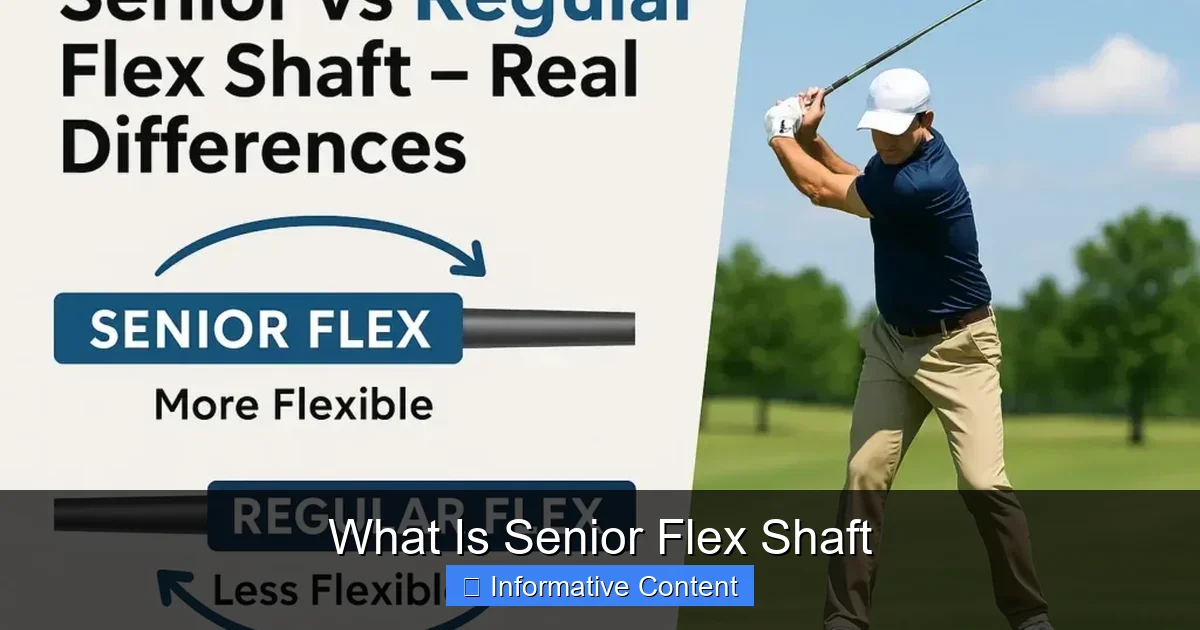
Here’s where we clear up the biggest myth. The name “senior flex” is a misnomer that causes endless confusion. It’s called “senior” because historically, it was marketed to older golfers whose swing speeds had decreased. But the label stuck, and now people think, “I’m 65, I must need senior flex.” That’s not necessarily true. The need is based on physics, not chronology.
Visual guide about What Is Senior Flex Shaft
Image source: staffordgolfstore.com
Swing Speed is the True North
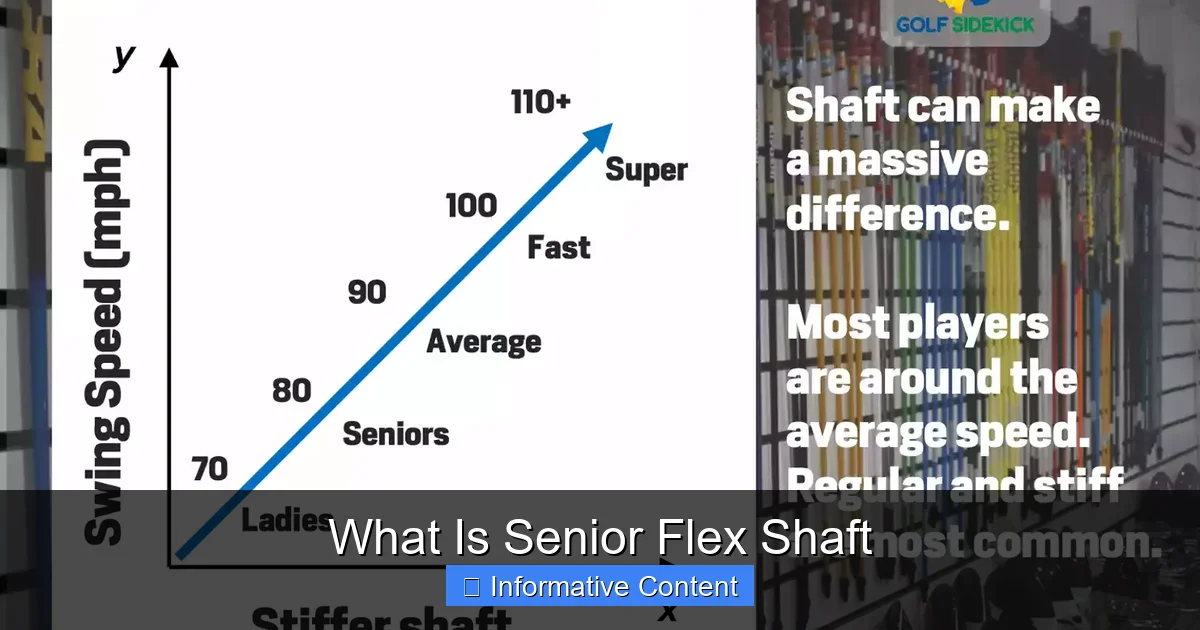
The primary determinant for shaft flex is your driver swing speed. This is the speed of the clubhead at the moment of impact. Here are the general, 2026-accepted guidelines:
- Ladies Flex: Typically under 70 mph
- Senior Flex: Approximately 70-85 mph
- Regular Flex: Approximately 85-95 mph
- Stiff Flex: Approximately 95-105 mph
- Extra Stiff: Over 105 mph
If your average driver swing speed is consistently in that 70-85 mph range, senior flex is very likely your best starting point. But speed isn’t the only factor.
Tempo and Transition Matter
Two golfers can have the same swing speed but different tempos. One might have a slow, smooth backswing and a gradual transition into the downswing. The other might have a quick, jerky backswing and an aggressive “hump” at the top. The smooth swinger will likely benefit more from a senior flex, as the shaft has time to load and unload properly. The quick-transition golfer might find a regular flex works better, as the stiffer shaft can handle the abrupt change in direction without over-flexing. This is why a professional fitting is so crucial—it accounts for these nuances.
The “Who” Beyond the Numbers: Common Profiles
While swing speed is key, certain player profiles almost always benefit from exploring senior flex:
- Golfers over 50-55 who notice a gradual loss of distance year after year, even with the same effort.
- Players with physical limitations—less shoulder turn, reduced wrist hinge, or injuries that limit power generation.
- Formerly strong players who are now “swingers” rather than “hitters.” They have great tempo but lack the raw muscle to load a stiff shaft.
- Women golfers with higher swing speeds (some low-handicap women can swing in the low 80s) might find senior flex offers a better balance of control and distance than ladies flex.
- Beginners and high-handicappers with naturally smooth, unhurried swings. Forcing a stiff shaft is a common mistake that kills confidence.
It’s also worth noting that your iron swing speeds are slower than your driver speed. A golfer with an 82 mph driver speed might have a 6-iron speed of 58 mph. Senior flex is available in irons, and the same principles apply. If your mid-irons feel like you’re “beating on a rock” and you can’t get them airborne easily, you might need a more flexible iron shaft, which could be a senior or even a regular flex depending on your speed.
Finally, let’s address the name directly. If you’re wondering what age is considered a senior citizen in the context of golf equipment, there’s no official cutoff. The USGA has no age rule for shaft flex. It’s a performance category. A 45-year-old with an 80 mph swing might need senior flex, while a fit, athletic 70-year-old who still swings his driver at 98 mph absolutely needs a stiff shaft. Don’t let the label dictate your choice; let your swing data and feel dictate it.
The Science and Technology of Modern Senior Flex Shafts
Senior flex shafts of the 1990s were often simple, heavy, graphite “whippy” things. They flexed, sure, but they were also inconsistent, heavy, and prone to twisting (torque), which killed accuracy. Today, 2026 technology has transformed what’s possible.
Visual guide about What Is Senior Flex Shaft
Image source: golfsidekick.com
Materials: The Graphite Revolution
Almost all modern senior flex shafts are made of graphite, not steel. Graphite is lighter, which is a huge advantage for seniors. A lighter clubhead (from a lighter shaft) allows you to swing faster with the same effort. But more importantly, graphite can be engineered to have specific flex and torque profiles. Manufacturers lay carbon fiber sheets at different angles and thicknesses around a mandrel to create a shaft that bends where they want it to and resists twisting where it matters.
For a senior flex shaft, the goal is a smooth, progressive bend from the grip to the tip. The tip section (the last 12-14 inches) is where most of the “whip” happens at impact. Advanced tip designs allow for that desirable late release without the clubhead snapping around unpredictably. The butt section (near the grip) is often stiffer to provide stability during the backswing and transition, giving you a solid feel and preventing the shaft from feeling like a wet noodle.
Key Specs: Torque and Kick Point
Two specs are critical to understand when shopping:
- Torque (measured in degrees): This is how much the shaft resists twisting. Lower torque (e.g., 3.5°) means the clubface is less likely to twist open or closed at impact, leading to tighter shot dispersion. Higher torque (5.5°+) can feel more forgiving but may increase slices or hooks. Modern senior flex shafts aim for moderate torque (4.0°-5.0°) to balance feel and control.
- Kick Point (or Bend Point): This is where the shaft bends the most. A low kick point (bend closer to the clubhead) promotes a higher launch and more spin, great for getting the ball airborne. A high kick point (bend closer to the grip) promotes a lower, penetrating ball flight. For seniors needing help getting the ball up, a low-to-mid kick point in a senior flex shaft is usually ideal. Many 2026 senior flex shafts are designed with a distinctly low kick point to maximize launch for slower speeds.
Weight: Finding the Sweet Spot
Shaft weight is a personal preference, but it matters. A very light shaft (50-55 grams) can help increase swing speed for some, but it might feel too insubstantial and reduce feedback. A heavier shaft (65-75 grams) can provide better tempo and feel but might slow your swing down. The sweet spot for many senior flex users is in the 55-65 gram range. It’s light enough to swing easily but heavy enough to provide a solid, confident feel. Some premium shafts use weight-saving technology in the tip to keep overall weight down while maintaining stability.
The takeaway? Modern senior flex shafts are highly sophisticated pieces of equipment. They are not just “softer” versions of regular flex; they are uniquely engineered to optimize the launch conditions for a specific swing profile. This is why a generic “senior flex” shaft from a big-box store might perform very differently from a custom-fit, high-tech senior flex shaft from a top manufacturer.
Senior Flex vs. Regular Flex: The Critical Comparison
This is the most common point of confusion. A golfer who should be in a senior flex is often “up-fitted” into a regular flex because it’s the next step up, or because a salesperson assumes “senior” means “old and weak.” Let’s settle the score once and for all. For a direct comparison, check out our detailed article on Senior Flex vs Regular Flex: What’s Different?.
Performance on the Course: Distance and Accuracy
For a golfer with an 80 mph swing speed:
- Senior Flex: The shaft will bend and release at the perfect moment, launching the ball higher (around 15-18° with a driver) with optimal spin (2200-2500 rpm). This maximizes carry distance. The higher launch also means the ball stays in the air longer, which can help with carry over hazards. Accuracy is generally better because the clubhead is on plane at impact.
- Regular Flex: The shaft will feel stiff and unresponsive. It won’t load properly, so the clubhead speed at impact will be lower than with a senior flex. The ball flight will be lower and weaker, with potentially higher spin if the face is open at an early release. The result is less total distance, a ball that doesn’t carry as far, and often a tendency to slice because the stiff shaft doesn’t allow the hands to release and close the face naturally.
In real terms, a golfer in the 80 mph range might lose 15-30 yards by using a regular flex shaft. That’s the difference between a 150-yard par 3 and a 180-yard par 3—a huge gap in scoring ability.
Feel and Feedback
This is subjective but important. A correctly fitted senior flex shaft should feel “active” or “responsive.” You should feel a distinct loading sensation in the shaft during the downswing and a smooth, accelerating impact. It shouldn’t feel floppy or unstable. A regular flex in the same swing will feel “boardy” or “dead.” You won’t feel the clubhead loading, and impact can feel harsh. Many golfers mistakenly think a harsh feel means they’re hitting it solidly, but it’s often a sign of a mismatch.
The Transition Zone: Where the Lines Blur
The 85 mph swing speed mark is a gray area. Some golfers at 83-87 mph might actually perform better with a stiff regular flex (some brands call this “Firm” or “Tour” regular) if they have a very aggressive, fast transition. Conversely, a golfer with an 80 mph swing but a very slow, smooth tempo might even benefit from a slightly softer senior flex (sometimes called “Soft Senior” or “A+”). This is why fitting is non-negotiable. You can’t go by speed alone.
Also, consider your 6-iron distance. If you hit your 6-iron 140-150 yards, you’re likely in the senior flex range for irons. If you hit it 165+, you’re probably in regular or stiff. This is a great on-course benchmark.
How to Choose and Fit Your Perfect Senior Flex Shaft
Knowing you need senior flex is step one. Choosing the right one is step two, and it’s just as important. Not all senior flex shafts are created equal.
The Non-Negotiable: Get a Professional Fitting
I cannot say this enough. Do not buy a senior flex shaft based on a guess, a catalog description, or because your buddy said so. A proper fitting involves:
- Launch Monitor Data: A device like TrackMan, FlightScope, or even a high-end simulator measures your exact swing speed, ball speed, launch angle, spin rate, and carry distance. This is objective data. A fitter will try different flexes (senior, regular, maybe even a stiff) and see which one produces the best combination of distance and accuracy for YOU.
- Shaft Weight and Balance: The fitter will have you swing different weights. Do you feel more rhythm with a lighter or heavier shaft? The swing weight (how the club feels when you hold it) also affects your ability to release the club.
- Grip Size: A grip that’s too large can restrict wrist release, making a flexible shaft feel stiff. A grip that’s too small can cause hooks. This is often overlooked but hugely important.
- Length: Senior flex shafts often come in standard lengths, but you might need a +0.5″ or -0.5″ adjustment for proper posture and swing arc.
Many golf retailers and club manufacturers offer free or low-cost fittings. It’s the best investment you’ll make in your equipment. And if you’re worried about cost, remember that a well-fitted $200 set of clubs will outperform a mismatched $1,000 set every time.
Key Specifications to Discuss with Your Fitter
When you’re in the fitting, talk about these specs for your senior flex shaft:
- Brand Model: Popular 2026 models include the Mitsubishi Chemical Tensei AV series (known for smooth feel), the Fujikura Speeder NX (lightweight and stable), and the Project X HZRDUS Smoke (a lower-launch option for stronger seniors). Each has a unique feel.
- Weight: Aim for 55-65g for drivers. For irons, 70-90g is common.
- Torque: Look for 4.0° to 5.5° for most players. If you fight a slice, lean toward the lower end.
- Kick Point: Low to mid for high launch. High kick points are rare in true senior flex shafts.
- Tip Stiffness: Some senior flex shafts have a stiffer tip section to improve accuracy without losing overall flexibility. Ask your fitter about this.
Stock vs. Aftermarket: Where to Buy
Many major brands (Callaway, TaylorMade, Ping, Titleist, Cobra) offer senior flex as a stock option in their game-improvement clubs (like the Callaway Paradym, TaylorMade Qi10, Ping G430). These are excellent, pre-configured choices that are often a great starting point. However, the aftermarket custom shaft market offers vastly more options in terms of weight, torque, and bend profile. If you have very specific needs or are a low-handicap senior player, going the custom route with a fitter is the way to go. You can also often upgrade the shaft in a set of stock clubs for a fee.
Budget-wise, you don’t need to break the bank. A good quality, modern senior flex shaft from a reputable brand will serve you well. Focus on fit over price tag.
Pro Tips for Maximizing Your Senior Flex Shaft Performance
You’ve got the right shaft. Now, let’s make it sing. Here’s how to get the most out of your senior flex clubs.
Adjust Your Swing Thought, Not Your Swing
A common mistake is getting a senior flex shaft and then trying to “kill it.” You think the shaft is so flexible you need to swing harder to make it work. Wrong. The whole point is to let the shaft do the work. Your new thought should be: smooth tempo, full extension. Focus on turning your shoulders fully and releasing your hands naturally at impact. Let the flexible shaft store and release energy. Swinging harder with a senior flex often leads to casting (releasing too early) and loss of power. Trust the equipment.
Check Your Lie Angles
This is huge. Senior flex shafts are often paired with more upright lie angles in irons because the higher launch can sometimes cause the ball to start left. A fitter will check this with impact tape or lie board. If your irons are too flat, you’ll hit the toe and push shots right. Too upright, and you’ll hit the heel and pull shots left. Getting the lie angle correct is as important as the flex itself for accuracy.
Don’t Neglect the Short Game
While senior flex is most discussed for drivers and fairway woods, it can apply to wedges and even putters for some players. If you have a very smooth, slow putting stroke, a softer putter shaft (some are even labeled “senior” or “soft”) can provide better feedback and a more consistent tempo. For wedges, if you struggle to get your 56° or 60° wedge airborne with a smooth swing, a softer flex (sometimes a senior or even a regular in a wedge) can help. Discuss this with your fitter.
Pair with the Right Clubhead
Flex is only half the equation. The clubhead must complement it. For a senior flex driver, look for a head with a higher moment of inertia (MOI) for forgiveness and a higher launch profile (often called “high launch” or “max game improvement”). These heads have a deeper center of gravity that helps get the ball up. A low-launch, “players” head paired with a senior flex shaft might result in a ballooning shot that lacks rollout. Match a high-launch head with your senior flex for the best results.
Maintenance: Know When to Replace
Graphite shafts don’t “wear out” like steel, but they can become stressed over thousands of impacts. A general rule: if you’ve played 500+ rounds with a driver shaft, or you notice a sudden, unexplained loss of distance or a change in feel (it feels “flat” or dead), it might be time for a new shaft. This is especially true for senior flex shafts, which undergo more bending stress. A good fitter can often tell by the sound and feel if a shaft has lost its “pop.”
Conclusion: Your Best Golf Awaits with the Right Shaft
Let’s bring it home. A senior flex shaft is not a label of decline. It is a tool of empowerment. It’s a piece of engineering designed to bridge the gap between your current physical capabilities and your golfing potential. In 2026, with the technology available, there is no reason for a golfer with a slower swing speed to struggle with equipment that fights them. The frustration of thin shots, slices, and lost distance is often not a flaw in your swing—it’s a flaw in your equipment fit.
Remember the core idea: flex is about timing. Your swing has a rhythm. A senior flex shaft is tuned to the rhythm of a smoother, slower swing. It bends at the right moment to launch the ball high and far with less effort. This translates to more enjoyment, less strain on your body, and lower scores. It means the par-3 that used to be a 7-iron might now be a comfortable 6-iron. It means the driver that used to find the rough might now find the fairway.
Your action step is simple but powerful: find out your real swing speed. Use a launch monitor at a local pro shop or retailer. Be honest with yourself. If it’s in that 70-85 mph range, book a fitting. Tell the fitter, “I want to try senior flex.” Compare it to regular. Feel the difference. See the data. The right shaft will feel like an extension of your body. It will feel effortless. That’s the signal.
Don’t let a misnomer hold you back. “Senior” in this context means “optimized for slower speed.” It’s a good thing. Embrace the technology. Get fitted. And get ready to enjoy your best golf yet, with more distance, more accuracy, and more fun every time you step on the course. The perfect shaft is waiting for you.
Frequently Asked Questions
What exactly is a senior flex shaft?
A senior flex shaft is a golf shaft with a higher degree of flexibility, designed for players with slower swing speeds (typically 70-85 mph). It bends more during the swing, storing and releasing energy to help generate higher launch and more distance with less effort.
How do I know if I need a senior flex shaft instead of regular flex?
The primary indicator is your driver swing speed. If it’s consistently between 70-85 mph, senior flex is likely best. You can also use your 6-iron distance; hitting it 140-150 yards suggests senior flex. A professional launch monitor fitting is the only sure way to know for certain.
Is a senior flex shaft only for older golfers?
No. The name is misleading. It’s based on swing speed and tempo, not age. A young or middle-aged golfer with a naturally slow, smooth swing may need senior flex, while a fit, athletic 70-year-old with a fast swing may need a stiff shaft.
Will a senior flex shaft make me slice the ball?
Not if it’s properly fitted. In fact, for a slicer with a slow swing using a shaft that’s too stiff, switching to the correct senior flex can help reduce the slice. The proper flex allows the hands to release naturally, closing the clubface. However, a shaft with very high torque can exacerbate a slice, so torque rating matters.
Are senior flex shafts more expensive than regular flex?
Not inherently. Many stock golf clubs offer senior flex at the same price as regular. In the custom aftermarket, premium senior flex shafts can cost the same as premium stiff shafts. You can find excellent senior flex options across all price points.
Can I use a senior flex shaft in my irons too?
Absolutely. If your iron swing speeds are slow (e.g., 50-60 mph with a 6-iron), a senior flex iron shaft can dramatically improve feel, launch, and distance. It’s common to have a driver in senior flex and irons in regular or even stiff, so a full set fitting is recommended.