
Walking Cane Ferrule Explained: Types, Sizing, Safety, and Replacement


Adjustable Bed Wedge Pillow

Bathtub Transfer Bench
Electric Mobility Scooter
Quick Answer
A walking cane ferrule is the rubber or synthetic tip fitted over the bottom of a cane. It creates grip, protects the cane shaft, absorbs some impact, and helps prevent slipping. Because the tread wears down with use, cane safety guidance from MedlinePlus recommends checking the cane tip regularly and replacing it when worn.
What matters most
- Grip: The tread helps the cane maintain contact with the floor or ground.
- Correct size: The ferrule must fit the cane shaft securely without wobbling or sliding off.
- Visible tread: A smooth, split, or badly worn base should be replaced.
- Right design: Standard, heavy-duty, flexible, and wider-base ferrules suit different needs.
- Regular checks: Inspect the ferrule whenever you notice reduced grip, uneven wear, or cane instability.
Before buying a replacement
- Remove the old ferrule and measure the outside diameter of the cane shaft where the new tip will fit.
If you’ve searched for a walking cane ferrule explained in plain language, the simplest description is “the cane’s rubber foot.” It looks like a small part, yet it affects grip, stability, comfort, and how confidently a cane meets the ground.
I like to think of a ferrule as the tire on a cane. A perfectly good shaft and handle cannot work as intended if the contact point with the floor is badly worn.
In This Guide
- What Is a Walking Cane Ferrule?
- How Does a Cane Ferrule Improve Grip and Stability?
- What Types of Walking Cane Ferrules Are Available?
- How Do You Choose the Correct Ferrule Size?
- When Should You Replace a Walking Cane Ferrule?
- How Do You Replace a Cane Ferrule?
- Which Ferrule Works Best on Different Surfaces?
- What Ferrule Safety Mistakes Should You Avoid?
- Frequently Asked Questions
- Final Takeaway
What Is a Walking Cane Ferrule?
A walking cane ferrule is the replaceable tip covering the bottom end of a cane or walking stick. On modern mobility canes, it is usually made from rubber or another flexible, high-friction material.
Definition: A walking cane ferrule is the ground-contact component fitted over the lower end of a cane to provide traction and protect the shaft.
The term can sound more technical than the part itself. In stores, the same item may be described as a cane tip, rubber foot, walking stick tip, rubber stopper, or replacement ferrule.
- Traction: The bottom surface helps resist unwanted sliding.
- Shaft protection: It keeps the cane tube or wooden shaft from directly striking the ground.
- Impact cushioning: Flexible material can soften some of the contact between cane and floor.
- Noise reduction: Rubber usually makes less noise than an uncovered metal or wooden end.
- Surface contact: The shape helps create a usable contact patch while the cane is angled.
NHS falls guidance also describes the rubber part touching the floor as the ferrule and notes that it helps stop a walking aid from slipping. You can read that guidance on the Guy’s and St Thomas’ NHS Foundation Trust website.
Ferrules are used on more than traditional single-point canes. Similar tips appear on crutches, walking frames, quad canes, stools, and other mobility equipment.
How Does a Cane Ferrule Improve Grip and Stability?

A ferrule improves grip by creating a higher-friction contact point between the cane and the walking surface. Its tread and flexibility help the base maintain useful contact as the cane moves through a normal walking angle.
The ferrule does not make a cane slip-proof. Wet tile, ice, loose gravel, polished floors, oil, leaves, and other hazards can still reduce traction.
- Tread pattern: Grooves and rings increase useful surface texture.
- Flexible base: A slightly flexible foot can maintain contact when the cane is angled.
- Wider footprint: Some designs spread contact across a larger area.
- Rubber compound: The material provides more grip than a bare hard shaft on many surfaces.
Older engineering guidance from U.S. Veterans Affairs rehabilitation research also emphasized flexible rubber tips and tread patterns that maintain contact as the cane tilts during walking. That design principle remains easy to recognize in many modern ferrules.
The Health in Aging Foundation’s cane and walker guidance likewise recommends a non-skid rubber tip on canes.
A good ferrule therefore supports the entire cane rather than working as an optional accessory. Once its tread disappears, the cane may feel different even when nothing else has changed.
What Types of Walking Cane Ferrules Are Available?
Walking cane ferrules come in several shapes because users, canes, and walking environments differ. A simple standard rubber ferrule remains suitable for many everyday indoor and pavement situations.
Other designs focus on durability, flexibility, shock absorption, or a larger base. Here is a practical comparison.
| Ferrule Type | Typical Feature | Useful For | Main Trade-Off |
|---|---|---|---|
| Standard rubber | Compact treaded base | Everyday indoor and outdoor walking | Smaller ground-contact area |
| Heavy-duty | Thicker material or reinforced base | Frequent use and harder surfaces | May feel bulkier |
| Bell-shaped | Flared lower section | Users wanting a broader footprint | Larger than a basic tip |
| Flexible or pivoting | Base flexes as cane angle changes | Mixed surfaces and dynamic walking angles | Usually more complex and costly |
| Wide or multi-foot | Large contact area | People seeking added ground contact | Heavier and less compact |
Some heavy-duty ferrules contain an internal metal washer or insert. This can help stop the end of a metal cane shaft from gradually cutting through the rubber.
A pivoting cane foot is more than a simple rubber cap. Its flexible structure lets the base remain flatter while the shaft moves through different angles.
Ice attachments are another category, but they should not be confused with an everyday rubber ferrule. They are specialized accessories intended for particular winter conditions.
How Do You Choose the Correct Ferrule Size?
The correct ferrule size is based primarily on the outside diameter of the cane shaft where the ferrule fits. The replacement should slide on firmly and stay secure during normal cane use.
Do not select a ferrule simply because it looks similar to the old one. A difference of only a few millimeters can create a poor fit.
- Remove the old ferrule: Pull and gently twist it from the cane if it is designed to be removable.
- Inspect the shaft: Check the bottom for damage, bending, cracks, sharp edges, or heavy corrosion.
- Measure across the shaft: Measure the outside diameter from one side to the other.
- Match the specification: Buy a ferrule designed for that shaft diameter and cane type.
- Test the fit: The tip should sit fully on the shaft without rotating loosely or dropping off.
Replacement ferrules are commonly sold in sizes such as 16 mm, 19 mm, 22 mm, and 25 mm, although those measurements are not universal. Cane designs vary, so your actual shaft measurement matters more than a common-size chart.
A wooden walking stick may also taper near the bottom. Measure the point where the ferrule will sit rather than guessing from a thicker section higher up.
If the cane manufacturer specifies a replacement part, that is usually the simplest reference. Specialized pivoting feet may require their own compatible collar or attachment system.
Never try to force a clearly undersized ferrule onto the shaft. You could damage the tip, prevent full seating, or create an unreliable connection.
When Should You Replace a Walking Cane Ferrule?
Replace a cane ferrule when the tread becomes smooth, the rubber splits, the base wears unevenly, or the tip no longer remains securely attached. Do not wait until the cane shaft breaks through the bottom.
There is no single replacement interval that suits every person. Walking distance, body weight, cane angle, surface type, weather, and ferrule material all affect wear.
- Missing tread: The original grooves have become shallow or smooth.
- Uneven base: One edge is noticeably lower than another.
- Cracks: Rubber has started splitting around the sides or bottom.
- Loose fit: The ferrule twists, slips, or pulls off too easily.
- Exposed insert: An internal washer or hard component is showing through.
- Shaft breakthrough: The cane tube is beginning to push through the base.
- Reduced traction: The cane feels less secure on surfaces where it previously gripped normally.
South Tees Hospitals advises users to check walking sticks regularly and replace worn or split ferrules. Its walking-stick safety guidance also recommends checking other parts of the walking aid at the same time.
I would make that inspection part of a simple cane routine. Look at the tip, handle, shaft, adjustment holes, and locking mechanism rather than focusing on only one component.
Safety note: If your cane feels unstable despite a sound ferrule, ask a physiotherapist, occupational therapist, or other qualified health professional to check the cane and your walking technique.
How Do You Replace a Cane Ferrule?
Many basic push-on ferrules can be replaced without special equipment. The important part is using the correct replacement and seating it fully onto an undamaged shaft.
- Stabilize the cane: Work while seated or place the cane securely on a stable surface.
- Remove the old tip: Pull it straight off while using a gentle twisting motion if necessary.
- Clean the shaft: Remove dirt and moisture from the lower end.
- Inspect for damage: Stop if the cane shaft is cracked, badly bent, or otherwise compromised.
- Align the replacement: Position the opening squarely over the cane end.
- Push firmly: Seat the ferrule as far as its design requires.
- Check security: Make sure it does not wobble, rotate loosely, or pull away with light hand pressure.
- Test carefully: Try the cane on a dry, level surface before returning to normal walking.
A little twisting can help with some friction-fit designs. Avoid oil or lubricant unless the manufacturer specifically tells you to use it, because residue can affect the connection or create a slippery mess.
Some ferrules use threaded components, replaceable feet, screws, collars, or proprietary fittings. Follow the manufacturer’s instructions for those systems rather than treating them like a simple push-on tip.
If you cannot remove the old ferrule safely, a mobility store or equipment provider can often help. Assistance is also sensible when the lower shaft appears damaged.
Which Ferrule Works Best on Different Surfaces?
No ferrule performs equally well on every surface. Your normal walking environment should influence the type of cane foot you choose.
Indoor floors
A conventional treaded rubber ferrule often works well on dry household flooring. Keep the bottom clean because dust, moisture, and debris can reduce useful grip.
Pavement and sidewalks
Frequent outdoor walking can wear a ferrule faster because concrete and asphalt are abrasive. A thicker or reinforced model may be worth considering for regular pavement use.
Grass and uneven paths
A wider or flexible cane foot can provide a larger contact area on some uneven surfaces. However, a cane is still less stable than some larger walking aids.
Wet surfaces
Even a new rubber ferrule can slide on wet, polished, oily, or contaminated flooring. Slow down and avoid assuming that deeper tread eliminates the hazard.
Snow and ice
Standard rubber ferrules are not designed to guarantee grip on ice. Purpose-built ice attachments exist, but they require careful use and should normally be folded or removed when entering smooth indoor flooring.
- Mostly indoors: Standard non-slip rubber ferrule.
- Daily pavement: Durable or reinforced ferrule.
- Mixed angles and terrain: Flexible or pivoting design may be useful.
- Need broader contact: Bell-shaped or wide-base designs may suit some users.
- Winter ice: Consider a dedicated winter attachment rather than relying on ordinary rubber.
If your balance needs have changed, changing the ferrule alone may not be enough. A clinician can help decide whether a different cane, quad cane, walker, or other mobility aid would offer more suitable support.
What Ferrule Safety Mistakes Should You Avoid?
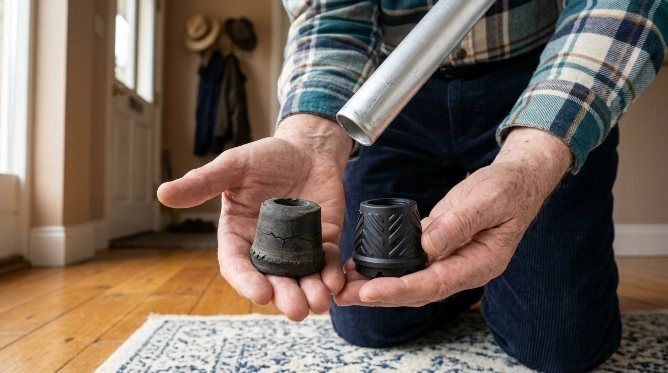
The most common ferrule mistake is continuing to use a tip after its tread has worn away. Because the change happens slowly, people can become accustomed to the declining condition.
A second mistake is buying a replacement by appearance alone. Correct shaft diameter and compatibility matter more than matching color or general shape.
- Do not use a loose ferrule: It should stay firmly seated on the cane.
- Do not ignore uneven wear: It may indicate the tip needs replacement or the cane is contacting the ground unusually.
- Do not use a bare shaft: A cane intended for a rubber tip should not be used without one.
- Do not assume new means slip-proof: Surface conditions still matter.
- Do not overlook cane height: Correct ferrule condition cannot compensate for a badly fitted cane.
- Do not modify unfamiliar systems: Proprietary pivoting feet may require specific replacement parts.
Cane height deserves special attention. Guidance for conventional canes commonly places the handle around wrist level when standing upright with the arm relaxed.
As of 2026, the basic maintenance message from mobility and falls-prevention guidance remains consistent: keep the rubber contact point in good condition and replace it when worn.
Check the ferrule more often if the cane gets heavy daily use. A 10-second inspection can reveal bald tread, cracks, stones, dirt, or a loose fit before your next walk.
Frequently Asked Questions
Is a walking cane ferrule the same as a cane tip?
Usually, yes. For everyday mobility canes, “ferrule,” “cane tip,” “rubber tip,” and “rubber foot” often describe the replaceable part fitted over the lower end of the cane.
How often should I change a cane ferrule?
There is no universal schedule. Inspect it regularly and replace it when the tread is worn, the rubber is split, the base becomes uneven, or the ferrule no longer fits securely.
How do I know what size ferrule I need?
Remove the old tip and measure the outside diameter of the cane shaft where the replacement will sit. Match that measurement to the replacement manufacturer’s stated fitting size.
Can I put any rubber cane tip on my walking cane?
No. The ferrule must match the cane’s shaft diameter and fitting design. Pivoting, threaded, and specialty cane feet may require model-specific parts.
Why is my ferrule wearing down on one side?
Some uneven wear can occur from the angle at which the cane meets the ground. Significant or rapid one-sided wear is worth discussing with a physiotherapist, especially if the cane also feels unstable.
Can a worn ferrule increase the chance of slipping?
Yes. The ferrule provides the cane’s main gripping surface, so worn tread, cracks, or damage can reduce its effectiveness. Replace damaged tips rather than waiting for complete failure.
Are wider cane ferrules always safer?
Not automatically. A wider footprint can provide more ground contact, but suitability depends on the user, cane design, walking technique, and environment. More support may require a different mobility aid rather than simply a larger ferrule.
Final Takeaway
A walking cane ferrule may be inexpensive and easy to overlook, but it is one of the cane’s most important working parts. It provides the contact between your walking aid and the ground.
Check the tread, fit, shape, and condition regularly. Replace the ferrule when it becomes smooth, cracked, loose, badly uneven, or worn through.
Choose a replacement by measuring the cane shaft rather than guessing. If the cane still feels unstable after replacing the ferrule, have the complete walking aid and your technique assessed by a qualified professional.
In short, treat the ferrule like the sole of a good walking shoe. When the grip is gone, it is time for a fresh one.
