
Walking Cane Base Explained: Types, Stability, and How to Choose


Puzzle Book for Seniors

Digital Blood Pressure Monitor

Heated Blanket
Quick Answer
A walking cane base is the part at the bottom of the cane that contacts the floor. Single-point bases are light and easy to move, while tripod, pivot-style, and quad bases create a wider footprint for additional stability. Your best choice depends on your balance, walking pattern, surroundings, and how much support you need; proper cane use and fitting matter just as much as base size.
Walking cane base types at a glance
- Single-point base: Compact, light, and easy to position for people who need modest support.
- Wide replacement base: Adds floor contact without using a traditional metal quad frame.
- Tripod base: Uses three contact points for a wider footprint and added stationary stability.
- Small quad base: Uses four feet while remaining relatively manageable in tighter spaces.
- Large quad base: Creates a broad support area but requires more room and deliberate positioning.
Before changing your base
- Make sure the replacement is compatible with your cane, fits securely, and matches your mobility needs.
A walking cane may look simple, but the part touching the floor has a major effect on how the cane feels during each step. That small detail can change maneuverability, grip, and how carefully you need to position the cane.
In this 2026 guide, I’ll explain what each walking cane base does, where different designs work best, and what to check before replacing one.
In This Guide
- What Is a Walking Cane Base?
- What Types of Walking Cane Bases Are Available?
- Which Walking Cane Base Is Most Stable?
- How Do You Choose the Right Cane Base?
- How Do You Fit a Replacement Cane Base?
- How Should a Cane Base Be Used on Different Surfaces?
- When Should You Replace a Cane Base or Tip?
- Walking Cane Base FAQ
- Final Takeaway
What Is a Walking Cane Base?
A walking cane base is the bottom portion of the cane that makes contact with the walking surface. It may consist of one rubber tip, several flexible contact points, or a larger three- or four-foot frame.
The base helps transfer force from your hand and cane shaft to the ground. It also affects traction and the size of the cane’s support footprint.
Simple definition: A walking cane base is the floor-contact system at the bottom of a cane. Its design affects grip, footprint, maneuverability, and how the cane must be positioned before you place weight through it.
Is the cane base the same as the cane tip?
Not always. A standard single-point cane usually ends in one replaceable rubber tip, sometimes called a ferrule.
A multi-point cane may instead have a complete base assembly. Each individual foot on that assembly can also have its own rubber tip.
Why does the base matter?
A wider base gives the cane more contact area with the floor. That can make the cane easier to keep upright while standing or moving slowly.
There is a trade-off. A larger base takes up more room beside your foot and requires more careful placement.
- Floor contact: The base determines how many points touch the ground.
- Traction: Rubber tips help the cane grip suitable walking surfaces.
- Maneuverability: Compact bases are generally easier to swing and reposition.
- Standing stability: Multi-point bases create a wider support footprint.
- Clearance: Larger bases need more space around furniture, doorways, and feet.
The World Health Organization’s assistive technology guidance also emphasizes that mobility products should suit the individual and support safe, functional independence.
What Types of Walking Cane Bases Are Available?

The main designs are single-point, widened replacement, tripod, and quad bases. They provide different combinations of support and freedom of movement.
One point is worth clearing up first. An offset cane describes the shape and alignment of the shaft and handle, not necessarily the type of base.
1. Single-point cane base
This is the familiar rubber tip found on many straight and offset canes. Only one point contacts the floor.
It has the smallest footprint. That makes it easy to place beside your foot, move through narrow spaces, and use with a more natural walking rhythm.
A single-point cane is generally intended for someone who needs limited balance or weight-bearing assistance rather than maximum support.
2. Wide or pivot-style replacement base
Some canes use a wider rubber base with several lobes or contact areas. Certain designs flex or pivot while the cane shaft changes angle.
This style sits between a standard tip and a traditional quad frame. It can provide a broader footprint without making the cane as bulky as a large quad cane.
Don’t assume every wide base fits every cane. Shaft diameter, attachment design, and manufacturer compatibility matter.
3. Tripod cane base
A tripod base has three feet or contact points. The three-point pattern creates a larger support area than a standard single tip.
Tripod designs can be useful when more stationary stability is desired but a full four-foot base feels cumbersome.
4. Small quad cane base
A small quad cane uses four feet arranged around the lower shaft. Its footprint is wider than a single-point cane but more compact than a large quad.
This design can be a practical middle ground for someone who needs more support while still navigating normal indoor spaces.
5. Large quad cane base
A large quad base spreads four feet across a wider area. Among common cane designs, it usually provides the broadest stationary support footprint.
The drawback is size. It can be slower to reposition and more awkward around narrow stair treads, chair legs, and tight corners.
| Base Type | Ground Points | Footprint | Maneuverability | Typical Use |
|---|---|---|---|---|
| Single point | 1 | Small | High | Mild support and everyday walking |
| Wide/pivot replacement | Varies by design | Small to medium | Moderate to high | Broader contact without a large frame |
| Tripod | 3 | Medium | Moderate | Added stationary support |
| Small quad | 4 | Medium | Moderate | More support with manageable size |
| Large quad | 4 | Large | Lower | Greater stationary support needs |
Section Takeaway: A wider cane base generally gives you a larger support footprint, but it also occupies more space and can slow repositioning. The best design balances support with the way you actually walk.
Which Walking Cane Base Is Most Stable?
A large quad base generally provides the widest stationary support area among common walking canes. A single-point base provides the smallest.
That doesn’t mean a large quad cane is automatically right for everyone. Stability during standing is only one part of safe walking.
The American Academy of Family Physicians notes that quadripod canes provide a larger base of support than standard or offset canes. Their four legs can also allow the cane to stand independently.
Why isn’t the biggest base always better?
A bigger base must clear your feet as you step. It also needs enough flat space for the contact points to sit correctly.
For someone who walks relatively quickly and only needs mild assistance, an oversized base may feel cumbersome. A smaller design may fit the person’s gait better.
- Single-point: Easier to swing and place quickly.
- Small quad: Adds support without the widest possible frame.
- Large quad: Favors stationary support over compactness.
- Pivot base: May offer a compromise between floor contact and movement.
One detail I pay close attention to is foot clearance. A base that repeatedly catches your shoe or furniture isn’t a good match simply because it looks more stable.
Safety note: If you have frequent falls, major weakness, severe balance problems, or need heavy support through the device, ask a doctor or physical therapist whether a cane provides enough support. A walker or another mobility aid may be more appropriate.
How Do You Choose the Right Cane Base?
Choose a cane base by matching the support you need with your gait, home layout, typical surfaces, and ability to position the cane correctly. Don’t select a base by width alone.
Start with the amount of support you need
A single-point cane may work when you need a modest amount of balance assistance. Multi-point designs provide a larger base for people who need more stability.
The Cleveland Clinic’s cane guidance describes single-point and multi-point options and recommends choosing the type and fit with help from a healthcare provider when needed.
Consider where you walk most often
- Small rooms: A compact single-point or smaller base provides easier clearance.
- Wide indoor spaces: Small quad and other multi-point bases may be easier to accommodate.
- Outdoor pavement: Focus on secure, unworn rubber contact surfaces.
- Uneven terrain: Don’t assume a wider base makes rough ground safe; every contact point still needs dependable placement.
- Stairs: Large bases can be difficult to position on narrow treads.
Think about your walking rhythm
A cane works as part of your gait. You must move it, place it, establish contact, and then continue your step.
If the base feels too bulky to position consistently, its theoretical stability may not translate into comfortable everyday use.
Check whether you need a self-standing cane
Many quad canes and some wide-base canes can stand without being leaned against furniture. This can be useful when you’re sitting at a table or reaching for something.
Self-standing doesn’t mean tip-proof. A bump, sloped surface, soft carpet, or poor placement can still knock a cane over.
Make sure the entire cane fits correctly
Base choice can’t compensate for a badly adjusted cane. When standing upright with your arms relaxed, the handle is generally adjusted around wrist level, leaving the elbow slightly bent.
Proper height helps you use the base without excessive leaning. It also makes the cane easier to position beside you.
How Do You Fit a Replacement Cane Base?
A replacement base must match the cane shaft and attachment system securely. A loose, improvised, or poorly fitting tip can move unexpectedly under load.
Measure the cane, not the old worn rubber
If your cane uses a removable rubber tip, remove it according to the manufacturer’s instructions. Measure across the outside diameter of the bare shaft.
Use that measurement to find the correct replacement specification. Check the cane manufacturer’s instructions whenever possible.
Follow these replacement steps
- Inspect the shaft: Check the lower cane for cracks, bending, corrosion, or damage.
- Remove the existing tip: Follow the cane maker’s instructions and avoid damaging the shaft.
- Measure carefully: Confirm the shaft diameter and required base connection.
- Check compatibility: Make sure the new base is designed for that cane or shaft size.
- Install it fully: The base should sit firmly without unwanted twisting or looseness.
- Test on a level surface: Apply light pressure first before returning to normal use.
Don’t force an undersized rubber tip onto a cane. Don’t use tape or makeshift spacers to compensate for an oversized base.
Some multi-point bases are part of the cane’s structure rather than a simple accessory. In that case, replacing the complete cane or manufacturer-approved assembly may be safer than modifying it.
How Should a Cane Base Be Used on Different Surfaces?
The base should make secure contact before you rely on the cane. With a quad cane, all four tips should contact the supporting surface before you put significant weight through it.
Smooth indoor floors
Check that rubber tips are clean and still have useful tread. Dust, water, and worn rubber can reduce dependable contact.
Keep floors dry and remove loose rugs or cords from regular walking routes.
Carpet
Thick or soft carpet can change how a multi-point base sits. Place the cane carefully rather than assuming every foot has settled evenly.
Watch transitions between carpet and hard flooring. Those edges can change the angle of the cane base.
Outdoor pavement
Look for cracks, gravel, leaves, wet patches, and uneven slabs. A multi-point base still depends on solid placement.
A wider footprint isn’t a substitute for watching the surface ahead.
Stairs and curbs
Stairs deserve extra care because the available surface is smaller. Large quad bases may be difficult to fit completely on narrow treads.
For a typical cane, MedlinePlus advises going up with the stronger leg first. When descending a step, the cane goes down before the weaker leg, followed by the stronger leg.
If you use a multi-point cane, make sure the base can be positioned as directed for that device. Ask a physical therapist to demonstrate stairs if you’re uncertain.
Safety note: Don’t balance a quad base with some feet hanging over the edge of a stair. If the device can’t be positioned securely, get professional instruction for a safer method.
When Should You Replace a Cane Base or Tip?
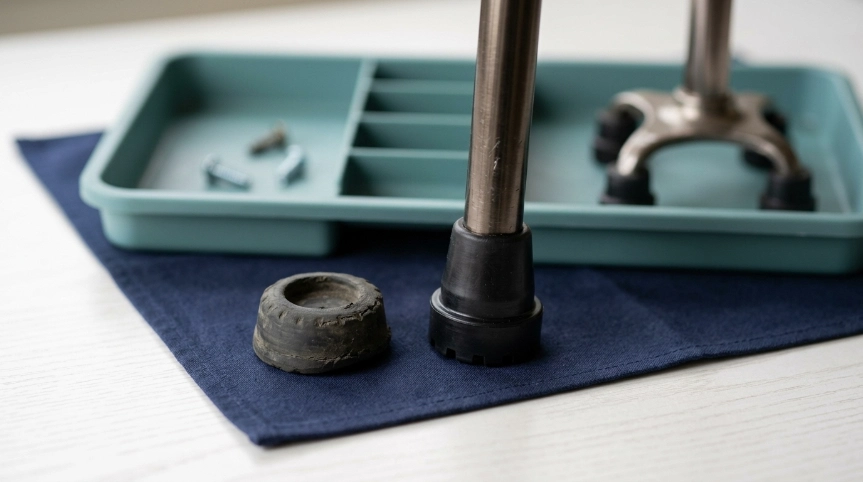
Replace a cane tip or base when it becomes worn, damaged, loose, uneven, or unable to maintain secure contact. Waiting until the rubber fails completely creates an avoidable risk.
MedlinePlus recommends checking cane tips regularly and replacing worn tips. I find a quick visual check is easiest to remember when it becomes part of your normal routine.
Look for these warning signs
- Worn tread: The rubber pattern has become smooth or flattened.
- Uneven wear: One side is noticeably thinner than another.
- Cracks: Rubber has split around the sides or bottom.
- Hardening: An older tip feels less flexible than it once did.
- Looseness: The base twists, rocks, or slides on the shaft.
- Missing feet: A quad or tripod base has a damaged or absent tip.
- Exposed material: Metal or hard structural material is contacting the floor.
Check the rest of the cane too
Don’t stop at the base. Inspect height-adjustment buttons, locking collars, the shaft, and handle.
A new rubber tip cannot correct a loose adjustment mechanism or damaged shaft.
The broader MedlinePlus mobility aid resource is useful if your support needs have changed and you’re wondering whether a different mobility device may now be appropriate.
Walking Cane Base FAQ
Is a wider cane base always safer?
No. A wider base provides a larger support footprint, but safe use also depends on correct fit, gait, floor conditions, and proper placement. A base that is too bulky for your walking style can be awkward to position and may interfere with your feet.
Can I put a quad base on a regular cane?
Only if the replacement base is specifically compatible with the cane’s shaft diameter and design. Some supportive replacement bases are made for standard shafts, while traditional quad canes use a dedicated structural base. Follow the manufacturer’s compatibility instructions.
What is the difference between a quad cane and a self-standing cane?
A quad cane has four feet arranged on a structural base. A self-standing cane may use a smaller widened or flexible replacement base instead. Both may stand independently on suitable level surfaces, but their footprint, weight, and walking behavior can differ.
Is a quad cane better than a single-point cane?
They serve different needs. A quad cane provides a broader support area, while a single-point cane is lighter and easier to maneuver. The better match depends on how much assistance you need and whether you can position the device correctly during walking.
Can a large quad cane be used on stairs?
Stairs can be difficult because a large base needs enough room for proper contact. Never rely on a partially supported base. If stairs are part of your routine, ask a physical therapist to show you a technique appropriate for your cane and mobility needs.
How often should I inspect my cane base?
A quick check before regular use is sensible, especially if you walk outdoors frequently. Look for worn tread, cracks, loose parts, uneven feet, or debris. Replace damaged components according to the manufacturer’s instructions rather than waiting for complete failure.
Final Takeaway
A walking cane base affects much more than whether the cane can stand by itself. It changes the cane’s footprint, movement, floor contact, and the amount of space needed for each step.
Single-point bases offer compact movement. Tripod, wide, and quad bases create progressively different support footprints, with large quad designs favoring stationary stability over easy maneuverability.
- Choose for your needs: Match the base to your balance and walking pattern.
- Check the environment: Think about stairs, narrow rooms, carpet, and outdoor surfaces.
- Confirm the fit: Replacement bases must securely match the cane.
- Inspect the rubber: Replace worn, cracked, or loose tips.
- Get help when needed: A doctor or physical therapist can determine whether a cane provides enough support.
If your balance or strength has changed, don’t simply keep making the base wider. Reassessing the complete mobility aid can be a better next step.
