
Walking Cane Parts Explained: Complete Anatomy and Functions


Motion Sensor Night Lights

Mattress Topper Memory Foam

Non-Slip Slippers
Quick Answer
A walking cane is built from several simple parts that work together for support, comfort, adjustment, and traction. The main components are the handle or grip, shaft, adjustment mechanism, collar, and ground-contact tip or ferrule. Some models also include wrist straps, folding joints, shock absorbers, or multi-point bases. For basic fitting and safety guidance, see the Mayo Clinic guide to choosing and using a cane.
Main Walking Cane Parts
- Handle: Gives your hand a stable place to hold and control the cane.
- Grip: Adds cushioning and helps reduce slipping inside your hand.
- Shaft: Forms the main structural body and carries force toward the floor.
- Adjustment system: Changes cane height on adjustable models.
- Ferrule or tip: Contacts the ground and provides traction.
- Optional components: Wrist straps, folding joints, quad bases, lights, or shock absorbers appear on specialized canes.
Walking canes look simple, but every part has a job. Once you know the names of those parts, choosing replacement tips, adjusting height, and spotting wear becomes much easier.
I like to examine a cane from the hand down to the floor. That approach makes its construction easy to understand, whether you’re looking at a basic wooden cane or a modern folding model.
In This Guide
- What are the main parts of a walking cane?
- What is the handle and grip of a cane?
- How do the shaft and adjustment parts work?
- What is the rubber part on the bottom of a cane called?
- What extra parts appear on folding and specialty canes?
- Which walking cane parts can be replaced?
- How should you inspect walking cane parts?
- How do cane parts affect fit and safety?
- Frequently asked questions
What Are the Main Parts of a Walking Cane?
The basic anatomy of a walking cane includes a handle, grip, shaft, and tip. Adjustable canes add hardware that lets the shaft extend or shorten.
A useful way to define the tool is simple: a walking cane is a handheld mobility aid that transfers some support from the user’s hand through a rigid shaft to the ground.
Basic cane anatomy from top to bottom
- Handle: The upper section held by the user.
- Grip: The material or shaped surface around the handle.
- Wrist strap: An optional loop attached near the handle.
- Upper shaft: The main structural tube or wooden stem.
- Adjustment button: A spring-loaded pin used on many adjustable canes.
- Adjustment holes: Positions that determine cane height.
- Locking collar: Tightens around telescoping sections to reduce movement and rattling.
- Lower shaft: The section extending toward the floor.
- Ferrule or cane tip: The replaceable ground-contact component.
Not every cane contains every item. A one-piece wooden walking stick, for example, may have only a handle, shaft, and rubber tip.
Adjustable aluminum canes have more hardware because two shaft sections must lock securely together.
| Cane Part | Main Job | Common Materials |
|---|---|---|
| Handle | Hand support and control | Wood, plastic, metal, foam |
| Shaft | Structural support | Aluminum, wood, carbon fiber |
| Adjustment mechanism | Changes and locks cane height | Metal and plastic |
| Ferrule or tip | Traction and floor contact | Rubber or synthetic compounds |
What Is the Handle and Grip of a Cane?
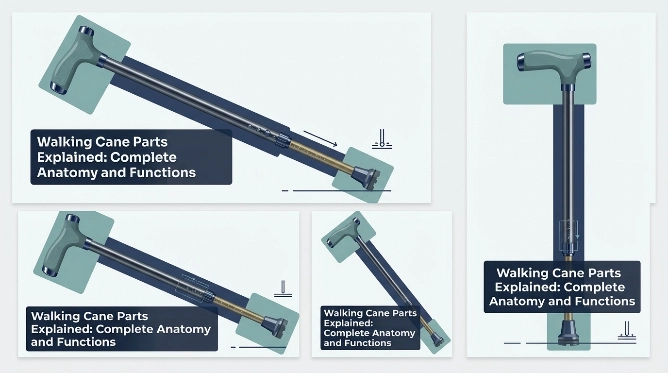
The handle is the upper structural portion of the cane. The grip is the surface your hand contacts, although people often use the two words interchangeably.
Handle design matters because it influences hand position and how easily you can control the cane.
Common walking cane handle types
- Derby handle: A curved, gently sloping handle commonly seen on everyday canes.
- Offset handle: Positions the hand over the shaft for a more centered loading point.
- Fritz handle: Uses a flatter shape that some people find easier to grasp.
- Crook handle: Forms the traditional hook shape seen on classic walking sticks.
- Ergonomic handle: Uses contours designed around the hand and palm.
Grip materials also vary. Foam feels soft but can compress or tear, while molded rubber tends to resist moisture better.
Hard plastic and wood last well but provide less cushioning. The most comfortable choice depends on hand size, grip strength, and how long the cane is used.
What does a wrist strap do?
A wrist strap keeps the cane close when you briefly release the handle. It can be handy while opening a door or reaching for something.
It should not replace a secure grip during walking. A damaged or stretched strap is normally easy to replace.
Section Takeaway: The handle controls the cane, while the grip controls how the handle feels in your hand. Comfort matters, but secure control matters more.
How Do the Shaft and Adjustment Parts Work?
The shaft is the long structural body between the handle and tip. It carries the force applied through the handle toward the floor.
Traditional canes may use one solid piece of wood. Modern adjustable models commonly use telescoping metal tubes.
Upper and lower shaft sections
A telescoping cane usually has a larger upper tube and a narrower lower tube. The lower section slides inside the upper section to change overall height.
Small adjustment holes run along one section. A spring-loaded metal button pops through the selected hole.
What is the cane adjustment button called?
You may see it described as a spring button, push button, snap button, or height-adjustment pin. Its job is to prevent the shaft from sliding once the height is selected.
The button should extend fully through its adjustment hole. A partly engaged button can leave the shaft feeling loose.
What does the locking collar do?
The collar is the threaded ring around many adjustable canes. After setting the height, you tighten it around the telescoping joint.
The collar usually reduces movement and rattling between the tubes. The adjustment button remains the main positive locking point on designs that use both parts.
What is inside a folding cane?
Many folding canes have several short shaft sections linked by an internal elastic cord. The cord pulls the sections together when you unfold the cane.
The joints must still seat completely before use. The elastic cord organizes the sections; it should not be viewed as the structural support by itself.
Section Takeaway: The shaft provides structure, while the button, holes, collar, and joints keep an adjustable or folding cane at its intended length.
What Is the Rubber Part on the Bottom of a Cane Called?
The rubber part touching the floor is usually called the cane tip or ferrule. It is one of the most important wear items on the entire cane.
Its job is to provide traction, soften ground contact, and protect the end of the shaft.
Why does the ferrule wear out?
Every step presses and twists the tip against the floor. Over time, the tread can flatten and the rubber can become hard, cracked, or uneven.
MedlinePlus guidance on using a cane recommends checking cane tips and replacing worn ones.
Are all replacement cane tips the same size?
No. Replacement tips must match the outside diameter of the lower cane shaft.
Measure the shaft itself rather than assuming the size from the cane’s overall height. The replacement tip should fit firmly without rocking or sliding off.
Standard tip versus pivoting tip
- Standard tip: A simple rubber ferrule with one ground-contact point.
- Wide-base tip: Uses a broader footprint for a different feel on the floor.
- Pivoting tip: Flexes or angles as the cane moves through the walking cycle.
- Multi-foot tip: Uses several small contact points in one assembly.
A larger tip changes the way a cane feels. It may also add weight to the lower end, so bigger is not automatically better.
Section Takeaway: The ferrule is a consumable safety component. Check its tread, hardness, cracks, and fit instead of waiting for it to fail completely.
What Extra Parts Appear on Folding and Specialty Canes?
Specialized walking canes add components beyond the traditional handle, shaft, and ferrule. These parts support a particular type of storage, terrain, or user preference.
Folding cane joints
Folding canes divide the shaft into several sections. Metal or reinforced joint ends allow those sections to fit together when opened.
A worn joint may create noticeable movement between segments. That is different from normal flexibility in the shaft.
Quad cane base
A quad cane replaces the single lower tip with a metal base and multiple rubber feet. This creates several ground-contact points.
Quad canes can provide more support than a standard single-tip design, but they also feel different when moved. MedlinePlus describes single-tip and four-prong canes as two common cane categories.
Shock-absorbing section
Some modern canes place a spring or flexible mechanism near the lower shaft. Manufacturers may market this as a shock-absorbing feature.
Any moving mechanism should remain tight and predictable. Excessive play deserves attention.
Ice attachment
Some canes accept a removable ice-grip attachment near the bottom. These accessories normally use small metal points for icy outdoor surfaces.
They must be positioned correctly for the surface in use. Metal points can be hazardous on normal indoor flooring.
Lights, alarms, and accessory mounts
Modern canes sometimes include LED lights, reflectors, storage clips, or emergency alarms. These accessories do not replace the main structural parts.
If an accessory fails but the structural cane remains intact, the cane may still function mechanically. Assess the model’s instructions before removing integrated parts.
Which Walking Cane Parts Can Be Replaced?
The rubber tip is the most commonly replaced walking cane part. Grips, straps, collars, and some specialty components may also be replaceable.
Structural shaft damage is different. Replacing the entire cane may be more appropriate when its main load-bearing section bends, cracks, or develops serious joint damage.
| Part | Typical Wear Sign | Common Response |
|---|---|---|
| Rubber ferrule | Flattened tread, cracks, hardness | Replace with correct size |
| Foam grip | Tears, twisting, compression | Replace if compatible |
| Wrist strap | Fraying or broken attachment | Replace strap |
| Adjustment collar | Cracking or inability to tighten | Use manufacturer-compatible part |
| Adjustment button | Sticking or incomplete engagement | Stop using until corrected |
| Shaft | Bend, crack, severe corrosion | Usually replace the cane |
Compatibility matters. A generic accessory may look correct while fitting poorly on a particular shaft or handle.
When possible, check the cane manufacturer, model number, shaft diameter, and original part specification before ordering replacements.
How Should You Inspect Walking Cane Parts?
A quick inspection can reveal problems before a normal walk. I would start at the handle and work downward so no component gets overlooked.
- Test the handle: Make sure it does not rotate, crack, or separate from the shaft.
- Check the grip: Look for loose foam, splits, or slippery surfaces.
- Inspect the adjustment pin: Confirm that it extends fully through its hole.
- Tighten the collar: It should sit securely without damaged threads.
- Examine the shaft: Look for bends, cracks, severe dents, or corrosion.
- Check folding joints: Each section should seat fully before weight is placed on the cane.
- Inspect the tip: Look for worn tread, cracks, uneven wear, or looseness.
- Test the whole cane: Place it on a dry, level surface and check for unexpected movement.
If the cane suddenly feels different, investigate the reason rather than simply adapting to it. New clicking, slipping, wobbling, or collapsing deserves immediate attention.
The National Institute on Aging’s fall-prevention resources also stress the importance of using appropriate mobility aids correctly when extra stability is needed.
Section Takeaway: Inspect from the handle to the ground. Loose locking hardware and a worn ferrule deserve particular attention because both can change how the cane behaves.
How Do Cane Parts Affect Fit and Safety?

A perfectly good cane can still be uncomfortable when adjusted to the wrong height. The handle, shaft adjustment, and ferrule all influence the final working height.
Changing to a substantially different tip can even alter the cane’s effective height slightly. Recheck the fit after changing major lower-end components.
Why handle height matters
When standing naturally, a properly fitted cane generally allows a slight bend at the elbow. The handle should also sit around wrist level when the arm hangs at the side.
For personalized fitting, a physical therapist or other qualified healthcare professional can evaluate the cane alongside your gait and support needs.
Which hand should hold the cane?
For many people using a cane to assist one weaker or painful leg, common clinical guidance is to hold the cane on the opposite side. That pattern lets the cane move with the affected leg.
Individual circumstances can differ. Follow the technique recommended by your healthcare professional when recovering from surgery, injury, or a neurological condition.
When might a cane not provide enough support?
A cane provides less support than many walkers and other larger mobility aids. Someone with major weakness or significant balance difficulty may need a different device.
MedlinePlus explains several types of mobility aids, including canes, crutches, walkers, wheelchairs, and scooters.
Safety note: A cane is a mobility aid, not a substitute for medical assessment. New falls, worsening weakness, dizziness, or major balance changes should be discussed with an appropriate healthcare professional.
Section Takeaway: The individual parts cannot compensate for poor fit. A sound cane still needs the right height, technique, and level of support for the person using it.
Frequently Asked Questions About Walking Cane Parts
What are the basic parts of a walking cane?
The basic parts are the handle or grip, shaft, and ground-contact tip. Adjustable canes normally add telescoping shaft sections, adjustment holes, a spring-loaded button, and often a locking collar.
What is the bottom of a walking cane called?
The bottom rubber component is commonly called a cane tip or ferrule. It provides traction and protects the lower end of the shaft. Because it contacts the ground repeatedly, it is also one of the parts most likely to need replacement.
What is the ring on an adjustable cane called?
The ring around the telescoping shaft is generally called a locking collar or adjustment collar. It tightens around the shaft connection and can reduce looseness or rattling after the desired cane height has been selected.
What is the small metal button on a cane called?
It is commonly called a spring button, snap button, push button, or adjustment pin. It pops through one of several holes in the shaft and locks an adjustable cane at the selected height.
Can you replace the rubber bottom of a cane?
Yes. Rubber cane tips are commonly replaceable. Measure the outside diameter of the lower shaft and choose a tip designed for that size. A replacement should fit tightly and should not twist or slide off during normal use.
Can a walking cane handle be replaced?
Sometimes. Replacement depends on how the handle is attached and whether compatible parts are available. On one-piece wooden canes or models with permanently integrated handles, replacing the entire cane may be more practical than rebuilding the handle.
How often should cane parts be checked?
Give the cane a quick visual check regularly and inspect it whenever its feel or sound changes. Pay particular attention to the rubber tip, height-adjustment button, locking collar, folding joints, and handle attachment.
Final Takeaway
Walking cane parts are easier to understand once you divide the cane into three zones: the hand-contact area, the structural shaft, and the ground-contact area. Handles and grips provide control, the shaft carries support, and the ferrule provides traction.
Adjustable and folding models simply add more hardware between those basic sections. Knowing what each component is called makes maintenance, replacement shopping, and troubleshooting much simpler.
As of 2026, cane designs range from basic one-piece sticks to folding, quad-base, ergonomic, and accessory-equipped models. Whatever the design, inspect its structural and ground-contact parts regularly and use a cane that fits your individual mobility needs.