
Walker vs Scooter: Which Is Better for Seniors?


Anti-Glare Reading Glasses

Smart Health Watch for Seniors

Book Holder Stand
A Walker vs Scooter choice often comes down to one simple question: does the person still want to walk, or do they need to travel while seated? A walker gives support while walking. A mobility scooter lets a person move while seated. Both can help with daily mobility, but they solve different problems.
For many seniors, a walker makes sense for short trips around the home or other places where walking is still comfortable. A scooter can make more sense when walking for longer distances is hard. The right choice depends on strength, balance, distance, home space, and how the device will be used.
Quick Comparison
There is no single winner here. A walker is better for supported walking, while a scooter is better for seated travel.
If the main goal is to stay on your feet and get support while walking, a walker is the more direct choice. If walking is too tiring or limited for longer trips, a scooter may offer more useful mobility.
The key difference is simple: a walker supports walking, while a scooter provides seated mobility.
Walker vs Scooter At a Glance
Here is the main difference in a simple view.
| Feature | Walker | Scooter |
|---|---|---|
| Main use | Supported walking | Seated mobility |
| Physical effort | More | Less walking effort |
| Indoor use | Often very practical | Depends on size and space |
| Longer trips | Can be tiring | Often more suitable |
| Storage | Usually easier | Needs more space |
| Power | No battery needed | Battery powered |
| Learning curve | Usually simple | Requires controls and steering |
| Best fit | People who can walk with support | People who need seated mobility |
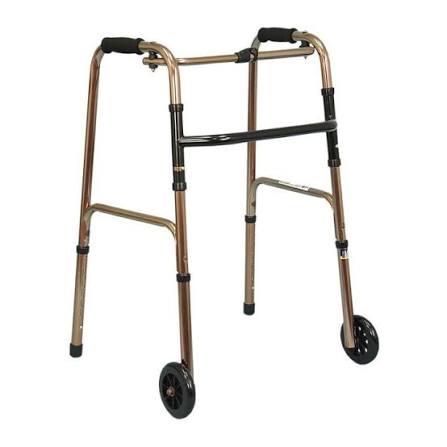
A walker can have no wheels, two wheels, or four wheels. Some models also have brakes, a seat, or a basket.
Walker Review for Senior Mobility
A walker is a simple aid for people who still want or need to walk. It can give support during short trips and may help a person feel more steady.
The main benefit is direct contact with the ground. There is no battery to charge. There is no motor to control. A walker can also be easier to store and carry than many scooters.
Ease of Use
Walkers are often simple to understand.
A person may need to lift, push, or guide the walker. The exact effort depends on the walker type. A wheeled walker can reduce the need to lift the frame.
Fit is important. MedlinePlus notes that walkers should be fitted correctly. A poor fit can make a mobility aid unsafe or uncomfortable.
Key Strengths
- Simple design
- No charging
- Useful for short trips
- Easy to keep close by
- Can provide walking support
- Some models offer a seat or storage
Potential Drawbacks
- Requires the user to keep walking
- May be tiring on longer trips
- Can take up space in narrow areas
- Some types require more upper-body effort
- Poor fit can reduce comfort and safety
Scooter Review for Senior Mobility
A mobility scooter takes a very different approach. The user sits and controls the scooter rather than walking with it.
This can be useful for people who can sit safely and control the device but find longer walking hard. MedlinePlus lists motorized scooters as mobility aids and notes that scooters may help when a person cannot walk because of injury or disease.
Ease of Use
A scooter removes much of the walking effort. That can be a major benefit on longer trips.
But a scooter has more to learn. The user must steer and use the controls. The user also needs enough control and awareness to operate it safely.
The size matters too. A scooter may be harder to use in a small room or narrow hallway than a compact walker.
Key Strengths
- Seated travel
- Less walking effort
- Useful for longer trips
- Can support greater travel range
- Helpful when standing or walking is limited
Potential Drawbacks
- Needs battery charging
- Takes more storage space
- Requires steering and control skills
- Can be harder to transport
- May not suit every home
- Adds battery and electrical maintenance
Which Is Easier for Seniors to Use?
The answer depends on the person’s ability and where the device will be used.
A walker may be easier for someone who has good enough strength and balance to walk but wants extra support. It can also be practical around the home.
A scooter may be easier for someone who struggles with longer walks but can safely sit and use the controls.
A walker does require physical effort. A scooter reduces walking effort, but it adds another task: steering and controlling a powered device.
For either choice, correct fit and safe use matter. The National Institute on Aging recommends getting help from a health or physical therapy professional when choosing and learning to use a mobility aid.
Performance Comparison
The two devices perform different jobs, so distance and walking ability matter more than raw speed.
A walker is made for supported walking. It works well for moving from room to room, getting around a home, or taking short walks.
A scooter is made for seated travel. It can be useful when walking longer distances is difficult.
| Performance Area | Walker | Scooter |
|---|---|---|
| Short indoor movement | Strong fit | Depends on space |
| Longer travel | More tiring | Better suited |
| Walking support | Yes | No |
| Seated travel | Some models | Yes |
| Physical walking effort | Higher | Lower |
| Tight spaces | Often easier | Can be harder |
So, the better device depends on the task. A scooter should not be viewed as a powered version of a walker. It serves a different purpose.
Comfort, Accessibility, and Senior-Friendly Design
Comfort starts with the person’s needs.
A walker keeps the person standing and walking. This may be useful for someone who wants walking support and can safely walk.
A scooter provides a seat. That may be more comfortable for longer trips. But the person must be able to sit safely and operate the controls.
Storage is another major difference. A walker is usually easier to place beside a chair, bed, or doorway. A scooter needs more room.
Think about the space first. A device that works well outdoors may be awkward inside a small home.
Features Comparison
The useful features are not the same for both devices.
| Feature | Walker | Scooter |
|---|---|---|
| Seat | Some models | Standard design |
| Basket/storage | Some models | Often available |
| Brakes | Common on wheeled types | Motorized braking system varies |
| Battery | Not needed | Required |
| Folding | Available on some models | Available on some models |
| Steering control | No | Yes |
Specific features vary by model. Buyers should check the exact product before purchase.
Price, Maintenance, and Long-Term Value
A generic price winner cannot be named because walkers and scooters cover a wide range of products.
A basic walker is usually a much simpler device. It does not need a motor or battery. This can reduce ongoing maintenance.
A scooter has more parts to consider. The buyer may need to think about the battery, charger, tires, controls, and service.
Look beyond the first price.
Check:
- Replacement parts
- Battery cost
- Charger
- Warranty
- Service support
- Storage needs
- Transport needs
- Accessories
The cheaper device is not always the better value. The better value is the one that fits the person’s real daily needs.
Who Should Choose a Walker?
A walker may suit someone who:
- Can still walk but wants more support
- Mainly moves around the home
- Takes short walks
- Wants a simple device
- Does not want battery charging
- Has enough strength and balance to use it safely
- Needs an easy-to-store mobility aid
A walker may also be useful during recovery when extra walking support is needed.
Who Should Choose a Scooter?
A scooter may suit someone who:
- Finds long walks too tiring
- Needs seated mobility
- Wants to travel farther without walking the full distance
- Can safely sit for the trip
- Can understand and use the controls
- Has enough space to store and use the scooter
- Can manage charging and basic maintenance
The exact need should be discussed with a health professional when mobility problems are linked to a medical condition or major safety concern.
Walker vs Scooter Final Verdict
There is no universal winner in this comparison.
Best for supported walking: Walker
Best for seated mobility: Scooter
Best for simple daily use: Walker may be the better fit for someone who can safely walk with support.
Best for longer travel with less walking: Scooter may be the better fit for someone who can safely operate it.
The most important difference is not the number of features. It is how the person moves. A walker supports walking. A scooter replaces much of the walking with seated travel.
Scoring Summary
Because this comparison covers two different types of mobility aids, a single overall score would be misleading. A task-based view is more useful.
| Category | Walker | Scooter |
|---|---|---|
| Supported walking | 10/10 | 2/10 |
| Seated mobility | 2/10 | 10/10 |
| Simple design | 10/10 | 6/10 |
| Long-distance travel | 5/10 | 9/10 |
| Easy storage | 9/10 | 5/10 |
| No charging needed | 10/10 | 1/10 |
These are task-fit scores, not laboratory test scores. They show the different jobs each device is designed to do.
How We Evaluate Products
For this comparison, the main factors are ease of use, physical effort, accessibility, comfort, safety, storage, maintenance, and long-term practicality.
We do not treat a walker and a scooter as direct substitutes in every situation. The goal is to match the mobility aid to the person’s daily needs.
Current guidance also stresses proper fit and safe use. A physical or occupational therapist can help assess which device is suitable and teach safe use.
Senior-Specific Buying Considerations
Before choosing, check these points.
Physical Effort
Ask how much walking, pushing, lifting, or steering the user can manage.
Controls
For a scooter, make sure the controls are clear and easy to operate.
Storage
Check the space available at home. Measure doors and tight areas if needed.
Setup
A walker may need little setup. A scooter may need charging and other setup steps.
Safety
Think about balance, walking ability, steering, uneven ground, and fall risk. The National Institute on Aging advises using the correct size and learning to use mobility aids safely.
Professional Guidance
If the choice is linked to a health condition, injury, major balance problem, or fall risk, ask a doctor or physical therapist for guidance.
Common Buying Mistakes
Avoid these common errors:
- Choosing only by price
- Ignoring the user’s walking ability
- Buying a scooter without checking home space
- Ignoring storage needs
- Forgetting battery and service needs
- Choosing a walker without checking proper fit
- Buying a device that is too hard to control
A mobility aid should fit the person, not just the budget.
Safety
Safety should come before convenience.
For walkers, correct height and proper use matter. All walker tips or wheels should stay on the ground when weight is placed on the device.
For scooters, the user needs enough control to steer and operate the device safely. Powered scooters are designed for indoor and/or outdoor mobility, and safety and control systems are covered by recognized device standards.
Keep walking areas clear. Good lighting also helps. Wet, slippery, or uneven surfaces need extra care.
Conclusion
Walker vs Scooter is really a choice between two types of mobility. A walker supports a person who still wants to walk. A scooter provides seated travel for someone who needs less walking effort.
For short, supported walking, a walker may be the more practical choice. For longer trips where walking is hard, a scooter may make more sense. The best choice is the one that matches the user’s strength, balance, space, travel needs, and ability to use the device safely.