
Senior Associate Capital One Salary


Tablet for Seniors

Mattress Topper Memory Foam

Automatic Pill Dispenser
Curious about the senior associate Capital One salary? This role offers competitive pay, strong benefits, and growth opportunities in finance and tech. Salaries typically range from $90,000 to $130,000, depending on location, experience, and department.
If you’re considering a career at Capital One—or already eyeing a promotion to senior associate—you’re probably wondering: What’s the senior associate Capital One salary really like? You’re not alone. This role is one of the most sought-after in the financial services and tech space, blending analytical rigor with real-world impact. Whether you’re in credit risk, data science, product management, or software engineering, becoming a senior associate opens doors to meaningful work and solid financial rewards.
Capital One has built a reputation not just for innovation in banking, but also for investing in its people. The company treats its employees as strategic assets, offering competitive pay, robust benefits, and a culture that values growth and inclusion. As a senior associate, you’re no longer just executing tasks—you’re leading projects, mentoring junior staff, and influencing business decisions. That level of responsibility comes with a corresponding level of compensation, and understanding the full picture of your earning potential is key to making informed career choices.
In this guide, we’ll break down everything you need to know about the senior associate Capital One salary. We’ll explore base pay, bonuses, benefits, and how location and skills affect your total compensation. You’ll also get insider tips on negotiating your offer and advancing your career. Whether you’re applying for your first role or aiming for a promotion, this article will give you the clarity and confidence to succeed.
Key Takeaways
- Salary Range: Senior associates at Capital One earn between $90,000 and $130,000 annually, with variations based on role and location.
- Performance Bonuses: Most employees receive annual bonuses ranging from 10% to 25% of their base salary, tied to individual and company performance.
- Comprehensive Benefits: Capital One offers health insurance, retirement plans, tuition reimbursement, and generous PTO, enhancing overall compensation.
- Career Advancement: The company promotes from within, offering clear paths to senior manager and director roles with significant pay increases.
- Location Impact: Salaries in high-cost areas like New York or San Francisco are 15–25% higher than in other regions.
- Skill-Based Pay: Technical skills in data analysis, software development, or risk management can boost earning potential.
- Work-Life Balance: Flexible schedules and remote work options contribute to job satisfaction beyond salary.
📑 Table of Contents
Understanding the Senior Associate Role at Capital One
Before diving into numbers, it’s important to understand what a senior associate actually does at Capital One. This title isn’t just a fancy job label—it reflects a specific level of responsibility, experience, and impact within the organization.
Job Responsibilities and Expectations
Senior associates are typically mid-level professionals with 3 to 7 years of experience. They operate with a high degree of autonomy and are expected to lead projects, analyze complex data, and present findings to leadership. Depending on the department, their work might involve building machine learning models, managing credit portfolios, designing customer experiences, or improving operational efficiency.
For example, a senior associate in the data science team might develop predictive models to reduce fraud, while one in product management could be responsible for launching a new mobile banking feature. In risk management, they might assess the financial health of loan applicants and recommend policy changes. Across all roles, senior associates are expected to think strategically, communicate effectively, and deliver measurable results.
Departments That Hire Senior Associates
Capital One employs senior associates across a wide range of functions. Some of the most common areas include:
– Technology: Software engineers, data scientists, and product managers working on digital banking platforms.
– Risk Management: Analysts who evaluate credit risk, market risk, and operational risk.
– Finance: Professionals managing budgets, forecasting, and financial reporting.
– Marketing: Specialists in customer segmentation, campaign analytics, and digital advertising.
– Operations: Leaders improving customer service processes and internal workflows.
Each department has its own performance metrics and compensation structures, but the senior associate title generally signifies a step above entry-level and below managerial roles.
Career Progression Path
The senior associate role is often a stepping stone to more senior positions. With strong performance, many employees advance to roles like senior manager, director, or even vice president within a few years. Capital One is known for promoting from within, so high-performing senior associates have a clear path upward.
For instance, a senior associate in technology might become a tech lead or engineering manager, overseeing a team of developers. In finance, they could move into a finance director role, managing multi-million-dollar budgets. This upward mobility is one of the reasons why the senior associate position is so valuable—it’s not just about the current salary, but the long-term earning potential.
Senior Associate Capital One Salary: Base Pay Breakdown

Visual guide about Senior Associate Capital One Salary
Image source: thecelebritylifestyle.com
Now, let’s get to the numbers. The senior associate Capital One salary is competitive, but it varies significantly based on several factors. Understanding these can help you set realistic expectations and negotiate effectively.
Average Base Salary Range
According to data from Glassdoor, Levels.fyi, and Payscale, the average base salary for a senior associate at Capital One falls between $90,000 and $130,000 per year. This range reflects differences in role, experience, and location.
For example:
– A senior associate in a non-technical role (like marketing or operations) might earn closer to $90,000–$105,000.
– A senior associate in a technical role (like software engineering or data science) often earns $110,000–$130,000 or more.
These figures are based on self-reported data from current and former employees, so they provide a reliable snapshot of what to expect.
Factors Influencing Base Pay
Several key factors determine where your salary falls within that range:
1. Department and Role: Technical roles typically command higher salaries due to market demand. A senior associate in machine learning, for instance, may earn significantly more than one in customer operations.
2. Years of Experience: Someone with 5 years of relevant experience will likely earn more than someone with 3 years, even in the same role.
3. Education Level: Advanced degrees (like an MBA or Master’s in Data Science) can boost your starting salary, especially in competitive fields.
4. Performance History: If you’re being promoted internally, your past performance reviews and achievements will influence your new salary.
5. Internal Equity: Capital One aims to maintain fairness across teams, so salaries are adjusted to avoid large disparities between similar roles.
Real-World Salary Examples
Let’s look at a few real-world examples to illustrate how these factors play out:
– Example 1: Sarah, a senior associate in marketing with 4 years of experience in Atlanta, earns $98,000. She holds a bachelor’s degree and has consistently exceeded performance goals.
– Example 2: James, a senior software engineer in San Francisco with 6 years of experience and a master’s degree, earns $128,000. He specializes in cloud infrastructure and has led several high-impact projects.
– Example 3: Maria, a senior risk analyst in Richmond, Virginia, with 5 years of experience, earns $105,000. She recently earned a CFA certification, which helped her negotiate a higher salary.
These examples show that while the average range is helpful, individual circumstances can shift your salary up or down.
Bonuses and Variable Compensation

Visual guide about Senior Associate Capital One Salary
Image source: simplify.jobs
Base salary is just one part of the total compensation package. At Capital One, bonuses and variable pay can significantly increase your annual earnings.
Annual Performance Bonuses
Most senior associates are eligible for an annual performance bonus, typically paid out in February or March. These bonuses are based on a combination of individual performance, team success, and company-wide results.
The bonus range is usually 10% to 25% of your base salary. For example:
– A senior associate earning $100,000 could receive a bonus of $10,000 to $25,000.
– High performers in critical roles (like data science or engineering) may receive bonuses on the higher end or even above 25%.
Bonuses are not guaranteed—they depend on meeting or exceeding goals. However, Capital One has a strong track record of paying out bonuses, even in challenging economic times.
Spot Bonuses and Recognition Awards
In addition to annual bonuses, employees may receive spot bonuses for exceptional work. These are smaller, one-time payments (usually $500 to $5,000) awarded for completing a major project, solving a critical problem, or demonstrating outstanding leadership.
For example, a senior associate who leads a successful product launch ahead of schedule might receive a $3,000 spot bonus. These rewards are a great way to boost your income and get recognized for your contributions.
Long-Term Incentives (LTIs)
Some senior associates, especially in technical or leadership-track roles, may also receive long-term incentives such as restricted stock units (RSUs). These are shares of Capital One stock that vest over time (usually 3–4 years).
While not all employees receive LTIs, they can add significant value to your total compensation. For instance, a $20,000 RSU grant vesting over four years adds $5,000 per year to your total package—on top of salary and bonuses.
Benefits and Perks That Add Value
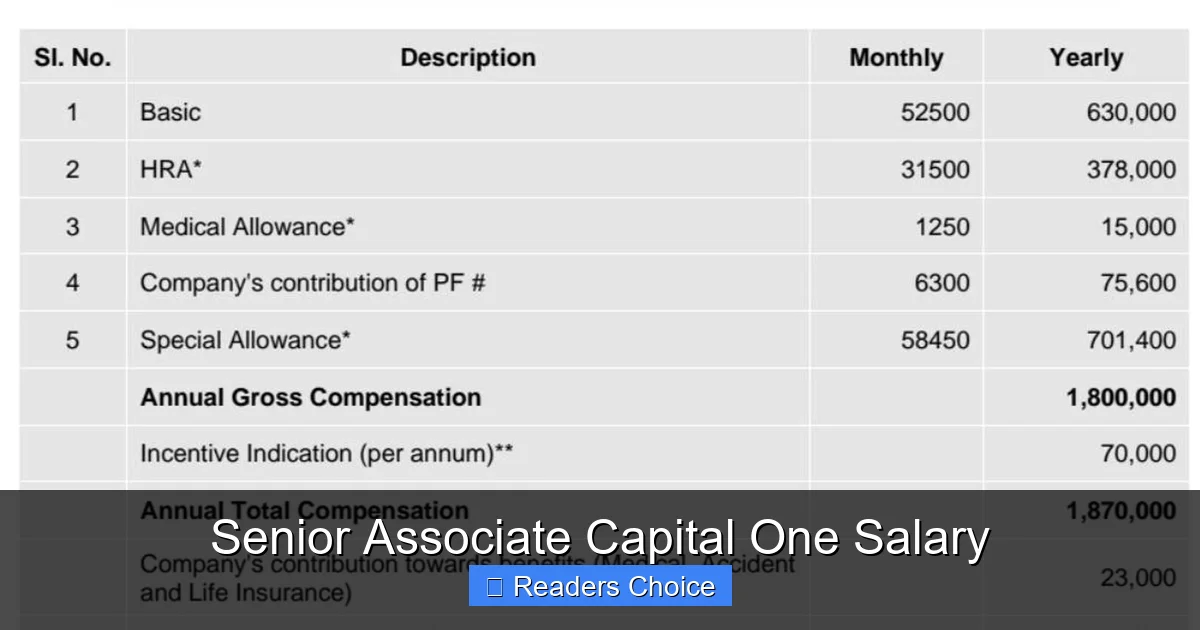
Visual guide about Senior Associate Capital One Salary
Image source: dslntlv9vhjr4.cloudfront.net
When evaluating the senior associate Capital One salary, it’s important to look beyond cash compensation. The company offers a comprehensive benefits package that can be worth tens of thousands of dollars annually.
Health and Wellness Benefits
Capital One provides excellent health insurance options, including medical, dental, and vision plans. Employees pay a low monthly premium, and the company covers a significant portion of the cost. Mental health support is also strong, with access to counseling, wellness programs, and stress management resources.
For example, a family health plan might cost the employee only $150 per month, while the company pays over $1,200—saving thousands per year.
Retirement and Financial Planning
The company offers a 401(k) plan with a generous match. Capital One matches 100% of your contributions up to 6% of your salary. If you earn $100,000 and contribute $6,000, the company adds another $6,000—free money toward your retirement.
They also provide financial planning services, student loan repayment assistance (up to $10,000 over five years), and access to financial advisors.
Time Off and Work-Life Balance
Senior associates receive generous paid time off (PTO), typically starting at 20–25 days per year, plus holidays and sick leave. The company also offers parental leave (up to 16 weeks for primary caregivers), sabbaticals, and flexible work arrangements.
Many teams support remote or hybrid work, allowing employees to live in lower-cost areas while earning competitive salaries. This flexibility is a major perk, especially for those with families or caregiving responsibilities.
Professional Development
Capital One invests heavily in employee growth. Senior associates have access to:
– Tuition reimbursement (up to $10,000 per year for approved programs)
– Internal training courses and certifications
– Mentorship programs and leadership development tracks
– Conferences and networking events
These benefits not only enhance your skills but also increase your long-term earning potential.
How Location Affects Your Salary
Where you work has a big impact on your senior associate Capital One salary. The company adjusts pay based on the cost of living and market rates in different regions.
High-Cost Cities Pay More
Employees in major metropolitan areas like New York, San Francisco, and Washington, D.C., typically earn 15% to 25% more than those in other locations. This is known as a “geographic differential.”
For example:
– A senior associate in Richmond, Virginia, might earn $100,000.
– The same role in San Francisco could pay $120,000–$130,000.
This adjustment helps ensure employees can afford housing, transportation, and other expenses in expensive cities.
Remote Work and Salary Adjustments
With the rise of remote work, Capital One has updated its policies. Some roles are now fully remote, but salaries may be adjusted based on the employee’s location.
For instance, a senior associate working remotely from Austin, Texas, might earn slightly less than one in New York, even if they’re on the same team. However, the difference is usually smaller than the cost-of-living gap, so remote workers often come out ahead financially.
Regional Examples
Here’s how salaries compare across different locations:
– Richmond, VA: $95,000–$110,000
– New York, NY: $115,000–$135,000
– San Francisco, CA: $120,000–$140,000
– Dallas, TX: $98,000–$115,000
– Chicago, IL: $105,000–$120,000
These ranges reflect both base salary and typical bonuses.
Negotiating Your Senior Associate Offer
If you’re offered a senior associate role at Capital One, don’t hesitate to negotiate. The company expects it and builds flexibility into their offers.
How to Prepare for Negotiation
Start by researching salaries for similar roles using tools like Glassdoor, Levels.fyi, and LinkedIn Salary. Gather data on what others in your location, role, and experience level are earning.
Also, consider your unique value. Do you have specialized skills, certifications, or experience that set you apart? Highlight these during negotiations.
What to Negotiate
You can negotiate several components of your offer:
– Base salary: Ask for a higher starting point based on market data.
– Signing bonus: A one-time payment to offset relocation or lost income.
– Relocation assistance: If moving, ask for help with moving expenses, temporary housing, or travel.
– Bonus target: Request a higher bonus percentage if you’re in a high-impact role.
– Equity or RSUs: If not offered, ask for stock grants as part of your package.
Tips for a Successful Negotiation
– Be polite and professional. Frame your request as a discussion, not a demand.
– Use data to support your case. Say, “Based on market research, the average salary for this role in this location is $X.”
– Be ready to compromise. If they can’t increase base pay, ask for a higher bonus or more PTO.
– Get the offer in writing before accepting.
Remember: Most hiring managers expect negotiation. It shows you’re serious about the role and understand your worth.
Career Growth and Long-Term Earnings
The senior associate role isn’t just about the current salary—it’s a launchpad for future growth. Capital One offers clear paths for advancement, which can significantly increase your earnings over time.
Promotion Timeline
On average, senior associates are promoted to senior manager within 2 to 4 years, depending on performance and business needs. Senior managers typically earn $130,000 to $180,000, including bonuses.
From there, employees can advance to director ($180,000–$250,000+) or even vice president roles, which come with six-figure salaries and substantial equity.
Skills That Accelerate Growth
To move up quickly, focus on developing in-demand skills:
– Data analysis and visualization (e.g., SQL, Python, Tableau)
– Leadership and project management
– Domain expertise (e.g., credit risk, fintech, AI)
– Communication and stakeholder management
Capital One offers training programs to help you build these skills, and high performers are often fast-tracked for promotion.
Internal Mobility
One of the biggest advantages at Capital One is the ability to move between departments. A senior associate in marketing might transition to product management, or a risk analyst could move into data science. These lateral moves can lead to higher pay and broader career opportunities.
Conclusion
The senior associate Capital One salary is more than just a number—it’s a reflection of your value, skills, and potential within one of the most innovative companies in finance. With base pay ranging from $90,000 to $130,000, plus bonuses, benefits, and growth opportunities, this role offers strong financial rewards and long-term career potential.
Whether you’re in technology, risk, finance, or operations, Capital One invests in its people. The company’s commitment to development, flexibility, and inclusion makes it a top choice for professionals looking to grow.
As you consider your next career move, remember that compensation is about more than salary. Look at the full package—bonuses, benefits, work-life balance, and advancement opportunities. And don’t be afraid to negotiate. You’ve earned your place at the table.
If you’re ready to take the next step, use the insights in this guide to evaluate offers, plan your career, and maximize your earning potential. The senior associate role at Capital One isn’t just a job—it’s a launchpad for a rewarding and prosperous future.
Frequently Asked Questions
What is the average senior associate Capital One salary?
The average senior associate Capital One salary ranges from $90,000 to $130,000 per year, depending on role, experience, and location. Technical roles often fall on the higher end of this range.
Do senior associates at Capital One receive bonuses?
Yes, most senior associates are eligible for annual performance bonuses, typically between 10% and 25% of their base salary. Spot bonuses and long-term incentives may also be available.
How does location affect my salary at Capital One?
Salaries are adjusted based on cost of living. Employees in high-cost cities like New York or San Francisco earn 15–25% more than those in lower-cost areas like Richmond or Dallas.
Can I negotiate my senior associate offer at Capital One?
Absolutely. Capital One expects negotiation. You can discuss base salary, signing bonuses, relocation assistance, and equity. Use market data to support your request.
What benefits do senior associates receive?
Senior associates enjoy comprehensive benefits, including health insurance, 401(k) matching, tuition reimbursement, generous PTO, parental leave, and professional development opportunities.
How can I advance from senior associate to a higher role?
Focus on strong performance, develop leadership and technical skills, and seek mentorship. Capital One promotes from within, and many senior associates advance to senior manager or director roles within a few years.