
Ontario Senior Care at Home Tax Credit


Non Slip Bath Tub and Shower Mat 40 x 16 Inch Extra Large

Levoit Classic 300S Cool Mist Humidifier

Telescopic Grabber Reacher Tool, 5-Level Adjustable Length
The Ontario Senior Care at Home Tax Credit (OSCAHC) is a provincial program designed to support Ontarians who pay for home care services for seniors. It offers a refundable tax credit to help reduce out-of-pocket expenses for eligible caregivers. Whether you’re caring for a parent or grandparent, this credit can make quality senior care at home more affordable and sustainable. Understanding the rules, income limits, and documentation needed ensures you get the maximum benefit available under Ontario’s healthcare framework.
Living with a loved one who needs assistance as they age doesn’t always mean moving them into an institution. In fact, many families choose to provide care at home because it preserves dignity, strengthens relationships, and often costs less than institutional options. But let’s be honest—paying for in-home care can quickly strain budgets. Between hiring professional aides, purchasing medical supplies, covering transportation, and adjusting your household routines, the financial burden adds up fast.
That’s where the Ontario Senior Care at Home Tax Credit comes in. This relatively new but increasingly important provincial initiative recognizes the real costs involved in keeping seniors safe and comfortable in their own homes. By offering a refundable tax credit, Ontario aims to ease some of that pressure and encourage more families to pursue dignified, community-based aging.
Whether you’re caring for a spouse, parent, or grandparent, understanding how this credit works—and whether you qualify—can save thousands of dollars annually. Let’s walk through everything you need to know: what the credit covers, who’s eligible, how much you might receive, and practical tips for maximizing your claim.
Key Takeaways
- What it is: The Ontario Senior Care at Home Tax Credit is a refundable tax benefit for individuals who financially support a senior receiving care at home.
- Eligibility matters: You must be the primary caregiver, meet income thresholds, and have formal or informal care arrangements in place.
- Types of care covered: Services include personal care, meal prep, transportation, medical equipment, and professional nursing—but not housing or utilities alone.
- Income limits apply: Higher-income households may see reduced or no credit; lower- to middle-income families receive the full amount.
- Documentation is key: Keep receipts, contracts, bank statements, and Form T776S when filing your taxes.
- It’s refundable: If your credit exceeds your tax owing, you’ll get a refund—making it valuable even for low-income filers.
- Apply through CRA: Claim the credit on Line 32999 of your federal return using Schedule 12 if required.
📑 Table of Contents
- Understanding the Ontario Senior Care at Home Tax Credit
- Who Qualifies for the Ontario Senior Care at Home Tax Credit?
- What Expenses Are Eligible Under the Credit?
- How Much Can You Actually Claim?
- How to Apply for the Ontario Senior Care at Home Tax Credit
- Alternatives and Complementary Benefits
- Looking Ahead: Future Changes and Advocacy
- Conclusion: Making In-Home Care Sustainable
Understanding the Ontario Senior Care at Home Tax Credit
The Ontario Senior Care at Home Tax Credit was introduced to recognize the growing demand for personalized, family-driven elder care across the province. Unlike traditional medical expenses claimed under the Medical Expense Tax Credit, this program specifically targets non-medical supports that enable seniors to live independently at home.
Think of it as a recognition that caregiving isn’t just about health—it’s also about companionship, daily living support, mobility assistance, and emotional well-being. These are essential components of quality aging, yet they rarely come with reimbursement unless you qualify for this special credit.
Importantly, the OSCAHC is refundable. That means if the value of the credit exceeds your total federal tax liability, the difference is paid back to you as a cheque—even if you don’t owe any taxes. This makes it especially valuable for retirees, low-income families, or those with modest incomes who still shoulder significant caregiving responsibilities.
How Does It Compare to Other Provincial Credits?
Ontario’s approach differs from other provinces. For example, Quebec offers its own caregiver benefit through Revenu Québec, while British Columbia provides a similar but separate deduction tied to disability supports. What sets Ontario apart is the breadth of allowable expenses and its focus on in-home senior care rather than institutional alternatives.
Unlike the federal Canada Caregiver Credit, which has broader eligibility but lower maximum amounts, the OSCAHC is tailored specifically to home-based support services. This means families using registered home care agencies, private duty nurses, or even trusted neighbors for respite care can all potentially benefit—provided they meet the criteria.
Who Qualifies for the Ontario Senior Care at Home Tax Credit?

Visual guide about Ontario Senior Care at Home Tax Credit
Image source: benefitswayfinder.org
Not everyone will automatically qualify, but the good news is that most dedicated family caregivers do. To be eligible, you must meet several conditions:
First, you must be the primary caregiver responsible for arranging or paying for care services. This doesn’t necessarily mean you’re the only person involved—but you should be the main decision-maker and financial supporter.
Second, the senior receiving care must be aged 65 or older and reside in Ontario. They don’t need to be disabled or chronically ill; simply needing assistance with daily activities like bathing, dressing, or meal preparation qualifies them.
Third, you must incur qualifying expenses during the tax year. These include payments to caregivers, home modifications, medical devices, transportation related to care, and certain home support services.
Finally, your adjusted net income (from all sources) must fall below the threshold set by the Ontario government each year. As of 2024, single filers earning over $90,000 likely won’t qualify, while couples filing jointly may max out at around $110,000 combined income.
Common Misconceptions About Eligibility
One common mistake is assuming you need a doctor’s note or formal diagnosis. While having documentation of functional limitations helps, it’s not mandatory. What matters most is proving that the care provided directly supports the senior’s ability to remain safely at home.
Another misconception is thinking only licensed professionals count. Actually, payments to family members (including adult children), friends, or even volunteer organizations can qualify—as long as they’re not claiming the same expense for another credit.
Also, many people assume they must live with the senior to qualify. Not true! Many adult children live separately but pay for weekly aide visits, transportation to appointments, or specialized equipment delivery. As long as the care happens in the senior’s home, it counts.
What Expenses Are Eligible Under the Credit?

Visual guide about Ontario Senior Care at Home Tax Credit
Image source: flipping4profit.ca
This is where the credit really shines—because it covers a wide range of everyday costs that aren’t typically reimbursed. Below are the main categories of qualifying expenses:
- Professional Home Care Services: Payments to licensed agencies or individual caregivers for tasks like bathing, grooming, medication reminders, light housekeeping, and companionship.
- Medical Equipment & Supplies: Wheelchairs, walkers, grab bars, stairlifts, oxygen concentrators, diabetic testing kits, and prescription medications (if not covered by insurance).
- Transportation Costs: Mileage reimbursement for driving the senior to medical appointments, therapy sessions, or grocery shopping (calculated at the CRA rate), plus public transit passes or taxi fares directly related to care.
- Home Modifications: Installation of ramps, widened doorways, bathroom safety rails, or grab handles—especially if recommended by a healthcare provider.
- Respite Care: Temporary relief for the primary caregiver, such as paying for overnight stays at a relative’s house or short-term facility visits.
Note: Personal expenses like rent, mortgage interest, groceries (unless medically necessary), or entertainment do not qualify. The IRS and CRA both emphasize that only direct care-related spending counts.
For instance, if you hire a certified nursing assistant three times a week at $25/hour for six hours total, that’s a clear qualifying expense. Similarly, buying a hospital bed after consulting your physician would count toward your total.
Documenting Your Expenses Properly
Proper recordkeeping is crucial. Without receipts or proof of payment, the Canada Revenue Agency (CRA) may disallow the entire claim—even if you’re eligible. Here’s what to keep:
– Signed contracts or service agreements with agencies
– Bank or credit card statements showing payments
– Receipts for equipment purchases (ideally with serial numbers and dates)
– Mileage logs (date, purpose, starting/ending odometer readings)
– Prescriptions or doctor’s notes justifying medical items
Consider creating a simple spreadsheet to track monthly expenses. Label each entry clearly (e.g., “Meal delivery service – March 2024”) and save digital copies securely. Most families find that maintaining records throughout the year prevents stress during tax season.
How Much Can You Actually Claim?
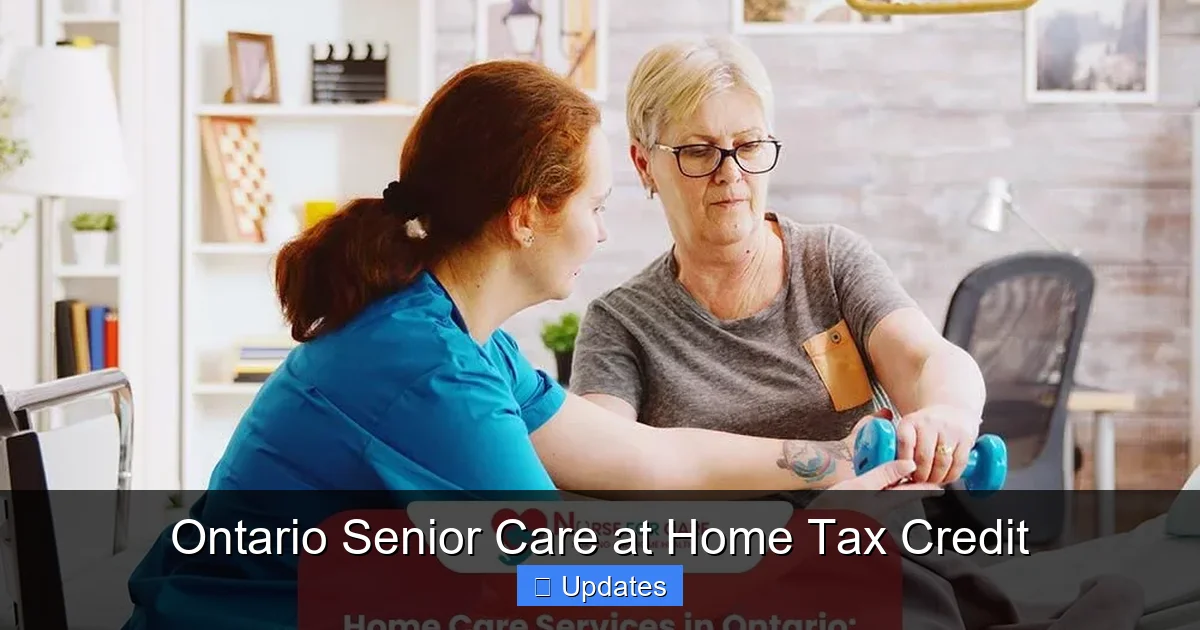
Visual guide about Ontario Senior Care at Home Tax Credit
Image source: nurseforcare.com
The credit is calculated as a percentage of your eligible expenses, up to a maximum annual limit. For 2024, the base rate is approximately 15% of qualified costs, capped at $2,500 per year for single filers. Couples filing jointly can claim up to $5,000 in combined expenses (still subject to income limits).
To illustrate, imagine you spend $8,000 annually on in-home care:
– First $2,500 → 15% = $375 credit
– Next $2,500 → another $375
– Remaining $3,000 → no additional credit
So even if you exceed the cap, you won’t get extra beyond $2,500 (or $5,000 for joint filers). However, unused portions cannot roll over to future years.
Income phase-outs begin once your net income hits certain levels:
– Single filers above $90,000 → reduced credit
– Joint filers above $110,000 → reduced credit
At higher brackets, the credit phases out completely. This ensures resources go to those who need them most.
Real-Life Example: A Family’s Experience
Take the case of Maria and her 78-year-old mother, Rosa. Rosa lives alone but struggles with balance and needs help preparing meals and taking medications. Maria pays $300/month to a local home care agency for two 4-hour shifts weekly. She also buys a walker and installs bathroom grab bars ($1,200 total). Plus, she drives Rosa to physiotherapy twice a month—about 15 miles roundtrip each time.
Maria logs her expenses carefully:
– Annual agency fees: $3,600
– Medical equipment: $1,200
– Transportation (at 61¢/km): ~$450
Total eligible expenses: $5,250
Since she files as single and earns $65,000/year, she qualifies for the full credit. Her calculation:
$2,500 × 15% = $375
She claims this on Line 32999 of her T1 return and receives a $375 refund. Over time, this adds up to hundreds saved annually—money she can reinvest in better care options or simply enjoy knowing her mom is safer at home.
How to Apply for the Ontario Senior Care at Home Tax Credit
Applying is straightforward once you’ve gathered your documents. There’s no separate form to submit to the province—everything flows through your federal tax return handled by the CRA.
Start by completing your regular T1 return. On Line 32999, enter the amount of your eligible expenses. If you’re unsure how to calculate mileage or need help categorizing costs, attach a brief explanation or use Schedule 12 (which isn’t mandatory but helps clarify complex claims).
You’ll also need to report any income earned from providing care services. For example, if you’re paid $200/month by your sibling to help care for their elderly father, that’s taxable income and must be declared—even though you’re also claiming the credit.
After submitting, the CRA reviews your claim. If approved, you’ll see the credit reflected in your notice of assessment. Discrepancies usually stem from missing receipts or misclassified expenses, so double-check everything before filing.
Tips for Maximizing Your Claim
– Start tracking expenses immediately—don’t wait until tax time. Use apps like QuickBooks Self-Employed or even Google Sheets.
– Consult a tax professional familiar with caregiver credits—they can spot deductions you might miss.
– Combine this credit with other benefits: the Canada Pension Plan Disability Benefit, Old Age Security, or provincial caregiver programs.
– Consider setting up a dedicated savings account just for caregiving expenses to simplify accounting.
Remember, honesty matters. Overstating expenses risks audits and penalties. But accurate documentation protects you and ensures you receive every dollar you’re entitled to.
Alternatives and Complementary Benefits
While the OSCAHC is powerful, it’s not the only tool available. Families should explore overlapping programs to maximize support:
– Federal Caregiver Amount: Available for adults with dependents under 18 or infirm relatives. Though separate from the OSCAHC, it can stack with provincial benefits.
– Ontario Trillium Foundation Grants: Some community organizations offer small grants for home safety upgrades.
– Employment Insurance – Caregiver Leave: Up to 26 weeks unpaid leave (with partial EI top-up) if you stop working to care for a seriously ill family member.
– Local Nonprofits: Groups like United Way or Meals on Wheels often provide free or subsidized services.
Combining these resources creates a stronger safety net. For example, use the tax credit to offset agency costs while relying on volunteers for occasional companionship.
When to Seek Professional Help
If your situation involves multiple seniors, blended families, or complex finances, consider speaking with a nonprofit financial counselor. Organizations like Credit Counselling Service of Toronto offer free advice on managing caregiving-related taxes.
Similarly, if you suspect your loved one is being taken advantage of (financially or otherwise), contact Adult Protective Services immediately. Safe at-home care isn’t just about comfort—it’s about security too.
Looking Ahead: Future Changes and Advocacy
As Ontario’s population ages, expect ongoing refinements to the OSCAHC. Recent discussions suggest expanding the maximum credit amount and relaxing income caps to reach more families. Advocacy groups like CARP (Canadian Association of Retired Persons) continue pushing for parity between medical and non-medical care supports.
Stay informed by checking updates on the Ontario Ministry of Finance website or subscribing to newsletters from caregiver coalitions. Being proactive means you’ll act early if changes occur mid-year.
In the meantime, take advantage of what’s already available. Even small adjustments in how you document and claim expenses can yield meaningful savings. And remember: supporting your senior at home isn’t just compassionate—it’s smart, sustainable, and increasingly supported by policy.
Conclusion: Making In-Home Care Sustainable
Caring for a senior at home is a labor of love—but it shouldn’t come at the cost of financial stability. The Ontario Senior Care at Home Tax Credit exists precisely to address that imbalance. By recognizing the real-world expenses of maintaining dignity and independence at home, this credit empowers families to make thoughtful, sustainable choices.
Whether you’re spending hundreds or thousands annually, understanding your options ensures you’re not shouldering the burden alone. With proper planning, documentation, and awareness of complementary programs, you can create a care plan that works for everyone involved.
And who knows? Maybe next year, you’ll be sharing your experience helping others navigate this important benefit. After all, caring doesn’t stop at the doorstep—it extends to supporting fellow caregivers too.
Frequently Asked Questions
Can I claim the Ontario Senior Care at Home Tax Credit if I live outside Ontario?
No, the credit is only available to residents of Ontario who provide care for a senior residing in the province. If you’re caring for a parent in another province, you may look into that region’s specific caregiver programs instead.
Do I need to be legally related to the senior to qualify?
Not necessarily. The credit applies to any individual paying for qualifying in-home care services, regardless of blood relation. Spouses, friends, or legal guardians are all eligible as long as they meet the other criteria.
What happens if I overestimate my expenses?
If the CRA determines your claimed expenses are inflated beyond reasonable limits, you may face penalties, interest charges, or even an audit. Always base your claim on actual receipts and verifiable payments.
Can I claim expenses from previous years?
Generally, no. The credit must be claimed in the year the expense was incurred. However, if you discover unreported eligible costs from earlier years, you can file an amended return within ten years.
Is there a deadline for applying?
Yes, you must file your federal tax return by April 30 (or June 15 if self-employed) to claim the credit for that tax year. Late filings may result in delayed processing or missed opportunities.
Does this credit replace provincial health coverage?
Absolutely not. The OSCAHC supplements existing public health services but does not cover basic medical treatments, hospital stays, or prescriptions fully paid by OHIP. It’s strictly for non-medical home support costs.