
Offset Walking Cane Explained: Benefits & Proper Use

Electric Heating Pad

Non-Slip Bathroom Mat

LED Magnifying Glass
Quick Answer
An offset walking cane is a mobility aid with a bent upper shaft that positions the handgrip directly over the main shaft. This design helps transfer downward pressure more efficiently than a traditional curved-handle cane and can make support feel more controlled. It is useful for people who need modest walking assistance, but it does not automatically provide the stability of a quad cane or walker.
The bend near the top is what makes an offset cane different. It may look like a small design change, but where the hand sits in relation to the shaft affects how force travels through the cane.
Understanding that difference helps explain why offset handles appear on everyday single-tip canes, folding models, and some four-point mobility aids.
What Is an Offset Walking Cane?
An offset walking cane is a walking aid with a specially angled upper section. Instead of placing the hand noticeably to one side of the supporting shaft, the offset shape aligns the grip more closely above it.
The main parts are straightforward:
- Offset handle: A generally horizontal grip positioned above the shaft’s supporting line.
- Angled upper section: The bend that creates the characteristic offset shape.
- Main shaft: The structural section that transfers force toward the ground.
- Adjustment mechanism: A height-setting feature found on many models.
- Ground tip: A rubber contact point or a wider base, depending on the model.
The offset design describes the cane’s handle and upper-shaft geometry, not its ground-contact system. An offset cane can therefore have either a single rubber tip or a multi-point base.
For a broader explanation of the supporting structure, see our guide to walking cane shafts.
How Does an Offset Cane Work?

An offset cane works by positioning the user’s downward hand pressure closer to the central line of the shaft. That makes the transfer of force toward the ground more direct.
Imagine pressing downward on an object. When the pressure is aligned with its main support, the force follows a relatively direct path. When the pressure is applied noticeably to one side, the object experiences a greater turning effect.
A traditional crook-handle cane often places the hand away from the shaft’s central line. The offset design reduces that separation.
This difference can improve how controlled the cane feels while supporting part of the user’s weight. The American Academy of Family Physicians describes this alignment as an advantage of offset canes for support and balance.
However, alignment is only one part of stability. Tip traction, walking technique, handle fit, surface conditions, and the user’s balance remain important.
Key Insight
An offset handle improves the alignment of hand pressure with the cane shaft. It does not increase the size of the cane’s ground-contact area unless the cane also has a wider base.
What Are the Benefits of an Offset Walking Cane?
The main benefits are more direct load transfer, a practical gripping position, and the possibility of greater comfort during routine walking.
1. Better Alignment for Weight Support
Because the handle sits over the shaft, downward pressure follows a more direct supporting line. This can make an offset design useful when a person needs to take some pressure off a painful or weaker leg.
The amount of assistance still depends on the cane’s rated capacity, the user’s strength, and proper technique. An offset handle should never be interpreted as permission to place unrestricted body weight on the cane.
2. A More Practical Hand Position
Many offset canes use a relatively straight, broad grip rather than a narrow curved hook. This gives the palm a different contact surface and may feel more comfortable during regular use.
Comfort is not universal, however. People with hand arthritis, reduced grip strength, or wrist discomfort may prefer a specially contoured handle. Grip shape and cushioning matter separately from the offset bend.
3. Support Without a Large Base
A single-tip offset cane can offer helpful everyday assistance while remaining relatively simple to carry and position.
This may suit people who walk independently but benefit from occasional support. Someone with substantial balance difficulties may instead need a wider-base cane or a walker.
4. Options for Different Mobility Needs
Offset handles are available on adjustable, folding, heavy-duty, and quad-base canes. Users can therefore consider handle alignment separately from portability, weight rating, and base design.
For example, a folding offset cane may prioritize storage convenience, while a rigid heavy-duty design may emphasize structural capacity.
Offset Cane vs. Straight Cane vs. Quad Cane
These terms describe different design features. A straight or standard cane typically has one ground tip, an offset cane describes the handle arrangement, and a quad cane has four ground-contact points.
| Feature | Traditional Crook Cane | Single-Tip Offset Cane | Quad Cane |
|---|---|---|---|
| Main distinction | Curved handle | Aligned handle and shaft | Four-point base |
| Ground contact | Usually one tip | One tip | Four tips |
| Handling | Simple and familiar | Direct load alignment | Broader support footprint |
| Main limitation | Grip alignment | Small support base | More cumbersome to advance |
A quad cane can also have an offset handle. The two features are not mutually exclusive.
The relevant choice is not simply which cane looks strongest. It is whether the support footprint, grip, and movement pattern match the user’s needs. Our walking cane types guide provides additional context.
Who Can Benefit From an Offset Cane?
An offset cane may suit adults who can walk with one-handed assistance and want some additional support or reduced loading through one leg.
Situations where it may be considered include:
- Mild walking instability: When a single additional point of support is sufficient.
- Hip or knee discomfort: When using a cane properly can reduce loading through the affected side.
- Recovery: When a clinician recommends progressing to a cane after an injury or procedure.
- Regular community walking: When the user can manage a single-tip cane but prefers an aligned handle.
- Hand comfort preferences: When a flatter grip feels better than a traditional curved handle.
These are possibilities, not automatic indications. A person with significant weakness, repeated falls, severe unsteadiness, or a need to support substantial body weight may require a different mobility aid.
MedlinePlus advises seeking guidance when pain, weakness, or balance problems are substantial because crutches or a walker may offer more appropriate support.
How to Adjust an Offset Walking Cane Correctly
Proper height is essential regardless of handle design. A cane that is too tall can encourage shoulder elevation, while one that is too short may cause sideways leaning.
- Wear your usual walking shoes. Shoe height changes the effective fit.
- Stand upright on a level surface. Keep your shoulders relaxed and your arms at your sides.
- Position the cane beside you. Its handle should approximately meet your wrist crease.
- Adjust the shaft. Set the height using the manufacturer’s mechanism and confirm that the locking button is fully engaged.
- Check the elbow angle. Holding the grip should produce a comfortable, slight elbow bend, commonly around 15–30 degrees.
- Walk a short distance. Check whether the cane encourages upright posture without shoulder lifting or excessive leaning.
The Mayo Clinic cane-fitting guidance emphasizes wrist alignment, elbow position, and appropriate handle selection.
For an adjustable model, also tighten any locking collar after selecting the height. A loose shaft can make the cane feel unstable even when its length is correct.
How to Walk With an Offset Cane Safely
The usual walking pattern is to hold the cane opposite the weaker or painful leg and move both forward together.
- Hold the cane in the hand on your stronger side, unless a clinician has instructed you differently.
- Stand upright with the tip resting securely on the floor slightly to your side.
- Move the cane and your affected leg forward together.
- Place the cane tip firmly before transferring pressure through the handle.
- Step forward with your stronger leg.
- Continue at a comfortable pace while looking ahead.
For example, if the left knee is painful, the cane will ordinarily be held in the right hand. The right-hand cane and left leg advance together.
This pattern can reduce loading on the painful side while allowing a more natural walking sequence.
The MedlinePlus guide to using a cane also explains safe walking and stair techniques.
What About Stairs?
When using a staircase, hold a secure handrail if available and follow any individualized rehabilitation instructions.
The usual sequence is to lead with the stronger leg when going upstairs and with the cane and weaker leg when going downstairs. Take one step at a time, especially while learning.
People who cannot maintain balance using the handrail and cane should not attempt stairs without appropriate assistance or training.
Safety Warning
An offset cane is not a substitute for a walker when significant balance assistance is needed. If you repeatedly lose balance, cannot safely advance the cane, or need substantial weight-bearing support, have a healthcare professional reassess your mobility aid.
Common Problems and How to Recognize Them
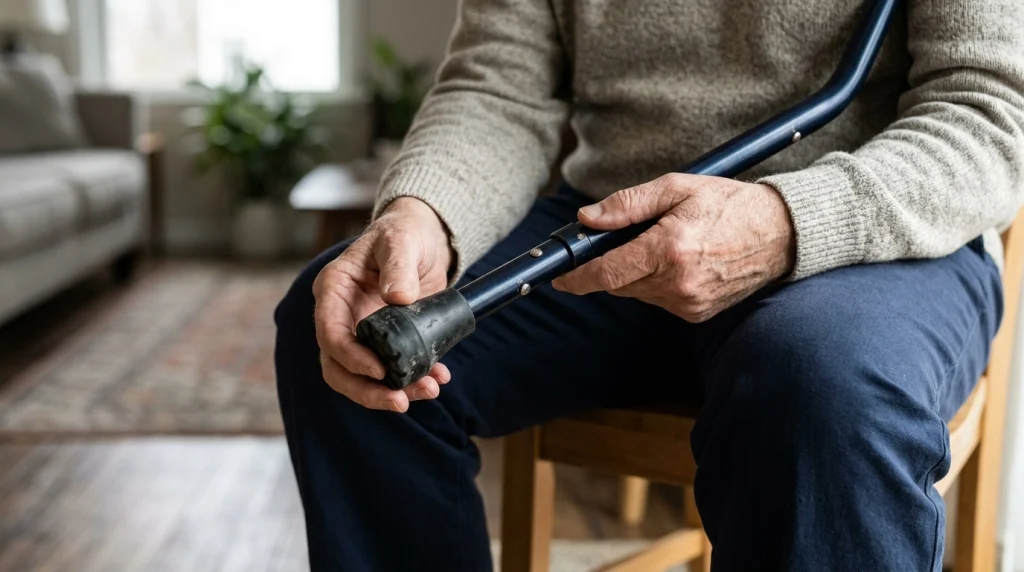
Even a well-designed cane can feel uncomfortable or insecure when its fit or condition is wrong.
Hand or Wrist Pain
Check whether the grip concentrates pressure on a small part of your palm. A different grip shape, correct height, or revised technique may help.
Numbness, persistent pain, or weakness in the hand deserves assessment rather than continued forceful gripping.
Cane Feels Too Short or Too Tall
Notice whether you lean sideways, bend forward, or lift your shoulder while walking. These signs can suggest a height mismatch or a problem with walking technique.
Recheck fit while wearing your normal shoes.
Tip Slips or Feels Unstable
Inspect the rubber tip for worn tread, hardening, cracks, or looseness. Replace a damaged tip with one that fits the exact shaft dimensions.
Wet tile, ice, loose gravel, and uneven surfaces also change traction. An offset handle alone cannot compensate for poor ground contact.
Shaft Rattles or Moves
Check adjustment buttons, collars, and folding connections. Stop using a cane with structural damage or an adjustment mechanism that will not lock securely.
The manufacturer-rated capacity must also be appropriate for the user. Do not assume that every offset cane has the same strength simply because the upper shaft looks similar.
How to Decide Whether an Offset Cane Is Right for You
Start by identifying how much support is required, rather than choosing the handle shape first.
- If you need light one-handed support: A properly fitted single-tip offset cane may be suitable.
- If you need a wider support base: Consider a quad cane, potentially with an offset handle.
- If you rely heavily on both arms: A walker or another prescribed aid may be safer.
- If your hand hurts: Compare grip shapes and seek fitting advice rather than assuming the offset bend solves the problem.
- If you travel frequently: Evaluate weight and folding mechanisms, while ensuring the joints remain secure.
For an example of how the handle design can appear on a higher-capacity cane, see the NOVA heavy-duty cane review. That product-specific discussion is separate from the general principles explained here.
Remember that an offset handle and an ergonomic grip are not exactly the same thing. The offset describes load alignment; ergonomics describes how comfortably the hand interacts with the handle. A suitable cane needs both an appropriate support design and a comfortable fit.
Related Product
Adjustable Offset Walking Cane
An adjustable offset cane lets you compare grip shapes, height ranges, and tip designs. Choose a model that matches your support needs and has an appropriate rated capacity.
As an Amazon Associate, we earn from qualifying purchases.
Frequently Asked Questions
Does an offset walking cane have to be held in a particular direction?
Hold the grip in the orientation specified by its manufacturer, with the handle positioned for proper load alignment. Do not reverse an unfamiliar handle design or use the curved shaft as a handhold.
Can an offset cane help someone with arthritis?
It may help reduce loading through a painful lower-limb joint when used correctly. If arthritis affects the hands or wrists, grip comfort requires separate attention because an offset handle is not automatically pain-free.
Are offset walking canes suitable for outdoor use?
Some are, provided their construction, tip, and specifications suit the surface. Check the manufacturer’s guidance and use caution on wet, icy, loose, or uneven ground.
Can an offset cane be used in either hand?
Many symmetrical offset handles can be used in either hand, but some shaped grips are hand-specific. Check the manufacturer’s instructions and follow any clinical guidance about which side to use.
Does an offset cane stand upright by itself?
Not necessarily. A conventional single-tip offset cane usually needs to be leaned or stored securely. Self-standing capability depends on its base design, not on the offset handle.
How often should an offset walking cane be replaced?
There is no universal replacement interval. Inspect the cane regularly and replace worn tips as needed. Replace or professionally assess the cane if the shaft, handle, locking system, or other structural parts become damaged.
Final Thoughts
An offset walking cane improves the alignment between the handgrip and supporting shaft. That simple structural difference can make it a useful option for people needing modest walking assistance.
The best results still depend on choosing the correct level of support, adjusting the cane properly, using appropriate walking technique, and keeping the tip and shaft in good condition. Handle design matters, but a safe fit and suitable mobility aid matter more.
