
Nj Senior Property Tax Cut


AUVON Plug-in LED Night Light 4 Pack, Motion & Dusk to Dawn Sensor

5X Large Rechargeable Hands Free Magnifying Glass with Light

CallToU Caregiver Pager with 2 Wireless Call Buttons for Elderly
The New Jersey Senior Property Tax Cut offers significant savings to qualified senior citizens by reducing or eliminating property tax burdens. This program targets homeowners aged 65 and older with strict income thresholds and specific eligibility requirements. Understanding the rules and applying early ensures maximum benefit from this valuable state support program.
Living on a fixed income becomes significantly easier when you can keep more of your hard-earned money in your pocket. For many seniors across New Jersey, that relief comes in the form of the NJ Senior Property Tax Cut—a vital lifeline for those navigating rising home values and stagnant incomes. This program isn’t just about saving a few hundred dollars; it’s about preserving independence, maintaining stability, and ensuring that staying in your home remains affordable well into retirement.
The NJ Senior Property Tax Cut is part of a broader effort by the state to support aging residents who often face unique financial pressures. Unlike general property tax assessments that can spike due to rising market values, this targeted relief adjusts based on your age and income, offering real protection against unexpected spikes. Whether you’re enjoying quiet mornings on your porch or simply want peace of mind knowing your bills won’t double overnight, understanding how this program works is key.
Key Takeaways
- NJ Senior Property Tax Cut Overview: A state-funded initiative designed to help seniors reduce their annual property tax burden through targeted relief based on age and income.
- Eligibility Criteria: Homeowners must be at least 65 years old, own their primary residence, and meet strict household income limits set annually by the state.
- Income Limits Vary by County: Each of New Jersey’s 21 counties has its own adjusted income ceiling, requiring applicants to verify their financial status accurately.
- Application Process is Timely: Applications must be submitted between January 1 and April 1 each year, so planning ahead is essential to avoid missing deadlines.
- Benefits Include Tax Reduction or Freeze: Approved applicants may receive a reduction in assessed value, partial exemption, or even a freeze on future increases in property taxes.
- Required Documentation: Applicants typically need proof of age (birth certificate or driver’s license), property ownership, Social Security statements, and recent tax returns.
- Renewal Required Annually: The benefit is not automatic—seniors must reapply every year to continue receiving support under the program.
📑 Table of Contents
What Is the NJ Senior Property Tax Cut?
At its core, the NJ Senior Property Tax Cut is a state-administered benefit that reduces or eliminates property taxes for qualifying senior homeowners. Administered primarily through county tax assessors and the New Jersey Division of Taxation, the program uses a combination of age verification and income screening to determine eligibility.
Unlike broad-based homestead exemptions, this cut specifically targets those most vulnerable to financial strain: seniors living on fixed incomes such as Social Security, pensions, or retirement savings. The idea? If your income hasn’t changed but your property taxes have skyrocketed due to neighborhood redevelopment or reassessment, the government steps in to help balance the scales.
It’s important to note that while the name includes “cut,” the actual mechanism varies. Some counties offer a dollar-for-dollar reduction in taxes owed, others apply a percentage discount to the assessed value, and still others implement what’s called a “tax freeze”—locking in today’s rate regardless of future hikes. All paths lead to one goal: making housing more affordable for those who need it most.
How Does It Compare to Other Senior Tax Relief Programs?
New Jersey’s approach stands out because it integrates directly with local property tax systems rather than operating as a separate credit or rebate. That means once approved, the savings show up immediately on your municipal tax bill—no waiting months for refund checks.
Other states offer similar programs under different names. For example, Massachusetts uses the Senior Circuit Breaker Tax Credit, which provides a direct rebate based on income and tax liability (learn more here). Meanwhile, Illinois allows seniors to defer payment of their property taxes altogether through deferred assessment plans. But in New Jersey, the focus is squarely on cutting—not delaying or deferring—the tax burden upfront.
This distinction matters. A true “cut” reduces what you owe today, giving immediate breathing room in your budget. Deferrals or freezes are helpful, too, but they don’t address the root issue: high taxes eroding limited resources.
Who Qualifies for the NJ Senior Property Tax Cut?
To qualify, you must meet several criteria:
– **Age Requirement**: You must be at least 65 years old as of December 31st of the tax year.
– **Residency Status**: Must live in New Jersey and own your home as your principal residence.
– **Income Thresholds**: Household income must fall below county-specific limits—these range from around $40,000 in some rural areas to over $80,000 in high-cost urban counties like Bergen or Morris.
– **No Ownership Limitations**: You can only claim this benefit on one primary residence at a time.
Let’s break down what “household income” really means. It includes wages, Social Security benefits, pension payments, IRA distributions, rental income (even if you live elsewhere), and investment earnings. However, certain deductions apply—like the first $10,000 of retirement income in many cases—so don’t panic if your total income seems high at first glance.
For context, consider Jane, a 70-year-old widow living alone in Camden County. Her monthly Social Security check is $1,800, and she receives an additional $12,000 annually from a private pension. Her combined yearly income is $34,600. Because Camden’s income limit for single filers is $48,000, she easily qualifies for the NJ Senior Property Tax Cut—potentially saving her hundreds or even thousands depending on her home’s assessed value.
On the flip side, Robert, also 70, lives in Essex County and earns $92,000 per year from part-time consulting work and rental properties. Even though he’s well within the age requirement and owns his home outright, his income exceeds Essex’s threshold of $79,000 for single applicants. As a result, he wouldn’t qualify for the standard cut—though he might explore other options like veteran exemptions or disability-based relief if applicable.
Understanding Income Limits Across Counties
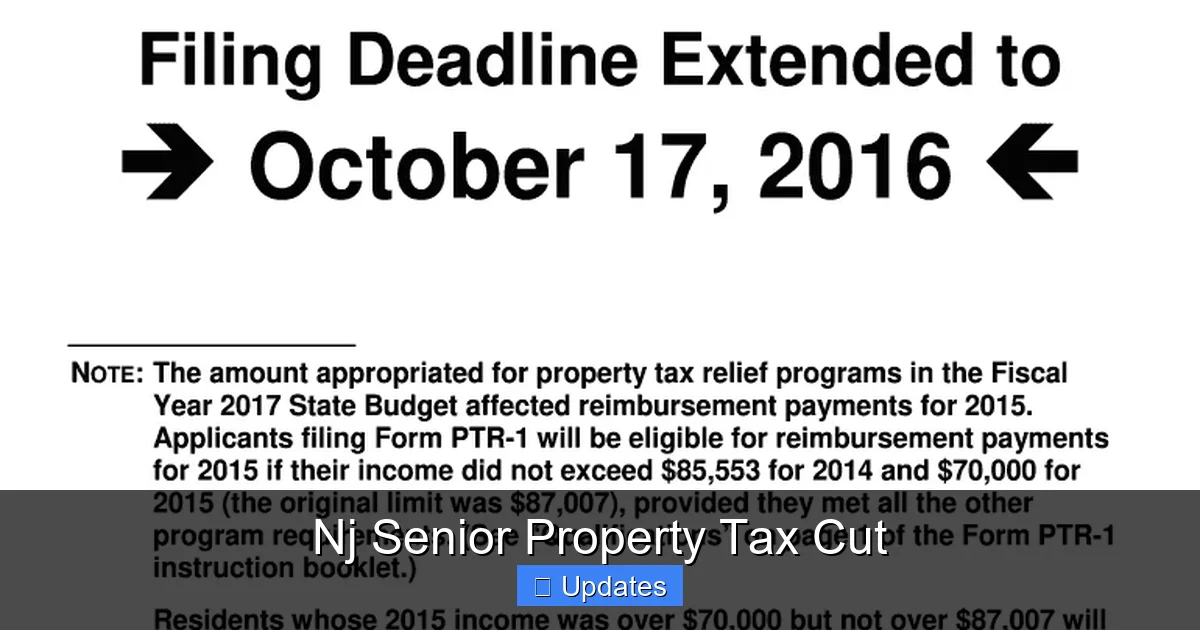
Visual guide about Nj Senior Property Tax Cut
Image source: pdffiller.com
One of the trickiest parts of applying is figuring out whether your income fits within your county’s guidelines. These aren’t statewide numbers—they’re tailored to reflect local cost-of-living differences and tax burdens. Below is a sample breakdown for select counties as of the latest available data:
| County | Single Applicant Limit | Married Couple Limit |
|————–|————————|———————–|
| Bergen | $68,000 | $85,000 |
| Camden | $48,000 | $60,000 |
| Essex | $79,000 | $98,000 |
| Middlesex | $62,000 | $77,000 |
| Monmouth | $65,000 | $81,000 |
| Ocean | $55,000 | $68,000 |
| Passaic | $50,000 | $62,000 |
*Note: Figures represent approximate 2023–2024 thresholds and are subject to minor annual adjustments.*
Why do these vary so much? High-demand areas like Bergen or Morris see higher income caps because property values and tax rates are steeper there. Rural counties like Sussex or Warren cap lower since the base tax burden is lighter to begin with.
If you’re unsure where your county falls, visit the official NJ Senior Property Tax Relief page for the most current tables. You’ll also find links to each county’s assessor office, where staff can walk you through calculations during in-person consultations.
Tips for Calculating Your Eligible Income
Don’t assume your gross income disqualifies you. Many seniors overlook deductions that bring their net figure below the threshold. Here’s how to approach it:
– **Gather Last Year’s Tax Return (Form 1040)**: This gives a clear picture of taxable vs. non-taxable income.
– **Include All Sources**: Don’t forget side gigs, annuities, or spousal income if married.
– **Subtract Qualifying Deductions**: The state allows exclusion of up to $10,000 in retirement income for single filers and $20,000 for joint filers in most counties.
– **Check for Exemptions**: Blindness, disability, or being a surviving spouse may increase your allowable income slightly.
Take Maria, a 68-year-old resident of Mercer County. She files jointly with her husband, both 71, and their combined income is $84,000—just above Mercer’s $81,000 cap. But because they exclude $20,000 in pension income (per the joint deduction rule), their effective count drops to $64,000. Suddenly, they’re eligible! Always double-check before ruling yourself out.
Step-by-Step Application Process
Visual guide about Nj Senior Property Tax Cut
Image source: njspotlightnews.org
Applying for the NJ Senior Property Tax Cut isn’t complicated, but timing and paperwork matter. Follow these steps carefully:
1. Confirm Eligibility Before Applying
Review your age, residency, and income using the county-specific charts. If anything’s unclear, call your local assessor’s office—they’re used to helping seniors navigate this process.
2. Gather Required Documents
You’ll typically need:
– Proof of age (birth certificate, passport, or driver’s license)
– Current deed or mortgage statement showing ownership
– Most recent federal tax return (Form 1040)
– Social Security award letters for all household members
– Bank statements or pension stubs if applicable
Having everything ready cuts processing time dramatically.
3. Submit Your Application Between Jan 1 and Apr 1
This window is non-negotiable. Late applications won’t be accepted, even if you’re eligible. Set a calendar reminder—April 1 sneaks up fast!
4. Track Your Submission Status
After submitting, ask for a confirmation number. Follow up after two weeks if you haven’t heard back. Approval usually takes 4–6 weeks.
5. Renew Annually
The benefit resets every year. Don’t assume automatic renewal—reapply each January to stay protected.
Pro tip: Consider enlisting a trusted family member or nonprofit advocate (like those at local senior centers) to help with paperwork. Many organizations offer free assistance through programs like the NJ Division of Aging Services.
Common Mistakes Seniors Make When Applying

Visual guide about Nj Senior Property Tax Cut
Image source: static.wixstatic.com
Even experienced homeowners sometimes stumble during the application. Watch out for these pitfalls:
– **Missing the Deadline**: April 1 comes faster than you think. Mark it on your calendar now.
– **Incorrect Income Reporting**: Using pre-deduction totals instead of adjusted figures.
– **Overlooking Spousal Income**: If married, both incomes count unless legally separated.
– **Using Wrong Deed Type**: Leaseholds or timeshares don’t qualify—only fee-simple ownership counts.
– **Failing to Update Address Changes**: If you moved within NJ, notify your new county assessor immediately.
Another frequent error: assuming eligibility extends to second homes. Nope—only your primary residence qualifies. Vacation properties remain fully taxable.
And remember: co-ownership adds complexity. If you share title with someone under 65, you may lose eligibility unless they’re listed as a dependent on your taxes.
What Happens After Approval?
Once approved, your tax bill will reflect the reduced amount. In some counties, you’ll see a line item noting the “Senior Tax Cut” applied. Others simply lower the total owed.
Keep copies of all approvals and correspondence. They serve as proof if questions arise later—especially if moving to a new county or selling the home.
Also, inform your bank if you have escrow accounts. Sometimes lenders apply the wrong amount without updated instructions.
Alternatives and Supplemental Benefits
While the NJ Senior Property Tax Cut is powerful, it’s not the only tool in the box. Explore these complementary options:
– **Property Tax Freeze Programs**: Some counties (like Jackson County) allow seniors to lock in current tax rates permanently—ideal if assessments keep climbing.
– **Veteran Exemptions**: Active-duty military, veterans with service-connected disabilities, or Purple Heart recipients may qualify for additional reductions.
– **Disability-Based Relief**: If mobility or health issues affect your ability to maintain the home, special exemptions might apply.
– **Low-Income Senior Housing**: Communities like Toms River’s subsidized units offer deeper savings for those needing assisted living support.
Combining programs maximizes savings. For instance, a disabled veteran over 65 could stack multiple exemptions to slash taxes by 50% or more.
Still confused? Reach out to regional aging agencies. Staff there often run workshops specifically about tax relief programs and can review your situation confidentially.
Real-Life Impact: How the Cut Changes Lives
Consider Robert and Linda, a couple in Atlantic County. Both retired teachers aged 67 and 69, they’ve lived in their Cape Cod-style home for 35 years. Last year, their property tax jumped from $4,200 to $6,800—a 62% increase driven by school district budget expansions.
Without the NJ Senior Property Tax Cut, they’d have faced a painful choice: sell the home they loved or dip into savings. Instead, they applied in February, included their pension statements and Social Security letters, and were approved by mid-April.
Their new bill dropped to $3,100—nearly back to original levels. That extra $3,700? It went toward medical co-pays and grocery bills instead of lining the town coffers. “It saved our retirement,” Linda told me recently. “We’re not rich, but we’re not scrambling either.”
Stories like this aren’t rare. Across New Jersey, tens of thousands of seniors rely on this program to preserve dignity and autonomy. It’s not charity—it’s justice, recognizing that fair taxation shouldn’t force people from their homes.
Long-Term Planning Tips
Thinking ahead? Here’s how to future-proof your finances:
– **Monitor Assessment Notices Closely**: Challenge inflated valuations if you believe they’re unfair.
– **Budget for Annual Reapplication**: Treat it like a bill—set aside time (and possibly professional help) each winter.
– **Stay Informed About Policy Changes**: Legislators occasionally tweak income caps or add new features.
– **Consider Downsizing Strategically**: Moving to a lower-assessed home could make you eligible for even greater savings.
Remember: the goal isn’t just to survive tax season—it’s to thrive in place, surrounded by memories and community.
Conclusion: Your Right to Affordable Housing
The NJ Senior Property Tax Cut exists because no one should face financial ruin simply for growing older in their own home. It’s a promise from the state that retirement doesn’t mean surrender—that stability and comfort remain within reach.
But promises only work if you claim them. Don’t wait until March to gather documents or panic at the first notice of increase. Start now, arm yourself with knowledge, and lean on trusted resources. Whether you’re reading this next week or next month, there’s always time to act.
And if you’re unsure where to begin? Visit our dedicated resource hub for step-by-step guides, downloadable forms, and contact info for every county office. We’re here to help.
Because every senior deserves a place to call home—without fear of losing it.
Frequently Asked Questions
How much can I save with the NJ Senior Property Tax Cut?
Savings vary widely based on your home’s assessed value and county-specific rules. On average, seniors save between $500 and $3,000 annually. In high-tax areas like Bergen County, top earners may save over $5,000. Your exact amount depends on income, property size, and local policies.
Can I apply if I’m 64 but turn 65 this year?
Yes, but only if you reach 65 by December 31st of the tax year for which you’re applying. For example, if you turn 65 in November 2024, you’re eligible for the 2024–2026 benefit year. Proof of birthdate is required.
Do I need to be a U.S. citizen to qualify?
Generally, yes. You must be a lawful permanent resident or citizen. Non-citizens with valid green cards may qualify, but undocumented individuals are ineligible. Always confirm with your county assessor.
What if my income changes mid-year?
The program uses prior-year income to determine eligibility. So if you retired in June 2023, your 2022 tax return would still apply for the 2023–2024 benefit cycle. Subsequent years would use updated figures.
Can I transfer the benefit to a new home if I move?
No. The NJ Senior Property Tax Cut applies only to your primary residence. If you buy a new home in NJ, you must reapply there—but you can’t carry the old property’s benefit forward.
Are there penalties for late applications?
Yes. Applications received after April 1 are automatically denied for that tax year. There’s no appeal process for missed deadlines. Plan ahead to avoid disappointment.