
Folding Walking Cane Explained: Use, Fit & Safety


Adaptive Eating Utensils

Weekly Pill Organizer

Talking Clock
Quick Answer
A folding walking cane is a portable mobility aid with several connected shaft sections that fold into a compact bundle for storage. When assembled correctly, the sections form a straight cane that provides balance and light walking support. Many models use an internal elastic cord to keep the sections connected. A folding cane must be fully assembled, adjusted to the correct height, and checked for secure joints before use. It is not designed to support a person’s entire body weight.
What Is a Folding Walking Cane?
A folding walking cane is a walking aid designed to become shorter when it is not being used. Instead of one continuous shaft, it has multiple connected sections that can be separated slightly and folded alongside one another.
Most conventional folding canes use lightweight metal tubing, a handle, a rubber ground-contact tip, and an elastic cord running through the shaft. Some designs also include adjustable height settings, locking collars, or multi-point bases.
The defining feature is portability. A folding cane can be stored in a suitable bag, vehicle compartment, or travel case without requiring the full storage length of a rigid cane.
Its purpose, however, remains the same as that of an ordinary walking cane: to provide an additional point of contact with the ground for someone who needs limited balance assistance or support while walking.
For an overview of other designs and their purposes, see our guide explaining walking cane types.
How Does a Folding Walking Cane Work?
A folding cane works by bringing several rigid shaft sections into alignment. Once those sections are connected securely, the assembled cane transfers some of the user’s applied force from the handle through the shaft to the ground-contact tip.
The internal elastic cord
Many folding canes contain an elastic bungee cord running through the hollow shaft sections. This cord keeps the individual pieces connected when the cane is folded and helps draw them together during assembly.
The cord is not a substitute for properly seated joints. The tube connections must fit together securely to form a stable walking aid.
Connecting sections and locking mechanisms
Each shaft section connects to its neighboring section through a fitted joint. Depending on the design, the joints may rely on securely seated tubing, locking sleeves, or additional retention components.
Some models have a push-button mechanism and locking collar near the upper shaft. These components commonly control height adjustment rather than every individual folding joint.
This distinction matters because a cane can appear straight while an individual section is not fully seated. Always inspect the actual connections rather than assuming that the internal cord makes the cane safe automatically.
The handle and rubber tip
The handle provides the user’s grip, while the rubber tip makes contact with the walking surface. Handle comfort, shaft alignment, and tip condition all influence how reliably the cane can be used.
The folding feature improves storage convenience. It does not eliminate the need for correct cane fitting or walking technique.
How to Unfold a Folding Walking Cane Safely
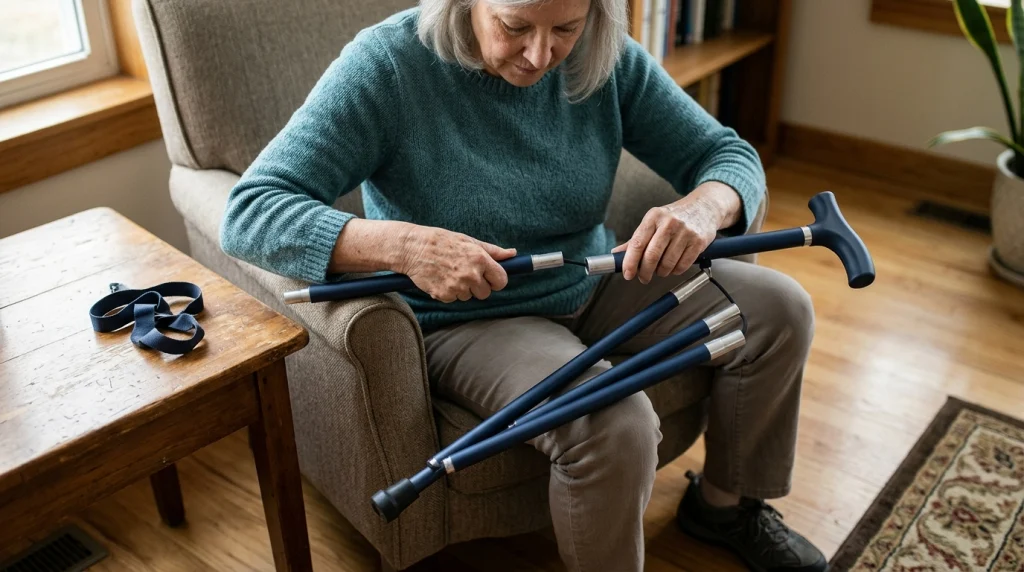
Unfold the cane while seated or standing securely, preferably away from obstacles. The exact assembly process depends on the manufacturer’s instructions.
- Remove the storage strap. Hold the folded sections together while releasing the strap or carrying band so they do not open unexpectedly.
- Separate and align the sections. Carefully extend the sections, keeping fingers away from joint openings.
- Connect each joint. Guide the tubing together until every section is seated firmly in the next.
- Check the adjustment mechanism. Make sure any push-button pin is fully engaged and any required locking collar is tightened.
- Inspect the complete shaft. Look for gaps, separated joints, unusual movement, or visible damage.
- Test stability carefully. On a firm, level surface, confirm that the cane feels secure before relying on it while walking.
Safety Warning
Never walk with a folding cane if a shaft section is loose, a joint will not seat completely, the height-adjustment pin is disengaged, or the internal cord is damaged. Stop using the cane until the problem is corrected according to the manufacturer’s instructions or the cane is replaced.
How to Fold the Cane for Storage
Folding the cane is generally straightforward, but it should be done only when you are no longer relying on the cane for balance.
- Place yourself in a secure seated position or use another suitable support.
- Hold the shaft sections securely.
- Gently separate the first folding joint according to the manufacturer’s directions.
- Fold the released sections alongside one another, then repeat for the remaining joints.
- Secure the folded bundle with its strap or place it in its storage case.
Do not force a joint apart or pull the sections farther than necessary. Excessive stretching can damage the internal elastic cord.
When traveling, store the cane where it cannot be crushed by heavy objects or accidentally opened while being handled.
How to Adjust a Folding Cane to the Correct Height
A folding cane should be adjusted so its handle is approximately level with the wrist crease when the user stands upright with arms relaxed at their sides.
According to MedlinePlus guidance on using a cane, the elbow should remain slightly bent while holding the handle.
To adjust an appropriate height-adjustable model:
- Wear your usual walking shoes and stand on a level floor.
- Let your arm hang naturally beside your body.
- Compare the cane handle with your wrist crease.
- If necessary, loosen the adjustment collar, press the adjustment button, and slide the shaft to an appropriate setting.
- Allow the button to engage fully in its adjustment hole.
- Tighten the collar if the design requires it.
- Hold the cane and check for a comfortable, slight bend at the elbow.
Do not use a height setting that places the handle noticeably above or below the position needed for comfortable upright walking.
Height adjustment and folding are separate mechanisms on many canes. A cane that folds compactly is not necessarily adjustable, so check the design rather than assuming both features are included.
How to Walk With a Folding Cane Correctly
Once securely assembled, a folding cane generally follows the same walking technique as a conventional cane.
If one leg is weaker, injured, or painful, the cane is typically held in the hand opposite that leg. For example, someone needing support for the left leg would normally hold the cane in the right hand.
- Stand upright with the cane positioned comfortably at your side.
- Move the cane forward together with the weaker leg.
- Place the cane tip securely on the ground.
- Apply only the amount of support appropriate for the cane and your needs.
- Step forward with the stronger leg.
- Continue at a controlled, comfortable pace.
Avoid reaching far forward with the cane or leaning your body excessively over its handle.
When using stairs, people with one weaker leg are generally taught to lead upward with the stronger leg and downward with the weaker leg and cane. Stair technique should be learned with a healthcare professional when balance or mobility is significantly impaired.
The Cleveland Clinic cane-use guide explains fitting, positioning, and safe walking practices in greater detail.
Are Folding Walking Canes Safe and Stable?
A folding walking cane can provide appropriate support when its design suits the user, its connections are securely assembled, and its parts remain in good condition.
However, folding canes introduce additional joints that must be inspected. A solid-shaft cane does not have the same segmented assembly requirements.
Safety depends on more than the folding mechanism. The user’s balance needs, cane height, handle shape, tip condition, walking surface, and the manufacturer’s stated limits all matter.
A folding cane should not be treated as full-body-weight support. If someone has substantial weakness, repeated falls, severe instability, or difficulty maintaining balance even with a cane, a different mobility aid may be more appropriate.
Key Insight
A folding cane is not automatically less safe than a rigid cane, but portability does not guarantee adequate support. The important question is whether the specific cane is correctly assembled, maintained, fitted, and suitable for the user’s balance and weight-bearing needs.
Folding Cane vs. Regular Cane: What Changes?
The main difference is portability, not the fundamental walking technique. Both types can provide a single additional ground-contact point, depending on their base design.
| Feature | Folding Cane | Rigid Cane |
|---|---|---|
| Storage | Folds into compact sections | Retains full shaft length |
| Assembly | Requires checking multiple joints | No folding joints to assemble |
| Travel convenience | Easier to store when not in use | Less compact for packing |
| Height adjustment | Available on some models | Available on some models |
| Maintenance | Inspect joints, cord, locks, and tip | Inspect shaft, handle, locks if present, and tip |
Neither design is universally more supportive. The specific construction, condition, base, and suitability for the user determine how well a cane performs.
If a broader base is needed, some people may benefit from a quad cane rather than an ordinary single-tip cane. For a practical example, see the small-base quad cane review, which describes a different support configuration.
Who May Benefit From a Folding Walking Cane?
Folding canes can be useful for people who need an appropriate walking aid but also value compact storage.
Examples include adults who use a cane for ordinary outings, travelers who want easier storage, and people who need to keep a prescribed mobility aid accessible when away from home.
However, convenience should not determine mobility-aid selection by itself.
If a person needs substantial weight-bearing assistance, experiences frequent falls, or cannot maintain balance with a single additional support point, they should have their mobility needs assessed. A walker, crutches, or another aid may provide more suitable assistance.
Some compact models combine folding shafts with broader bases or additional handles. These features change how the cane is used and should be evaluated individually rather than assumed to offer the same performance as a standard folding cane.
Common Folding Cane Problems and What to Check
Regular inspection can identify problems before they cause an unexpected loss of support.
The shaft sections feel loose
Stop using the cane and check whether every joint is fully seated. If the sections remain loose, do not improvise a repair with tape, adhesive, or other unauthorized materials.
The height-adjustment button will not engage
Check that the adjustment hole is aligned and that the mechanism is free from visible obstruction. If the button still fails to lock securely, the cane should not be used.
The rubber tip is worn
Inspect the tip for cracking, uneven wear, looseness, or missing material. Replace it with a compatible tip following the manufacturer’s instructions.
The elastic cord is frayed or damaged
Do not continue using the cane with a damaged internal cord. Follow the manufacturer’s approved repair or replacement procedure, if one is available.
The cane slips on certain surfaces
Stop and assess the surface and tip condition. Wet, icy, uneven, or very soft surfaces can present slipping or instability hazards. A regular rubber tip does not make every surface safe.
What Should You Check Before Every Walk?

A brief inspection is particularly important for folding canes because their segmented construction must remain secure.
- Joints: Every shaft section is fully seated.
- Adjustment button: The button is engaged in the selected hole.
- Locking collar: Any required collar is secured.
- Handle: The grip is firm and undamaged.
- Rubber tip: The tip is attached and not excessively worn.
- Shaft: No visible cracks, bends, or unexpected movement.
- Fit: The handle remains at the appropriate height.
If the cane does not pass these checks, do not rely on it until the problem has been resolved.
For people considering a design with an offset handle and compact base, the offset walking cane review illustrates how handle position, folding size, and base configuration can differ between models.
Frequently Asked Questions
1. Can a folding walking cane be used every day?
Yes, if the specific cane is appropriate for the user’s mobility needs and remains in safe condition. Regular users should check the joints, adjustment mechanism, handle, and tip frequently.
2. Can a folding cane collapse while walking?
A poorly assembled or damaged folding cane may separate or become unstable. Properly seating all joints, securing adjustment mechanisms, and avoiding damaged equipment help reduce this risk.
3. Do all folding walking canes have adjustable heights?
No. Some folding canes have fixed heights, while others use adjustable telescoping sections. Always check the height range and adjustment instructions for the particular model.
4. Is a folding cane suitable for someone with serious balance problems?
Not necessarily. A standard folding cane provides limited support and may be insufficient for severe instability or substantial weight-bearing needs. A healthcare professional can assess whether another mobility aid would be safer.
5. How should a folding cane be stored?
Fold it according to the manufacturer’s instructions, secure the sections, and keep it in a clean, dry location. Avoid storing it where heavy objects may crush the handle, joints, or shaft.
6. Can the rubber tip on a folding cane be replaced?
Many folding canes have replaceable rubber tips. Use a replacement with the correct size and compatibility for the specific cane, and follow the manufacturer’s installation instructions.
Conclusion
A folding walking cane combines basic walking assistance with convenient storage. Its segmented shaft makes it practical for travel and everyday carrying, but each connection must be assembled securely before use.
Correct height, suitable support, sound joints, and a properly maintained tip matter more than portability alone. Choose a cane that meets your mobility needs, and never use a folding cane that feels loose, damaged, or unstable.
