
Best Can Opener for Seniors: 5 Easy Options


Smart Health Watch for Seniors

Adjustable Bed Frame

Digital Thermometer
Opening a can should not require a strong grip or awkward wrist movement. For some older adults, a stiff manual opener can make a simple kitchen task frustrating.
The best can opener for seniors should match the user’s hand strength and dexterity. We compared easy-grip manual models and electric options, focusing on simple controls, comfortable handling, lid safety, and everyday convenience.
Best Can Opener for Seniors
A good senior-friendly can opener should reduce the effort needed to grip, turn, or hold a can. These five models offer different approaches, from simple manual designs to one-touch electric operation.
Best Overall: OXO Soft-Handled Can Opener
The OXO Soft-Handled Can Opener is our best overall choice for seniors who prefer a traditional manual opener. Its large cushioned handles and oversized knob are designed to make turning easier. OXO also uses a stainless steel cutting wheel.
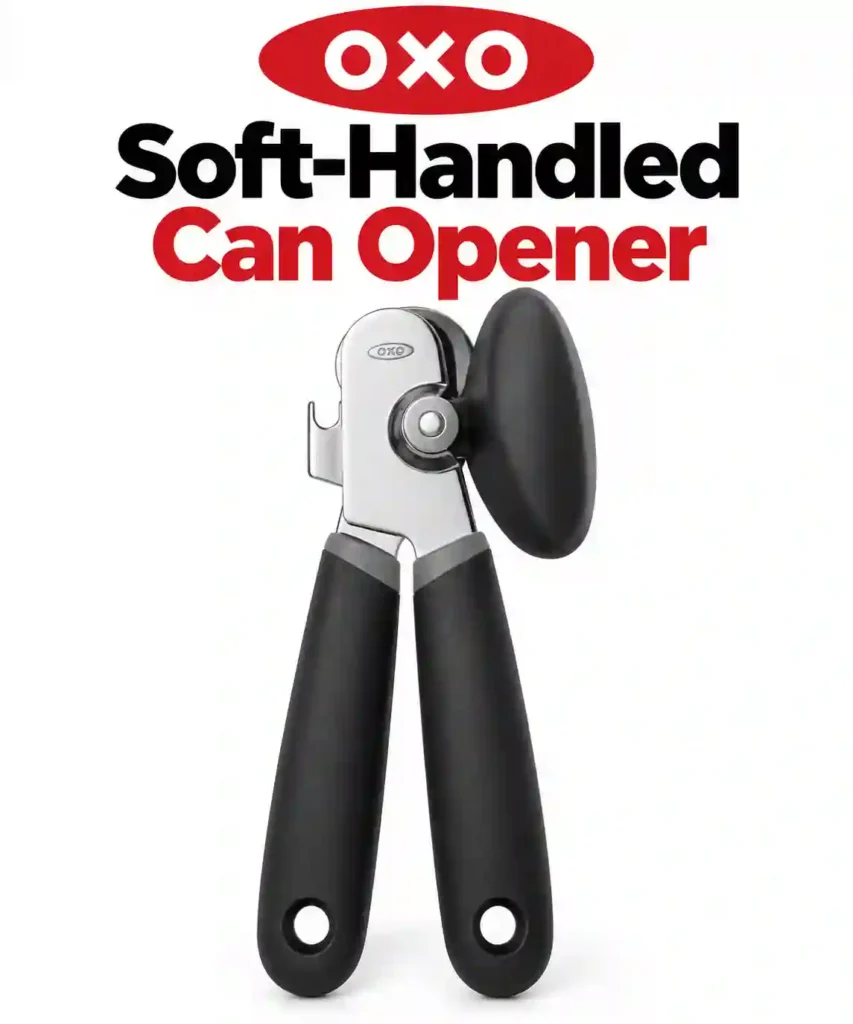
The main advantage is simplicity. There are no batteries, cords, or buttons to manage. It is also compact enough to keep in a kitchen drawer.
The trade-off is that it still requires the user to grip the handles and turn the knob. Someone with very weak hand strength may be better served by an electric model.
| Specification | Details | Why It Matters |
|---|---|---|
| Design | Manual | No batteries or cord |
| Handles | Large, cushioned | More comfortable grip |
| Cutting wheel | Stainless steel | Durable cutting surface |
| Size | 7 x 2 x 3 inches | Compact storage |
Pros And Cons
The OXO is straightforward and comfortable, but it is still a manual tool.
| Feature | Pro | Con |
|---|---|---|
| Grip | Large cushioned handles | Still needs hand control |
| Knob | Oversized and easier to turn | Requires repeated turning |
| Size | Compact | Not hands-free |
| Power | No batteries needed | Requires manual effort |
| Construction | Stainless steel cutting wheel | Not electric |
Who Should Consider This Product
This opener makes the most sense for seniors who want a familiar manual design but find small, stiff handles uncomfortable.
It may not be the best choice for someone who has very limited grip strength or struggles to rotate a knob.
Best For: Seniors wanting a comfortable everyday manual opener
Not Ideal For: People who need hands-free or one-touch operation
Best For Arthritic Hands: Zyliss Lock N’ Lift
The Zyliss Lock N’ Lift stands out because its locking mechanism holds the cutting wheel in place while opening the can. Its soft-touch handles and smooth turning mechanism are designed to reduce hand fatigue.
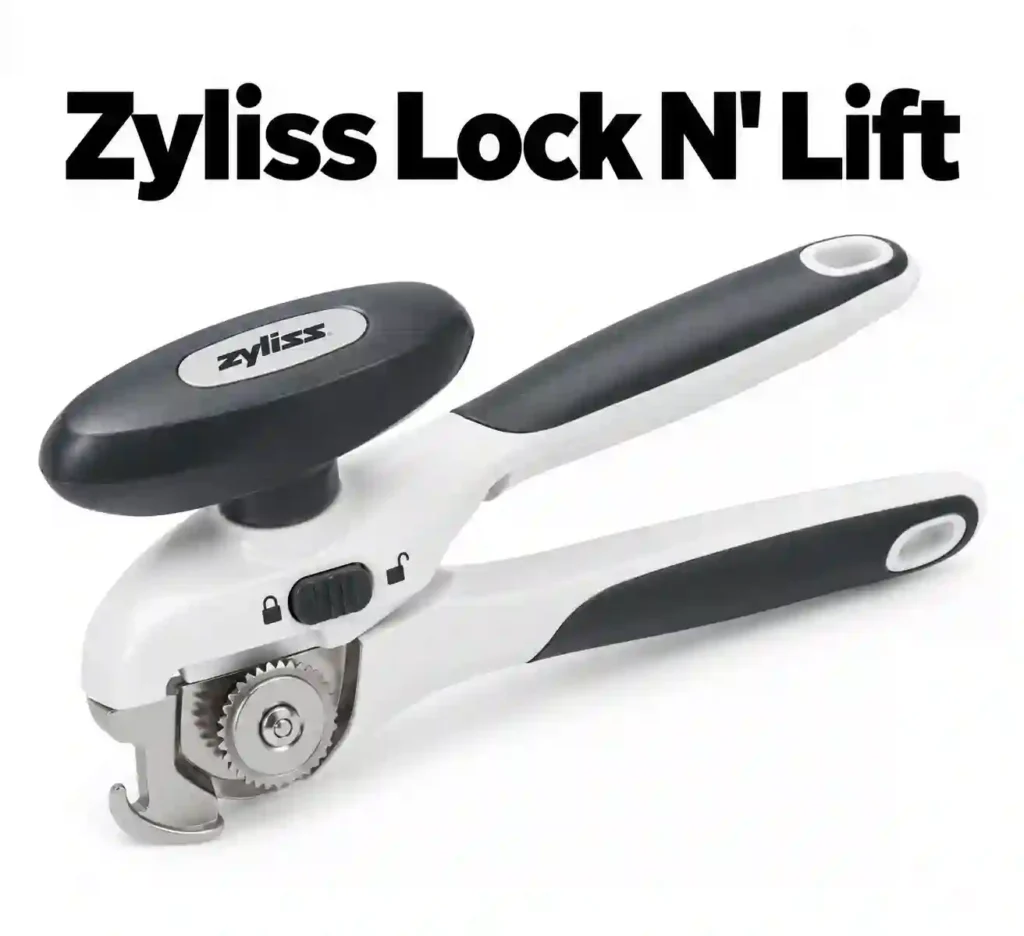
Another useful feature is the built-in magnet. It lifts the lid after opening, so the user does not need to grab the sharp metal lid directly.
Zyliss lists a five-year guarantee, which is also useful for a kitchen tool that may see frequent use.
| Specification | Details | Why It Matters |
|---|---|---|
| Type | Manual locking opener | Holds the opener on the can |
| Grip | Soft-touch, non-slip | More comfortable handling |
| Lid handling | Built-in magnet | Helps lift the lid |
| Warranty | 5-year guarantee | Added ownership protection |
Pros And Cons
Its locking design makes the opening process easier to control, although it still requires manual turning.
| Feature | Pro | Con |
|---|---|---|
| Locking mechanism | Keeps cutter in position | Adds a step to setup |
| Handles | Soft-touch grip | Still requires hand movement |
| Lid magnet | Helps remove the lid | Magnet does not replace the cutting step |
| Storage | Compact design | Manual operation |
| Warranty | Five-year guarantee | Warranty terms apply |
Who Should Consider This Product
The Zyliss is a strong option for seniors who can use a manual opener but want a design that stays locked onto the can.
It may not suit someone who cannot comfortably turn a handle for a full opening cycle.
Best For: Seniors who want a controlled manual opening process
Not Ideal For: Users who need completely automatic operation
Best Hands-Free Option: Kitchen Mama One-Touch
The Kitchen Mama One-Touch is a better match for seniors who struggle with manual turning. It works with the push of a button and automatically shuts off when the opening process is complete. The manufacturer says it uses a side-cutting design intended to leave a smoother edge.

The unit weighs about 7 ounces and uses four AA alkaline batteries. It is also designed to work without requiring the user to hold the can opener around the can while it operates.
That makes it particularly useful when grip strength is the main problem. The downside is that users must keep batteries available, and the device should be cleaned with a damp towel rather than submerged.
| Specification | Details | Why It Matters |
|---|---|---|
| Operation | One-touch electric | Less manual effort |
| Weight | 7 ounces | Easy to handle |
| Power | 4 AA batteries | No power cord |
| Blade | Stainless steel | Durable cutting component |
Pros And Cons
The biggest benefit is reduced hand effort, but battery dependence adds a small maintenance task.
| Feature | Pro | Con |
|---|---|---|
| Operation | One-button use | Requires batteries |
| Weight | Very light | Lightweight design may feel less substantial |
| Lid cutting | Side-cutting design | Not suitable for every unusual can shape |
| Convenience | Automatic shutoff | Electronics require more care |
| Cleaning | Simple wipe-down | Cannot be submerged |
Who Should Consider This Product
This is a strong choice for seniors who find traditional can openers difficult because of weak grip or limited hand movement.
It is less attractive for someone who prefers a simple manual tool with no batteries.
Best For: Seniors with limited hand strength who want one-touch operation
Not Ideal For: Users who prefer manual tools or do not want battery-powered gadgets
Best Smooth-Edge Electric: Hamilton Beach Smooth Touch
The Hamilton Beach Smooth Touch Electric Can Opener is designed to cut along the side of the can rather than through the top. This leaves a smoother lid edge and reduces direct contact between the blade and the food.
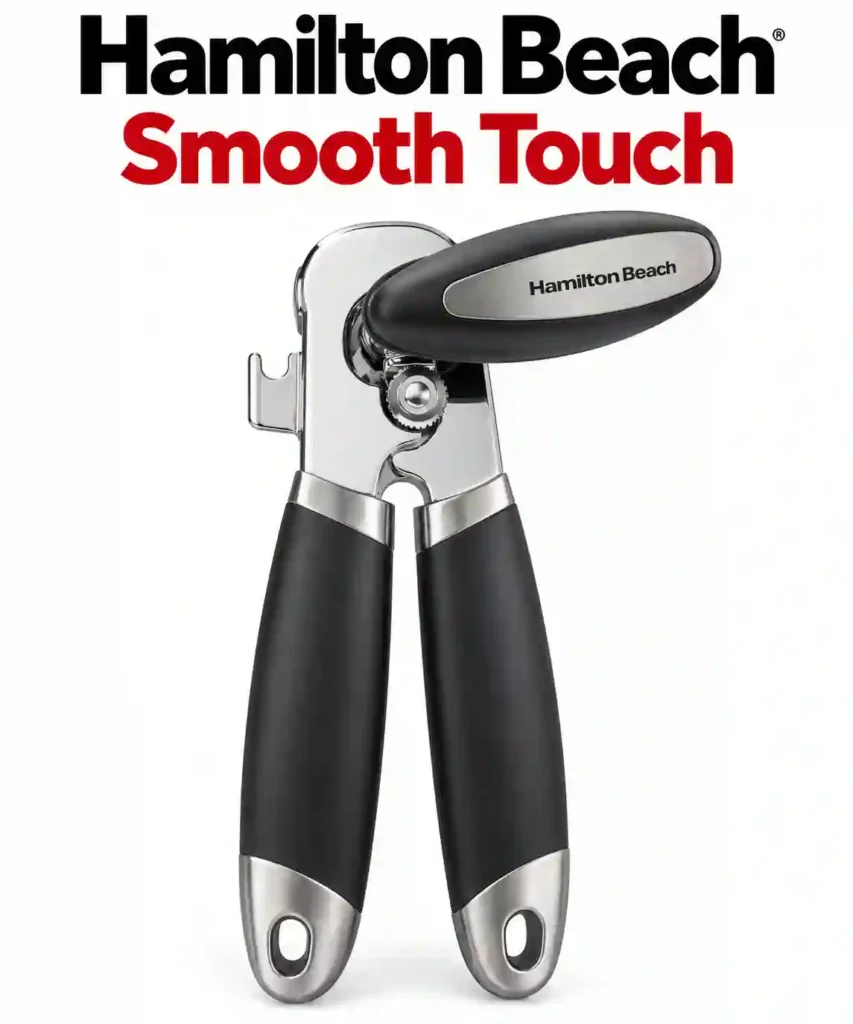
It also has one-handed operation and a large lever. The manufacturer lists a high-carbon stainless steel cutting blade, plus a built-in knife sharpener and bottle opener.
For seniors who worry about handling sharp can lids, the side-cutting design is one of its biggest advantages. Its countertop footprint is larger than a basic manual opener, however.
| Specification | Details | Why It Matters |
|---|---|---|
| Operation | Electric | Minimal manual effort |
| Cutting style | Side cut | Helps reduce sharp lid edges |
| Operation | One-handed lever | Simple control |
| Dimensions | 9.7 x 4.2 x 4.5 inches | Needs counter space |
Pros And Cons
This model offers strong convenience and lid-safety features, but it takes up more space than a manual opener.
| Feature | Pro | Con |
|---|---|---|
| Side cutting | Smoother lid edge | Larger countertop unit |
| Lever | Easy-touch operation | Requires counter placement |
| Food contact | Blade does not touch food | More parts than a manual opener |
| Extras | Knife sharpener and bottle opener | Extra features may not be needed |
| Operation | One-handed | Requires an electrical outlet |
Who Should Consider This Product
The Hamilton Beach is a good fit for seniors who want an electric countertop opener and prefer a smooth-edge cutting system.
It may be excessive for someone who opens cans only occasionally and has no difficulty using a manual opener.
Best For: Seniors prioritizing easy electric operation and smoother lid edges
Not Ideal For: Small kitchens with limited counter space
Best Value Electric: Cuisinart Deluxe Can Opener
The Cuisinart Deluxe Can Opener is a simple countertop electric option with one-touch operation. It has a Power Cut blade, magnetic lid holder, sturdy base, and removable activation lever for easier cleaning.
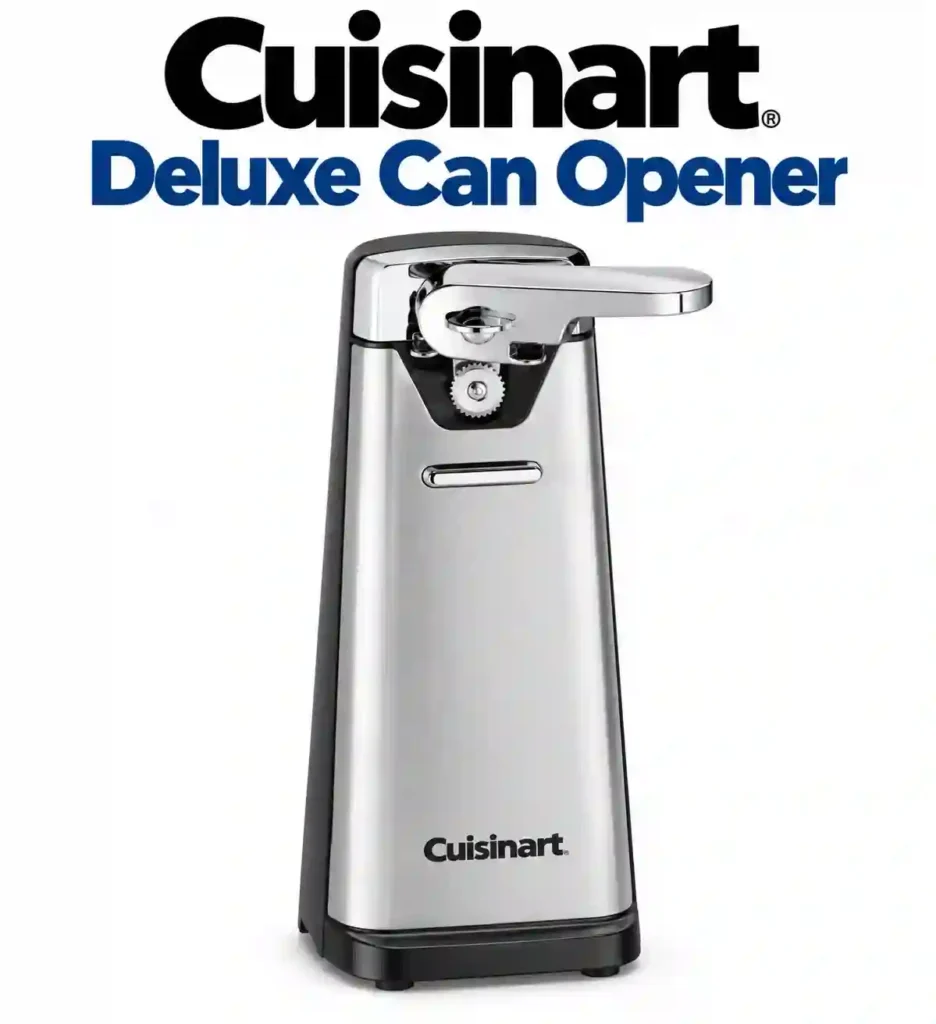
Its wide base is designed to help prevent sliding or tipping. Cuisinart also lists a three-year limited warranty.
Compared with a basic manual opener, it takes more counter space. But for a senior who wants push-button operation without a complicated setup, its straightforward design is appealing.
| Specification | Details | Why It Matters |
|---|---|---|
| Operation | Single-touch | Easy everyday use |
| Blade | Power Cut | Designed for can opening |
| Base | Sturdy | Helps reduce movement |
| Warranty | 3-year limited | Added product support |
Pros And Cons
The Cuisinart keeps the controls simple, although its countertop design is less compact than a manual opener.
| Feature | Pro | Con |
|---|---|---|
| Operation | Single-touch | Requires countertop placement |
| Base | Helps prevent tipping | Takes up storage space |
| Lid holder | Magnetic | Adds moving parts |
| Cleaning | Removable lever | Needs occasional cleaning |
| Warranty | Three years | Limited warranty terms apply |
Who Should Consider This Product
This is a good choice for seniors who want a traditional countertop electric opener with simple controls.
It may not be worth the extra space for someone who is comfortable using a compact manual model.
Best For: Seniors wanting simple countertop electric operation
Not Ideal For: Users who need a compact drawer-stored opener
Comparison At A Glance
The five options cover two main needs: comfortable manual opening and reduced-effort electric opening. Your hand strength and available counter space should guide the final choice.
| Product | Best For | Key Trade-Off |
|---|---|---|
| OXO Soft-Handled | Everyday manual use | Still requires turning |
| Zyliss Lock N’ Lift | Controlled manual opening | Requires manual effort |
| Kitchen Mama One-Touch | Limited hand strength | Uses batteries |
| Hamilton Beach Smooth Touch | Smooth-edge electric opening | Needs counter space |
| Cuisinart Deluxe | Simple countertop electric use | Larger than manual models |
How We Chose These Products
We focused on features that can make a real difference for older adults, including grip comfort, operating effort, lid handling, control simplicity, storage, and maintenance.
We also checked current manufacturer information for specifications and product features rather than relying only on popularity.
| Evaluation Factor | Why It Matters |
|---|---|
| Ease Of Use | A simple mechanism can reduce frustration |
| Grip Comfort | Large, soft handles can be easier to control |
| Opening Effort | Electric models can reduce manual turning |
| Lid Safety | Smooth or magnetic lid handling can reduce direct contact |
| Maintenance | Simple cleaning makes regular use easier |
| Value | Features should match the user’s actual needs |
What To Look For When Buying
The right can opener depends more on the user’s abilities than on the number of features. Start by deciding whether a manual or electric model makes more sense.
Choose Manual Or Electric
Manual openers are compact and do not need batteries or electricity. They can work very well for seniors who still have enough grip and wrist strength.
Electric models make more sense when turning a knob or squeezing handles is difficult. One-touch models can reduce the physical work needed to open a can.
Look For A Comfortable Grip
A large, cushioned, or non-slip handle can be easier to hold than a thin metal handle. Look for controls that can be operated without a tight pinch.
The OXO and Zyliss models are good examples of manual designs that emphasize grip comfort.
Consider Lid Handling
The lid can be an overlooked safety issue. A magnetic lid lifter can help keep fingers away from the cut metal.
Electric side-cutting models can also be appealing when smoother lid edges are a priority.
Check Storage Space
Manual openers usually fit easily into a drawer. Electric countertop models need a permanent or semi-permanent place in the kitchen.
Measure the available counter space before buying a larger electric opener.
Think About Cleaning
Food residue can collect around the cutting mechanism. Check the cleaning instructions before buying.
For example, Kitchen Mama advises wiping its electric opener with a damp towel rather than immersing it in water.
Common Buying Mistakes
A can opener may look simple, but the wrong design can become frustrating quickly. These are some common mistakes to avoid.
| Mistake | Better Approach |
|---|---|
| Choosing only by price | Match the opener to the user’s hand strength |
| Buying a manual model for very weak hands | Consider one-touch electric operation |
| Ignoring grip size | Look for large, comfortable handles |
| Forgetting counter space | Check dimensions before choosing an electric model |
| Ignoring lid handling | Consider magnetic or smooth-edge designs |
Safety Considerations
A can opener should make food preparation easier without creating unnecessary handling risks.
Sharp lids are the main concern with traditional can opening. After opening a can, avoid grabbing the cut lid with bare fingers, especially if the edge is sharp.
For seniors with significantly reduced hand strength, poor dexterity, or difficulty safely controlling kitchen tools, an electric model may be easier to manage. A caregiver can also help determine which design is appropriate.
Do not assume that one opener is safe for every user. If mobility, hand function, or another individual limitation affects kitchen safety, professional guidance may be appropriate.
Frequently Asked Questions
What is the easiest can opener for seniors?
An electric one-touch model is generally the easiest option when manual grip or turning is difficult. The Kitchen Mama One-Touch is designed around one-button operation and automatic shutoff.
Are manual can openers good for seniors?
Yes. A manual opener can be a good choice when the user has adequate grip and wrist strength. Large handles and an oversized turning knob can make the process more comfortable.
What can opener is best for weak hands?
An electric model is usually worth considering when weak hands make manual turning difficult. The Kitchen Mama and Hamilton Beach models both reduce the amount of manual work required.
Are smooth-edge can openers safer?
Smooth-edge designs can reduce the sharp edge left by some traditional top-cut openers. Hamilton Beach’s Smooth Touch, for example, cuts along the side of the can and is designed to leave a smoother lid.
Conclusion
For most seniors who can comfortably use a manual opener, the OXO Soft-Handled Can Opener is the best overall choice because of its large cushioned handles and oversized knob. The Zyliss Lock N’ Lift is another strong manual option for users who value a locking mechanism and magnetic lid handling.
For seniors with limited hand strength, the Kitchen Mama One-Touch is the better choice because it reduces manual turning. If smooth lid edges are a priority, the Hamilton Beach Smooth Touch is especially appealing. The Cuisinart Deluxe is a straightforward countertop alternative for seniors who prefer simple electric operation.
The best choice is not necessarily the most expensive model. Match the opener to the user’s grip strength, dexterity, kitchen space, and comfort level. A simple tool that the intended user can operate confidently is usually the better buy.
